OPENPUBLICA · PUBLIC MEETING RECORD
Record of Proceedings
NYC Council General Welfare Committee Hearing on Shelter Safety and Reporting Bills, October 28, 2026
City Council — Wednesday, October 28, 2026
BodyNew York City, New York
SessionCity Council
DateWednesday, October 28, 2026
StatusNEW · FILED
Video Record
STREAMING COPY IN PREPARATION — RECORDING AVAILABLE FROM THE ORIGINAL SOURCE
Transcript — Verbatim
Speaker numbers apply only to this recording. Names come from transcript evidence. “Possibly” marks uncertain attribution.
Discussion Breakdown — Share of Meeting
Homelessness47%
Public Safety16%
Public Engagement7%
Personnel Matters6%
Budget3%
Mental Health Awareness3%
Education2%
Engineering And Infrastructure2%
Public Health2%
Summary of Proceedings
NYC Council General Welfare Committee Hearing on Shelter Safety and Reporting Bills
The New York City Council Committee on General Welfare, chaired by Crystal Hudson, met at 1:00 PM on Wednesday, October 28, 2026, in Hearing Room 3 at 250 Broadway for an oversight hearing on shelter safety and to consider two transparency bills. Members present included Hudson, Avilés, Morano, Nurse, Ung, and Wilson; Councilmember Brewer and Public Advocate Williams also attended. The committee heard from a formerly homeless panel, public witnesses, and Department of Social Services and Department of Homeless Services leadership, then laid over both proposed bills.
Oversight Overview
- Chair Hudson said more than 83,000 people slept in New York City shelters the prior Sunday, across more than 500 shelters serving single adults, adult families, and families with children, mostly operated by contracted nonprofits. She framed safety as including physical security, facility conditions, trauma, and dignity, citing the multi-year repair delay at the Borden Avenue veterans residence as an example of administrative barriers.
- Public Advocate Williams said 83,000 people resided in shelters as of October 2026, including 51,000 families with children. He cited a women's shelter where priority-one incidents rose from 123 in 2019 to 208 in 2024 and said its FY25 priority-one rate was more than double the citywide average for single adult shelters. He urged passage of Intro 387 and supported Intro 99.
- Councilmember Brewer, sponsor of Intro 99, said the bill would require the Department of Homeless Services to report annually on how often families with children are placed in shelters in the same or an adjoining zip code as their last address, broken down by borough and whether the family has children under age three. She emphasized keeping children near their schools to reduce absenteeism.
Public Comments & Testimony
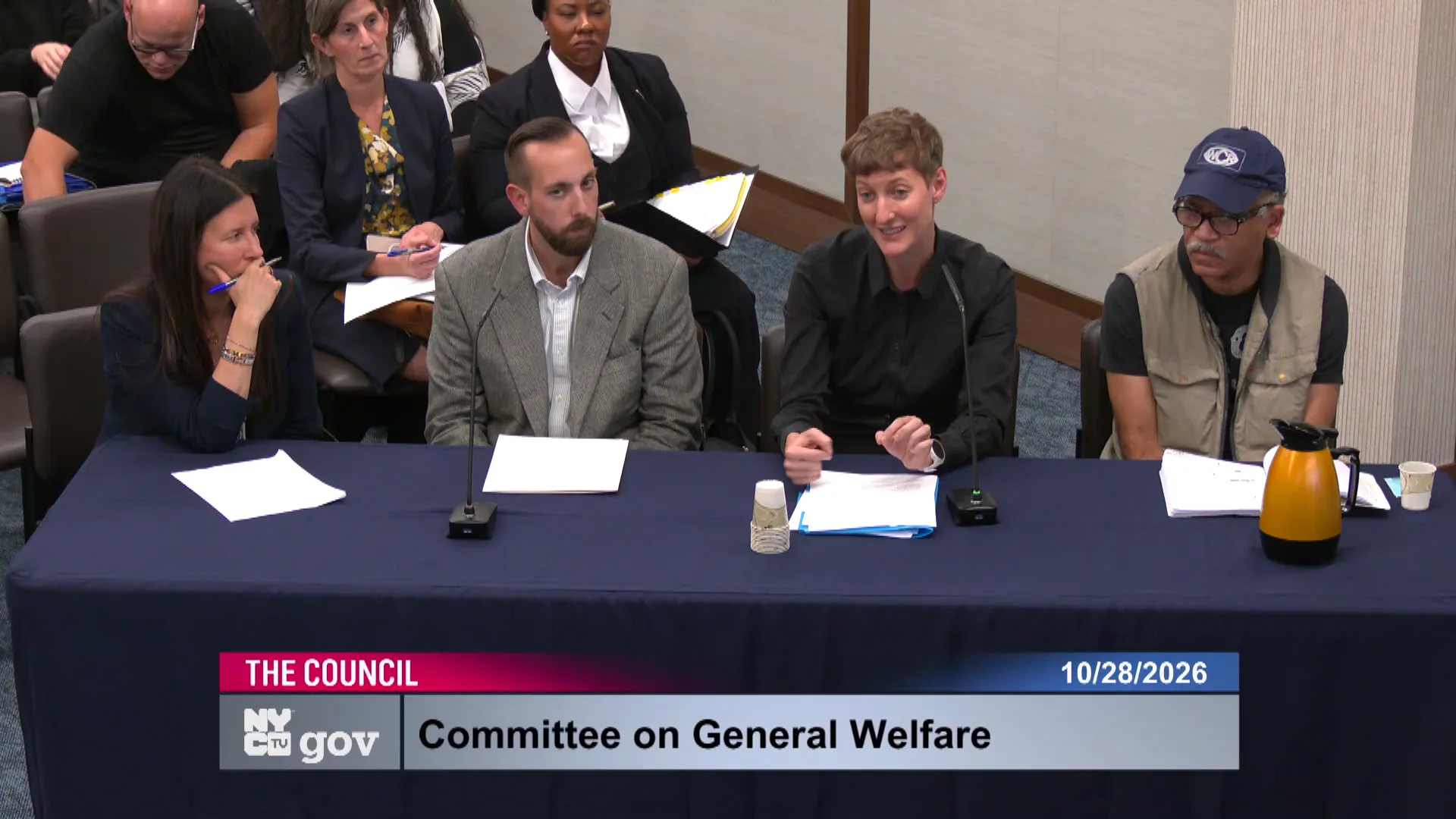
- Former shelter residents with the Coalition for the Homeless Community Leadership Collective described staff disrespect, ignored medical emergencies, forced exposure to cold, mice and flooding, lack of privacy, unsafe commutes, and grievances going unanswered. Francisco Insfran recounted staff failing to intervene in a fight and ignoring requests, and said he often had to translate for Spanish-speaking residents. A panelist suggested an independent grievance lockbox.
- Coalition for the Homeless government affairs director Alison Milke said DHS oversight is failing and that residents file twice as many complaints to the coalition hotline about staff mistreatment as about safety concerns. She said DHS's roughly 31,000 complaint count is a vast undercount because evening and weekend non-urgent complaints are routed to 311 and are not reported to the ombudsman's office.
- WIN vice president Chris Mann, whose organization shelters nearly 7,000 people including 3,800 children each night, said about 40% of families were placed in a different borough from their youngest child's school. He strongly supported Intro 99 and also urged the council to address PATH intake delays and pass Intros 816 and 232.
- NYLAG director Deb Berkman said safety transfers usually require legal intervention and that some clients are forced into street homelessness rather than remain in unsafe shelters. She supported Intro 99 and stronger provider accountability.
- Richard Flores, a shelter resident, alleged unreported crimes at shelters and called for federal investigations.
- Additional witnesses included Viviana de Jesus, Jorge Jimenez, Lauren Napier, Clifton Williams, Calvin Michael, Wendy Bruno, Hannah Mercurious, Helen Strom, and Grace Busser. Their testimony described abusive or retaliatory staff, unresponsive grievance processes, theft, unsafe physical conditions, lack of on-site medical personnel, absence of air conditioning, stalking victims being unable to access domestic violence shelters, and police or ACS involvement deterring residents from seeking help. Several witnesses supported Intro 99 and housing-first approaches. Bronx Defenders attorney Grace Busser raised concerns that Intro 387 as written would emphasize policing; she said the organization could support it if reporting distinguished allegations from substantiated findings, separated resident-vs-staff incidents, and identified which incidents led to police response.
Agency Testimony and Discussion
- DSS Commissioner Aaron Dalton, joined by DHS First Deputy Commissioner Christine Fellini and Deputy Commissioner for Shelter Security Bavante Priester, outlined safety operations: around-the-clock security, risk-based assessments, cameras and access controls, 352 DHS peace officers, provider assistance unit training, and trauma-informed customer service training for over 15,000 staff under Local Law 49. Dalton cited 2,654 safety transfers in FY26, up from 2,625 in FY25.
- Agency data: serious violent incidents in single-adult shelters fell to 2.8 per 1,000 residents in FY25 from 4.8 in FY22, and family shelter rates remained below 1 per 1,000. Complaints about discrimination, assault, and harassment rose 19%, and complaints about staff-client interactions rose 46%. The shelter death rate fell from about 11 per 1,000 in FY22 to 3.5 in FY25; deaths fell from 512 to 305 while the shelter population nearly doubled. Overdoses accounted for 40% of all deaths and 42 of 73 shelter deaths in FY25.
- Facilities: 365 standard shelters averaged fewer than four open violations each, with only one in ten high-priority. Approximately 169 flexible-capacity sites, mostly commercial hotels, averaged about 42 open violations each; DHS said that number partly reflects residential code standards applied to non-residential buildings and does not always indicate an active safety hazard. DHS has 55 city- and state-owned buildings, with a FY27 capital budget of $106 million for 102 projects across 38 shelters; eight projects were complete and 31 were in active construction.
- On Intro 99, DHS said it already tracks borough-level school continuity: 62.9% of families were initially placed in the borough of their youngest school-age child, and over 80% were in that borough over the duration of their stay. DHS said it would work with the council on zip-code-level reporting and noted that domestic violence cases may require placement away from a prior address.
- On Intro 387, DHS said it shares the goal of transparency and already reports to state oversight bodies and through the Mayor's Management Report, but it cannot publish some security information disaggregated by individual shelter because of confidentiality concerns.
- Member questions covered flexible-capacity shelter violations, Tillery Street Women's Shelter improvements under its new operator BRC, grievance and ombudsman procedures, training compliance, staffing ratios, mental health staffing, housing specialist ratios, air conditioning reporting, peace officer retention, and Rikers release planning.
Key Outcomes
- Oversight hearing T2026-2629 on shelter safety was held and filed by the committee.
- Intro 0099-2026, requiring DHS to report on family shelter placements by zip code, was heard and laid over by the committee.
- Intro 0387-2026, requiring annual critical incident and security reporting, was heard and laid over by the committee.
- DHS committed to follow up in writing on multiple data requests, including shelter demographics, older adult and substance-use population data, grievance and incident breakdowns, training compliance, language-capability tracking, and FY26 security budget figures.
- Written testimony was accepted for 72 hours after the hearing by email to testimony@council.nyc.gov.
Meeting Transcript
Good afternoon. Welcome to the Committee on General Welfare. At this time, we ask that you please silence all electronics. If you wish to testify, please see one of the sergeant at arms in the back. And at no point, please do not approach the dais. Chair, you may begin. Thank you. Good afternoon. I'm Crystal Hudson, chair of the New York City Council's General Welfare Committee, and my pronouns are she her. Thank you all for joining us for today's hearing on shelter safety. We are additionally joined by Council members Morano, Ung, and Wilson. Sorry, I thought there was somebody else over there. Um every New Yorker deserves a safe place to live, including New Yorkers who turn to the city for shelter during a period of crisis. Shelter must be more than a roof over someone's head. It must be a place where people can rest without fear of violence, access the support they need, and be treated with respect. However, we have heard too many concerns about conditions that can make shelters unsafe, including deteriorating facilities, overcrowding, violence, theft, and insufficient staffing. When people feel that entering a shelter puts their safety, security, or dignity at risk, they may choose not to enter shelter at all. Some of the major safety issues we will look at today include not just security incidents such as arrests, thefts, or violence, but also how the shelter systems systems design can impact physical and mental health and well-being, exacerbate trauma, and deter New Yorkers from engaging with our shelter system and making use of the robust social safety net DSS can provide. The New York City shelter system is sprawling. In the 1980s, a series of lawsuits resulted in the establishment of a right to shelter in New York City. This was an incredibly important step towards serving unhoused New Yorkers and resulted in the city needing to increase shelter capacity. Over the last 40 years, the number of shelters and the shelter population has grown. Just this past Sunday, over 83,000 individuals slept in our shelters. Today, there are over 500 shelters throughout the city that serve single adults, adult families, and families with children. The majority of shelters are operated by contracted nonprofit organizations. And while most of these organizations are dedicated to serving New Yorkers, third-party contracting can result in oversight and compliance challenges, including sometimes funding unscrupulous actors, subsidizing exorbitant executive salaries, or inadvertently developing contracts that force providers to focus more on volume than long-term sustainable outcomes and client well-being. Further, the additional layer of administration can make it difficult for providers to make essential repairs or changes to premises that improve safety and security. Last week at our joint hearing with the Committee on Veterans, for example, we heard about the difficult and length lengthy process for making essential repairs to the Borden Avenue veterans' residence, resulting in a multi-year process to repair a leaking roof. Today's hearing is an opportunity to hear from DSS about how they address shelter safety concerns, conduct oversight of challenges to shelter safety, and to hear from the public about what the city can do better. In addition to today's oversight on shelter safety, we will also consider two bills intended to strengthen transparency and accountability in the shelter system. Introduction 99, sponsored by Councilmember Gail Brewer, would require the Department of Homeless Services to report annually on the number of families with children placed in shelters in the same or an adjoining zip code as their last address. Councilmember Brewer, I now pass to you to make a statement about the legislation you're sponsoring today. Thank you very much. Families entering the shelter system, as you uh know, should be able to remain close to their schools, their child care, their doctors, their jobs, and their community support networks whenever possible. Placing families far from their former homes creates additional hardships, particularly for families with young children who rely on nearby child care and family support. We in the council and the public need to know how often families are placed in shelters in their former zip code or an adjoining zip code. Currently, this information is not regularly reported. Intro 99 requires DHS to report annually on shelter placements with data broken down by borough and by families with children under age three and those with older children. I believe that this reporting will help the council identify where families are being displaced from their communities and push for shelter placement policies that minimize disruption to children's lives. I must admit, during the issue when we had so many wonderful migrants here, I really appreciated the work that the Adams administration did despite all the challenges and housing people with DSS at the time. We work really hard to keep if people move shelters to keep them in their uh school zone. And to me, uh, based on all of this uh criteria to remain close, schools are the most important. And I want this bill particularly to try to keep the families near their schools. The absenteeism at DOE, or whatever the hell it's called now, New York City Public Schools, um, is huge. And I have a horrible feeling that part of it is because people just can't get to school.
SUMMARIZED BY OPENPUBLICA AI
TRANSCRIPT VIA PUBLIC VIDEO
openpublica.com
openpublica.com