OPENPUBLICA · PUBLIC MEETING RECORD
Record of Proceedings
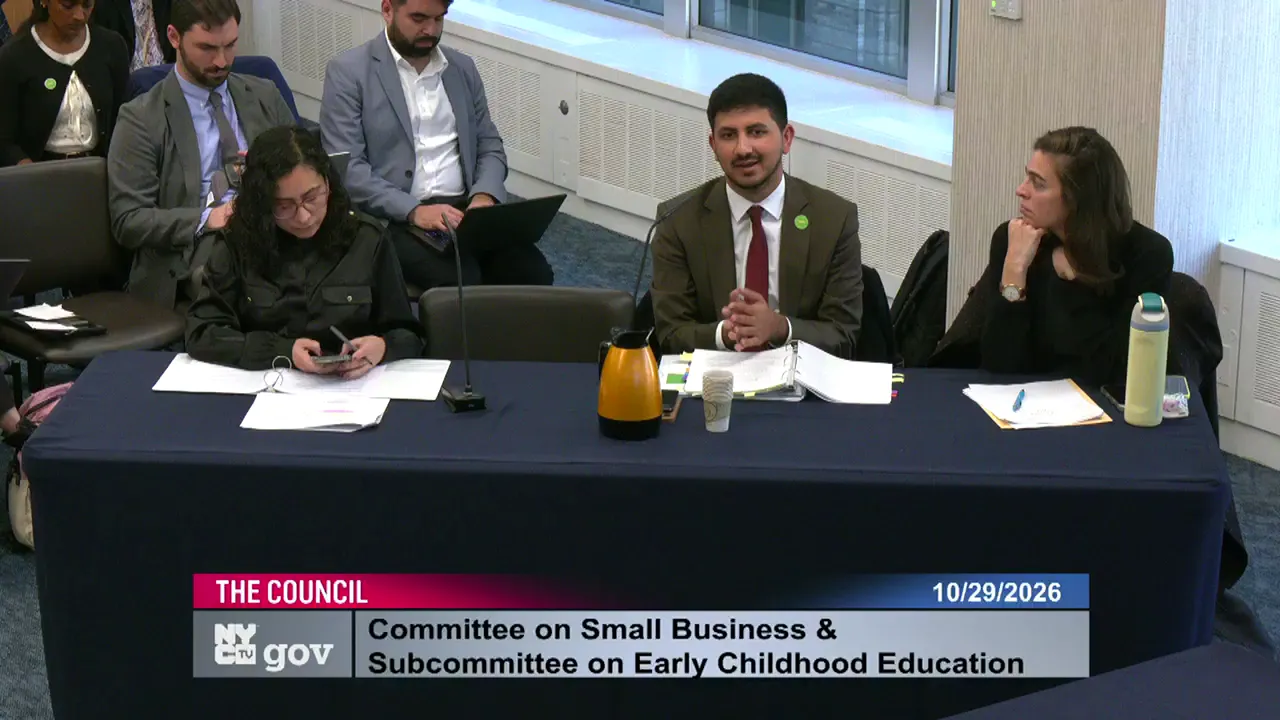
NYC Council Joint Small Business/Early Childhood Hearing on Child Care and Int. 0445-2026, October 29, 2026
City Council — Thursday, October 29, 2026
BodyNew York City, New York
SessionCity Council
DateThursday, October 29, 2026
StatusNEW · FILED
Video Record
STREAMING COPY IN PREPARATION — RECORDING AVAILABLE FROM THE ORIGINAL SOURCE
Transcript — Verbatim
Speaker numbers apply only to this recording. Names come from transcript evidence. “Possibly” marks uncertain attribution.
Discussion Breakdown — Share of Meeting
Child Care41%
Early Childhood Education13%
Education10%
Public Engagement9%
Small Business8%
Public Housing6%
Budget3%
Workforce Development3%
Insurance2%
Summary of Proceedings
NYC Council Joint Small Business/Early Childhood Hearing on Child Care and Int. 0445-2026, October 29, 2026
The New York City Council Committee on Small Business, chaired by Shanel Thomas-Henry, met jointly with the Subcommittee on Early Childhood Education, chaired by Jennifer Gutiérrez, on Thursday, October 29, 2026 at 1:00 PM in Hearing Room 1, 250 Broadway. The hearing examined the business of child care and considered Introduction 0445-2026, which would require the Department of Small Business Services (SBS) to expand the Business Pathways Program to creative fields, retail, and cosmetology, with supports including business education, mentorship, licensing, health and safety training, provider applications, and commercial space help. Roll call: Thomas-Henry, Brooks-Powers, Hanif, Maloney, Morano, and Santosuosso were present; Salaam was absent. Other council members attending included Gutiérrez, Riley, Brewer, Joseph, and Felder. The oversight was heard and filed; the introduction was heard and laid over.
Discussion Items
- Chair Thomas-Henry opened by citing a 2024 U.S. Small Business Administration report finding that nearly all child care firms are small businesses, that small child care firms have exited the market disproportionately, and that child care prices grew by 230% from 1990 to 2022. She described the regulatory and cost burden on child care small businesses and introduced Int. 0445-2026.
- Co-Chair Gutiérrez called child care a textbook example of a broken market, noting most providers are women, often women of color, and that for-profit child care facilities operate on margins below 1%, far below the 15% healthy margin seen across most industries.
- Emmy Liss, Executive Director of the Mayor's Office of Child Care and Early Childhood Education, testified that the Mamdani administration and governor committed over $1.2 billion to universal child care. She cited state licensing data showing more than 10,000 licensed child care programs in New York City: over 2,200 licensed daycare centers, more than 1,500 licensed school-age child care centers, close to 5,600 group family daycares, and about 740 family daycares. More than half of child care programs employ fewer than five people; only 3% employ more than 50. She highlighted the new permitting portal, a $43 million overhaul of New York City Public Schools early childhood operations, a $40 million rate investment including a 5% rate increase for family child care providers and a 2% increase for networks and center-based providers, a $3 million emergency microgrant fund, and planning for a shared-services cooperative for home-based providers.
- Harris Khan, SBS Chief of Staff (the transcript also identifies him as Horace Khan), testified about SBS supports, the Open for Small Business reform agenda, and the Business Pathways Program operated by NYCHA. NYCHA Vice President Shana Castillo reported 448 residents enrolled in food business pathways since 2014 and 189 in child care business pathways, with 365 food graduates and 149 child care graduates; 57 child care businesses launched and 27 currently operating as of August 2026.
- Councilmembers' questions and concerns included: the roughly 5,000 family child care providers not in networks; voucher waitlists with 30,000 families and 3,000 invitations issued toward the mayor's 10,000-child commitment; prioritization of families under 300% of the federal poverty line, unhoused families, and children with disabilities; MWBE certification and language access; pay parity and wage gaps; liability insurance increases reported by 80% of child care owners nationwide; private equity entry into child care; microgrant timing; late and reversed payments; contract registration delays, including Independent Budget Office data showing the average early childhood contract registration went from 83 days after its start date in fiscal 2021 to 247 days after its start date in fiscal 2024; whether the city reimburses interest costs for late payments; lack of systematic notification of provider closures; and the need for cost and economic impact analyses for universal child care expansion.
- SBS and NYCHA described services including commercial lease assistance, worker cooperative support, contract financing loan funds, Workforce1 recruitment, NYCHA resident training, and Business Pathways cohorts with a 15-week child care track, roughly 25 residents per cohort, and about $100,000 in baseline costs per cohort. Officials committed to following up on specific provider complaints and providing additional data to the council.
Public Comments & Testimony
- Elena Knigna Colson, an educational director at a DOE-contracted preschool, described a $914,000, 10-month budget, $30,000 monthly rent, and low assistant-teacher wages of about $30,000 for full-time work, and called for pay parity and recognition of early childhood educators as educators.
- Abigail Leonard, of Children's Aid, reported that Children's Aid's core liability premiums doubled from 2022 to 2026, with primary general, professional, and sexual abuse coverage rising from about $594,000 to $1.2 million, and umbrella coverage from $206,000 to nearly $630,000. She urged support for a forthcoming council resolution on state insurance legislation and review by the new Office of Insurance Affordability.
- The owner-director of Supermoon Art Space, a small center-based program in Ridgewood, said the center was underenrolled for the first time because middle- and lower-income families can no longer afford care. She described applying for 2K, concern that 2K funding would cover only minimum staffing, and difficulty connecting with voucher families.
- Ingrid Matias Chungata, of Nuestros Niños, and Shanita Bowen, of ECE on the Move, called for predictable contracts, timely payments, transparent systems, equitable per-child funding, and an end to payment reversals and late reimbursements for family child care educators.
- Drew Weber, of the Consortium for Worker Education, described union and provider convenings supporting a shared-services cooperative, pay ladders, care for workers with non-traditional hours, and child care benefits negotiated into union contracts.
- Shelby Lohr, of the Daycare Council of New York, cited a 2023 survey of more than 250 early care and education providers in which 64% reported they remained unpaid for the prior month's services; among providers forced to bridge gaps, 25% obtained business loans and 26% took out personal loans.
- Lynn Fredericks, of Family Cook Productions, expressed support for the bill and highlighted a resource gap for community- and family-based child care operators, including lack of training funds for program quality.
- Carmelita Lopa, a group family daycare educator in East Flatbush, described voucher payment reversals, payments arriving three to four weeks late, and lost enrollment due to 2K and 3K hour changes. She also described receiving a COVID-related violation despite passing inspection.
- Multiple virtual speakers, including Joanne Lamart, Katie Johnston, Mariella Perez, Ethan Chan, Jesse Guido, Sarah DeSena, Sean Plunkett, Annie Lindenberg, and Kylie Chan, testified about the announced closure of Christ the King Community Daycare and Preschool in Middle Village, Queens. They said the center serves more than 200 children from six weeks through pre-K and is scheduled to close by July 1, 2027, and they asked the council to intervene and to scrutinize a charter school expansion on the same campus.
- Sheba Kapoor and Anne Rita Wentworth, of the New York State Montessori Alliance, asked the city to recognize median age for determining predominant age in mixed-age classrooms and to recognize accredited Montessori credentials as a qualification pathway for lead teachers in 3K and pre-K programs.
- Mary Ayinde, of St. Nick's Alliance and Small World Early Childhood Center, called for strengthening the early childhood workforce, paying providers the real cost of operating centers, and investing in regulatory agencies.
- Diana Diaz, of the Committee for Hispanic Children and Families, and Mercedes Mulhola, a home-based educator, raised concerns about destabilization from universal pre-K expansion, workforce compensation, and pressure on family child care providers to join networks.
- Debbie Kionis, a non-network group family daycare provider in Bushwick, said she and other providers feared the 2K rollout would force them to close without a clear pathway for non-network providers.
- Rosa Martinez, representing Shining Angels group family daycare in the Bronx, supported universal child care but said 2K is building on unresolved 3K problems, including unfair rates, delayed contracts and payments, and pressure on family child care providers to join networks.
Key Outcomes
- The Committee filed oversight T2026-2560 after hearing testimony.
- Introduction 0445-2026 was heard and laid over; no vote was taken.
- Committee staff will accept written testimony for up to 72 hours after the hearing via testimony@council.nyc.gov.
- Administration representatives committed to following up on the list of unpaid providers raised by Councilmember Felder, voucher-family and provider matching, specific provider cases involving payment reversals and permitting, data on contract registration and payment timelines, provider openings and closures, and updates on the early childhood management system and microgrant launch.
- The hearing was adjourned after public testimony; no additional legislative action was taken.
Meeting Transcript
Good afternoon. Welcome to the New York City Council hearing for the Committee on Small Business jointly with the subcommittee on early childhood education. At this time, we're gonna ask everyone in the room to silence all cell phones and electronic devices. If you wish to testify, you need to fill out an appearance card. If you haven't done so yet, uh please see the sergeant at arms in the back of the room, and we'll get you signed up. Most importantly, at this time, no one is allowed to approach the dais. Chair, you may begin. Good afternoon, everyone. I am Councilmember Chanel Thomas Henry, Chair of the Committee on Small Business. Thank you for joining us for today's joint hearing between the Committee on Small Business and Subcommittee on Early Childhood Education to examine the business of child care. I'd like to begin by thanking my co-chair, Councilmember Jennifer Gutierrez. I'd like to also thank the representatives from the administration, members of the public, and my council colleagues who have joined us here today, including Councilmember Santoso, Joseph, Felder, and Brewer. And on Zoom, we have Councilmember Maloney. The last couple of years, we've seen conversation grow significantly around child care in New York City. This year, the mayor, the governor, and the council have focused their efforts to examine the landscape of child care and approve its affordability and accessibility for New York City families. Part of this examination is considering who would provide child care. And that is why today's hearing is so important. New York City small businesses are significant providers of child care, and ensuring that they have the resources and guidance to conduct their business is crucial to meeting the affordability needs of New York City families. According to a 2024 report from the U.S. Small Business Administration, nearly all firms in the child care industry are small businesses. But most of the child care firms that have exited the market have been small businesses. The growing cost of the industry has been an overwhelming burden for small businesses, and this 2024 report further noted that the price of child care grew by 230% from 1990 to 2022. Many serve as unofficial community centers or were started by someone who was born and raised in the neighborhood. Businesses can begin because of deep need to give back to the community or share a passion, but starting a small child care business takes a unique amount of work. There are many complex requirements that a child care business must meet, in addition to a mirrored rules and regulations that all small businesses must follow in New York City. The costs and the complexity of starting and sustaining a child care business cannot be understated. And we must find ways to appropriately streamline the business of child care if we truly want to make child care affordable. The committee is also hearing introduction 445 from Councilmember Stevens, which requires the Department of Small Business Services to expand the business pathways program to include creative fields, retail, and cosmetology. The programs would assist NYCHA residents in formalizing their businesses, including via professional business education course, mentorship, and professional coaching. Support in obtaining business licenses, guidance on business operations, marketing and financial structures, funding to complete required health and safety trainings, support in completing provider applications and help for certain businesses to secure a commercial space. Public information about this program is limited, including who is presently responsible for running the program, and we look forward to hearing from the administration about this program and their thoughts on council member Stevens Bill. I would like to thank Tyla Walls and Rebecca Borrillo from Central Staff for their work putting this hearing together, as well as my own staff, Derek Slaughter, Franklin Richards, and Sierra Smith, and everyone working in the background to help make this hearing possible. I'd also like to mention, I believe we were joined by Councilmember Moreno. Morano. Yes, I'm coming. Okay. He's here somewhere. All right, we'll find Councilmember Morano shortly. In the meantime, I will turn it over to my co-chair, Councilmember Gutierrez for remarks. Thank you, Chair. Good afternoon, everyone. I'm Councilmember Gutierrez, Chair of the Subcommittee on Early Childhood Education. We're so excited to join the Committee on Small Business. Um, and their chair, Councilmember Chanel Thomas Henry for today's oversight hearing on the business of child care. Over the last several months, as chair of the subcommittee, I've had the privilege of hearing directly from families about how reliable, affordable child care plays an integral role in their lives. Yet the people who run child care programs are caught in an impossible squeeze.
SUMMARIZED BY OPENPUBLICA AI
TRANSCRIPT VIA PUBLIC VIDEO
openpublica.com
openpublica.com