OPENPUBLICA · PUBLIC MEETING RECORD
Record of Proceedings
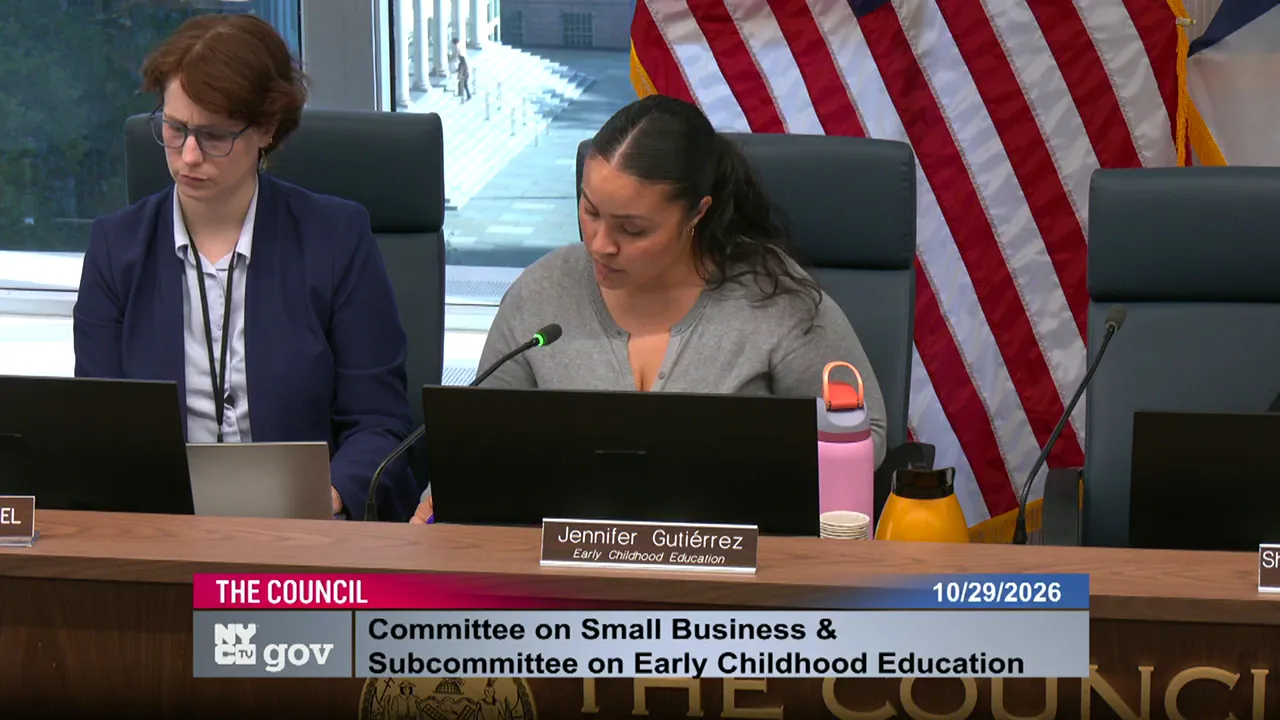
Joint Hearing on the Business of Child Care: Early Childhood Education & Small Business Committees - October 29, 2026
City Council — Thursday, October 29, 2026
BodyNew York City, New York
SessionCity Council
DateThursday, October 29, 2026
StatusNEW · FILED
Video Record
STREAMING COPY IN PREPARATION — RECORDING AVAILABLE FROM THE ORIGINAL SOURCE
Transcript — Verbatim
Speaker numbers apply only to this recording. Names come from transcript evidence. “Possibly” marks uncertain attribution.
Discussion Breakdown — Share of Meeting
Child Care57%
Early Childhood Education18%
Small Business8%
Public Housing5%
Workforce Development3%
Procedural2%
Budget2%
Public Engagement2%
Private Equity1%
Summary of Proceedings
Joint Hearing on the Business of Child Care: Early Childhood Education & Small Business Committees - October 29, 2026
On October 29, 2026, the New York City Council's Subcommittee on Early Childhood Education (Chair Jennifer Gutierrez) and Committee on Small Business (Chair Chanel Thomas Henry) held a joint oversight hearing to examine the business of child care, focusing on the financial viability of child care small businesses and the impact of regulatory burdens. The hearing also covered Introduction 0445-2026, which would expand the Business Pathways Program. Administration officials from the Mayor's Office of Child Care and Early Childhood Education (MOCCEE), the Department of Small Business Services (SBS), and the New York City Housing Authority (NYCHA) testified, followed by extensive public testimony.
Discussion Items
Administration Testimony & Agency Updates
- Emmy Liss (MOCCEE) detailed the administration's progress on universal child care, including a $1.2 billion state investment, a new provider permitting portal, a $43 million overhaul of DOE contracting to address payment delays, a $3 million emergency microgrant program, and the expansion of 2K. She reported over 10,000 licensed child care programs in NYC, mostly small businesses operating on thin margins.
- Horace Khan (SBS) outlined agency support through the NYC Business Express Service Team and the Open for Small Business reform agenda.
- Shauna Castillo (NYCHA) reported 365 graduates in food and 149 in child care since 2015, with 57 child care businesses launched.
Introduction 0445-2026: Expansion of Business Pathways
- Chair Thomas Henry questioned the program scope. NYCHA stated a baseline cost of $100,000 per cohort and confirmed no cost analysis for expansion had been completed.
Councilmember Questioning: Key Challenges
- Payment Delays: Councilmembers Felder and Morano highlighted late payments, with IBO data showing contract registration delays averaging 247 days in FY24. The administration acknowledged the issue and cited historic disinvestment.
- Voucher System: Councilmembers Joseph and Gutierrez pressed on the 30,000-family voucher wait list. MOCCEE confirmed 3,000 families had been invited off the list.
- 2K Rollout: Councilmembers Santosuosso and Gutierrez raised concerns about independent providers feeling pressured to join networks and the destabilization of the infant/toddler market.
- Private Equity: Councilmembers Hanif and Gutierrez expressed concern about private equity in child care. The administration discussed cooperative and employee-owned models.
- Liability Insurance: Multiple councilmembers flagged the insurance crisis. MOCCEE is exploring city-level interventions.
- NYCHA Providers: Councilmembers Joseph and Riley questioned MWBE certification access and support for resident businesses.
Public Comments & Testimony
- Provider Financial Struggles: Elena Knigna Colson, Shelby Lohr (Daycare Council), and Shanita Bowen (ECE on the Move) testified to razor-thin margins, late payments (64% unpaid in a 2023 survey), payment reversals, and the resulting reliance on personal loans. Providers expressed strong support for increased and timely reimbursement.
- Christ the King Daycare Closure: Multiple parents and residents from Middle Village (including Katie Johnston, Joanne Lamart, Ethan Chan) strongly opposed the announced closure of Christ the King Daycare, which serves over 200 children, advocating for Council intervention to save the program.
- Advocacy for System Change: Ingrid Matias Chungata (Nuestros Ninos) called for predictable contracts and equitable funding. Rosa Martinez and Debbie Kinonez expressed fear that the 2K system marginalizes non-network providers without fixing core rate issues.
Key Outcomes
- The oversight hearing (T2026-2559) was held and filed.
- Introduction 0445-2026 was heard and laid over by the subcommittee.
- Councilmembers directed follow-up requests on late payments, the Christ the King closure, and potential expansion costs for the Business Pathways Program.
- The hearing record remains open for written testimony for 72 hours.
Meeting Transcript
Good afternoon. Welcome to the New York City Council hearing for the Committee on Small Business jointly with the subcommittee on early childhood education. At this time, we're gonna ask everyone in the room to silence all cell phones and electronic devices. If you wish to testify, you need to fill out an appearance card. If you haven't done so yet, uh please see the sergeant at arms in the back of the room, and we'll get you signed up. Most importantly, at this time, no one is allowed to approach the dais. Chair, you may begin. Good afternoon, everyone. I am Councilmember Chanel Thomas Henry, Chair of the Committee on Small Business. Thank you for joining us for today's joint hearing between the Committee on Small Business and Subcommittee on Early Childhood Education to examine the business of child care. I'd like to begin by thanking my co-chair, Councilmember Jennifer Gutierrez. I'd like to also thank the representatives from the administration, members of the public, and my council colleagues who have joined us here today, including Councilmember Santoso, Joseph, Felder, and Brewer. And on Zoom, we have Councilmember Maloney. The last couple of years, we've seen conversation grow significantly around child care in New York City. This year, the mayor, the governor, and the council have focused their efforts to examine the landscape of child care and approve its affordability and accessibility for New York City families. Part of this examination is considering who would provide child care. And that is why today's hearing is so important. New York City small businesses are significant providers of child care, and ensuring that they have the resources and guidance to conduct their business is crucial to meeting the affordability needs of New York City families. According to a 2024 report from the U.S. Small Business Administration, nearly all firms in the child care industry are small businesses. But most of the child care firms that have exited the market have been small businesses. The growing cost of the industry has been an overwhelming burden for small businesses, and this 2024 report further noted that the price of child care grew by 230% from 1990 to 2022. Many serve as unofficial community centers or were started by someone who was born and raised in the neighborhood. Businesses can begin because of deep need to give back to the community or share a passion, but starting a small child care business takes a unique amount of work. There are many complex requirements that a child care business must meet, in addition to a mirrored rules and regulations that all small businesses must follow in New York City. The costs and the complexity of starting and sustaining a child care business cannot be understated. And we must find ways to appropriately streamline the business of child care if we truly want to make child care affordable. The committee is also hearing introduction 445 from Councilmember Stevens, which requires the Department of Small Business Services to expand the business pathways program to include creative fields, retail, and cosmetology. The programs would assist NYCHA residents in formalizing their businesses, including via professional business education course, mentorship, and professional coaching. Support in obtaining business licenses, guidance on business operations, marketing and financial structures, funding to complete required health and safety trainings, support in completing provider applications and help for certain businesses to secure a commercial space. Public information about this program is limited, including who is presently responsible for running the program, and we look forward to hearing from the administration about this program and their thoughts on council member Stevens Bill. I would like to thank Tyla Walls and Rebecca Borrillo from Central Staff for their work putting this hearing together, as well as my own staff, Derek Slaughter, Franklin Richards, and Sierra Smith, and everyone working in the background to help make this hearing possible. I'd also like to mention, I believe we were joined by Councilmember Moreno. Morano. Yes, I'm coming. Okay. He's here somewhere. All right, we'll find Councilmember Morano shortly. In the meantime, I will turn it over to my co-chair, Councilmember Gutierrez for remarks. Thank you, Chair. Good afternoon, everyone. I'm Councilmember Gutierrez, Chair of the Subcommittee on Early Childhood Education. We're so excited to join the Committee on Small Business. Um, and their chair, Councilmember Chanel Thomas Henry for today's oversight hearing on the business of child care. Over the last several months, as chair of the subcommittee, I've had the privilege of hearing directly from families about how reliable, affordable child care plays an integral role in their lives. Yet the people who run child care programs are caught in an impossible squeeze.
SUMMARIZED BY OPENPUBLICA AI
TRANSCRIPT VIA PUBLIC VIDEO
openpublica.com
openpublica.com