OPENPUBLICA · PUBLIC MEETING RECORD
Record of Proceedings
New York City Council Sanitation Committee Oversight Hearing on Snow Removal and Plow Data Legislation (Nov. 2, 2026)
City Council — Monday, November 2, 2026
BodyNew York City, New York
SessionCity Council
DateMonday, November 2, 2026
StatusNEW · FILED
Video Record
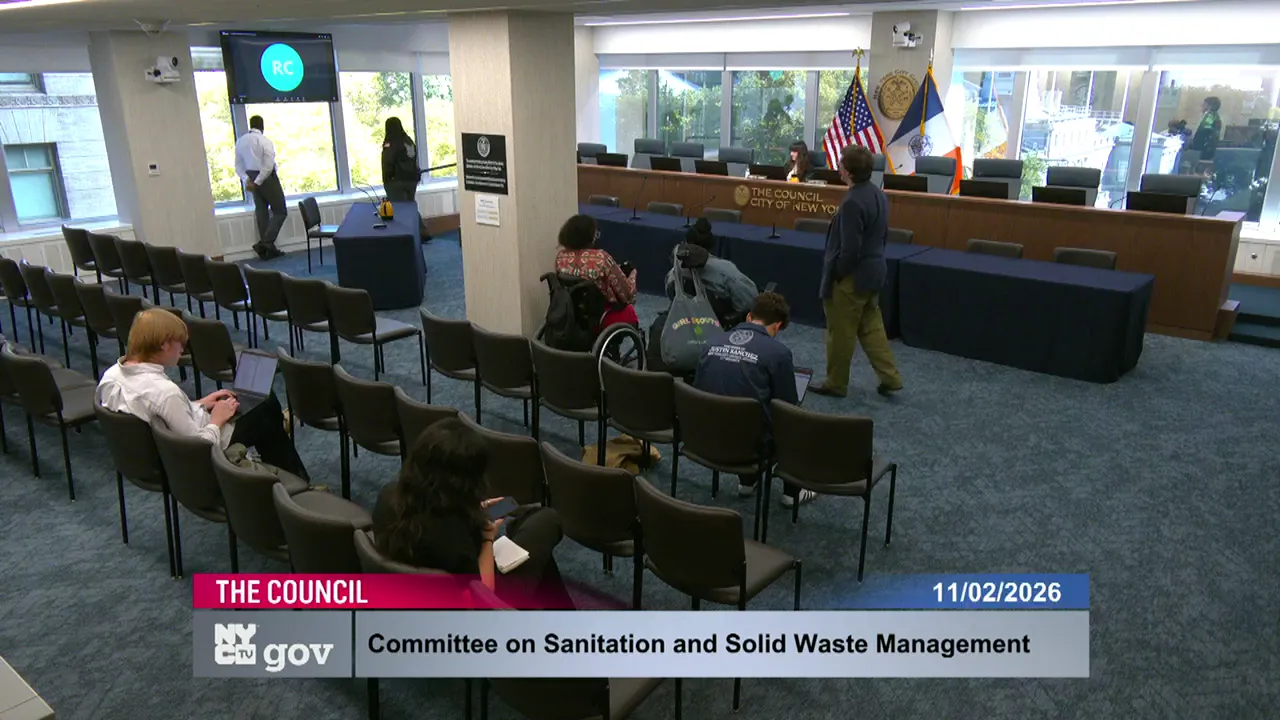
STREAMING COPY IN PREPARATION — RECORDING AVAILABLE FROM THE ORIGINAL SOURCE
Transcript — Verbatim
Speaker numbers apply only to this recording. Names come from transcript evidence. “Possibly” marks uncertain attribution.
Discussion Breakdown — Share of Meeting
Sanitation and Solid Waste Management43%
Disability Rights24%
Procedural10%
Transportation Safety10%
Public Engagement4%
Accessibility3%
Public Works2%
Public Safety2%
Community Engagement1%
Summary of Proceedings
New York City Council Sanitation Committee Oversight Hearing on Snow Removal and Plow Data Legislation (Nov. 2, 2026)
The New York City Council Committee on Sanitation and Solid Waste Management, chaired by Justin E. Sanchez, held a hearing on November 2, 2026, to review the City's snow removal and winter storm response plans and to discuss Introduction 1042-2026, which would require the publication and visualization of snow plowing operations data. Chair Sanchez opened the hearing by acknowledging a recent tragic death of a constituent involving a sanitation truck in his district and thanking the Commissioner for their proactive outreach. Department of Sanitation (DSNY) officials, including the Commissioner, fielded questions on new prioritization strategies, equipment, enforcement, and interagency coordination. Multiple members of the public testified regarding disability access and environmental justice concerns.
Public Comments & Testimony
- Iman Ramawi Doster (New York Lawyers for the Public Interest): Stressed the severe difficulties disabled New Yorkers face during snowstorms. Proposed assessing fines for non-compliant property owners, eliminating fines for seniors and disabled people unable to clear snow, prioritizing curb cuts and crosswalks, and establishing a DSNY alert system. Argued the lack of accessible streets is a violation of rights.
- Elizabeth Valdez (Brooklyn Center for Independence of the Disabled): A wheelchair user, described being trapped by impassable snow. Supported the intent of Int. 1042 but urged it be amended to specifically track and resolve barriers impacting people with disabilities. Called on the city to take ultimate responsibility for sidewalk and curb cut clearance.
- Mary Arnold: Criticized DSNY's waste-by-rail program, citing stench, rats, failure to achieve diversion goals, climate impacts, and environmental injustice. Asserted the program violates state environmental conservation law due to defective, non-leak-proof containers.
Discussion Items
- Snow Removal Prioritization and Strategy: The Commissioner outlined a new plan to prioritize clearing approximately 20,000 corners based on proximity to transit (within 200 feet), top-tier DOT crosswalk rankings, accessible pedestrian indicators, and neighborhoods with high populations of seniors and people with disabilities. Councilmember Restler urged the department to consider more aggressive timelines and learn from cities like Montreal, and raised chronic issues with DOT's failure to clear BQE bridges and overpasses, suggesting DSNY take over that responsibility.
- Bike Lane and Street Infrastructure Clearing: The Commissioner clarified that DSNY treats bike lanes simultaneously with roadways, contradicting outdated 311 language. He stated 47 plow units are dedicated to bike lanes and that the department is planning proactively with DOT for new bike infrastructure. Councilmembers also discussed the impact of permanent street dining sheds on snow removal routes and the need for adequate turning radii for plow vehicles.
- Property Owner Responsibilities and Enforcement: Councilmember Thomas-Henry highlighted confusion over alleyway garbage service and fines. The Commissioner committed to proactive mailer and text notifications when alley service is suspended for snow events. Councilmembers questioned the adequacy of current fines ($100-$250). The Commissioner noted over 19,000 violations were issued last winter and that the city can theoretically bill property owners for the cost of city-led shoveling, though it is administratively burdensome.
- Data Transparency (Int. 1042-2026): Councilmember Hankerson, the bill's sponsor, questioned why residents cannot access historical GPS plowing data from the Plow NYC website. The Commissioner affirmed the technological feasibility of the bill's goals but stated development resources are needed to build out the functionality.
- Fleet Capacity and Equipment: The Commissioner reported the average age of collection trucks is 5.1 years, with 12% of salt spreaders beyond their 12-year service life. The department has 26 snow melters (13 operated last year) and is proactively ordering new equipment through requirements and emergency contracts. A councilmember noted discrepancies in equipment allocation in Bronx Community Districts 1, 2, and 3, which the Commissioner attributed to the smaller geographic size and less hilly terrain of those districts.
- ADA Compliance and Disability Access: Councilmember Hanif questioned whether the practice of delegating sidewalk clearance to property owners satisfies the city's ADA obligations. The Commissioner maintained that property owner responsibility remains but expressed openness to a roundtable discussion with the Mayor's Office for People with Disabilities (MOPD) and disability advocates to hear direct input on prioritizing assets and improving communication.
Key Outcomes
- The committee heard testimony and filed Oversight T2026-2596 on the City's Snow Removal and Winter Storm Response.
- The committee held a hearing on Introduction 1042-2026 (Plow Data Transparency) and laid it over for future consideration.
- The Commissioner committed to updating 311 guidance to reflect the current policy of clearing bike lanes simultaneously with roadways.
- DSNY will explore scheduling a roundtable with MOPD and disability advocates.
- The department agreed to improve communication strategies regarding alley service suspensions for snow events.
Meeting Transcript
Hello, we're going to get a little bit more. And welcome back. Thank you for uh joining us through the uh committee on sanitations uh cyber attack. That you know Los Angeles really uh came for us. Um they needed all of our snow knowledge. Um, uh, I will now turn it over to Council Member Sanchez Roso for some questions. And before I start with questions, I just want to acknowledge the um constituent who was killed in my district uh last week uh by a sanitation truck. Um and I know the incident is still under investigation, and we'll have lots of time to to discuss, you know, what what could have been done, but I I appreciate so much the the early outreach by you, Commissioner, um and your commitment to you know finding out whatever we can do to prevent that from happening again. So thank you so much. Um I want to ask primarily when it comes to snow clearing. Um we've established, I think, uh as the result of the last hearing that the corner property is responsible for clearing a pedestrian ramp. Is that correct? Corner property is responsible for clearing the pedestrian the the path to and including a pedestrian ramp. That is largely clear correct, yes. Okay. And I think at the last hearing we discussed, and it what I don't I don't believe you had been appointed yet. And so um my sort of pet peeve last year, because of everyone pushing a stroller and having accessibility issues, is that people were clearing the corner, a path to the corner and clearing the pad ramp, but then sanitation was plowing snow such that it piled up right at the end of the crosswalk. So there would be a mound of snow in between the crosswalk where people were crossing and then the properly cleared, hopefully, pedestrian ramp. Um hopefully we don't get that level of snow again such that it has mounds sort of staying on the street. But at the time, uh the acting commissioner was looking into ways that we could sort of make sure that the entire crosswalk was cleared, particularly when the corner property is doing their their piece and clearing the ped ramp. Um wondering if there's a strategy this year around around that. Yeah, so to start, I think that's where having the emergency snow shoveler program be much more robust and also having more uh snowblowers and other equipment to be able to respond to those areas more quickly will be really helpful. Uh we've also um done a lot of work in routing to those corners. We're trying to avoid the this distinction between it's uh ped ramp versus its uh crosswalk versus we're just treating everything on the corner that connects the sidewalk to the street as a corner. Great. And if we get there and it's not shoveled, we will shovel it. If we get there and it's shoveled, great, we'll move on. Uh so the thing that we're that we're doing differently from a routing perspective this year is we are trying to prioritize which corners we are doing first with our snow shovelers and our sanitation workers. Uh we have a couple different criteria that we're using to prioritize those. Um the first is any corner that is within 200 feet of a bus stop or a subway stop is getting prioritized. Any corner that is on uh DOT has a sort of five-tier uh ranking of crosswalks. Um any corner that's in the top three tiers of those rankings, uh, which is the the areas that have the highest uh number of pedestrians, um those are prioritized. Uh we're also looking at um corners that have the accessible pedestrian indicators, so those are the audible indicators for uh the crosswalk, those are all prioritized. In total, it comes out to around 20,000 corners, uh, which we understand is still a very small share of all of the corners in New York City. I think there, you know, there's never a world where we are going to get to everything as a number one priority. So we have to do some prioritization based on where the most people are moving uh in uh you know in the the days immediately after a storm. And uh one of the things that we are also doing is working with the mayor's office for people with disabilities and um the department for the aging to make sure that we are uh also prioritizing areas where we know there are high populations of people with mobility challenges or um who rely on mobility devices to get around, so that we are also uh accounting for that. If I may, I mean it sounds like you sort of worked out that priority structure, but schools were also what I heard the most of. And granted, I know it's mostly DOE's responsibility to clear outside of uh school sites, but making sure those corners are clear given the heavy pedestrian traffic, especially during um you know, dismissal and dropping drop-off as well. Yeah, absolutely. And I think the the uh New York City Public Schools uh custodial staff do tremendous work to get schools back open, often you know, in the hours or less than a day after the snowfall ends. Um I think the thing that we that we try to work very close with them on is making sure that the routes to get to that school, either from the the nearest public transit stop or from where uh where parents or buses are dropping off are also clear. So it's not just the sidewalk immediately proximate to the school, but it's the larger uh area around the school, and that's something that we work very closely with. Uh Kevin Rand, who's their chief uh operating officer and and his team on. Great. Thank you so much. Thanks, Chair.
SUMMARIZED BY OPENPUBLICA AI
TRANSCRIPT VIA PUBLIC VIDEO
openpublica.com
openpublica.com