Norman City Council Discussion on South Extension Turnpike Interchange Locations - August 11, 2026
STREAMING COPY IN PREPARATION — RECORDING AVAILABLE FROM THE ORIGINAL SOURCE
Norman City Council Discussion on South Extension Turnpike Interchange Locations - August 11, 2026
The Norman City Council held a meeting on August 11, 2026, to discuss potential interchange locations along the South Extension Turnpike, planned by the Oklahoma Turnpike Authority (OTA). OTA representatives provided an update on the Access Oklahoma program and presented two proposed interchanges at Alameda Street and Tecumseh Road, while also addressing questions about the Etowa Road interchange partially within Norman city limits. Councilmembers raised concerns about property acquisition, environmental impact studies, public safety, and fire response times.
OTA Project Update
Trenton January, OTA Chief Engineer, provided an overview of the Access Oklahoma program, an $8.2 billion investment. He reported that as of August 2026, OTA has spent or has under contract $1.63 billion across the program. Regarding right-of-way, OTA is actively working with 408 parcels and has closed on 219 parcels program-wide. On the Toby Keith Expressway (East-West Connector), OTA is working with 124 parcels and has closed on 118. January highlighted construction progress, including the Canadian River bridge (beams hung, completion expected 2028, westbound bridge open by end of 2027) and the 10-Mile Flats Creek area (40% construction complete, targeted spring 2027). Upcoming projects include the Western Avenue interchange (September 2026, $50 million), grade drain/surface from Santa Fe to South Telephone Road (October 2026), and several bridges on the Toby Keith Expressway ($151 million total investment for 2026).
South Extension Interchange Discussion
Director E. Kelly presented the proposed interchanges for the South Extension. The alignment was moved west from an earlier route near Lake Thunderbird due to Bureau of Reclamation restrictions. Kelly explained that the turnpike's primary purpose is moving freight and providing an alternative to I-35. Two interchanges are under consideration: at Alameda Street and at Tecumseh Road. OTA emphasized that these interchanges would require additional land acquisition but would not impact additional houses beyond those already identified for the mainline alignment. A "tight diamond" design would minimize footprint. OTA also noted that interchanges at Lindsey Street and Franklin Road were ruled out due to proximity to Highway 9 and the Toby Keith interchange, respectively. The city's feedback is sought on whether to proceed with these interchanges.
Etowa Road Interchange (Norman-Noble Border)
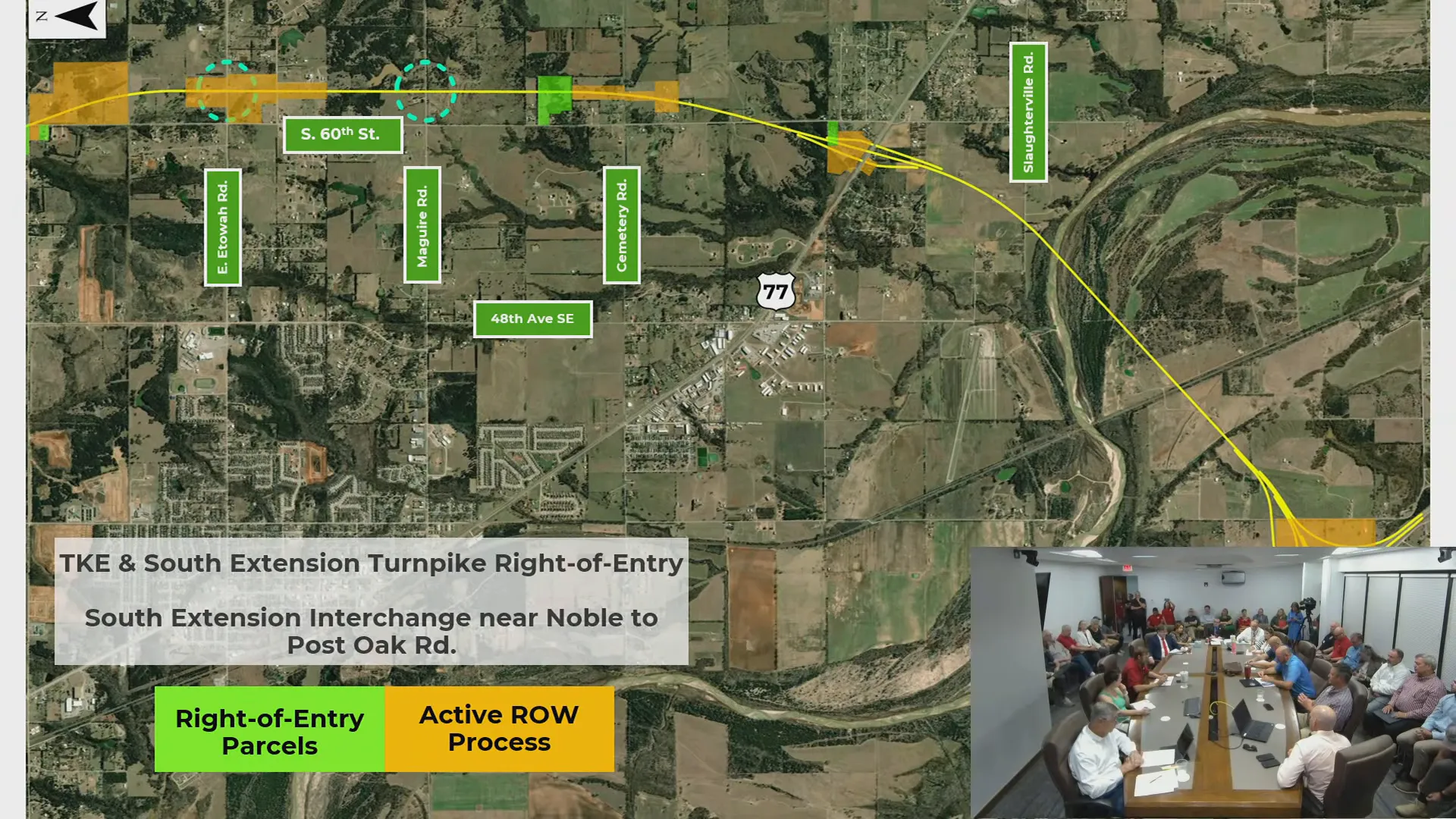
The proposed interchange at Etowa Road lies partially within Norman city limits (north half of the road). OTA indicated that Noble has requested a split interchange, and the design should fit within previously identified property takings without additional homes. Council acknowledged that Norman would need to pass a resolution supporting this interchange as it affects a city street. Councilmember Curtis pointed out that a home and shop on the north side of Etowa are being taken and that property owners are not cooperating.
Public Safety and Fire Response Concerns
Councilmember Steele questioned OTA about emergency response on turnpikes. OTA confirmed that fire services would be provided by local departments, and OTA pays for call-outs for grass fires but does not typically fund equipment. Fire Chief King and Fire Chief Foster stated that a recent third-party study recommended interchanges at Highway 9, Alameda, and Tecumseh to improve response times. They noted that current fire stations (Station 6 on East Alameda, Station 9 on East Alameda) could access these interchanges, and a proposed Station 10 at 36th and Highway 9 and a future Station 12 at 108th and Franklin would further improve coverage. OTA offered to consider providing emergency access gates and median crossovers if interchanges are not built, but acknowledged these are less safe. Councilmember (unidentified) asked if OTA could help with land for a fire station near Tecumseh and 24th, and OTA responded that there might be room within acquired right-of-way.
Councilmember Concerns and Opposition
Councilmember Curtis voiced strong opposition to OTA's land acquisition practices. He stated that OTA has not provided requested environmental impact studies, has used law enforcement to enter properties without court orders, and has shown disrespect to landowners. He emphasized the historical and emotional significance of the land, including his own family's dairy farm that was forced out by Lake Thunderbird. He challenged OTA's claims of no additional house impacts, arguing that taking land destroys wildlife habitats and that the process is unjust. He also referenced a lawsuit between Catoosa and Claremore where turnpike commitments were not honored, questioning OTA's reliability.
Key Outcomes
- No formal votes were taken during the meeting.
- The council discussed the need for a resolution supporting the Etowa Road interchange; OTA requested city input on the Alameda and Tecumseh interchanges.
- The fire department's study supports interchanges at Highway 9, Alameda, and Tecumseh for improved emergency response.
- OTA indicated willingness to discuss partnerships for fire equipment or station placement on acquired right-of-way.
- Council expressed significant concerns about property rights, environmental impact, and the process of land acquisition, with some members opposing the current approach.
- The city will likely continue discussions with OTA and may bring resolutions for consideration at a future meeting.
Meeting Transcript
They said they could do that. Okay. All right, it is a little bit after five, so we'll go ahead and get started and wait for other council members to uh when they come in, they can jump in on the discussion. Um welcome to the city council conference for Tuesday, August 11th, 2026. We have one item on the agenda, and that is a discussion regarding potential interchange locations within Norman for the South Extension Turnpike planned for construction by the Oklahoma Turnpike Authority. And we do have representatives from the Oklahoma Turnpike Authority here to answer any questions. Um I think they've got a few slides and then answering questions that council has about uh this particular uh proposal. So please proceed there. All right, thank you, Mayor Holman. Um I'm Trenton January. I'm the chief engineer for the Oklahoma Turnpike Authority, and I'm gonna I wasn't able to be at the last transportation committee meeting. Um I was uh talking with the Winstone neighborhood just south of Indian on south of Indian Hills, west of I-35, giving them an update on where we are with uh construction and progress-wise, what they can expect during construction. So wasn't able to be here to provide that normal update that I've been giving over the past few months. So I'm gonna go through some of these slides. Um councilwoman Grant has suggested since there are a couple new council members to kind of talk about OTA and our process just so they're kind of caught up to speed and where they're caught up to speed of where everything is. And so I'll run through that and then I'll let Director E. Kelly kind of touch base on the interchanges after that. So I'll try to keep it brief as brief as possible. Um really just wanted to talk about OTA's bond process where we go issue bonds, we do design and construction, and then we collect the tolls, and then we pay off those bonds with those tolls that we collect. Um, and so that's just kind of how our business model we operate, um, just so everybody understood that process. And again, we all know the Access Oklahoma program, it's an $8.2 billion investment into our system into the state's uh turnpike system. Um the different projects are not just the new alignments, um, it's also widening the Turner Turnpike, adding in interchanges where there are interchanges there today. I'm gonna use the example would be the community of DPU. When the Turner was originally built, they didn't get an interchange. Well, now that we have gone cashless, we have that opportunity, and they're asking for an interchange at their community so people can if they need to get off or visit their community and get there. Um we also have some widening on the Will Rogers Turnpike, and we're adding interchanges on that or completing interchanges that are only partial interchanges to provide additional access. And really that additional access is is you know, there's a safety component behind that of if you're you're traveling down the turnpike, and maybe there's a 17-mile distance in between two interchanges. Um now you may have more of an opportunity, maybe a shorter distance to be able to turn around, or for emergency management services to be able to access something that may happen on the turnpike. So those are those are some of the things when we're talking about adding interchanges is not only access but allowing more the ability for people to get to locations that they need to get to. Uh John Kilkpatrick, uh, we're widening the rest of the John Kilpatrick on the west side of Oklahoma City, also adding additional interchange there at County Line. And then as you can see on the Cimarron, the Creek, the Bailey, and the Indian Nation. Again, talking about adding those interchanges in locations where there hasn't been any uh access. Again, an example is on state high or on the Indian Nation at State Highway 63 and Blanco. Um, it connects with the state highway, providing additional access to for people to be able to get on the turnpike or get to McAllister or get down to Antlers or Hugo or Paris, wherever they may be trying to get to. And then again, the new alignments where there's about 4.4 billion on the new amount of alignments. This is just an overall map of you can you can see on our Access Oklahoma website where you can you can go in there and you can click on these and you can get a lot more information. Um again, orange orange is active construction, green are the completed projects, yellow are the ones that are currently in design, and the blue are our future routes that we're working on, but you know, we're not we're not um heavily working on those right now. Here's kind of a snapshot of where we are today to date, what we have spent in engineering right-of-way and construction, and then also what we have under contract, whether it was an awarded construction contract or whether it is a board-approved contract with engineering or right-of-way acquisition or any of those contracts, engineering, design contracts. Um, you know, we still have these amounts left on those contracts, which totals up to about 1.63 billion that we've spent or have under contract to date. This is just a uh this up here when we say 208 pre-construction submittals, these are the planned designs that uh the firms have turned in across the entire Access Oklahoma program. Um they've submitted 200 sets of those submittals, whether that be a 30%, 60%, 90%, a total or the PSNE, the final package. And then down here at the bottom, oops, sorry, down here at the bottom is a kind of a right-away update. This is for the full access program. So anything on the Turner, Will Rogers, Indian Nation, any right-a-way that we have been working with landowners to purchase. We're currently actively working with 408 different parcels. We've closed on 219 across the entire program. And then specifically on the Token Key East West, East West Express. We're actively working with 124 parcels, and we've closed on about we close on 118. And those are as of Friday, last Friday. Um, we gave this presentation yesterday, so we we wanted to state the same numbers.
openpublica.com