The Norman City Council held a study session on November 3, 2026, to discuss voter-approved bonds for a permanent shelter, a proposed immigration resolution, and the city's potential withdrawal from ACOG 911. A discussion on the Animal Welfare Center was postponed. Discussion Items 1. Voter-Approved Bonds for Permanent Shelter Bond counsel provided an update on the $8 million, 20-year general obligation bond sale for a permanent shelter, following a favorable court ruling. A resolution is scheduled for November 10 to set the sale date for December 8, with closing set for January 20, 2027. An emergency clause will be used to allow the ordinance to take effect immediately. Councilmembers discussed the legal requirement to accept the lowest interest rate bid and how residents can purchase the bonds. Bond counsel estimated interest rates for comparable 20-year bonds to be around 4.2%. 2. Immigration Resolution (Continued Discussion) Councilmember Grant presented a proposed resolution to centralize resources for Norman’s immigrant community on the city website. - Councilmember Bruce submitted formal questions expressing concern that the resolution does not distinguish between lawful and unlawful residents and could be interpreted as encouraging unlawful presence. The city attorney stated the text does not explicitly encourage unlawful immigration and highlighted that other local governments in the state, including Oklahoma City and Tulsa, have passed similar measures. - The Norman Police Department expressed operational concerns, arguing the resolution could confuse its public safety mission and potentially deter crime reporting. The department emphasized its policy is focused on public safety, not immigration enforcement, and it does not want to deviate from that core message. - Councilmember Grant argued the resolution is a low-barrier, centralized information tool similar to existing city pages, helping residents find legal, tax, educational, and consular resources. It was clarified that Norman is not a sanctuary city. - The council reached consensus to move the resolution to the formal voting agenda on November 24, 2026, with councilmembers invited to submit amendments. 3. City of Norman’s Participation in ACOG 911 The city manager and communications manager Russell Anderson recommended that Norman withdraw from the ACOG 911 trust. - Financials: Norman pays approximately $132,000 per month in 911 fees but directly recoups only $35,000, with ACOG retaining nearly $1.2 million of Norman's fees annually. The trust's total fund balance is $33.3 million, with staff estimating Norman’s proportionate share to be $6.3 million. - Rationale: Staff argued the city can efficiently handle its own 911 operations using its new Emergency Operations Center. The state's development of a free statewide ESINet makes ACOG 911's parallel efforts redundant, amounting to "double taxing" citizens. Retaining the funds would allow the city to hire up to seven dispatchers and fund other public safety needs identified in a recent study. - Impact: Staff noted that other large cities (Edmond, Moore, Midwest City) share these concerns and are also exploring withdrawal. Norman has the capacity to offer dispatch services to smaller neighboring agencies to ensure continuity. - Councilmembers strongly supported the direction to withdraw. The city manager was directed to draft a notice of intent, targeting an exit between July 1, 2027, and June 30, 2028. Key Outcomes - Shelter Bonds: Resolution scheduled for November 10 to authorize the bond sale. - Immigration Resolution: Moved to the November 24 voting agenda. Amendments welcome. - ACOG 911 Withdrawal: City manager directed to draft notice of intent to exit by the 2027-2028 fiscal year. - Animal Welfare Center: Item postponed.
Public Meetings - Norman, Oklahoma
Public Meetings - Norman, OklahomaThe Norman City Council, Norman Utilities Authority, Norman Municipal Authority, Norman Tax Increment Finance Authority, and Norman Parking and Transit Authority met jointly on October 27, 2026. The council adopted three proclamations, heard ward and mayoral announcements, approved the consent docket, and acted on five non-consent items: two Ward 5 final plats, the city auditor compensation ordinance, the city auditor employment contract, and a public parks ordinance amendment. Most votes were unanimous; the two final plats passed 8–1 and the auditor contract passed 8–1. Proclamations - Oklahoma Mobility Week (November 1–7, 2026) was proclaimed. A representative of ODOT and the mobility management program thanked Norman for its partnership and invited residents to walk, bike, and use public transit. - World Kindness Day (November 13, 2026) was proclaimed. Angela Jimenez Calhoun, founder and CEO of the Beacon Project, accepted and said the Norman nonprofit serves approximately 500 Norman public school teens each year through food boxes, a teen cafe, and essential items. She thanked the Human Rights Commission for bringing the recognition forward. - Native American Indigenous Peoples Heritage Month (November 2026) was proclaimed. An Absentee Shawnee tribal member and commander of the Absentee Shawnee Veterans Association accepted, and Lucianne Harjo, coordinator of Indian Education for Norman Public Schools, said the program serves about 2,600 students from 75 tribal nations in a district of roughly 17,000 students, about 17–18 percent of the student population. Council Announcements - Ward 1 encouraged a kindness challenge on Friday, November 13; noted a local restaurant's Dr Pepper promotion; mentioned Transition House's search for an executive director; and sought applicants for economic development advisory board positions. - Ward 2 urged safety during Halloween and OU homecoming weekend and reminded residents to vote in the November 3 election, with early voting starting October 28. - Ward 3 thanked First Christian Church for a $250 donation for document recovery, announced a $700,000 first responders addiction recovery grant to the city, and reported calls about camping, transit/light rail, and ADA concerns. - Ward 4 congratulated Thunderbird Clubhouse on receiving $126,000 in solar infrastructure, stated the project generates 65 kilowatt hours and offsets 65 percent of the clubhouse's usage, and highlighted the Norman Solar Initiative's 45 completed projects with over 880 kilowatts of solar capacity and over 200 kilowatts of storage. - Ward 5 announced town halls at the Norman Public Library on November 7 from 4–5 p.m. and November 21 from 9–10:30 a.m., and said residents have called about Turnpike Authority partial property takes, water protection, and data centers. - Ward 7 also encouraged early voting and Election Day participation. - The mayor thanked Fall Fest organizers; noted the ribbon cutting for the new airport air traffic control tower; announced the Reese Park kids space groundbreaking and a spring community build; reminded residents that city-sponsored trick-or-treating is not mandated and suggested Friday and Saturday, noting there will not be another Saturday Halloween until 2037; and celebrated the Oklahoma Supreme Court's affirmation allowing the voter-approved shelter project to move forward. Consent Calendar - Items 4 through 25, with the exception of Items 13 and 14, were placed on the consent docket and approved unanimously. - Item 5, Hospital Authority Board appointments, was included. Councilmember Kirby noted the board currently has six west-side members, three east-side members, and two core-area members, and voiced concerns about medical access and fire response times while supporting the appointments. - Item 24, a resolution to make the temporary shelter compliant with the State Fire Marshal's recommendations and repair HVAC damage from the July 4 storms, was approved. Councilmember Grant said it would make the shelter safe and habitable until a permanent shelter is built. - Item 6, a camping-on-public-property ordinance, was not acted on; the mayor clarified that action had been postponed to November 24, 2026. Public Comments & Testimony - No members of the public spoke during the meeting. Registered speakers for non-consent items, including Stephen Ellis, Floyd Carroll, and Cynthia Rogers, were not present, and no one spoke during the final miscellaneous comments period. Discussion Items Item 13 – Norman Groundwater Facility Final Plat - Staff member Nathan Maddenwald presented the final plat for the Norman groundwater facility at 4020 East Tecumseh Road, about one-half mile east of 36th Avenue Northeast in Ward 5. He said it implements a preliminary plat approved by council in March 2025. - The facility will centralize chlorination for the city's 43 groundwater wells, which currently send untreated groundwater directly into the potable distribution system. The state Department of Environmental Quality requires chlorination; the facility will add chlorine and ammonia to form chloramines. - Staff said the project does not include drilling new wells or increasing pumping, though the site is sized to handle additional wells if the city later chooses to drill them under the AIM water plan. Councilmember Bruce noted the project was tied to the voter-approved utility rate increase of June 13, 2023. - Councilmember Kirby raised concerns about aquifer depletion, the Garber-Wellington aquifer, and impacts on Ward 5 residents and farmers. She moved to postpone the item to December 8 for hydrology studies, but the motion failed for lack of a second. She also referenced long-range water plans increasing from 4 billion to 8 billion gallons and questioned future water supply choices. - The final plat was approved 8–1, with Councilmember Kirby voting against. Item 14 – Summit Valley Edition Section Four Final Plat - The final plat is located one-half mile north of State Highway 9 and 300 feet west of 36th Avenue Southeast in Ward 5. - Councilmember Kirby asked that it be considered separately from the consent docket because of concerns about recharge-plate coverage and the city's 10-acre rule. No other discussion or public comment was offered. - The plat was approved 8–1, with Councilmember Kirby voting against. Item 26 – City Auditor Compensation Ordinance - The ordinance fixes the city auditor's compensation consistent with the city manager's compensation under Article 18, Section 1 of the Norman Charter and includes an emergency clause. - City Attorney Rick Knighton said the ordinance gives council authority to enter into the auditor contract but does not itself guarantee employment. Councilmember Steele asked whether it was consistent with the voter-approved charter change; Knighton confirmed the requirements would be in the ordinance. - Councilmember Bruce noted the city has more than 1,000 employees, a budget over $300 million, annual grants of $40–70 million, and 13 departments, calling the auditor role a tough job. - The ordinance passed second reading and final reading unanimously. The emergency clause was moved and seconded; Councilmember Bruce questioned whether it was a true emergency, while Councilmember Steele supported using it to hire an auditor promptly. Item 27 – City Auditor Employment Agreement - Council considered an employment agreement between the city and its related authorities and Deborah Rohrbaugh, setting terms for her service as city auditor. - Councilmember Bruce questioned a provision providing 12 months of salary plus insurance and benefits for certain terminations, saying it appeared higher than other municipalities. Knighton responded that the contract was consistent with the prior auditor's contract, that the city manager, city attorney, and city auditor are at-will employees of the council, and that severance provisions help attract qualified applicants given political risk and annual council turnover. He also reviewed the prior auditor's departure and the job announcement error that had led to a severance payment. - The contract was approved 8–1, with Councilmember Bruce voting against. Item 28 – Public Parks Ordinance Amendment - The ordinance amends sections 2-316 and 24-50 of the Norman code to provide oversight, prohibit certain activities in public parks, establish exceptions and enforcement, and include an emergency clause. It passed first reading by title only unanimously. - On second reading, Councilmember Steele moved to adopt the revised ordinance in the agenda packet and then moved to amend it to keep camping prohibited in Sutton Urban Wilderness. He explained that without the amendment, adopting the revised ordinance would remove the current camping prohibition at Sutton while the broader camping-on-public-property ordinance is still pending. - City Attorney Knighton said Sutton Urban Wilderness is owned by the state and leased to the city, and the lease requires certain ordinance provisions. Councilmember Kirby asked whether a similar special clause was needed for Cates Park; Knighton said that lease does not contain the same camping-specific provision. - The amendment passed unanimously, and the revised ordinance as amended passed second and final readings unanimously. The emergency clause was moved; no separate vote tally is recorded in the transcript. Key Outcomes - Consent docket (Items 4–25 except 13 and 14) approved unanimously. - Item 13 final plat approved 8–1 (Kirby dissenting); motion to postpone to December 8 failed for lack of a second. - Item 14 final plat approved 8–1 (Kirby dissenting). - Item 26 auditor compensation ordinance adopted on second and final readings unanimously; emergency clause moved and seconded. - Item 27 employment agreement with Deborah Rohrbaugh approved 8–1 (Bruce dissenting). - Item 28 parks ordinance amended to retain the Sutton Urban Wilderness camping prohibition; adopted on second and final readings unanimously; emergency clause moved. - Next steps: a postponed camping-on-public-property ordinance is scheduled for November 24; Ward 5 town halls are set for November 7 and November 21; and a community build for the new Reese Park kids space is planned for spring 2027.
The Norman City Council held a special meeting on October 27, 2026, to discuss updates to the Economic Development Advisory Board (EDEB) ordinance and to consider entering an executive session for settlement discussions. The council focused on expanding board membership to ensure ward representation and set a timeline for filling vacancies. Discussion Items - Economic Development Advisory Board Ordinance Update: The council continued discussions from the October 2nd meeting regarding revisions to the EDEB ordinance. Key changes included expanding the board from seven to eleven members (option two) to allow immediate representation for each ward, with a reduction back to nine members after two current terms expire in August 2027. At least seven members must have expertise in economics, business, finance, law, policy analysis, community development, small business ownership, or other relevant experience. The ex-officio non-voting member was changed from the NEDC executive director to the Cleveland County Economic Development Coalition. The ordinance also added duties to review economic and risk analyses related to TIFF. - Ward Representation and Vacancy Filling: Councilmembers debated how to handle vacancies when no qualified applicant from a specific ward is available. Suggestions included allowing business owners or managers operating in that ward to qualify, and setting a time limit before opening the seat to applicants from other wards. After discussion, a consensus emerged for a 45-day period for the ward council member to find an applicant, after which the mayor could appoint from other wards. The mayor expressed a preference for ward representation but wanted flexibility to avoid prolonged vacancies. - Councilmember Positions: Councilmember Stewart supported option two (11 members) for immediate representation. Councilmember Dixon raised concerns about difficulty finding ward representatives and suggested a release mechanism. Councilmember Bruce emphasized expertise diversity over ward geography. Councilmember Grant and Councilmember Board supported allowing business owners or managers to represent a ward where they operate. Councilmember Gansery noted past successful appointments from outside wards when highly qualified. Mayor Bree agreed with prioritizing ward residents or business owners but wanted flexibility. - Quorum and Procedural Changes: The quorum requirement was changed to a majority of appointed members to allow functioning with vacancies. Key Outcomes - Decision on Board Size: The council agreed to proceed with option two (11 members) as the preferred structure for the EDEB, with automatic reduction to nine members in August 2027. - Vacancy Fill Procedure: The council settled on a 45-day period for the ward council member to find a qualified applicant from that ward (resident or business owner/manager). If no applicant is found, the mayor may appoint from other wards. - Staff Direction: City staff were directed to draft the revised ordinance incorporating these decisions, with a goal of first reading on November 10, 2026, and second reading later in November to allow the ordinance to take effect by year-end. Applications for the board will be opened immediately. - Executive Session: The council voted unanimously to adjourn the special meeting and convene into an executive session to discuss potential settlement of pending tort claims (Lucas Ortiz and Ray Remundo Lopez).
The Community Planning and Transportation Committee met to receive updates on public transit performance for September 2026 and on the status of the Traffic Management Center (TMC) and ongoing transportation projects. Discussions focused on ridership trends, grant applications, operational costs of microtransit, TMC staffing with student operators, and future infrastructure funding. Public Transit Update - Ridership: Embark Norman total ridership in September 2026 was 51,441, up from 47,643 in September 2025 (fixed route and paratransit). Weekday and Saturday fixed-route ridership increased. Norman on Demand provided 1,984 rides in September 2026, down from 2,928 in September 2025. The service served 11 wheelchair-accessible trips (up from 8). - Grants & Vehicles: Staff reported progress on FTA grants (ICAM for regional paratransit, CAD/AVL upgrade, bus and paratransit replacements) and ACOG funding for future fixed-route vehicles. A replacement for unit 52065 is being scheduled. - Microtransit Cost Concern: Councilmember expressed concern that the city subsidizes non-disabled riders at $26–$27 per trip via Norman on Demand, questioning the sustainability. Staff noted the service fills gaps (late-night, Sunday) and that the city competes with private providers. A potential update to the Go Norman Transit Plan was discussed to incorporate microtransit data and system-wide optimization. - Future Transit Plan: Staff indicated a holistic review of the transit plan is timely, possibly next budget year, to re-evaluate routes, stops (e.g., Variety Care), and coordination with other services (e.g., Embark, MBAR). Council requested distribution of the current Go Norman plan to members for background. Traffic Management Center (TMC) Update - History & Staffing: David and Brian presented the TMC evolution from concept (1990s) to go-live on April 1, 2026. The center is staffed by 12 part-time student operators earning $15–$18/hour, funded through previously allocated consultant funds. Three iTOC workstations allow management of all 158 traffic signals and over 500 video feeds. - Accomplishments: Operators monitor congestion, adjust signal timing, and manage incidents. During three home football games and one concert, operators manually controlled key corridors. At the most recent game (September/October 2026?), Lindsay Street cleared in 50 minutes, Flood Avenue in 80 minutes, and Highway 9 in 90 minutes after game end (9:50 PM plan activation, game ended 9:40 PM). Police reported more efficient traffic management. - Infrastructure: 24 CCTV cameras (24 PTZ) cover about 20% of signalized intersections. Phase 2 (24 more cameras) is programmed; Phase 3 is being applied for. Video detection upgrades and dynamic message signs are planned through 2030. - Recordings & Access: Operators can access 72-hour rolling recordings from CCTV. Police have access for crash investigations. Council questioned the policy of not sharing footage with citizens for insurance purposes. Staff cited a statute limiting recording duration and noted storage capacity constraints. Future clarification from legal was requested. - Student vs. Full-time Employees: Council debated reliance on students (often from outside Norman) versus hiring local full-time staff. Staff noted part-time positions avoid benefit costs and allow use of dedicated grant funds. Some students have changed majors due to TMC experience; one aims to become a full-time operator. Council expressed support for retaining talent locally. - Future Software & AI: Discussion on potential for AI-assisted operator alerts and corridor retiming. Staff indicated scalability and ongoing pilot programs. Ongoing Transportation Projects (Brief Update) - Staff highlighted recent federal grant successes: over $50 million awarded competitively in the last year (including $36 million for 36th Avenue projects, $14 million for Porter Bridge, $1.5 million for a roundabout, and funding for 24th Avenue Northeast). These were among only a handful awarded nationally. - Construction updates: The Farm Pipe project (48th to 36th NW) pre-work began; go-live planned November 9. Waterline relocation may start first. Jenkins Avenue project is expected to complete end of March (contractor schedule) but weather may push to May/June. 36th Avenue federal grant agreement is imminent, with activity expected spring 2027. - A comprehensive bond program and capital fund update will be presented in November. Key Outcomes & Next Steps - Council directed staff to: (1) Provide data comparing traffic clearing times (game days and incidents) before and after TMC implementation. (2) Seek legal clarification on the recording policy and potential release of footage for insurance claims. (3) Consider a holistic review of the Go Norman Transit Plan including microtransit integration, with possible budget request for next fiscal year. (4) Explore a park-and-ride MOU with property owners (e.g., Homeland). (5) Distribute current Go Norman plan to council members. - Staff will compile a full update on bond programs and grant-funded projects for the November committee meeting. - Council expressed appreciation for staff and student operators' work, and requested continued emphasis on local hiring and data-driven improvements.
The Norman City Council met on October 15, 2026, beginning at 22:00:55 UTC, to discuss establishing turnpike cost-tracking accounts and reviewing monthly revenue and expenditure reports. No agenda or minutes were available in the source transcript; this summary is based solely on the transcribed discussion. Discussion Items Turnpike Cost Tracking - Finance staff (Kim Kaufman, sitting in for Clint Mercer) proposed two tracking mechanisms: geocoded dispatch codes for police/fire responses in turnpike corridors, and capital-project-style accounts for other departments to code eligible expenses. - Councilmember Still said there has been little turnpike-related expense so far but supported a cost code to track money coming in and going out over the long term. Councilmember Gandersbury agreed that police/fire collection systems could wait until traffic is closer, noting anticipated traffic west of I-35 at the Indian Hills leg around the end of 2027. - Councilmember Bryce asked whether employee time could be coded as billable hours to the turnpike account; staff confirmed that time sheets can be coded to a specific project and mined by department. - Regarding the earlier Oklahoma Turnpike Authority water-well transaction, staff said the approximately $8.9 million check was deposited in the water utility fund and no significant expenses have been incurred to date. Staff said backfilling related costs into the new account is achievable in the current fiscal year. - Council directed staff to proceed with the accounts and to report activity to council. Monthly Revenue and Expenditure Report - General fund sales tax was 4% above budget projection to date; licenses and permits were 63% above target; shared other taxes were about 40% below target; and overall major general fund revenues were 3% above target. - Westwood was about 19% below projected pool revenue at season close due to the Fourth of July storm, landscaping, and equipment issues, but Westwood overall was up 36% over the prior fiscal year and the swimming pool was up 14%. - Water fund major revenues were 10% over budget, helped by the completed smart meter program that now bills accurately for water passing through meters. Water reclamation fund revenues were about 10% over budget; new development excise fund revenues were 90% over budget; sanitation fund revenues were about 5% over budget. - A rate study was nearing completion; staff said they would provide an ETA for council. - Monthly sales tax comparisons with comparable cities: June was 13.35% over the prior year, with increases of $85,000 in manufacturing, $321,000 in retail trade, $236,000 in colleges/professional schools, and $238,000 in accommodation/food service. August, reflecting June sales, had increases of $281,000 in manufacturing and $376,000 in colleges/universities. September, reflecting July sales, had increases of $136,000 in retail trade, $55,000 in colleges/universities, $55,000 in manufacturing, and $50,000 each in arts/entertainment and construction. October, reflecting August sales, was 8.4% over the prior year, with $366,000 more in retail trade and $243,000 more in colleges/universities. - Councilmember Grant asked if game-day sales were included; staff said yes because OU has one tax permit, and the cashless stadium environment makes accounting more accurate. - Councilmember Still asked whether sales tax data could be broken down by location. Staff said it is possible by business but complicated by mailing addresses vs. physical locations, and offered to pair cell-phone traffic data with credit-card swipe data to analyze district-level activity. - Norman Forward sales tax receipts were below projection, though general fund revenues were up; staff indicated future Norman Forward projections will use a cleaner calculation. Budget, FEMA, Overtime, and Staffing - FEMA approved reimbursement for the Fourth of July storm. The city submitted about $4.5 million in claims within roughly $8.5 million in cumulative claims; about half of the city claim covered debris removal and the rest represented the destroyed MSTAT building. Staff will meet next Thursday with state emergency management, FEMA, and Cleveland County claimants, and will ask whether the building reimbursement can be used for another emergency-response facility such as Fire Station 5. - Mayor Holman reported that about 94-95% of the annual overtime budget had been spent four months into the fiscal year, with fire over by $215,000 and police about $30,000 from exceeding their overtime budget; about 50% of the fuel budget was spent. He noted record sales tax revenue is being outpaced by costs. - Staff plan to recommend adding three firefighters to staff Ladder 2 at the first November council meeting, with recruitment starting in January and the next academy expanded by three seats. Incentives to reduce sick-leave usage are part of the overtime mitigation strategy. - Councilmember Steele asked about dispatcher vacancies; staff said dispatch turnover slowed significantly after moving to the new emergency operations and communications center and will confirm with the police chief. - The FY27 budget baseline was adjusted after the FY26 close, moving the projected general fund ending-balance shortfall from about $2.7 million to $4.6 million, partly because of required payments into the risk management fund. Staff described revenue forecasts as conservative. - Staff discussed health-care cost-containment tools including subscription health care; 10 employees enrolled in the initial open-enrollment period. - Staff said the last COLA was July 2024; the city has invited bargaining units back to the table to discuss a COLA and insurance premiums given the improved revenue picture. - Outside-agency funding requests are expected to flow through the Finance Committee and Social and Voluntary Services Committee process in February. Key Outcomes - Staff were directed to establish turnpike cost-tracking accounts and to bring monthly activity to council as it occurs. - No formal vote was recorded; the items were discussions and directional decisions. - A single FEMA reimbursement payment is anticipated before the end of the calendar year, with timing and use details to be clarified at next Thursday's meeting. - A recommendation to add three firefighter positions is expected at the first November meeting. - Staff will provide an ETA for the rate study and will work on a map pairing cell-phone and credit-card data for district-level sales tax insights.
The Norman City Council, along with several related authorities, held a meeting on October 13, 2026, covering proclamations, a consent docket of routine items, zoning changes for an event venue and a large residential development (Cedar Lane), a lift station funding contract, a preliminary plat, and a bicycle safety ordinance (the "Idaho stop"). The meeting included extensive public comment on these items as well as broader fiscal and policy concerns. Proclamations - Item 1: Proclamation proclaiming October 2026 as Breast Cancer Awareness Month in Norman. Councilmember Blodgett, a breast cancer survivor, gave a personal address emphasizing screening, community support, and equity. She noted there are over 4.3 million breast cancer survivors in the United States. - Item 2: Proclamation proclaiming Sunday, October 18, 2026 as CROP Hunger Walk Day. Brenda Willock, co-chair, reported the walk has raised nearly $600,000 over 42 years, with $45,000 raised last year (ranking 31st nationally among 500 walks). Funds support local food banks and global relief. Council Announcements - Ward 2: No announcments. - Ward 3: Thanked Citizens Academy participants; emphasized duty of citizenship. - Ward 4: Highlighted first reading of item 4 (city auditor hiring), zoning code updates at NoranDEVcode.com, local events (Artober, Fall Fest), and birthday bash for The Standard. - Ward 5: No comments. - Ward 6: Thanked Ward 6 residents; announced invasive species removal at Sutton Wilderness, coffee chat on Octber 17. - Ward 7: Date changed for Reeves Park kids' space groundbreaking to Octber 19 at 3 PM. - Ward 8: Noted Councilmember Gannisbury met with Garden Village (Tulsa homeless facility) and is in de-escalation instructor training; he was absent. - Mayor Holman: Thanked Citizens Academy; reported first meeting of the public safety ad hoc committee; announced ribbon cutting for new air traffic control tower at OU on Octber 21, bike trail rebuilding on Octber 24; mentioned council committee schedules. Consent Docket - The council unanimously placed items 3 through 47 (with the exception of item 22, postponed to Octber 20) on the consent docket and then unanimously approved the consent docket. Councilmember Bruce commented that 44 items on consent warrant careful attention from the public. Item 48: Rezoning of 3201 Deskin Drive from I1 Light Industrial to spUD (Simple Planned Unit Development) for Event Venue - Applicant Shannon Hinckley (Countdown Event Center) presented the request to rezone her event space, operating since Febuary 2025, to comply with zoning. She cited parking arrangements with neighbors and a typical event capacity below parking lot limits. - Public comment: Stephen Ellis (Ward 4) expressed concern about spot zoning and set precedent; Cindy Rogers (Ward 4) echoed worries about parking for large events. Kimmerley Howard (Ward 6) and others supported the business and its accessibility features. - Council discussion: Clarified that the spUD retains existing I1 uses; Mayor noted compatibility and hope for future zoning code update to avoid such requests. - Vote: Unanimous on second and final readings. Items 49-51: Cedar Lane Development (Rezoning, Lift Station Contract, Preliminary Plat) Item 49: Rezoning of 116 acres from PUD, A2 (Rural Agricultural), and Parkland to R1 (Single-Family) (412 lots plus one commercial lot), near 12th Avenue SE and Contre Lane Road - Applicant Steve Rollins (Ark Engineering) presented the rezoning to allow higher density (from 31 estate lots to 16 single-family lots consistent with earlier phases) and 8.15 acres from A2 to R1, enabled by a new lift station. - Public comment: Stephen Ellis and Cindy Rogers supportd increased density and developer paying its way; John Proctor (Indian Springs resident) expressed concerns about railroad crossing obstructions on Post Oak Road and traffic, but noted the extension of Skylar Way would provide a second access for his neighborhood. - Council discussion: Noted the need for a future fire station in the area (city manager confirmed planning underway), the limited land along the railroad for future rail use, and that the lift station (item 50) would fund operations and maintenance. - Vote: Unanimous on second and final readings. Item 50: Contract with Cedar Lane LLC for Monthly Lift Station Fee - City utilities director explained the fee would cover operation, maintenance, and replacement of the Cedar Lane lift station over a 20-year cycle, collected only from developed lots in the addition. - Public comment: Stephen Ellis and Cindy Rogers praised the principle of development paying marginal costs; Ellis noted the pending Raftelis study to set appropriate fees; a citizen (JB Foote) argued fees only pass costs to consumers/renters. - Vote: Unanimous approval. Item 51: Preliminary Plat for Cedar Lane Addition - Public comment: None. - Vote: Unanimous approval. Item 52: Ordinance Allowing Bicyclists to Safely Proceed Through Stop Signs or Red Signal Lights (Idaho Stop) - City transportation engineer David Rieslin and Bicycle Advisory Committee chair Hal Cantwell presented the ordinance, which mirrors state law (passed in Oklahoma) to improve cyclist safety. They pledged public education for both cyclists and drivers. - Public comment: Briane Zimmerman (Ward 2) and Randy Carter (Ward 5) supportd, citing momentum and safety benefits; Randy Carter noted cyclists already often act this way. Rodney Johnson (Ward 2) opposed, urging council to table for a safer definition of "safely proceed." Kimmerley Howard and others worried about younger cyclists and driver liability. - Council discussion: Councilmember Bruce noted the ordinance simply enables municipal court enforcement of a state law. Councilmember Kirby raised liability concerns, particularly in rural areas (Ward 5) with high speeds and limited sightings. Councilmember Blodgett and vice mayor supportd; an amendment for speed limits above 35 mph was considered but not offered. The council discussd that e-bikes were deferred to a future update. - Vote: Unanimous on second and final readings. Miscellaneous Comments - Stephen Ellis: Urged council not to oppose a trial on whether the statutory review committee did its job in the arena TIF case; noted sketchy bond (Goldman Sachs and Stifel found no path to investment grade) and urged council to avoid taking ownership of a bad deal. - Cindy Rogers: Commented on e-bike issues and intersection sensor problems; criticized piecemeal approach to the Lindsay Water Tower lighting contract (item 22) and urged comprehensive cost data; provided bond issuer reports. - Mike Read (first-time attendee): Criticized perceived disrespect from council members. - JB Foote: Commented on city contracts combining surveillance and advertisement; high rents; need for progressive tax policy; argued the Idaho stop changes common sense; urged a trial for the TIF review committee. - Rodney Johnson: Urged continued open discussion of de-annexation; expedited economic committee with real-world expertise; argued that Oklahoma City's Bricktown TIF succeeded. - Kimmerzley Howard: Emphasized respectful use of the podium and thoughtful speech. - Councilmember Bruce: Thanked staff for grants ($35-40 million/y); notd de-annexation conversation should have ben led by Ward 5 residents. Key Outcomes - All votes on agenda items were unanimous. - Proclamations acknowledge. - Consent docket (items 3-47 except item 22) approved. Item 22 postponed to Octber 20. - Item 48 (rezoning for event center) adopted on second and final readings. - Item 49 (Ceder Lane rezoning) adopted on second and final readings. - Item 50 (lift station contract) approved. - Item 51 (preliminary plat) approved. - Item 52 (Idaho stop ordince) adopted on second and final readings.
The Norman Planning Commission met on October 8, 2026, with a quorum present. The Commission considered multiple items including a preliminary plat for a Dollar General store, center city planned unit development (CCPUD) requests, a utility easement vacation, a comprehensive land use amendment, rezoning, and a preliminary plat for an AutoZone store. The meeting included staff presentations, applicant testimony, public comments, and votes on each item. Meeting Minutes Approval - Item 1: The Commission approved the minutes of the September 10, 2026 Planning Commission meeting by a vote of 7-0. Discussion and Action Items Item 4: PP 2627-4 – 108th Avenue Business Edition (Dollar General) - Location: 2403 108th Avenue Southeast, Ward 5. - Proposal: Preliminary plat for a Dollar General store on commercially zoned land. - Staff Comments (Brandon Brooks, Public Works): The project complies with WQPZ offset requirements (offset from top of bank) and DEQ regulations (50-foot well separation). - Applicant Presentation (John Siller, 4D Construction): The store requires approximately 800 rooftops to be viable. The proposed spray irrigation system (aerobic sewage) meets DEQ standards: spray heads are 15 feet from the property line, operate between 1 a.m. and 6 a.m., and are directed away from the neighbor. A 6-foot sight-proof fence will be installed. - Public Comment (James Maxwell, adjacent neighbor): Expressed concerns that the well location had not been independently verified and that runoff could affect his property. He noted three other Dollar Generals within five miles. - Commission Discussion: Questions about demand, produce availability (this is not a market store), and mitigation of spray drift. - Vote: Motion to approve carried 5-2. Item 5: O-2627-1 – CCPUD at 201 West Apache - Location: 201 West Apache, Ward 4. - Proposal: Rezoning to CCPUD for 32 bedrooms (8 units, 4 bedrooms each). - Staff Presentation (Anna East): Landscaping proposed on east, north, and south sides. One protest (1%) received. - Applicant Presentation (Caitlin Turner, Box Law): The site was recently rezoned (March 2025). Parking: 28 off-site (lease with First Baptist Church), 2 on-site, 5 on-street (total 35, exceeding 32 required). Variances for reduced RBL (5 ft to 3 ft) and landscaping placement. Uses such as short-term rentals and family daycare removed. - Commission Questions: Lease duration is 10 years, with no anticipated issues for extension. - Vote: Motion to recommend approval carried 7-0. Item 6: O-2627-10 – Vacation of Utility Easement at 200 Vicksburg Avenue - Location: 200 Vicksburg Avenue, Ward 1. - Proposal: Close and vacate a 15-foot platted utility easement due to encroachment by an existing accessory structure. - Applicant (Caitlin Turner): The structure has been in place since 1981; prior variances have been obtained. Cox Communications responded and will receive a reserved easement through district court. - Commission Discussion: Confirmation that utility providers were properly notified via internal city process. - Vote: Motion to approve carried 7-0. Item 7: O-2627-11 – CCPUD at 211 West Sims (10-Year Parking Lease) - Location: 211 West Sims, Ward 4. - Proposal: Rezone from CCFBC (City Center Form-Based Code) to CCPUD to allow a 10-year parking lease (instead of 20-year). - Staff (Anna East): 12 dwelling units, 3 bedrooms each; 23 on-site parking, 10 off-site (lease with First Baptist Church). One protest (2.1%). Construction underway. - Applicant (Peter Petramelli, CSO Development): The 10-year lease is the church’s standard term; renewal is likely. Originally planned to lease from a property the group owned but would require demolition. - Vote: Motion to recommend approval carried 7-0. Items 8-10: Land Use Amendment, Rezoning, and Preliminary Plat for Retreat at Norman - Location: 3060 Classen Boulevard, Ward 7. - Proposals: Amend AIM Comprehensive Plan from TOD (Transit-Oriented Development) to UM (Urban Medium), rezone from A2 to PUD, and approve preliminary plat for 190 units on 20 acres. - Staff (Logan Gray): Density is 9 units/acre vs. TOD’s 18 units/acre; bicycle parking initially half of code but corrected. 40% green space (2.05 acres private parkland, exceeding 1.68 acre requirement). Staff noted inconsistency with TOD but allowed. - Applicant (Libby Smith): Right-in/right-out access on 12th Avenue; green space includes dog park, pickleball courts, walking trails. No protests; unanimous Park Board approval. - Commission Questions: Clarification on railroad crossing (not crossed), tree preservation. - Vote: Motion to approve all three items carried 7-0. Items 11-12: Rezoning and Preliminary Plat for AutoZone Highland - Location: 328 East Robinson Street, Ward 4. - Proposals: Rezone from R3 to C2 and approve preliminary plat for an AutoZone store. - Staff (Grayson Williams): 3.5% protest. Variances sought for driveway spacing. Site currently vacant. - Applicant (D'Angelo Reyes, Pape Dawson): Site plan refined with city input: single driveway on Robinson aligned with existing across street; dumpster pad rotated 45 degrees. Stormwater detention on site with oversized underground system. - Public Comment (Dr. Carla Denton, owner of Wimmer Veterinary Hospital): Opposed the current plan due to dumpster proximity to her business, potential cut-through traffic from Robinson to Hayes, and boundary survey discrepancies. Requested postponement to allow negotiation. - Commission Discussion: Concerns about the through-drive alignment and dumpster location. Commissioners sought a more neighbor-friendly design. Applicant indicated postponement was not preferred but acknowledged time needed for redesign. - Vote: Motion to postpone to the November 12, 2026 Planning Commission meeting carried 7-0. Key Outcomes - Minutes of September 10, 2026 approved 7-0. - PP 2627-4 (Dollar General) approved 5-2. - O-2627-1 (CCPUD at Apache) recommended for approval 7-0. - O-2627-10 (utility easement vacation) approved 7-0. - O-2627-11 (CCPUD at Sims) recommended for approval 7-0. - Items 8-10 (Retreat at Norman) approved 7-0. - Items 11-12 (AutoZone) postponed to November 2026 by 7-0 vote. - Staff announced a community open house and ongoing code rewrite (Normandevcode.com) with next public review in January 2027. - Meeting adjourned.
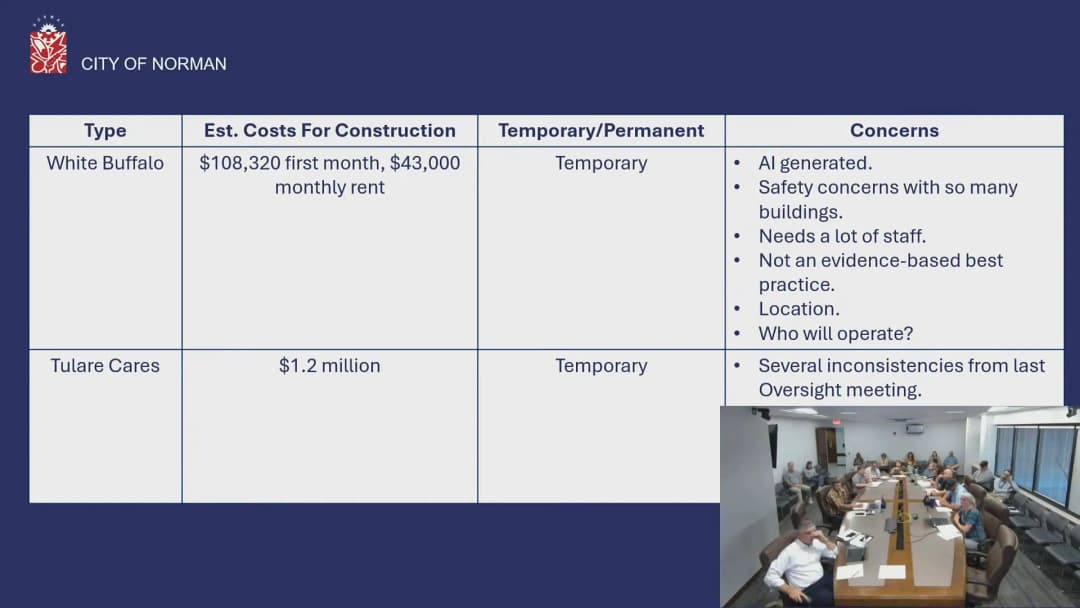
The Norman Animal Welfare Oversight Committee met on October 8, 2026 (transcript timestamp 2026-10-08 22:00:07+00:00) to discuss two main topics: a proposed ordinance restricting the commercial retail sale of cats and dogs in Norman, and alternatives for homeless sheltering. No agenda or minutes were provided with the transcript; this summary is based solely on the raw meeting transcription. No formal votes were recorded, but the committee reached consensus on next steps. Ordinance on Commercial Sale of Cats and Dogs - Kelly Robinson, presenting on behalf of the Animal Welfare Oversight Committee, described a proposed ordinance adding Section 4-511 to prohibit commercial pet stores from selling, offering for sale, displaying, or transferring for consideration any dog or cat obtained directly or indirectly from a commercial breeder. The ordinance defines commercial breeding as breeding dogs or cats and selling, transferring, or providing them to another person or entity for compensation, directly or through a broker, agent, distributor, or third party. - Robinson emphasized that the proposal targets the commercial source of the animal, not whether a breeder has been accused of mistreatment. It would not ban pet stores, breeders, or direct purchases from breeders, and it would allow pet stores to host shelter/rescue adoption events as long as the store does not own the animals or charge a fee for the space. - According to the Oklahoma Department of Agriculture, there are 125 commercial licensed breeders in Oklahoma. Oklahoma's commercial breeder threshold is owning more than 10 female dogs; the number of male dogs is not regulated. Robinson said no Norman pet store currently sells cats or dogs, but a nearby metro store on I-35 and 19th Street was selling puppies kept in aquarium-like cages with shredded paper bedding and bottle water sources, with no nighttime caretaker. The store's website advertised 2,000 puppies placed, 71 puppies in inventory, zero-down payments, terms up to 60 months, financing for bad or no credit, and prices of $5,000-$8,000 per puppy. - Robinson cited Norman Animal Welfare data: 41 French bulldogs entered the shelter in the past 12 months, and 7 were not reclaimed by their owners, many with severe health issues; those dogs were adopted by experienced bulldog owners or transferred to Tornado Alley Bulldogs. - National data cited from Best Friends Animal Society: 4.74 million dogs and cats entered U.S. shelters in 2025, 2.5 million were adopted, 396,000 were euthanized, and the national save rate was 82.5%. About 7 million U.S. households were expected to add a pet; if roughly 1 in 17 of those households chose adoption instead of purchase, about 6%, Best Friends estimated the U.S. could reach no-kill nationwide. Norman maintains a 90%-plus save rate through foster programs, TNR, out-of-state transports, and free spay/neuter for residents. - Robinson warned that lobbyists for Petland and another large retail pet chain (transcribed as 'Petito') had pushed a state bill last year to prohibit municipal ordinances like this one; it passed the House but died in the Senate. If reintroduced in 2027, having a local ordinance already in place could grandfather Norman. - Councilmember Steele expressed support and requested fast-tracking so the ordinance could be in place before the next legislative session to beat possible state preemption. Councilmember Kirby said rescues never breed or profit and expressed 100% support. Councilmember Dixon expressed full support and asked for clarity that commercial breeding follows the State Department of Agriculture definition; Robinson noted the ordinance language was adapted from an active Bend, Oregon ordinance. Councilmember Handisbury noted a quick online search showed about 4-5 breeders in Norman and suggested pulling kennel license data; Robinson agreed to research local kennel licenses and breeders. Councilmember Bruce also supported moving it forward with clarification. There appeared to be consensus to advance the ordinance. Homeless Shelter Alternatives - Amanda Sheriff reported that the current Gray Street shelter operated by CityCare is under construction to meet state fire marshal requirements. Demo and painting are complete, and the remaining work is sprinkler installation, with an estimated completion around November. - ClearSpan: roughly $300,000 for construction, about 9,000 square feet, described as a large tent with no walls, plumbing, bathrooms, showers, or dog kennels; it would need a concrete slab, is temporary, is not evidence-based, and has no identified location or operator. The vendor reportedly told staff it was not what they were looking for. - Sprung structure: roughly $2.2 million, about 8,500 square feet, a permanent membrane-walled building; includes bathrooms and showers outside the main structure, but not laundry or dog kennels; requires a concrete slab; frame rated for 40 years and membrane for 25 years; can be owned or leased and repurposed; weather-rated for Oklahoma; construction estimated around four months. Councilmember Dixon noted this is about $258 per square foot, comparable to a luxury home, and raised funding concerns. Several members viewed it as the closest to an evidence-based shelter because it could include beds, storage, offices, pet kennels, and case-management space. - Homeland locations: about $16 per square foot; the 62,000-square-foot space at Robinson and 24th would be temporary and would require rezoning; the real estate agent did not think the owner would rent for a shelter. - White Buffalo: an AI-generated proposal circulating on Facebook, estimated in the presentation at $108,000 first-month cost and $43,000 monthly rent; temporary; not evidence-based; concerns included staffing every building, security costs, and a militaristic and not trauma-informed design. One council member disputed the cost figures, stating the $108,000 figure they had previously quoted was actually a full two-year rental for eight sleeping containers, two shower containers, and one laundry container, including delivery, cleaning, and pickup. - Tulare, California (transcribed as 'Tulari' in the raw transcript) model: estimated $1.2 million; temporary; not evidence-based. Sheriff said she had unanswered questions after repeated outreach: Tulare's 2025 pit count showed 324 unhoused people, 269 unsheltered, and the encampment numbers did not match; a September 2024 article raised sanitation concerns; and the city said if it could redo the project it would use hard structures or tiny homes. - Sheriff defined evidence-based best practices as including client choice, low barrier access, connection to housing and treatment services, case managers, dignity, and trauma-informed design. She said the Sprung structure fits most closely because it could operate like a regular overnight shelter. - Discussion highlighted three missing prerequisites: land, operator, and budget. Councilmember Steele said land acquisition was the biggest bottleneck and suggested identifying actual locations. Holman asked about state property near the mental health campus; City Attorney Parrington said conversations with the state were ongoing, but staff needed more specific council direction before initiating a land purchase or creating administrative work for the state agency. Councilmember Bruce said scoping and flexing with existing providers and recent federal funding changes should be considered. Sheriff noted a roughly one-year wait list for Section 8 vouchers, with funds released slowly, contributing to visible homelessness, and said winter plans were in the works but not finalized. She also doubted many service providers would be willing to operate most of the alternatives discussed. Key Outcomes - The committee reached consensus to advance the cat and dog retail-sale ordinance to a future full council study session and to consider fast-tracking it before the next legislative session to avoid state preemption. Staff will research kennel licenses and existing breeders in Norman for the study session. - No formal vote was taken on homeless shelter alternatives. The committee agreed the topic remains under study; no land, operator, or budget has been identified, and further council direction is needed before staff contacts state agencies about property.
The Board of Park Commissioners met on October 1, 2026, to address several agenda items including land dedication, annual reports from arts and sports organizations, funding disbursements to cultural centers, and approval of a new pavilion design at Reese Park. The meeting concluded with updates on capital projects and a public comment regarding a historical marker. Consent Calendar - Unanimously approved the minutes of the regular meeting from August 6, 2026. Public Comments & Testimony - Michael Givell, Ward Two, commented on the proposed Fansville Pocket Park, advocating for a historical marker and asking about the process for creating such a marker, including public review and accuracy of historical prose. He noted evidence of a Hooverville from the Great Depression on the site. Discussion Items - Previously Approved Council Items (September 2026): Staff reported on several council-approved items including a built environment grant ($598,000 total, $299,000 per year for two years), annual reports for Firehouse Arts Center, Norman Optimist Club, Westwood Golf Maintenance, and others. Also noted $75,000 for median landscaping near Quick Trip, and $360,000 transferred for emergency repairs after July 4 storms. - Retreat at Norman Edition – Park Land / Fee in Lieu: The development at Highway 9 and 12th Avenue SE proposes 190 units of duplexes and apartments. The developer offers 2.05 acres of private park land (above the required amount) with programming (pickleball, picnic areas, dog park). Staff recommended accepting the private park solution, citing proximity to existing public parks and safety concerns about railroad crossings. The board voted unanimously to accept the recommendation. - Annual Report – Norman Arts Council (NAC): Executive Director Leslie Nottingham presented the NAC’s public art activities. Key points: new public art map at normanarts.org (with voiceovers for accessibility), condition reports on the 20-year-old duck sculptures (five may need retirement), a new interactive art piece “Prairie Signal” for University Town Center (first interactive piece for Norman), mural incentive program, and plans for Gray Street barrier wall murals. The NAC’s public art fund start balance was $53,771.08. Board accepted the report and voted to forward to city council. - Annual Report – Norman Youth Soccer Association (NYSA): Executive Director Brian Judge reported on NYSA’s programs (recreational, academy, competitive, adult, TOPS for special needs) and a record 283 teams at the Celtic Cup tournament (812 room nights). Concerns were raised about a $500,000 drop in competitive revenue from 2025 to 2026 in the budget. Judge attributed it to accounting errors from multiple registration platforms. Board voted to postpone forwarding the report to city council until NYSA provides a written explanation of the discrepancy. - Annual Report – Little Axe Youth Sports: Vice President Brandon Smith presented for the small rural league. Approximately 60 athletes (ages up to 10U) participated in 2025. Field drainage issues and sticker weed problems were noted. Staff offered maintenance assistance. Board voted to forward the report to city council. - Annual Report – Healthy Living Norman: No questions from board; staff recommended forwarding to city council. Approved unanimously. - Funding Disbursements for FY2027: Three cultural centers received funding allocations: Moore Lindsay Historical House ($62,500, including $5,500 carryover), Sooner Theater ($109,286), and Performing Arts Studio/Depot ($61,188, including $5,700 carryover). This is the first year under a new process where city council provides a lump sum to the parks board for distribution. Board approved each separately. - Reese Park Open Air Pavilion Design: Students from OU Gibbs College of Architecture presented the “Wing Pavilion” design – an airfoil-inspired roof with mass timber structure, designed for durability, shade, and community use. The pavilion will be built by students at no cost to the city (city pays for materials, $80,000). Board approved the design and recommended the contract with the university. Key Outcomes - Approved the private park decision for Retreat at Norman Edition (unanimous). - Accepted the Norman Arts Council annual report and forwarded to city council. - Postponed forwarding the Norman Youth Soccer Association annual report pending explanation of budget discrepancy (unanimous). - Accepted and forwarded the Little Axe Youth Sports annual report. - Accepted and forwarded the Healthy Living Norman annual report. - Approved three funding disbursement agreements: Moore Lindsay Historical House ($62,500), Sooner Theater ($109,286), and Performing Arts Studio ($61,188) – all passed separately. - Approved the design of the Reese Park open-air pavilion and recommended the contract with OU Gibbs College of Architecture. Updates & Other Business - Norman Forward Update: Projects ongoing (Bluestem Park, Saxon Park, land acquisition near Canadian River). Last play at Reese Park scheduled for October 11; Kids Space groundbreaking October 14. - Division Updates: Maintenance reported on sticker weed treatment at Little Axe, Dr. Pepper water tower painting (completion mid- to late October), and other capital projects. - Public Comment: Michael Givell’s comments were officially noted.
The City of Norman's Business Committee Affairs meeting convened on Thursday, October 1, 2026, at 4:00 PM. The meeting focused on two main agenda items: updating the ordinance for the Economic Development Advisory Board (EDAB) and discussing potential conflicts of interest among city-appointed board, commission, and committee members who are parties to litigation against the city or its public trusts. City Attorney's Office representative Miss Walker led both discussions. No formal votes were taken; the committee provided direction for staff to prepare revised language for further consideration. Discussion Items 1. Updating the EDAB Ordinance - Miss Walker presented proposed changes to the EDAB ordinance, which were previously discussed in August. Key changes included: increasing the board size from seven to nine members, making appointments ward-specific (with one at-large member from within Norman city limits), maintaining a majority of members with required expertise (originally 4 of 7, proposed 5 of 9), updating ex-officio membership from NEDC to the Cleveland County Economic Development Coalition, updating quorum requirements, and adding duties related to reviewing economic and risk analyses for proposed TIF projects. - A transition plan was outlined to handle existing members and fill vacancies: current members would not be removed but would be replaced with ward-specific appointees as their terms expire. Miss Walker noted that if the ordinance passes by December, new appointments could begin in January. - Councilmember Steele proposed temporarily expanding the board to 11 members to allow appointments from all currently unrepresented wards (1, 2, 5, and 7) while retaining all current members. The board would then revert to nine in August 2027 when current terms expire. Some councilmembers (e.g., Bruce, Gainsburg) expressed concerns about board effectiveness with 11 members, preferring to keep it at nine and fill wards through natural attrition. - Councilmember Bruce argued that the required expertise majority should be raised to 6 or 7 of 9, saying a 5-of-9 majority was too low for the board's responsibilities. He emphasized needing members with senior-level decision-making backgrounds in economics, business, finance, or law. - Councilmember Kirby and Grant suggested broadening the expertise categories to include small business owners, home occupations, and community development experience, not just traditional roles like economists or bankers. - Councilmember Perry supported 7 of 9 for expertise and agreed on broadening qualifications, noting successful businesspeople without college degrees should be eligible. - Councilmember Gainsburg favored keeping the board at nine members for ward representation and supported 7 of 9 expertise to ensure qualified advice on economic development. - Councilmember Steel agreed with 7 of 9 if broadening requirements, but noted that if the board temporarily went to 11, the expertise requirement should also increase proportionally. - On handling unfilled ward seats, some (e.g., Steele, Gainsburg) suggested leaving a seat vacant if no qualified applicant from that ward applies, to allow future applicants from that ward. - Consensus emerged to: (a) increase the required expertise majority to 7 of 9; (b) expand expertise criteria to explicitly include small business owners and other relevant experience; (c) consider both 9- and 11-member options for the board size; and (d) bring revised language back to the October 27 committee meeting. 2. Conflicts of Interest Among Board/Commission Members in Litigation Against the City - Miss Walker provided an overview of current ethics policies, which require recusal for actual pecuniary conflicts but do not specifically address being a party to litigation against the city. She noted that ad hoc committees are exempt from conflict provisions. - Councilmember Bruce expressed concern about the appearance of impropriety when a board member is a plaintiff or attorney in a lawsuit against the city, even if unrelated to the committee's work. He argued that self-reporting of lawsuits should be required, and for related lawsuits, the member should step aside. - Councilmember Steel worried about First Amendment implications of removing someone solely for suing the city, but Miss Walker clarified that appointment is a privilege and that the city could set qualifications without violating rights. - Councilmember Deck suggested a policy where a member voluntarily steps aside during active litigation but retains their seat, returning after the case is resolved. However, concerns were raised about extended vacancies affecting quorum. - Councilmember Grant noted that in unrelated cases, the conflict is less clear, and she would not want to remove a passionate member serving on a different committee (e.g., a plaintiff in the Overhead policy lawsuit serving on a public safety ad hoc committee). She agreed that related conflicts should require recusal or removal. - Councilmember Bruce emphasized that bringing up litigation in a committee meeting without being on the agenda is a violation, regardless of the lawsuit's relevance. - Councilmember Deck proposed adding language that prohibits discussion of any city litigation in committee meetings unless it is agendized or requested from city staff. - Councilmember Steel supported that idea, adding that if a committee member discusses litigation off-agenda, it could be an ethics violation leading to removal by council vote. - The city clerk noted that historically, complaints about committee behavior have been handled internally through discussion; council removal via majority vote (5 of 9) is possible but rarely used. - It was agreed that staff should be reminded and empowered to keep meetings focused on agendized items. Miss Walker will work on ethics policy and ordinance changes to address these issues and return with proposals. Key Outcomes - EDAB Ordinance Update: The committee provided directional consensus to: raise the required expertise majority to 7 of 9 members; expand expertise criteria to include small business owners and other relevant experience; and prepare both 9-member and 11-member transition options for the board size. Staff will bring revised language to the October 27th study session for further discussion before a formal vote. - Conflicts of Interest: The committee directed staff to develop language for ethics policy and ordinance changes that: (a) add a qualification barring service on boards/commissions if a member is party to litigation against the city that directly relates to the committee's duties; (b) prohibit discussion of unagendized city litigation in committee meetings; and (c) clarify process for removal or recusal. Staff will bring proposals back for consideration. - A reminder was issued to empower committee chairs and city staff to maintain order and relevance in meetings, with the city clerk’s office to coordinate training and handle any complaints.