Norman City Council Oversight Committee Meeting on August 13, 2026
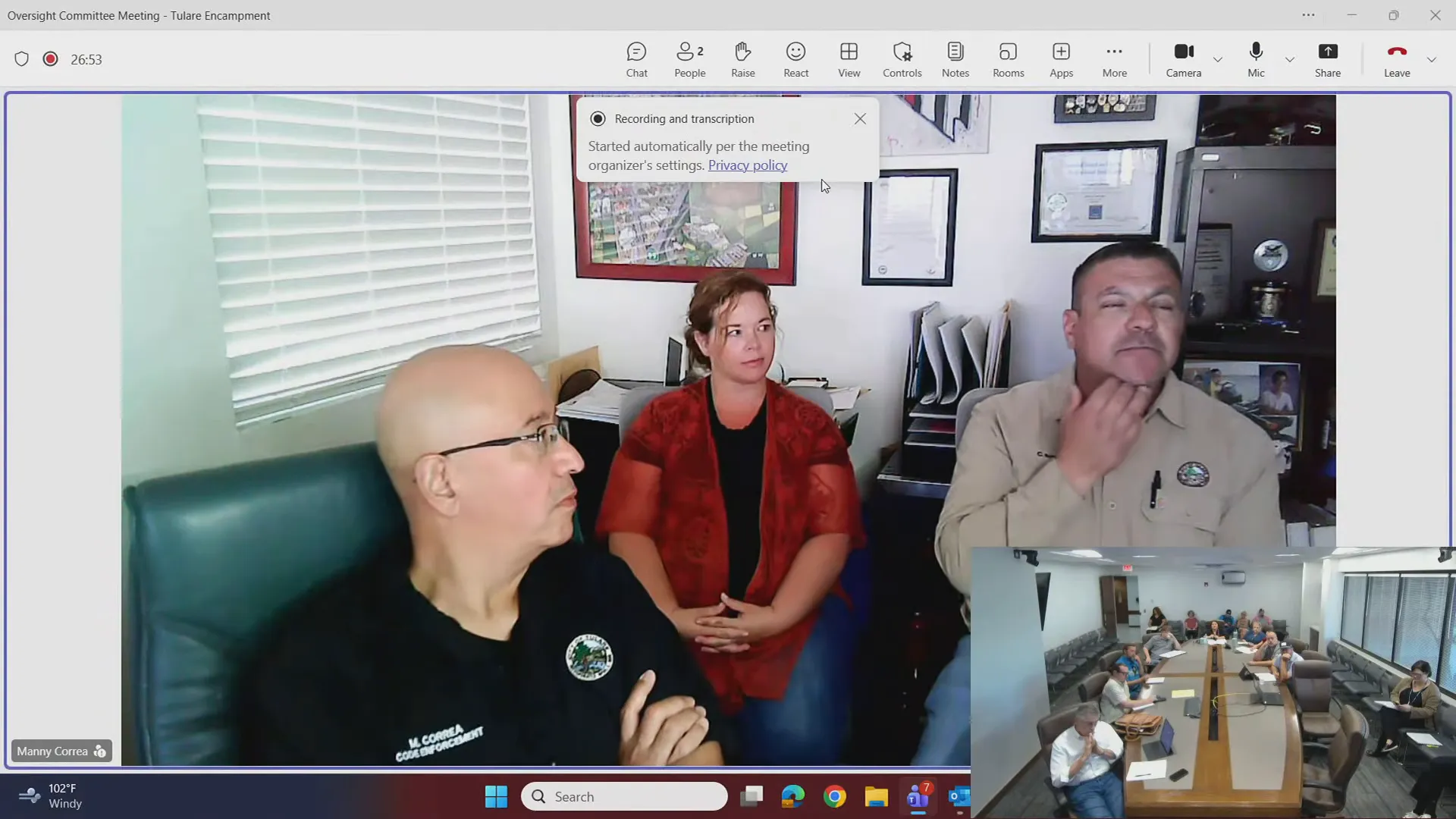
STREAMING COPY IN PREPARATION — RECORDING AVAILABLE FROM THE ORIGINAL SOURCE
Norman City Council Oversight Committee Meeting – August 13, 2026
The City Council Oversight Committee met to discuss three items: a presentation on the homeless response program from the City of Tulary, California; a proposed immigration resolution; and a potential charter amendment requiring a supermajority vote for future tax increment finance (TIF) proposals. No votes were taken on any agenda item.
Discussion: Tulary Care's Homeless Response
- Presenters: Tiffany (Administrative Assistant), Carlos (Community Maintenance Manager), and Manny Correa (General Services Director) from the City of Tulary, California.
- The city opened a temporary encampment on two acres of purchased land in 2021 after receiving numerous complaints about homeless encampments. The site can accommodate up to 220 guests; current occupancy is 77.
- Funding: A $1.5 million grant (mostly post-COVID funds) covered land, tents, picnic tables, grills, etc. Ongoing operations (approx. $700,000–$800,000 per year) now come from general funds.
- Cost Reductions: By replacing a towed shower trailer with an on‑site unit, costs dropped from $31,000/month to $6,000/month. Switching to a single roll‑off trash bin saved $4,000/month. Security was changed to a more effective company, and in‑house staff replaced outside cleaning crews.
- Rules and Enforcement: Guests sign a 14‑page liability agreement. A 5 p.m. visitor curfew reduced gang violence. Temporary exclusion (90‑180 days) and a probation system (allowing second chances) are used. Background checks for sex offenders and violent crimes are performed; those with such records are not accepted at the permanent shelter.
- Permanent Shelter: A new indoor shelter (operated by Lighthouse Rescue Mission) will open soon, with a proposed budget of $3.5 million (currently under budget due to delays). It will have 16 units for families. The county will hold 25% of beds for county residents. A new “public camping” ordinance will prohibit camping in any public area once the shelter opens.
- Residency: To use the city’s shelter, individuals must have been residents of Tulary for at least two years. Non‑residents may access county‑reserved beds or be sent to other resources and are given two weeks to decide before being subject to the camping ban.
- Community Relations: Presenters emphasized the importance of building trust and offering water, cooling towels, etc. Volunteers (14 of the 77 guests) help with chores. The team noted that 80% of probationary placements succeed.
Discussion: Immigration Resolution
- Presenter: Rick (City Attorney) presented proposed changes to a draft resolution originally submitted by Councilmember Grant.
- The resolution aims to provide information to immigrant residents about resources, civil rights, and city policies regarding immigration enforcement.
- Key Points of Discussion:
- Concern about using the term “immigrant civil rights” because it is not a discrete body of law; the proposed revision instead directs residents to local immigration attorneys.
- The Human Rights Commission lacks subpoena power and cannot force private individuals to comply; complaints may be better directed to federal agencies (e.g., EEOC).
- Reporting ICE activity: The original draft called for the city to publish verified ICE enforcement activity. Councilmembers debated the difficulty of verifying such activity and the risk of spreading misinformation. A revised version (Option 5) limits reporting to correcting inaccurate information about the Norman Police Department’s involvement in federal immigration enforcement.
- Councilmember Bruce expressed concern that the resolution could be seen as “aiding and abetting” illegal immigration, but others argued the purpose is to ensure all residents, regardless of status, feel safe reporting crimes.
- Outcome: No decision was reached. Some members requested consulting the state Attorney General’s office; others opposed that step. The matter will be brought back after further review.
Discussion: Supermajority Vote for Future Tax Increment Finance (TIF) Proposals
- Presenter: Catherine Walker (City Attorney’s Office) reviewed options for requiring a supermajority vote (6 of 9 members) to approve TIF ordinances.
- Background: The city charter currently requires a simple majority. A 1966 Norman case allows charter amendments to require higher votes for zoning, but state law (Local Development Act) explicitly requires only a majority for TIF approvals. A charter amendment would likely be challenged as a matter of statewide concern.
- Options Presented:
- Require six votes for any ordinance creating a TIF that apportions more than a certain percentage of city sales tax.
- Empower the council to enact ordinances imposing a supermajority (similar to the planning commission model).
- Council Views:
- Councilmember Dixon opposed supermajorities in general, arguing they diminish representation.
- Councilmember Steele preferred requiring six votes for all ordinances to encourage consensus.
- Councilmember Bruce noted that the UNP TIF (60% sales tax diversion) passed 5‑4; a supermajority rule would have killed it.
- Outcome: The item was tabled due to time constraints and the absence of two members. The committee will revisit after gathering additional information.
Meeting Transcript
Yes. Welcome to the city council oversight committee meeting for August 13th. First item on our agenda is a discussion regarding Tulary Care's homeless response. And we're gonna let our guests introduce themselves and tell them our tell us about their program and then we'll do some QA. So welcome. Perfect, thank you. Go ahead and start. Hi, my name is Tiffany, and I am the administrative assistant for our general services department here in Telere, and I assist with um the Telera Care's Consampment. Hi my name is Carlos. I'm the community maintenance manager here for the city of Slory. My name is Manny Correa, I'm the general services director for City of Teleri. We're gonna be in charge of uh overseeing the shelter, and we've been doing the temporary encampment for two years already. Oh like two years we took over. So um can you describe the process of how your city was it your city council that directed you all uh to open an encampment? Uh let me turn this off. There you go. Uh what happened is back in 2000, 2000 uh 2021. I think it was something like that. We start getting more complaints from the from all the neighbors about homeless encampments all over the city. Uh not only residential but commercial buildings, all the stuff. So uh the first thing I did uh being kind of in charge of the homeless outside was to ask the city manager if we can use one of the parks to concentrate all that community in one place and see how it goes. And uh that's what we start doing every time that we found people around the railroad or any place, and especially we were having a couple deaths around the railroad, we want to remove everybody from around the railroad to prevent that. So we start using a park that's called Centennial Park, and we start putting everybody at that location. I understand it's a park, they're gonna destroy the grass and everything, but it will reduce the complaints from the citizens. At the same time, because we were in um COVID with Carlos, we decided to bring portal parties and and uh hand washing stations and trash bins for the trash and everything to reduce contact and to reduce uh to try to be cleaner, right? So as soon as we they saw the success of having everybody in one location, that's when they started thinking what can we do to build a place where everybody can be there, it can be controlled by the city, and we can get everybody out of the street. So that's when uh city council asked the city manager to come with an idea. So we went all over the city looking the best location. We don't want close to schools, we don't want close to uh residence, uh residential places. So we found a place that is around some commercial area. So we went out and talked to all the neighbors, and I'll say 80% they were with it because we promised that we were gonna be available to respond. So that's when the city decided to buy two acres of land. And the city uh manager turned around and says, Manny, Carlos, let's build it. Hey, we never built uh uh something like that in the past. So between everybody in the city engineering, planning, everybody got together, and we got two acres, we do did the markings, we put the size of the tents, we organized everything. We put a fire pit, so they have a fire pit within the distance from the tent to comply with the NFPA and everything, the fire codes. And built the subfloors for the tents. We build uh uh Carlos built soft floors for the uh big uh uh pallets. It's they're what 10 by 10? Eight and a half by eight and a half. Eight and a half by eight and a half, so the tents don't go directly in the ground, it will go into the pallets, and there was plywood in the top, and it was uh they painted with a special paint to prevent uh moisture and all the stuff. Uh so we set it up for about 220 guests of the encampment, that's how we call them the guest. And so far, right now at this date, we have 82. We have 77. Oh my goodness, 77. 77 guests and the encampment. Okay. Um, how did you get your funding? What is this cost? Um what are some things you've learned about how to reduce costs?
openpublica.com