Novato City Council Receives Pavement Management Update on July 9, 2024
STREAMING COPY IN PREPARATION — RECORDING AVAILABLE FROM THE ORIGINAL SOURCE
Novato City Council Receives Pavement Management Update on July 9, 2024
The Novato City Council received a presentation on the status of the city's roadway pavement condition, including a detailed analysis of the Pavement Condition Index (PCI), funding scenarios, and the financial implications of maintaining or improving the network. The update was provided by Public Works Director Nick Nguyen and consultant Margot Yapp of NCE Consulting, who highlighted the asset value, current condition, and future needs of the city's 152.3 centerline miles (327 lane miles) of roads, valued at approximately $277 million.
Discussion Items
- Current Pavement Condition: The city's overall PCI is 66 (on a 0–100 scale), with 40% of roads in good condition, 49.7% fair, 10.7% poor, and 1.4% failed. The statewide average PCI is 65, placing Novato in the middle among comparable Marin County cities.
- Historical Trend: Novato's PCI has declined from 72 about 13 years ago to 66 today, with a slow, gentle deterioration now approaching a critical threshold where pavement failure accelerates and repair costs multiply.
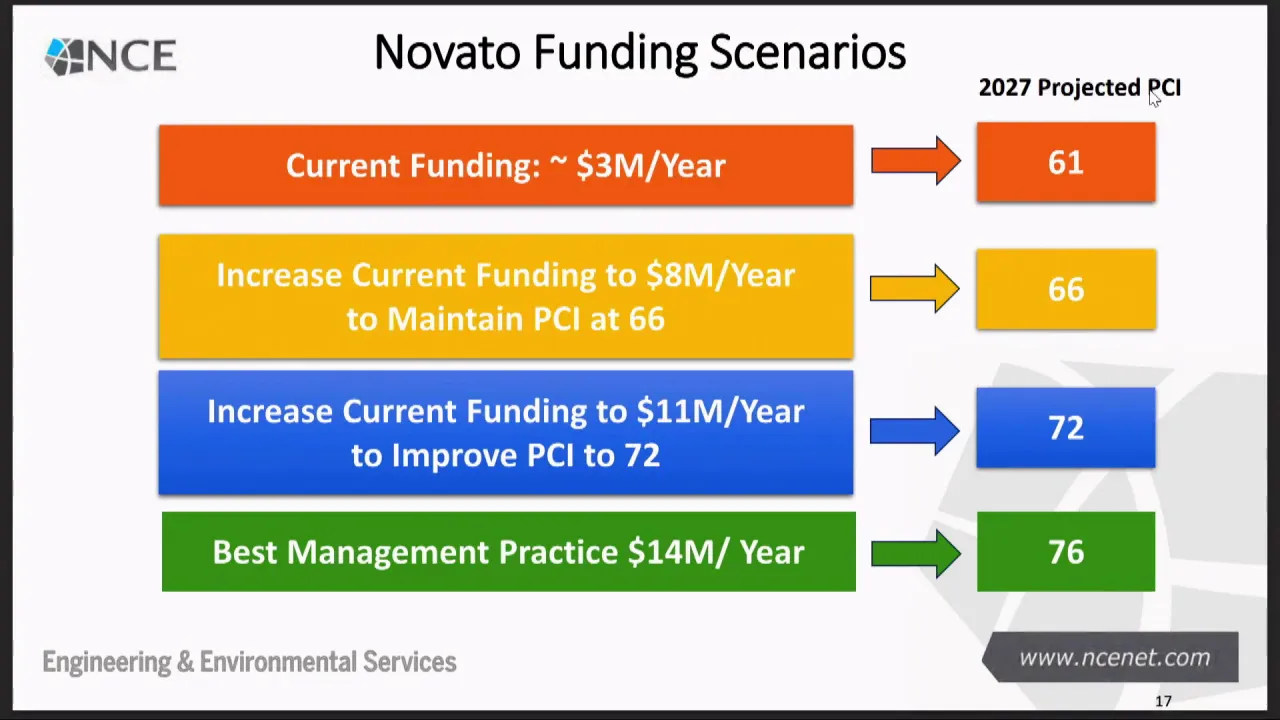
- Funding Scenarios: Four scenarios were presented based on annual funding levels:
- $3 million/year (current): PCI projected to drop to 61 by 2027; deferred maintenance (unfunded backlog) to rise from $47.1 million to $61 million.
- $8 million/year: Stabilizes PCI at 66; deferred maintenance remains around $42 million.
- $11 million/year: Improves PCI to 72, reducing deferred maintenance to about $20 million.
- $14 million/year (best management practice): Raises PCI to 76, cutting deferred maintenance to $3.4 million.
- Preventive Maintenance Emphasis: Consultant Margot Yapp stressed the importance of preserving good roads with lower-cost treatments (e.g., microsurfacing at $10.50/square yard) rather than allowing roads to deteriorate to costly reconstruction ($120/square yard), drawing an analogy to regular car maintenance.
- Funding Sources: Potential funding streams include federal (RSTP, IIJA), state (gas tax, CalRecycle grants), and local sources (general funds, parcel taxes, sales tax measures, impact fees).
Key Outcomes
- The City Council received the report as informational; no formal action or vote was taken. Staff and the consultant were available for questions, and the data will inform future budget and policy decisions regarding pavement management.
Meeting Transcript
With that, we're going to move to our general business, item J1, receiving a report on the status of the city's roadway pavement condition, or also known as PCI. The staff report. I'm sorry, I'm going to call on our public works director, Nick Nguyen to open the item. Welcome again, Nick. Thank you, Mr. Mayor. Good evening. Mr. Mayor and Council members. It is our privilege tonight to provide an update on the general health of the city's pavement network. The City of Novato is responsible for maintaining approximately 320 lane miles of road. For perspective, just imagine for a moment. This is equivalent to a one-lane highway stretching from here to past the city of Santa Barbara. It takes the proverbial village to manage this pavement network, from the actions taken by this exteem council to residents such as members of the Complete Streets and Pathway Oversight Committee, and to the city staff and contractors who help craft capital maintenance solutions. It also requires a significant amount of funding, technology and regional support. Our funding comes from a limited and constrained source, which is the state gas tax. This restricted revenue is projected to be relatively flat in the future, if not declining due to new vehicle efficiency mandates. One of the bright spots in this narrative is the narrat is the technology and regional support we receive from the Transportation Authority, Marin, also known as TAM, and the Metropolitan Transportation Commission, also known as MTC, who provide us with additional funding opportunities. MTC also provides the city with a key management tool, a pavement management program called Street Saver. Not only does is the use of a pavement management decision support program best practice, it is also mandatory if the city is to access federal funds. For these reasons, the city has utilized a pavement management program for many years to catalog our road inventory and condition, forecast budgets, and establish our preliminary five-year annual street rehabilitation list. Our pavement management program is updated every two years. We last updated the program in 2023, and the consultant who helped with the update is here tonight to present the results of the findings. From NCE consulting, we have Margot Yap. We are fortunate to have Marg on our team, as she is a legend, uh not to overstate in the pavement engineering industry and has been at the forefront of pavement management for over 20 years. At the conclusion of our consultant's presentation, our associate engineer Ghoshra Woodfin and I, as well as Margot, our and her team, um will be available for any question. With that, I would like to turn it over to Margot to present the update. Welcome. Good evening, Mayor Mayor and Council members. So as Nick said I'm here to talk a little bit about the city streets, and I like to think of it as a kind of a state of the streets uh summary for um or for all of you. So let me just get the clicker. So the as um Nick mentioned, you know, you've got a pretty substantial street network here. Um this is about 152 center line miles, a little bit over 327 lane miles, and these are all numbers, but I don't want you to focus on those numbers. What I want you to focus on is this last item down here on the slide, which is what is the value of the street network that you have. It conservatively is about 277 million dollars today. And that's quite a large um chunk for you know a city of the size of Novato. So the point of my presentation here really is to talk about the value of a publicly owned asset and what we need to do to maintain it and to keep it in good shape. And so I'm gonna present you with lots of numbers tonight. Um, hopefully to uh help inform you in any uh policy decisions that you're gonna be making. So to do a quick comparison in benchmark um Novato with some of the other cities in Marin, you can see that in general, um, you know, we have about 2.9 miles per per per person or per capita in in Marin, uh excuse me, in Novado, and it ranges, it's pretty much in the average. I think sentence almost a little bit higher, but by and large, it's sort of um uh e more or less the same as some of the other cities. And when let's keep those numbers in mind, and then let's go to something called the PCI. And this is the pavement condition index. And very simply, it's a scale from zero to a hundred, with a hundred being best roads and zero being the worst or failed street. And where Novato fails on average, is it's at 66. And then this number 66 is good and bad news, right? The good part of it is if you look at the pie chart on the right hand side, um, about 40% of your roads are in pretty good shape. That's really good news. About half are in fair shape. And the not so good news is you've got about 12% that's poor or failed.
openpublica.com