OPENPUBLICA · PUBLIC MEETING RECORD
Record of Proceedings
Olympia PBIA Advisory Group Recap and Planning — November 3, 2026
City Council & Commissions — Tuesday, November 3, 2026
BodyOlympia, Washington
SessionCity Council & Commissions
DateTuesday, November 3, 2026
StatusNEW · FILED
Video Record
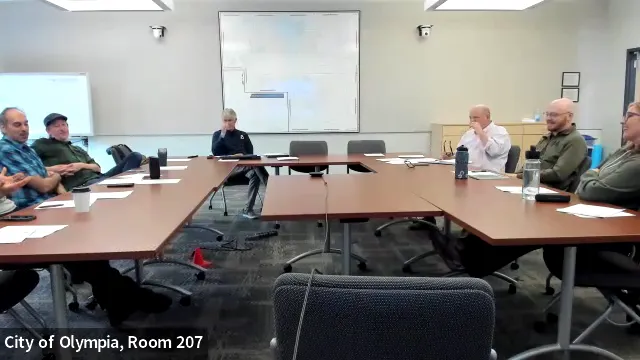
STREAMING COPY IN PREPARATION — RECORDING AVAILABLE FROM THE ORIGINAL SOURCE
Transcript — Verbatim
Speaker numbers apply only to this recording.
Discussion Breakdown — Share of Meeting
Community Engagement29%
Downtown Revitalization27%
Public Engagement16%
Economic Development11%
Parking Management8%
Public Safety6%
Public Transportation3%
Summary of Proceedings
Olympia PBIA Advisory Group Recap and Planning — November 3, 2026
The Olympia parking/business improvement area advisory group met at 19:30 UTC on November 3, 2026. No agenda or minutes were available, so this summary is based on the raw transcript. The discussion centered on debriefing the first advisory/leadership meeting, reviewing phase-one consultant findings, and planning next steps toward a written recommendation by the end of calendar year 2026.
Discussion Items
- Staff recapped the initial advisory/leadership meeting, including summary notes, the core group of participants, and a few people who may join later. Jenica had presented phase-one consultant work and recommendations; Desiree gave a primer distinguishing the PBIA from the ODA, Chamber of Commerce, and related entities. Staff planned to use the Friday meeting to review best practices and how other communities use PBIA-type dollars.
- Residential assessments drew challenging comments from two or three participants, especially the phase-one consultant recommendation to assess rental properties. Staff said nothing was set in stone and that the concerns were aimed at that recommendation, if not necessarily the concept of assessing rental or residential properties. Urban Olympia pushback included sticker shock and the comment that owners should not be punished for being successful. A phase-one figure of $100 per unit was discussed, with the expectation that landlords could pass an assessment through to tenants. Staff and board members said the program needs to be framed as a value and a clear line drawn from fees to services.
- Parking and transit generated substantial energy: customer and commuter throughput, employees feeding meters, and possible parking benefits for downtown employees. A parking garage was described as outside the program’s guardrails and funding capacity, costing roughly the whole budget times 10. Smaller parking benefits were considered potentially feasible. One participant said the Diamond Parking lot is city-owned; another said they believed it is private, and the transcript does not resolve the discrepancy.
- Participants were open to re-evaluating the PBIA map and zones but did not show a burning priority to do so. Staff noted that shifting the physical footprint would likely introduce the most complexity. The transcript references three overlapping zones with some unique areas.
- Questions arose about who is covered by the ratepayer framework, including nonprofits and public entities. The transit agency, referred to in the transcript as inner city transit, was described as a significant downtown presence but not a participant or ratepayer; concerns included idling, wear and tear, and trash near bus stops. Participants suggested considering these impacts in clean-and-safe operations.
- Empty buildings and downtown vacancy were raised as a related issue. Staff connected the conversation to the city’s downtown vacancy study and said there should be closer attention to the perception that some owners benefit more from leaving space empty than renting it.
- Communication and clarity were repeated themes: the business community must clearly understand what it gets for its fees, and the program should avoid alphabet-soup confusion. Staff noted that annual reflection meetings had not been held for a few years and could return after restructuring. A targeted resident information packet and quantifiable “were it not for the PBIA” examples were suggested. Marketing and communications capacity is limited, and former subcommittees no longer exist largely because of city staffing constraints.
- The clean team was discussed as a service to restore or expand rather than radically transform. Staff said the city now covers clean team costs entirely, whereas the PBIA previously contributed about 40% of its budget to clean team and ambassadors. A dedicated downtown clean team expansion was framed as a possible added value. Bathroom infrastructure came up but was cautioned as expensive. Safety was noted through alleyway lights and possible cameras.
- The history of the Downtown Improvement District was reviewed: an ODA consultant proposed a DID, which would have required signatures from 60% of downtown property owners and would have replaced the PBIA. It failed to reach the threshold, with reported pushback from some residential property owners.
- A possible name change was discussed. Because parking is the first word in the PBIA name, participants suggested that if the final recommendation does not substantially address parking, the board could recommend a name change to avoid raising expectations. Staff said a name change would likely require City Council action rather than a public vote.
- Internships and outreach were discussed. The contract has some budget for interns, a job description has been drafted, and contacts exist at Evergreen and St. Martin’s, including a St. Martin’s pool of four people. The board was comfortable with student interns receiving a stipend and supporting business outreach and open houses. Desiree and the ODA are expected to lead marketing and communications.
- Staff outlined next steps: a Friday meeting on best-practice research, open-house events in the next month, and an order of operations for the next few meetings. Staff wants a written final recommendation before the end of 2026, even though the city contract runs into the first quarter of 2027. November was described as the key working month because December holidays will pull attention.
Key Outcomes
- No formal motions or votes appear in the transcript. The group generally agreed to continue the process and use the Friday meeting to focus on best practices and comparative PBIA models.
- Staff was directed in discussion to structure the next meetings toward a written recommendation, develop alternative scenarios, and consider issues including nonprofit inclusion, ratepayer framework, possible name change if parking is not substantively addressed, and clearer communication of benefits.
- The board supported using student interns for outreach, subject to a stipend and quality assurance, and supported planning open-house events.
- Jenica was asked to email the board a link to the archived recording so members who missed the conversation could catch up.
- No decision was made on residential or rental assessments; staff emphasized that the phase-one recommendation remains open for alternative approaches.
Meeting Transcript
Did a copy of the sort of summary notes from that initial discussion. It includes a list of all the folks who showed up from our solicitations out to the community. Had a couple people that um said they wanted to show and weren't able to show in our sort of maybes for the next one. Um so we may have some more people down the line as well, but I think this is probably the core group we're looking at going forward. Um we had a really strong discussion. Uh it was interesting. There was a bit of sort of getting folks up to speed on phase one work and what the consultant had done in the past. Um I think you know, the notes summarize sort of the broad strokes of where most of the meetings energy and discussion was. So if you guys all think it's a good use of time, will you just go through those real quick and kind of just recap a little bit, and then I might ask Jacob to maybe provide some thoughts since he was at the meeting as well. Um some things that you know were sort of actions for us to take away from some things that we want to provide at the meeting that's gonna happen at the end of this week on Friday, um, with some follow-up about best practices and what other communities are choosing to do with their PDIA dollars, right? Sort of get a sense of um, you know, are there services or benefits or resources that are being provided that would be useful in downtown Olympia that maybe we haven't considered yet. Um, since this is an opportunity to sort of reflect on the program, it's a good idea to maybe go see you know what other folks are doing successfully if we're adopting those changes. Uh just uh we have uh brought in a consultant like previously who did really in-depth you know, studies and was uh uh person who actually basically started the idea of BIA. Uh he gave us a lot of information, so that is available, I'm assuming to you guys as well too. Yeah, I can tell you how like what's the L junction, other smaller markets that they compared us to. So all of that exists as like services and things. Yeah, so Jenica gave a gave a good presentation about phase one at the beginning of the previous meeting, and you know, went over some of the ideas that the previous consultants are phase one or immediately. Uh, we paid somebody a lot of money to come in and uh help us for those. And there's that information does exist, and it's really thoroughly helpful to see how other areas have spent their money. Yeah, but I just want to make sure we're gonna inform because if not, we'll go ahead and grab it. So yeah. And I think Jenica did touch a little bit on it and then on the recommendations that the consultant built out of that survey as well. So I think one of the things that I I got away from that was I just kind of walked into that meeting is kind of a so mean, probably incorrectly. That a lot of people were very well versed about the PBIA. And I asked so I think about halfway through it. I finally asked Desiree, hey, could you just give a primer on the differences between the PBIA, the ODA, the Chamber of Commerce, etc.? She did a really good job with that. I think that helped level set and got into the notion of kind of best practices. So I think this group has a pretty good understanding, and maybe you have a different opinion, but I think you have a good good understanding why we're there. What are the resources, what are the tools? But one of the things they came up was okay. Let's look at best practices. So I think we'll spend some time on that on Friday. Because that group needs to be up to speed as well. Yeah. Yeah. So you know, a lot of this these discussions have been sort of bringing these folks in and getting them involved and getting them up to speed on existing work as well. So that was that was very helpful of Jenica to spend a bunch of time with that. And there's more to discuss.
SUMMARIZED BY OPENPUBLICA AI
TRANSCRIPT VIA PUBLIC VIDEO
openpublica.com
openpublica.com