Note: The meeting transcript indicates October 19, 2026, but the provided meeting date is October 26, 2026. This summary uses the given date. The Olympia Planning Commission met to conduct regular business, including approval of the agenda and prior minutes, a public hearing on parking code amendments, and a briefing on the Urban Forest Management Plan. Key actions included a vote to recommend revisions to minimum parking requirements. Commissioners also heard public testimony and staff announcements. Consent Calendar - Approval of Agenda: Moved by Jason, seconded by Daniel Garcia. All aye; no abstentions. Approved as submitted. - Approval of Minutes (October 5, 2026): Moved by Raphael Garcia, seconded by L. Commissioner Greg abstained; all other commissioners aye. Approved. Public Comments & Testimony - Judy Bardin (Resident): Expressed concerns over upcoming neighborhood-scale commercial amendments. She requested expanded definitions for operating hours, clarification on public nuisance evaluations, and addressed potential disruptive impacts from outdoor alcohol consumption, deliveries, and off-hour operations. Bardin urged the commission to further flesh out these items. Staff Announcements - Casey (Staff): Provided a heads-up that a council subcommittee proposal to sunset advisory committees (including the Bicycle Pedestrian Advisory Committee) may shift additional workload to the Planning Commission. Staff will keep the commission apprised of any changes. Discussion Items Parking Code Amendments (Public Hearing) - Casey Shoffler, Associate Long Range Planner: Presented proposed amendments to Olympia Municipal Code Chapter 18.38 (Parking and Loading) to comply with the state's Parking Reform and Modernization Act (PRMA). The amendments eliminate all vehicle parking minimums citywide, consolidate parking typologies into four categories, and update bicycle parking requirements. Staff also proposed three specific revisions: 1. Change the bicycle parking requirement language to "up to a total of 12 required spaces." 2. Exempt bicycle parking for change of use in existing commercial spaces under 3,000 square feet in the downtown exempt area. 3. Limit the parking maximum exemption to multi-story parking structures only. - Commission Discussion: Commissioners debated parking structure definitions, maximum allowances, and bicycle parking thresholds. Vice Chair Garcia argued that the 12-space maximum for commercial bicycle parking was arbitrary and should be removed. Commissioner Garcia (Raphael) raised questions about shared parking agreements and their continued applicability. Commissioner Ibrahimovich (Zaynab) inquired about the feasibility of using on-street bike racks to meet requirements. Ultimately, the commission agreed to: - Remove the 12-space bicycle parking maximum (voice vote: one opposed, all others in favor). - Include staff's Downtown exemption recommendation (voice vote: unanimous). - Include staff's multi-story structure limitation (voice vote: unanimous). - Motion: Moved by L, seconded by Daniel Garcia, to recommend city council approval of the proposed amendments with the revisions as discussed. All aye. Approved. Urban Forest Management Plan (Briefing) - Kim Foley (Environmental Planner) and Leanne Wells (Urban Forester): Presented an overview of the upcoming Urban Forest Management Plan. The plan will address tree-protection code updates, equitable distribution of tree canopy, and integration with stormwater management, housing, and climate goals. Staff highlighted the city's current 42% tree canopy cover (measured in 2023), the need for strategic rather than uniform tree preservation, and a community engagement process starting with story maps, focus groups, and workshops. No action was taken; the briefing served to inform the commission ahead of future decision points. Key Outcomes - Parking Code Amendments: The planning commission voted to recommend approval of the parking code amendments to city council with three revisions: (1) removal of the 12-space maximum for bicycle parking for commercial uses; (2) exemption from bicycle parking requirements for change of use in existing commercial spaces under 3,000 square feet in the downtown exempt area; and (3) limitation of parking maximum exemptions to multi-story parking structures only. The recommendation will be forwarded to the Land Use and Environment Committee and then to city council, with a state deadline of January 27, 2027. - Urban Forest Management Plan: No decisions were made. The plan remains in the early development stage, with public engagement set to begin in earnest and draft recommendations expected in approximately one year. - Next Meeting: The next regular meeting is scheduled for November 2, 2026. The meeting adjourned at 8:50 p.m.
Public Meetings - Olympia, Washington
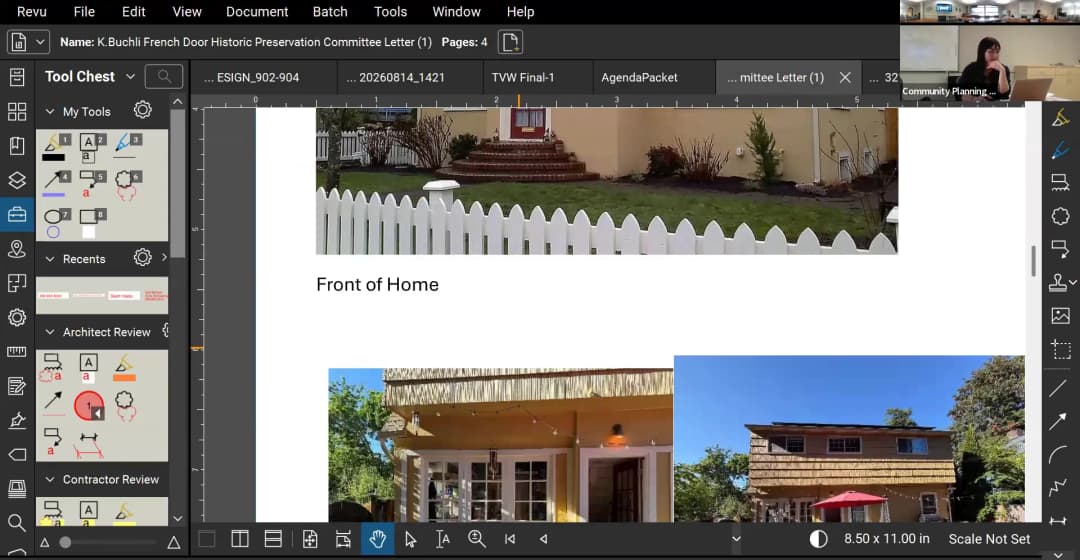
Public Meetings - Olympia, WashingtonThe Olympia Heritage Commission met from 5:39 p.m. to 6:41 p.m. on the recorded meeting date of 2026-10-26. Although the transcript repeatedly calls this the September Heritage Commission meeting, no agenda or minutes were available to confirm the discrepancy. Commissioners Cotter, Bowman, Patrick, Kimball, and Becker were present; Stedman was excused and Nace was absent. Consent Calendar - Commissioners approved the meeting agenda by consensus on a motion. - Commissioners approved the previous month's meeting minutes by consensus on a motion. Public Comments & Testimony - No public comment was offered and no members of the public appeared on the attendee list. Announcements - Staff announced that the city did not receive its Certified Local Government (CLG) grant; there were many applicants and higher-priority projects were selected, so the commission plans to try again. Commissioners thanked staff for the application work. - A commissioner announced a podcast recording, 'Info at the Archives,' at Nicole's bar the next day from 5:30 to 7 p.m. on the history of the state capitol building. - Staff noted a preservation roundtable in Portland on October 10 focused on preserving historic African American churches, including a free church tour, discussion, and lunch from 8:30 a.m. to 2 p.m. Discussion Items: Event Recaps and Upcoming Events - Harbor Days: Commissioners described a successful booth with an activity for community members to write memories of the Sandman and place them in bottles. A large sign showed where Sandman pieces will be located. The booth was busy, especially Saturday, and attendees were engaged. Staff reported the Port has moved the Sandman to the next deconstruction phase, and a council resolution to delist it is scheduled for mid-November as a consent item. - Thurston County Heritage Day: Not recapped; a commissioner said Stephanie may share details at the next meeting. - South Capitol Barbecue: A commissioner attended in a library capacity and spoke with neighborhood residents Jerry and Sue; many were still surprised at the cost of a survey, so the effort is a slow process. No commission display materials were seen. - Pacific Northwest Field School: One commissioner attended the week-long field school at Ginkgo Petrified Forest State Park with 9 to 11 participants. Work included restoring garage doors, masonry, and wood windows, along with evening lectures and a field trip to a tribal museum and Wanapum Dam. The commissioner praised the experience and offered to share photos and more details. - Artswalk: The commission has Friday coverage but urgently needs Saturday volunteers. The planned activity will gather material for a historic preservation zine, using prompts about what makes Olympia distinct, surveys, and crowdsourced drawings. The sign-up will be resent with a deadline. - Trivia: Trivia is postponed for now because of scheduling changes; it may be revived in winter. Discussion Items: Committee Reassignments - Commissioners discussed filling gaps, especially the Heritage Review Committee because site visits usually happen Monday around noon and take about 15 minutes. Staff will send a committee list and more practical descriptions of time commitments. - Commissioner Kyle volunteered to join the MORE committee to broaden participation. - Commissioner Melissa proposed trying committees to find a good fit and announced she will be away for five weeks starting Monday, through November 1, missing the next meeting. Commissioner Michael offered to help with design review in her absence. Reports - Design Review - French door project: At the individually listed Vance House, the rear facade's existing wood windows were not original and were being replaced with fiberglass French doors. Approval included a condition to stucco the infill to match the house. Commissioners noted no one can see the rear facade from the street. - Design Review - Evergreen Inn: The applicant formally filed for tax valuation and heritage register listing. The building was completed in 1971 in the Pacific Northwest regional style, has 196 rooms, and is being converted to housing with a proposed rehabilitation budget of about $15 million. The project is also going through state review, and staff will verify qualified rehabilitation expenditures. A quick turnaround is needed before the end of the year. - POG committee: Staff has not yet checked in with the South Capitol Neighborhood Association but plans to discuss next steps and possible phasing. Key Outcomes - Agenda and minutes approved by consensus. - CLG grant denial was accepted; the commission will apply again in the future. - The Sandman delisting resolution is expected before council in mid-November as a consent item. - Staff will resend the Artswalk volunteer sign-up with a deadline and will distribute committee descriptions and membership lists. - More volunteers are needed for the Heritage Review Committee; Kyle was added to the MORE committee. - Michael offered to cover design review while Melissa is away. - The meeting adjourned at 6:41 p.m.
The Olympia City Council Land Use and Environment Committee met on October 26, 2026, chaired by Robert Vanderbilt. The committee discussed and took action on the Critical Areas Ordinance periodic update, received updates on the Urban Forest Management Plan and tree protection measures, and heard staff reports on the annual comprehensive plan amendment process, short-term rental enforcement, and the West Bay Yards project. Consent Calendar - The committee unanimously approved the agenda and the minutes from September 19, 2026. Public Comments & Testimony - No members of the public signed up to provide comment. Critical Areas Ordinance Periodic Update - Planning Manager Kernan Lean presented the proposed updates, which include clarifications, wetland buffer modifications based on best available science, stream buffer adjustments, a new provision for functionally disconnected buffers, consolidation of geologically hazardous area review to administrative review, and updates to underground injection control requirements. The committee discussed the public impact, alignment with comprehensive plan values, and technical details. The committee moved to forward the recommendation to the city council (motion by Councilmember Gilman, seconded by Councilmember Vanderpool; all in favor). The item will be a consent item on the November 17 Planning Commission agenda. Urban Forest Management Plan - Environmental Planner Kim Foley updated the committee on the project timeline and public participation plan. The plan is on track for completion by March 2028. Key components include an interactive tree canopy story map and focus groups starting in January 2027. The committee discussed the need to balance tree preservation with development goals and to coordinate with upcoming code amendments. Councilmembers expressed support for the process and emphasized prioritizing mature trees. Tree Protection Measure - Community Development Director Tim Smith presented a director interpretation that provides guidance to staff to prioritize preservation of trees with a diameter of 36 inches or greater during early project design. The interpretation also mandates an urban forestry scoping meeting for certain projects. The committee discussed the rationale for the 36-inch threshold and the importance of early collaboration with applicants. The committee expressed support for the approach. Staff Reports and Updates - Annual Comprehensive Plan Amendment Process: Director Smith announced plans to bring a consent item to the city council to set a submittal deadline for 2028 amendments and to consider codifying an annual date. A committee member requested that the staff report include the committee's request to set the date into code moving forward. - Short-Term Rental Enforcement: Staff completed an audit of short-term rental enforcement. Challenges include difficulty tracking unpermitted rentals, confidentiality of tax data, and limited code enforcement resources (two officers for the city). Staff recommend continuing complaint-driven enforcement and outreach to listing platforms, rather than proactive enforcement. A committee member raised concerns about fairness and suggested exploring third-party services to monitor listings. - West Bay Yards Project: The hearing examiner approved the 488-unit apartment project, but the decision was appealed to the Shoreline Hearings Board. A prehearing conference was held in the current week, and a hearing is set for February 2027. - Meeting Schedule: The next committee meeting will be a special session on November 19, 2026, at 5 p.m. The December 17 meeting may be canceled. A work plan discussion will be held in November. Key Outcomes - Critical Areas Ordinance: Forwarded to full city council for consideration. - Tree Protection: Director interpretation to be implemented immediately by staff. - Short-Term Rentals: No change to enforcement strategy; continued education and outreach. - Comprehensive Plan Amendments: Staff to bring date-setting item to council in November. - Urban Forest Plan: Process moving forward; code amendments expected after plan completion in 2028. - West Bay Yards: Subject to Shoreline Hearings Board appeal.
The Olympia Planning Commission met on October 21, 2026, for a business meeting that included a public hearing and recommendation on parking-code amendments and a briefing on the Urban Forest Management Plan. The transcript labels the meeting date as October 19, 2026; this summary uses the supplied meeting date of October 21, 2026. Unless otherwise noted, votes were voice votes. Call to Order and Procedural Approvals - Chair Queen called the meeting to order and roll call was completed. - The commission approved the meeting agenda as submitted. - The commission approved the October 5, 2026 meeting minutes, with one commissioner abstaining. Public Comments & Testimony - Judy Bardin spoke during general public comment about the upcoming neighborhood-scale commercial amendments. She asked the commission and staff to consider expanded definitions and clarifications for operating hours, how the city would evaluate public nuisance and minimized detrimental activity, and outdoor alcohol consumption. She cited personal experience living next to an Airbnb with loud hot-tub noise at night. - No members of the public testified during the parking-code public hearing. Staff Announcements - Casey Shoffler announced that the Community Livability and Public Safety Council Subcommittee would ask City Council the next evening to sunset three advisory committees, including the Bicycle and Pedestrian Advisory Committee. He noted the Planning Commission could inherit some related work items. Public Hearing: Proposed Parking Minimum Amendments - Casey Shoffler presented proposed amendments to Olympia Municipal Code Chapter 18.38 to implement the state Parking Reform and Modernization Act (PRMA) and to update parking standards. - Staff described the PRMA as capping minimum parking requirements, including a one-half space per multifamily unit limit for developments of four or more units, one space per single-family home, and two spaces per 1,000 square feet of commercial space. - The proposal would eliminate all citywide vehicle parking minimums, remove the existing parking-use table, consolidate parking types into residential, commercial, industrial, and institutional/public facilities, and revise bicycle parking standards. - The proposal would establish parking-lot maximums: residential uses would be limited to three spaces per 1,000 square feet of lot area or 50 spaces, whichever is less; commercial uses would be limited to four spaces per 1,000 square feet or 100 spaces, whichever is less. - Staff recommended revisions after the briefing: clarifying the bicycle-parking cap as up to a total of 12 required spaces; exempting bicycle-parking requirements for changes of use in existing commercial spaces under 3,000 square feet in the downtown exempt parking area; and limiting the parking-maximum exemption to multi-story parking structures. - During discussion, Vice Chair Daniel Garcia proposed removing the 12-space maximum for commercial bicycle parking, calling it arbitrary. Commissioners also discussed parking-structure loopholes, shared parking agreements, ADA accessible parking, cargo and adaptive bicycles, and potential future bicycle-parking work. Key Outcomes: Parking Amendments - The commission voted to recommend that City Council approve the proposed amendments to Olympia Municipal Code Chapter 18.38, Parking and Loading, with revisions as discussed. - The approved revisions included: - Removing the maximum of 12 required bicycle-parking spaces under the commercial and related categories covered by the revision. - Exempting bicycle-parking requirements for change of use in existing commercial spaces under 3,000 square feet in the downtown exempt parking area. - Applying the parking-maximum exemption only to multi-story parking structures. - Staff will draft a recommendation letter for commission review before the November 2, 2026 meeting. The item is scheduled for the Land Use and Environment Committee on November 19 and a first City Council briefing on December 8. The PRMA requires local adoption by January 27, 2027. Briefing: Urban Forest Management Plan - Kim Foley (Environmental Planner, Public Works Water Resources) and Leanne Wells (City Urban Forester, Community Development) briefed the commission on the upcoming Urban Forest Management Plan. - The plan will treat the urban forest as all trees in Olympia, including street trees, yard trees, parking-lot trees, shoreline trees, and park trees. - The 2023 tree canopy assessment found Olympia had about 42% tree canopy cover, which the presenters said is relatively high; the plan will focus on strategically protecting and managing existing canopy rather than simply planting more trees everywhere. - Drivers include growth pressures, overdue tree-protection code updates, stormwater permit requirements, and a Washington State urban and community forestry grant that was delayed about one year due to federal funding pauses. - The plan will emphasize equitable distribution of tree benefits and burdens, addressing infrastructure conflicts, sustainable funding and staffing, and potential tree-code amendments. - Consultants Cascadia Consulting and Facet will support community engagement and urban-forestry technical work. Engagement will include an Engage Olympia story map, paid focus groups with underrepresented and overburdened communities, open houses, and tabling events. - In response to commissioner questions, presenters said staff can overlay tree-canopy GIS data with utility and transportation layers and are working to make those layers more publicly accessible. They also explained that tree planting is not currently an accepted stormwater BMP for development requirements, but the City uses tree-canopy data to prioritize street sweeping and planting near salmon-bearing streams. - No formal action was taken on the Urban Forest Management Plan. Reports and Adjournment - No commissioner reports were offered. - The meeting was adjourned after the regular business; the next regular meeting is scheduled for November 2, 2026.
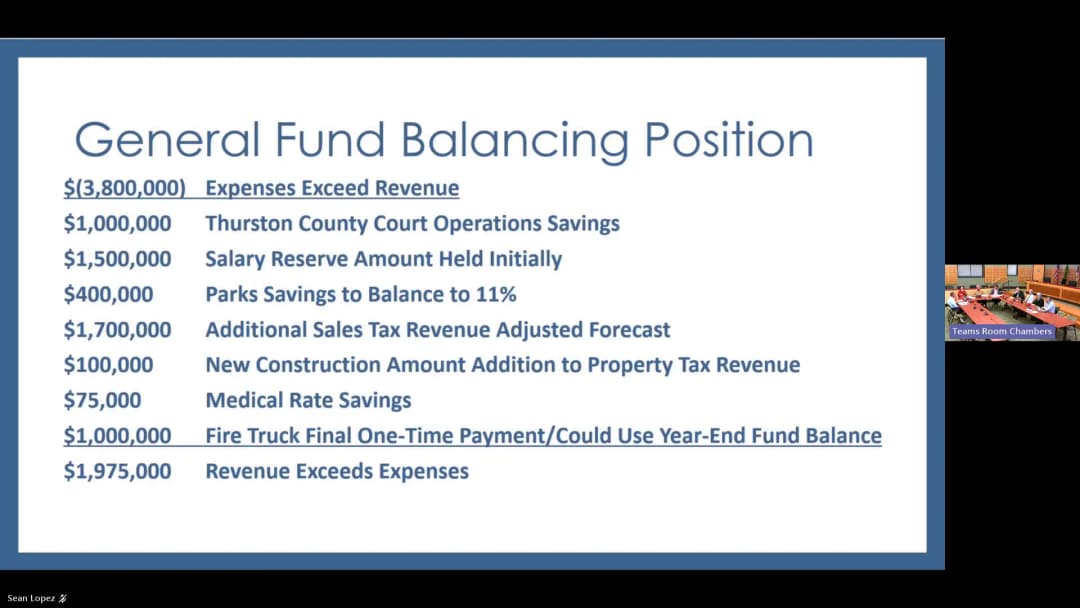
The Finance Committee of the Olympia City Council met on October 20, 2026, at 4:30 p.m. All three members were present. The meeting covered a report from the Washington Center for the Performing Arts, a budget snapshot on property tax, and an update on the 2027 operating budget. Key topics included the Washington Center's financial health, subscriber growth, community impact, and the city's budget balancing efforts. Consent Calendar - Approved the agenda unanimously. - Approved the minutes of the September 21, 2026, Finance Committee meeting unanimously. Discussion Items Washington Center for the Performing Arts Annual Report - Presented by Tim Coley, Board Chair, and Jill Barnes, Executive Director. - 2025 fiscal year audit: clean opinion, unmodified opinion; $2.5 million in unrestricted cash at year end; healthy organization with no debt and positive operating cash flow. - Net income of $387,000 before depreciation and non-operating items; unaudited 2026 shows similar trends. - Board-designated fund balances: $916,000 in operating reserves (goal of 12 months of basics), $151,000 for new technology and equipment, and $200,000 restricted plus $151,000 unrestricted for education and community engagement. - Current operating budget: $3.8 million revenue, $3.8 million expenses, net of $10,000. - Subscriber growth: 456 subscribing households (23% growth over last year, 70% over four years); subscribers buy 6% more shows than last year. - 30% of ticket sales from outside Thurston County (15,600 tickets); patrons from 34 states and 3 countries. Tourism impact: 86% of long-distance visitors said attending a Washington Center event was primary trip purpose; 63% stayed overnight; 41% used paid accommodations; 35% stayed in hotels/motels. - Artistic partners supported: over a dozen local nonprofits; partners represent 49% of ticket revenue; rates subsidized by over $365,000 (30-50% off commercial rates). - Community engagement: blood drives, flu shot clinic, Dolly Day (250 attendees, 330 books donated), student matinees (1,210 students from Olympia School District in 2024-25, focus on middle/high school), and other events. - Staff expressed the unique value of balancing touring shows with community partner priority. Councilmember Green highlighted the importance of the center's role in the community. - On LTAC funding: Jill Barnes noted challenges in the application process because all applicants are compared equally despite different purposes. Councilmember Vanderpool acknowledged the issue and suggested future policy work. - On potential land sale: no imminent sale; active conversations but likely not within six months. Budget Snapshot: Property Tax - Presented by Joan Nut, Senior Finance Manager. - Washington state property tax system is budget-based with a 1% annual growth limit (or IPD, whichever is less). For 2027, IPD is 3.88%, so the city will take the 1% limit. - City of Olympia’s share of total property tax is 17%; schools account for 62%. - Current levy rate: $1.82 per $1,000 assessed value (state statutory maximum is $3.32). A levy lid lift or legislative change would be needed to increase the rate. - 2026 collection: total assessed value $11.9 billion; highest lawful levy $20.9 million; after 1% increase and new construction, levy amount set at $21.7 million. - Impact on property owners: $400,000 home pays about $1,200 annually in city property tax. - Preliminary 2027 numbers shown; final certification to county by November 30. - Councilmember Vanderpool and Green sought clarity on state-assessed property and the mechanics of levy rate. 2027 Operating Budget Update - Presented by Mike Githon, Finance Director, and City Manager Bernie. - 2026 year-end estimated balance above 10% reserve: just over $3.5 million (revenues stronger than forecast). - Current balancing gap: $3.8 million (recurring revenue vs. expenses). Steps taken to reduce gap: budgeting for salary savings, correcting duplicated positions, delaying vehicle purchases, reducing liability insurance, moving one fire truck payment to 2028, reducing development fee fund contribution, increasing basic life support revenue, adjusting risk management transfers, and recognizing higher sales tax. - Late-breaking news: a benefits calculation error in the 2027 budget (two employee groups not loaded into the budgeting system) will widen the gap; exact amount pending. - Positive progress: county rate study saved $1 million; released $1.5 million from workers' comp reserve; Parks closing a $400,000 gap; additional sales tax revenue of $1.7 million (mostly from new categories like security services and IT, which sunset in 2029). - Net after these adjustments: positive $1.9 million position, but pending benefit error. - Prioritized budget enhancements: First priority (revenue-supported): Public Works engineering position (funded by drinking water program), event planning support (two seasonal transportation workers, potentially offset by LTAC), and CARES position ($46,000 gap for grant retention). Total $133,000. Second priority (general fund): Signs and Signals Operations Supervisor (restore cut), additional prosecutor, downtown strategy or Plum Street Corridor consultant ($150,000), HR position, climate funding ($100,000-$500,000). Committee expressed support for using REET for the supervisor position and economic development reserves for the downtown/Plum Street study. - City manager proposed using $1 million of year-end fund balance for one-time fire truck payment, but may not be necessary if balancing holds. - Committee members voiced support for the priority order and noted the importance of staff capacity and climate funding. Key Outcomes - No formal votes were taken; the committee expressed consensus on the reports and budget direction. - The December Finance Committee meeting will be cancelled as budget work will be complete. - City Manager will return on November 10, 2026, with a final balancing proposal addressing the benefits calculation error and potential enhancements. - The next steps include a first public hearing on the budget on October 27, a second hearing on November 17, and final ordinances in December.
The Olympia Planning Commission met on October 8, 2026, at 6:30 p.m. in Room 207 and online. Chair Greg Quetin presided. The meeting concluded at 9:02 p.m. Key agenda items included a public hearing on the Critical Area Ordinance (CAO) update and a briefing on proposed Minimum Parking Requirements code amendments. The Commission also discussed a comment letter on the 2027-2032 Capital Facilities Plan (CFP). Consent Calendar - The meeting agenda was approved as submitted. - Minutes from the September 12, 2026 Planning Commission Retreat were approved with abstentions from Commissioners Aaron Sauerhoff and Jessica Grubb. - Minutes from the September 21, 2026 Planning Commission Meeting were approved unanimously. Public Comments & Testimony - No members of the public provided comment during the general public comment period. - A public hearing for the Critical Area Ordinance Update opened and closed at 6:47 p.m. with no speakers. Discussion Items - Critical Area Ordinance (CAO) Update (26-0767): Current Planning Manager Kernan Lien presented proposed amendments, representing the final step of the 2045 Comprehensive Plan update. Key changes included updated wetland buffers based on the Department of Ecology's preferred option, consolidated geologically hazardous reviews, and modifications to non-conforming use provisions. Agency comments from Ecology, WDFW, and DNR, received shortly before the meeting, were described as generally supportive with no expected substantive changes. - Minimum Parking Requirements Code Amendments (26-0770): Associate Planner Casey Schaufler briefed the Commission on amendments driven by the state's Parking Reform and Modernization Act (PRMA), which must be implemented by January 27, 2027. Staff proposed going beyond state law by eliminating all parking minimums and establishing parking maximums (e.g., 4 spaces per 1,000 sq ft for commercial, 2 spaces per unit for residential). The proposal streamlines parking use types from over 30 to 4 (Residential, Commercial, Industrial, Institutional/Public). Commissioners discussed bicycle parking standards (minimum 2, maximum 12 for commercial), the implication that ADA spaces can only be required if parking is provided, potential spillover into residential neighborhoods, and ensuring existing parking is not perpetually preserved. Commissioners requested a side-by-side comparison of state law requirements versus the city's voluntary proposed changes to inform their decision. Key Outcomes - Critical Area Ordinance: Commissioner Taellious moved, seconded by Vice Chair Garcia, to recommend City Council adopt the CAO amendments as drafted. The motion passed unanimously. - Minimum Parking Requirements: The Commission did not vote but indicated general support for the direction. Staff will refine the draft, including incorporating bicycle parking best practices from the Association of Pedestrian and Bicycle Professionals (APBP), and present a revised draft at a public hearing tentatively scheduled for October 19 or November 2, 2026. - Capital Facilities Plan Comment Letter: The Commission reviewed and approved a comment letter on the 2027-2032 CFP. The letter addresses recurring concerns about funding and the need for clearly defined levels of service tied to comprehensive plan goals. Staff will explore future briefings from the finance team. - Reports: Vice Chair Garcia informed the Commission about the annual 'Week Without Driving' events occurring from October 1st to 8th.
The Olympia Hearing Examiner, Mark Scheipmeyer, convened a hybrid public hearing on September 29, 2026, at 1:30 PM to consider two separate land-use applications: a shoreline permit request for the West Bay Marina replacement project and the continued preliminary plat hearing for the Springwood Gardens subdivision. The hearing included sworn testimony from city staff, applicants, and public commenters. The Examiner orally approved both applications with conditions, subject to written findings. Public Comments & Testimony - West Bay Marina Hearing: Melissa Johnson, a boathouse owner at the marina, expressed support for the replacement project but voiced concern about the potential loss of her investment in the boathouse, noting that no other marinas in Puget Sound accept boathouses due to environmental rules. She sought clarity on restitution or demolition responsibility. - Springwood Gardens Hearing: Multiple residents testified, focusing on two issues: pedestrian connectivity and stormwater management. Alexander Prescott argued that the stormwater dispersion trench constitutes an indirect discharge to the wetland, triggering core requirement 8, and questioned the justification for a 25% wetland buffer reduction. David Mackey and Sandra Herndon highlighted safety hazards from the lack of a sidewalk on Springwood Avenue, noting children and pedestrians must walk in the road. Zach LeClair echoed concerns about wetland buffer reduction and stormwater discharge interpretations. Discussion Items West Bay Marina (Case 25-1692): City planner Paula Smith presented the proposal to replace aging marina infrastructure at 2100 West Bay Drive, including removal of 405 creosote-treated piles, reduction of boat slips from 364 to 221, and removal of 45,136 sq ft of covered moorage. Staff recommended approval of a shoreline substantial development permit and shoreline conditional use permit, finding that the project produces no net loss of ecological function through improved materials and reduced environmental impact. Applicant representative Tabitha Simonetti (former Marine Floats employee) affirmed the project's environmental benefits and noted that a water quality monitoring plan would be developed with the Department of Ecology. The Examiner discussed the removal of pilings near contaminated sediments and the adequacy of conditions to avoid disturbance. Springwood Gardens Subdivision (Case 26-0980): This was a continuation from an April 2026 hearing. Senior planner Jackson Ewing explained that after further review, the wetland buffer habitat score increased from 6 to 7, raising the standard buffer from 180 ft to 220 ft. The applicant seeks a 25% reduction to 165 ft. City stormwater engineer James Patton testified that the stormwater pond redesign, which uses a dispersion trench to spread water over the buffer, does not trigger core requirement 8 (direct/indirect discharge to a wetland) because the water is dispersed, not channeled. Applicant engineer Matt Weber confirmed the pond was deepened to maintain detention volume within a smaller footprint, and that infiltration systems also manage runoff. Wetland specialist Natalie Denson concurred with the revised report and reduction request. On pedestrian connectivity, the applicant Matt Lewis stated they secured a 10-ft easement and are willing to construct a pedestrian pathway if conditioned. The Examiner also discussed the original proposal to open Central Street to vehicle traffic. Key Outcomes - West Bay Marina: The Hearing Examiner orally approved both the shoreline substantial development permit and shoreline conditional use permit, finding the project consistent with the shoreline master program and management act. The written decision will be issued in 10–14 business days; the shoreline conditional permit will require final Department of Ecology approval. - Springwood Gardens: The Hearing Examiner orally approved the preliminary subdivision plat with two additional conditions beyond the staff-recommended conditions: 1) The applicant shall construct a five-foot pedestrian sidewalk across the easement to the west to improve connectivity to Bethel Street, and 2) Central Street shall be designated pedestrian-only (except for emergencies) instead of open to vehicular traffic. The applicant's request to allow bonding for wetland mitigation prior to final plat approval was accepted, pending formal language. The written decision is expected within 10–14 working days.
Note: The meeting transcript references September 23, 2026, but the official date provided for this summary is September 24, 2026. This discrepancy is noted here. The Olympia Salary Commission met to finalize the 2026 council member salary schedule. The three members present (Paul, Aaron, Karen) unanimously approved the agenda, previous meeting minutes, and the new salary schedule after a brief discussion of insurance cost projections. Consent Calendar - The agenda was approved unanimously by voice vote. - Minutes from the May and July meetings were approved unanimously by voice vote. Public Comments & Testimony - No public comments were received. No members of the public attended or registered in advance. Discussion Items - 2026 Council Member Salary Schedule: The commission reviewed the proposed salary schedule and a draft letter. Chair noted a slight change in the insurance cost projection from 22.4% to 22.2%. Members expressed satisfaction with the process and noted the schedule had been posted on the city website for public comment for a week with no input. Commissioner Aaron indicated he would be stepping down from the commission and would submit a formal letter. The commission thanked staff (Regina) for thorough preparation. Key Outcomes - Adoption of 2026 Salary Schedule: The commission unanimously voted to adopt the proposed 2026 council member salary schedule. The motion included a letter and addendum with notes for future consideration. - Commissioner Departure: Aaron announced his resignation; a formal letter is forthcoming. The chair thanked Aaron for his service. - Next Meeting: The commission does not expect to meet again until early 2027 to begin work on the next salary cycle.
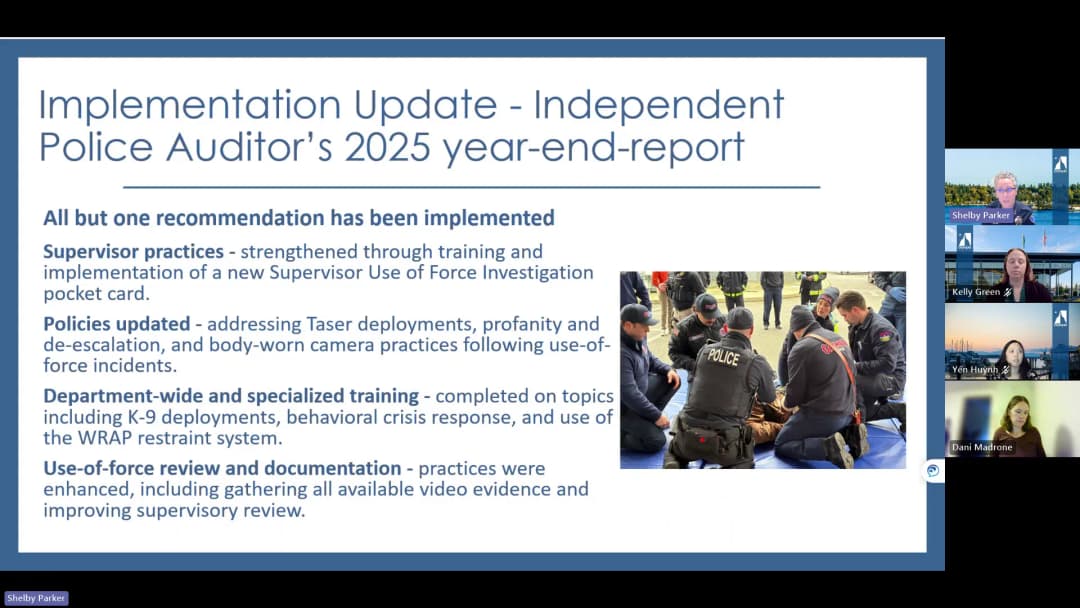
The Olympia City Council's Community Livability and Public Safety Committee met to review upcoming calls for art, receive a mid-year public safety update from Olympia Police Chief Shelby Parker, and recommend restructuring four council-appointed advisory bodies. Committee members present were Chair Danny Madrone, Kelly Green, and Ian Quinn (full committee). Note: The transcript states the meeting occurred September 23, 2026 at 5:30 p.m., while the meeting metadata indicates September 24, 2026; this summary uses the metadata date as instructed. Consent Calendar - Agenda approved as published by unanimous voice vote. - Minutes from August 26, 2026 approved unanimously. - No members of the public signed up for public comment. Discussion Items Upcoming Calls for Art Review - Parks Arts and Recreation staffer Stephanie Johnson and Arts Commission Vice Chair Catherine Ransom presented two calls for art: the Arts Crossing Project and the new Murals in Parks pilot. - Arts Crossing Project: Eight gateway locations within a mile of downtown Olympia; three are complete (West Bay Drive "Guardians", East Side Street "Unity" by Andrea Wilber Saigo, and Martin Way/Pacific Avenue, reinstalled after a car accident). A National Endowment for the Arts matching grant allows two new projects at once—Harrison/Division and Henderson/Eskridge. Capitol Boulevard is not viable (not city property and slated for redesign with the Capitol Lake estuary project). Sixteen community members attended the Henderson/Eskridge community meeting. - Timeline: The NEA grant runs about two years; staff hope to bring a concept plan to council by June 2027, giving the selected artist a full year for fabrication and installation. - Process: Neighborhood input questions (what do you value, what should people know, how is the neighborhood connected to Olympia) are handed to artists, who also participate in full-day workshops, site walks with a traffic engineer and historic preservation officer, and an evening community meeting. Each selection committee includes four representatives with neighborhood ties and one from Greater Olympia; a high school representative serves on one committee. - Committee feedback: Members praised the selection committee makeup and encouraged pushing artistic boundaries beyond plinth-based sculptures (while coordinating with Public Works). Johnson noted Harrison/Division has limited space and may require vertical elements, and she hoped Henderson/Eskridge could accommodate something functional, while emphasizing the artist ultimately decides. - Murals in Parks pilot: Focused on Yager Park and Sunrise Park; murals will be painted on boards (smoother than siding, removable for repair, and able to reduce certificate of insurance requirements for artists). The project emerged from equity, inclusion, and belonging work. Johnson stated the park sites were chosen partly because they are in low-income neighborhoods with nearby apartment complexes; Sunrise already has a mural on the grub garden. Arts Crossing is the priority due to grant timing, with Murals in Parks launching in spring. - Artist eligibility language: After discussion, the committee agreed to remove the word "strong" from "artists with a strong connection to Olympia," leaving a requirement that artists articulate a connection to Olympia. Ian Quinn had suggested opening the call to "artists willing to work with communities in Olympia," while Kelly Green preferred retaining "connection" as broad. Johnson accepted the change, noting the call still seeks artists capable of large-scale sculpture and would be posted on CAFÉ (a national call for art). - No formal decision was needed; this was a check-in and feedback item. Public Safety Update (Chief Shelby Parker) - Mid-year data (January–June 2026): OPD responded to almost 28,000 calls for service with officer response, filed about 3,400 police reports, fulfilled more than 2,000 public disclosure requests, and the Crisis Response Unit (CRU) made nearly 4,000 contacts—up about 30% over the same period last year. Overall calls for service rose about 5%. - Crime trends (first half 2026 vs. first half 2025): Felony assault down 12%; rape down 21%; commercial burglary down 17%; auto theft down 28%. Residential burglary up by 8 incidents; criminal trespass up about 32%, often driven by businesses and property owners requesting response. There were 2 homicides in the first two quarters (domestic violence) and 2 additional deaths since (an ongoing dispute ending in gunfire) that will appear in year-end reporting. - Arrests: 1,685 arrests year to date; 18 were juveniles (1.1%). - CRU: 80% of its nearly 4,000 contacts were resolved by CRU alone; 20% were co-responses with officers. Self-initiated contacts totaled 973. Chief Parker attributed growth to community familiarity, internal deployment improvements, and strong staffing enabling proactive work. - Staffing: 88 commissioned positions; 11 officer vacancies; 10 officers in academy/field training; 7 officers on leave (paid family medical leave, light duty, critical incident leave)—totaling 28 commissioned staff unavailable to the community, or about 70% service capacity. Patrol: fully staffed would be 40 officers; contractual minimum is 32; current patrol staffing is 28, four below minimum, requiring overtime shifts of up to 16 hours. The department has 4 community resource officers (not fully commissioned). The school resource officer position remains frozen; Chief Parker said OPD will return to schools "the moment" the Olympia School District invites them. - Recruitment: A record 16 hires in 2026 (including patrol and CRU); a $25,000 lateral officer incentive (paid over time) and an employee referral incentive attracted 3 lateral officers. New officers require about one year to complete academy and field training. - Illicit massage businesses: Following 2025 code changes, neighborhood police officers are conducting education and compliance inspections, prioritized by community-reported concerns, with enforcement possible when circumstances warrant; Chief Parker described the work as resource-intensive and ongoing. - Independent Police Auditor 2025 year-end report: All but one recommendation implemented; the remaining item (a more holistic review of use of force incidents) is in progress. Implemented changes include: June 10 supervisor training and a new use of force investigation pocket card; a policy restricting simultaneous taser deployments unless the first clearly fails; transition to the Taser 10 platform (no drive stun); a July 1 body-worn camera policy (OPD 422.3.2.E) requiring cameras to remain unmuted after use of force until relieved by a supervisor; May training reinforcing a profanity prohibition except in limited deadly force circumstances; and an early August policy revision making profanity during deadly force encounters "strongly discouraged." Additional training covered canine deployments, behavioral crisis response, and the wrap restraint system. - Auditor mid-year report: The 2026 mid-year review has been drafted and will be presented to the Community Policing Board; some incidents reviewed predate the policy changes described. - Committee response: Kelly Green applauded hiring progress and the team's responsiveness to the auditor's recommendations; Ian Quinn praised high standards and the low juvenile arrest number; Chair Madrone expressed interest in the auditor's forthcoming CRU evaluation and thanked the Chief for the update. Advisory Body Restructuring Recommendation (Stacy Ray with Margot Morales and Genevieve Kenseco Chan) - Staff presented a proposal following a citywide evaluation of the 14 council-appointed advisory bodies, guided by goals of meaningful input, equitable engagement, impactful volunteer work, and sustainability. - Process improvements: Standardized onboarding; a criteria test; regular evaluation; two alternating recruitment cycles (Cycle 1 opening November 1, 2026 with April appointments; Cycle 2 recruitment July 2027 with January appointments); council work plans set in January informing advisory body work plans finalized in April/May with an official cycle starting June; and a proposed mid-cycle update to the full council. - Proposed sunsets: (1) Bicycle and Pedestrian Advisory Committee (BPAC), sunsetting March 2027 at the end of its work plan cycle, with its mission integrated into the Planning Commission (without growing Planning Commission membership). (2) Design Review Board, sunsetting at the end of its work plan cycle, with regular review work shifting to an administrative staff process; staff liaisons indicated the workload is at least net-equal and likely more efficient. (3) Parks and Recreation Advisory Committee (PRAC), sunsetting February 2028 after completing the parks master plan update, with terms extended as needed; complementary work exists with the Olympia Metropolitan Park District, and future engagement may use the community collaborator model. Staff consulted chairs and liaisons on honoring accomplishments, retaining institutional knowledge, offering vacancies on other bodies to sunsetting members, and continuing special programs (e.g., Design Review Board awards of merit) through ambassadors/collaborators. - Social Justice and Equity Commission (SJEC): Retained but with a refined scope focusing on one or two significant, meaningful work efforts per year, with meeting cadence and time commitments aligned to project needs, plus continued regional coordination. Staff noted attendance and investment struggles and the commission's history of being a "stopover" for policy referrals; the city now has an equity framework and equity-focused staff to support policy review. Chair Madrone recounted the commission's evolution from a human rights commission concept and its preference for start-to-finish work. - Engagement toolkit: Staff described Engage Olympia, community ambassadors (formerly connectors), community collaborators (ad hoc, topic-based), and community academies (used most frequently by the police department), with work continuing on defined roles, stipend structures, and staff guidance. - Committee discussion: Chair Madrone supported the SJEC scope and the sunset schedule, raised the need to address municipal code references (e.g., park naming recommendations currently assigned to PRAC) and OMPD considerations, and confirmed the DRB workload expectation. Kelly Green asked where equity-lens policy review would occur (answer: the city's equity framework and equity-focused staff) and urged thoughtful recognition of passionate current members, especially BPAC. Ian Quinn expressed readiness to act. - Motion: Ian Quinn moved to approve the proposal to sunset BPAC, the Design Review Board, and PRAC and to refine the scope of the Social Justice and Equity Commission, along with the associated changes; the motion passed unanimously by voice vote (all three members in favor). The recommendation will proceed to the full council, followed by municipal code updates; Cycle 1 recruitment is targeted to launch in November. Key Outcomes - Agenda and August 26, 2026 minutes approved unanimously. - Committee directed removal of "strong" from the artist eligibility language, requiring artists to articulate a connection to Olympia. - Public safety mid-year update received; no formal action taken. - Unanimous recommendation to the full council to sunset BPAC, the Design Review Board, and PRAC, and to refine the SJEC scope. - October CLIPS committee meeting rescheduled to November 4, 2026, subject to Chief Flowers' availability. Reports & Updates - Chair Madrone announced the October CLIPS meeting will move to November 4, 2026; calendar notices will follow. - Staff confirmed that reaction buttons are intentionally disabled for general attendees in virtual city meetings to limit interaction; presenters retain broader options.
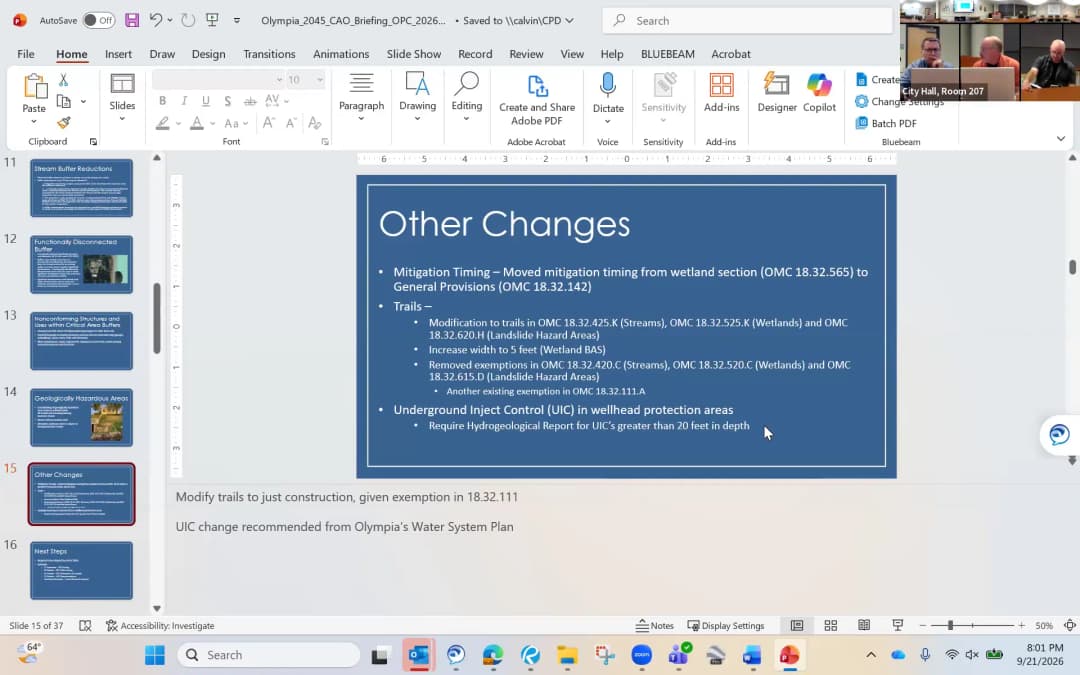
The Olympia Planning Commission met on September 22, 2026, to conduct a public hearing on the Preliminary 2027-2032 Capital Facilities Plan (CFP) and receive a briefing on proposed amendments to the Critical Area Ordinance (CAO). The meeting was called to order at 6:32 p.m. and adjourned at 8:32 p.m. The commission unanimously recommended the CFP with considerations and scheduled a public hearing on the CAO for October 5, 2026. Consent Calendar - Approved the agenda for the September 22, 2026 meeting. - Approved the minutes from the August 17, 2026 meeting. Public Comments & Testimony - No public comments were offered during the designated public comment period or during the CFP public hearing. Discussion Items Preliminary 2027-2032 Capital Facilities Plan (CFP) – Public Hearing Staff introduced the revised plan, noting the six-year total of $412.6 million (up from $396.6 million originally, a 6% increase) and a revised first-year budget of $82.3 million (up from $70.3 million). Commissioners discussed ongoing concerns: Vice Chair Daniel Garcia highlighted the declining cable tax without a replacement and the need for more mobility and pedestrian/cyclist safety projects. Commissioner Jessica Grubb expressed concern about a projected 25% decline in Real Estate Excise Tax (REET) revenues, which accounts for 20% of the transportation budget. Commissioner Zainab Nejati noted that the Waste Resources facility (currently $51 million) has only a 10% contingency and a high likelihood of cost growth. Chair Greg Quetin raised deferred maintenance issues, especially for transportation, where the pavement condition index (PCI) is 66 against a goal of 75, with only $2.86 million per year invested versus an estimated $16 million needed. Commissioner Jessica Grubb added that property value declines may affect general obligation bonds for fire stations. Concerns about grant funding uncertainties and the difficulty of raising the PCI also emerged. Commissioner Nejati moved to recommend the plan as proposed with considerations to be documented in a comment letter; the motion was seconded by Commissioner Jason Taellious and passed unanimously. Critical Area Ordinance (CAO) Update – Briefing Current Planning Manager Kernan Lien presented proposed amendments driven by best available science (BAS). Key changes include: adopting Option 1 for wetland buffers (based on mitigation measures and habitat corridors); maintaining current stream buffers (consistent with site-potential tree height of 196-235 feet); adding provisions for functionally disconnected buffers and non-conforming structures (limited to hard surfaces); consolidating geologically hazardous area reviews as administrative; adjusting trail disturbance thresholds; and requiring hydrogeologic reports for underground injection controls deeper than 20 feet in wellhead protection areas. Commissioners asked clarifying questions: Commissioner Nejati questioned whether a pipe under a road could make a buffer functionally connected; Commissioner Raphael Garcia asked about the basis for the 4,000-square-foot threshold for Category IV wetlands; Commissioner Jason Taellious inquired about fencing requirements; and Commissioner Grubb noted that GIS wetland data is not fully up-to-date. The briefing was informational; a public hearing is set for October 5, 2026, with potential deliberations on October 19, 2026. Key Outcomes - The commission unanimously recommended (9-0) that City Council adopt the Preliminary 2027-2032 Capital Facilities Plan as proposed, with considerations to be outlined in a comment letter drafted by the finance subcommittee. - The Critical Area Ordinance update briefing was received; the commission will hold a public hearing on October 5, 2026, and aims for City Council adoption by November/December 2026. - The finance subcommittee will meet on September 23, 2026 to begin drafting the CFP comment letter.