General Assembly Committee Briefing on 2026 Legislative Session and Budget – April 28, 2026
STREAMING COPY IN PREPARATION — RECORDING AVAILABLE FROM THE ORIGINAL SOURCE
General Assembly Committee Briefing on 2026 Legislative Session and Budget – April 28, 2026
On Tuesday, April 28, 2026, at 9:00 AM, the Prince George's County Council's General Assembly Committee convened an informational briefing in Committee Room 2027 of the Wayne K. Curry Administration Building in Largo, Maryland. Chair Wanika Fisher presided; Vice Chair Shayla Adams-Stafford, Councilmember Danielle Hunter, and Councilmember Thomas Dernoga were present, and Councilmember Sydney Harrison was excused. The committee received presentations from lobbyists on the 2026 Maryland General Assembly session and the fiscal 2027 state budget. No votes were taken.
Budget Overview (Fiscal 2027 State Budget)
- Roger Mano of Mount Associates presented the county's state budget outcome. The county began with a $660 million capital priority list and significant operating priorities amid a structural deficit.
- The county secured approximately $2.21 billion in total state operating and capital aid, including roughly $2.052 billion in direct operating aid and about $160 million in retirement support. Capital impacts ranged from $250 million to $400 million, with over $200 million in direct capital funding; Prince George's County ranked second among Maryland jurisdictions, behind Baltimore City.
- Operating aid grew by $92–100 million (4–5%) over FY26. Education aid totaled about $1.8 billion (roughly 81% of total aid) and grew 5–6%; community colleges grew about 3%; health funding increased 20%; transportation declined 10–12%.
- Capital investments included $150–250 million for school construction, over $50 million for higher education (including $10 million for UMD's Quantum Initiative and $20 million for INQ), $18 million for healthcare (including $10 million for Doctors Community and $8 million for MedStar Southern Maryland), over $20 million for economic development and Blue Line TOD projects, and over $35 million for infrastructure (including $12 million for Port Towns watershed).
- Education facility capital included $17 million for Cool Spring Elementary and $6.3 million for Riverdale.
- Statewide programs benefiting county residents included the autism waiver at about $62 million and child care scholarships totaling $414 million statewide.
- Disparity grants totaled $56.9 million for FY27, down $11.4 million (17%) from FY26's $68.3 million, which had been a temporary enhancement; the FY27 amount is 24% below full formula funding and equals about 2.5% of total state aid.
- The teacher pension shift splits pension cost growth 50/50 between the state and counties, adding $5.7 million in annual obligations. The state still provides about $160 million in retirement support, covers 96% of pension costs, and the added cost is about 3.5% of retirement support received.
- Questions and follow-ups: Vice Chair Adams-Stafford requested a detailed breakdown of Bowie State capital funds, including transportation funding outside general capital dollars. Chair Fisher asked about Maryland Transit Authority police for the Purple Line (opening in 2027), specifically whether an MOU with Metro Police is planned; Mano said he would provide that information within the week.
Legislative Consultant Reports
- Derek Green (Green Consultants) reported on alcohol and public safety legislation. Successful bills included HB 443 (Class B small event center licenses) and HB 406 (multiple alcohol licenses; includes a prohibition on wine festival licenses in state legislative district 24). Failed bills included HB 415 (grocery store beer/wine licenses), HB 421 (speed monitoring on Route 210), SB 173/HB 249 (automated enforcement reciprocal agreements), and SB 138/HB 84 (domestic violence as a mitigating factor). Cigar lounge legislation did not pass; discussion focused on the need for a state license to combine cigar and liquor sales and a possible Office of Law opinion.
- Lorenzo Bellamy (Bellamy Gen Group) said his firm tracked over 100 bills. Passed legislation highlighted included bans on machine-gun conversion devices (SB 334/HB 577), youth charging reform (SB 323/HB 409), police face covering ban (SB 1/HB 155), housing voucher anti-discrimination (SB 355/HB 315), the Maryland Certainty Act (SB 325/HB 548), the Maryland Transit and Housing Opportunity Act (HB 894/SB 384), Patuxent Research Refuge protection (HB 1267), Prince George's County TIF expansion for entertainment venues (HB 1247, the “Sphere bill”), and a personal property tax exemption for small manufacturers (HB 1243). He noted the Suitland Development Authority bill (HB 1452/SB 552) passed without Prince George's County Council representation after an amendment. The Voting Rights Act of 2026 (SB 255/HB 350) was signed as an emergency bill on April 28, 2026, allowing the Attorney General to challenge local election systems that dilute minority voting. The 287(g) bill (SB 245/HB 444) prohibiting local law enforcement agreements with ICE also passed.
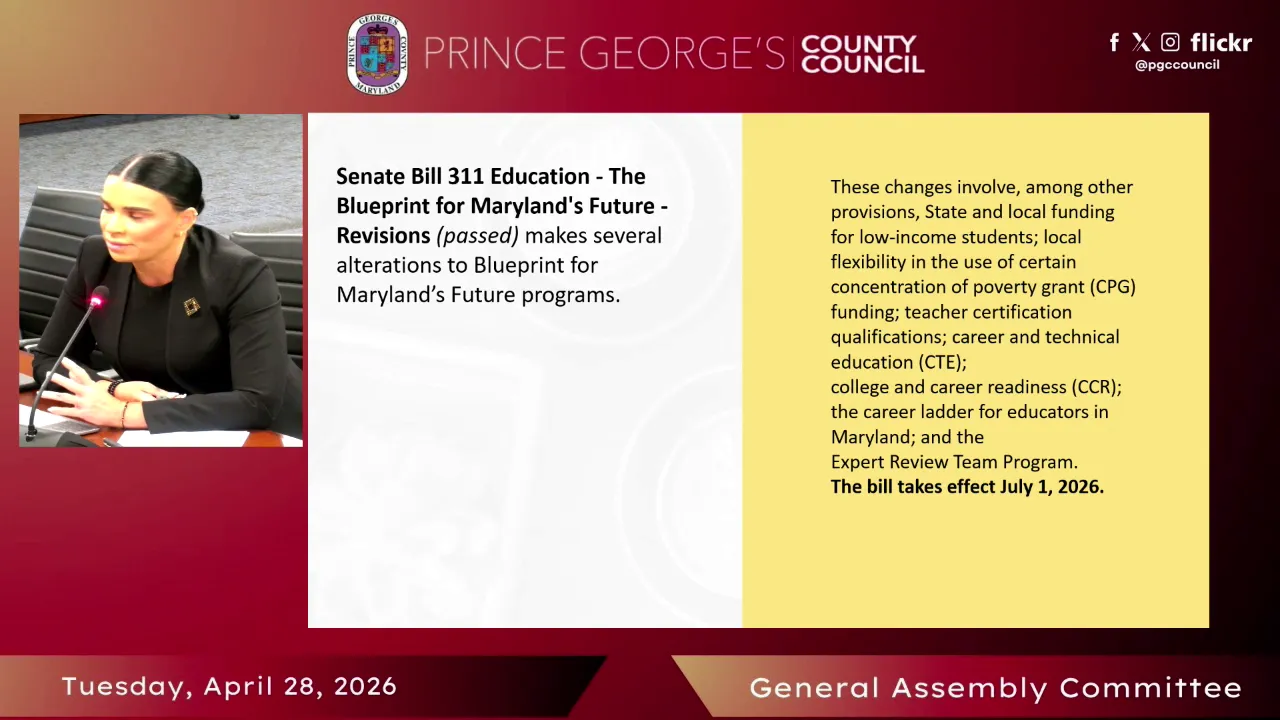
- Teresa Hessler (Ashler Government Relations) summarized education, environment, energy, health, and tax legislation. The session was characterized by fiscal constraint, with many proposals scaled back to studies, pilots, or reporting requirements. The Blueprint education funding revisions passed and take effect July 1, 2026. A commission was established to investigate the House of Reformation and Instruction for Colored Children (SB 776/HB 552), with reports due at the end of 2027 and 2029. HB 1532, the Utility Relief Reducing Energy Load Inflation for Every Day's Family Act, passed with energy and utility provisions. Tax legislation extended business tax credits (SB 88/HB 898) and expanded nonprofit housing tax exemptions (HB 571). Local bills included HB 423, providing free drink-spiking and drug-detection products in public high schools, while HB 1223 (farmers market/street vending work group) and HB 1224 (vacant and abandoned property tax rate) did not pass. Hessler recommended beginning interim planning in early summer 2026 for the 2027 session.
Key Outcomes
- No votes were taken; the meeting was informational.
- The committee received comprehensive briefings on the county's $2.21 billion state aid package, capital project ranges, and major legislative wins and losses.
- Follow-ups were directed: a Bowie State capital breakdown; Purple Line police/MOU status; an Office of Law opinion on cigar lounge authority; an OMB review of the Maryland Certainty Act's potential commercial impact on the county's bond rating; and a planned virtual evening briefing for residents.
- Director Jabari Cooper was recognized on his last committee meeting; the committee will not meet again until after the MACo summer conference, with interim planning to resume before the 2027 legislative session.
Meeting Transcript
Good morning, Prince George's County. It's great to be here with you all on this morning on Tuesday, April 28th. I'm Councilmember Winika Fisher. I chair the General Assembly Committee. And I'm pleased to be joined with my colleague, Councilwoman Danielle Hunter. Councilwoman. Good morning. Good morning. We have two here at roll call, so we will continue with the General Assembly Committee as an informational meeting. As there will not be any votes taken today, uh, the General Assembly Committee will receive a major overview of pieces of legislation that passed during the 2026 General Assembly session, as well as a budget update on the funds allocated to Prince George's County. This briefing will provide us a clear understanding of the county's legislative wins, fiscal impact, and opportunities these outcomes create for our residents. Since today's meeting is focused solely on legislative briefings, no votes will be taken. And our goal is to ensure that the council and the public are fully informed about the legislation that will shape the county's operations and as we enter our budget season ahead. Um at this time I will turn to Mr. Jabari Cooper, our general assembly committee director. Thank you, uh Chair Fisher, and uh thank you for Councilmember Hunter for being here. Thank you for all the uh lobbyists and consultants for being here. Um we will begin with our budget overview from Mr. Um Roger Manow and um well please begin, Roger. Thank you, Director Cooper. Um maybe give us a second if we get our uh yep, perfect. Madam Chairman Beacon. Okay, I'm gonna try to move through these slides as quickly as possible. Is it down? I need actually do it. I need to read through it. Okay. Yeah, yeah. That's all right. Can you go to the full screen view? Yeah, yeah. Okay, thanks. I guess it's down. Okay, great. So this will be uh an overview of the fiscal 27 state budget as it relates to the county. And for the record, Roger Mano, attorney at Mount Associates. Uh Mr. Claire, can you call the role? Chair Fisher. Present. Vice Chair Adam Stafford. Present. Councilmember Hunter. Here. Three members present during roll call. Thank you. We're now officially sitting as the full general assembly committee. Go ahead, Mr. Mannow. Thank you, Madam Chair.
openpublica.com