Streamlining Development Review Work Group First Meeting – April 29, 2026
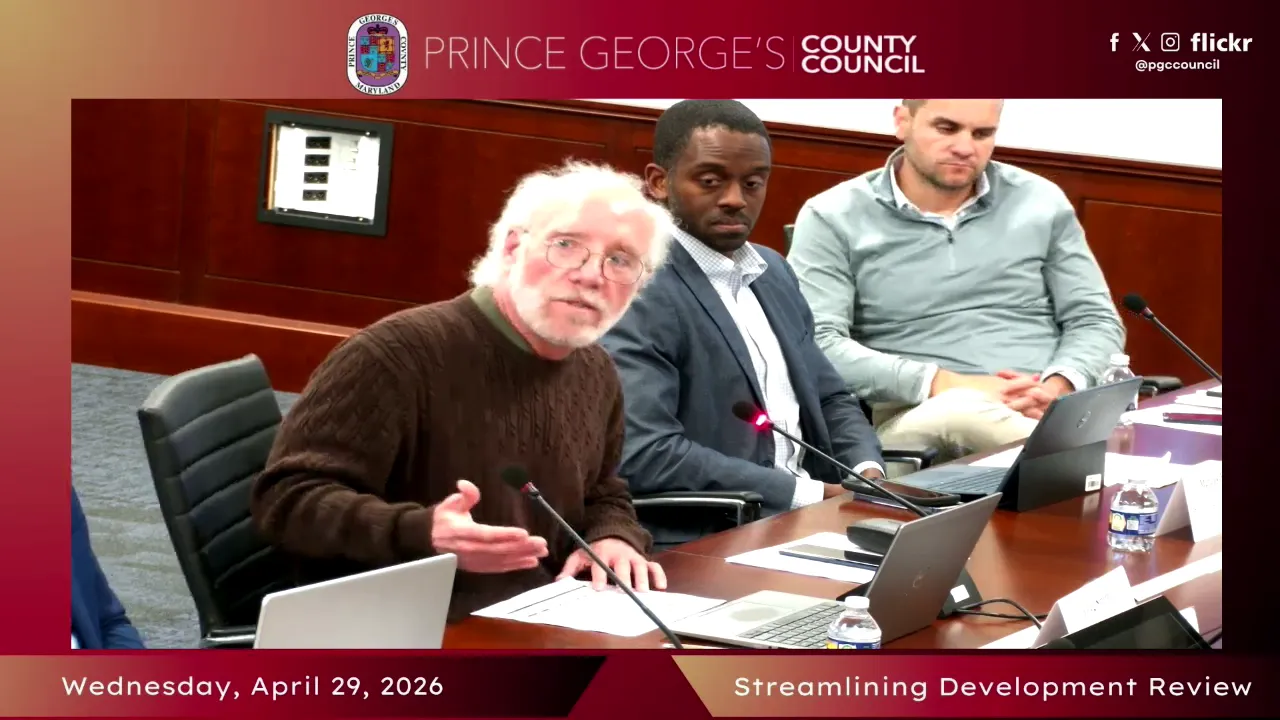
STREAMING COPY IN PREPARATION — RECORDING AVAILABLE FROM THE ORIGINAL SOURCE
Streamlining Development Review Work Group First Meeting – April 29, 2026
The Streamlining Development Review Work Group convened for its first meeting on April 29, 2026, at 2:00 PM in Committee Room 2027. The meeting was called to order by the Chair, who emphasized the goal of balancing competitive efficiency with community voice. The work group is tasked with producing tangible legislative recommendations within a 30‑to‑60‑day fast‑track timeline, with a target adjournment date of June 26, 2026 (subject to extension). The primary agenda item was an overview of enabling legislation CR‑014‑2026 and a detailed presentation on regional development review processes.
Consent Calendar
- No consent calendar items were presented.
Public Comments & Testimony
- Greg Smith (environmental activist) raised concerns about public access to documents, stating that the DAMS (Document Access Management System) often falsely indicates no relevant documents are available. He criticized the “tyranny of the 70‑day calendar,” noting technical staff reports are frequently filed too late for meaningful public review, and urged better transparency and earlier community engagement.
- Parker (speaker) asked for details on how community engagement metrics were determined for each jurisdiction and contrasted the limited pre‑application neighborhood meetings in Prince George’s County with the robust, continuous community engagement in Arlington County.
- Matthew Tedesco (land‑use attorney) acknowledged that some applicants do conduct genuine community outreach and urged the work group to recognize good actors, not just failures, and to create uniform standards.
- Marcus Wannaw (planning department) offered to provide staff to clarify the process flowchart and to share a collection of 260 comments from land‑use attorneys and developers gathered during a February trip.
Discussion Items
- Overview of Enabling Legislation (CR‑014‑2026): Staff (Josh Hamlin) explained that the resolution formed this work group to review Prince George’s County development review processes and propose solutions. A weekly meeting schedule (virtual after the first in‑person meeting) was discussed and agreed upon.
- Regional Development Review Process Analysis (James Campbell): James Campbell, land‑use development specialist for the county council, presented a comparative analysis of five counties: Arlington (VA), Fairfax (VA), Howard (MD), Montgomery (MD), and Prince George’s (MD). Key points included:
- Common path: concept, application, agency review, public input, decision, permitting, construction, close‑out.
- Arlington County: Collaborative, design‑focused, community‑driven with robust early public engagement; final decisions by elected county board.
- Fairfax County: Board‑centric, structured, predictable workflow; moderate public engagement; conditions often drive post‑approval steps.
- Howard County: Engineering‑focused, emphasizes environmental protection and stormwater; county council not involved in process.
- Montgomery County: Master‑plan‑driven, planning‑board‑centric; projects must align with long‑range plans; parallel reviews to improve efficiency.
- Prince George’s County: Two‑layer decision structure (Planning Board and District Council) adds legal complexity; described as linear and compliance‑driven but with moderate iteration and predictability medium.
- Timeline and Staffing Comparisons: Several members (Matthew Tedesco, Brad, Parker) requested data on actual processing times, staffing levels, number of agencies involved, and project throughput to understand why Prince George’s process takes 24–36 months despite similar on‑paper steps.
- Community Engagement: Members debated how community input is solicited across jurisdictions. The Chair noted that the required pre‑application neighborhood meeting is often the only formal public touchpoint before hearings, and that uniform standards are needed to prevent inconsistency between council districts.
- Next Steps and Work Group Logistics:
- A recommendations spreadsheet (Google Sheets/Excel) was distributed for members to submit proposals offline.
- The group agreed to meet weekly virtually, starting after a survey to prioritize “pain points” in the process.
- Future meetings will be structured around each of the nine steps identified in the presentation, with deep‑dives into best practices, agency coordination, and public engagement.
- Staff will circulate a proposed meeting schedule and the entitlement/permit schedule published by Park and Planning and DPI (November 2024) as a common framework.
Key Outcomes
- No formal votes were taken; the meeting was informational and organizational.
- Action Items:
- Staff to email members a proposed weekly meeting schedule and a poll to rank the most significant process pain points.
- James Campbell to gather additional data on timelines, staffing levels, and number of agencies per jurisdiction.
- Planning department to offer personnel to clarify the process flowchart and share the 260‑comment collection.
- Members are encouraged to pre‑fill recommendation forms to expedite discussion at subsequent meetings.
- Next Meeting: To be scheduled virtually within the next week; topic will be determined based on the pain‑point survey (likely inviting the Maryland Building Industry Association to present).
Meeting Transcript
All right. Good afternoon, everyone, and welcome to the Streamlining Development Review Work Group. I appreciate everyone that is joining us to be part of this work group. As many of you know, it was something that was really important to me. I have heard loud and clear from both sides, right? From the industry around ways that we can be more competitive compared to some of our neighboring jurisdictions or our process. But as many know, um, I'm also an advocate for wanting to make sure that the community has voice in the process. And so the goal for this um work group was to have um representation from industry, community agency, um, to do a fast track uh work group for 30 to 60 days for us to think about ways that we can be more efficient and to move forward with a recommendation. Um, because a lot of times I know people feel like there's lots of conversations, but what really comes out of some of the work groups and task force, and many that meet with me know I'm very action-oriented. So I want a tangible piece of legislation to aiming to balance competitive efficiency. Hold on now. Okay, AI is always listening. Okay, it's about to give us a solution. Okay. So I definitely want to make sure we get a tangible solution now. I do I think we'll fix everything in 30 to 60 days and have a perfect piece of legislation come out that fixes everything. No, and that's not what my aim is. Um, this is just a beginning step. But know that if we feel like there's other things that come from this that we need to continue to have conversation about, I have no problem extending um for us to meet longer and for us to have other conversations on other areas, right? Um, but this is just a first step at us trying to make sure we bridge the gap between those two realities and things that we want to do. Um, so as we get started, I think the first thing we'll do is do we need to do attendance, or we just want to go around the room and let everyone introduce themselves, which makes the most sense. Um, Madam Chair, everyone should introduce themselves since this is our first meeting. Perfect. So we'll start with you, Ms. Hightown. We'll go around and end with um Karen Savakis. Hi, everyone. My name is Raina Hightower, and I'm the committee director for planning housing and economic development. Good to meet everyone and to see everyone. Good afternoon, everybody. Josh Hamlin, I'm legislative attorney for the county council. Good afternoon, everyone. Ariana Bead, director of legislative impact for the county council. Good afternoon, James Campbell. I am the land use and development specialist for the county council. Good afternoon, everyone. My name is Ray De Guzman. I'm associate director for Deep Bye. Good afternoon, Victoria Balastero. I'm a civil engineer with Guide Engineering. Uh good afternoon, everyone. Madam Chair Matthew Tedesco of the Law Firm of MacMeosey Land Use Council in the County. Good afternoon. I'm Greg Smith, and apparently I'm an environmental activist. That's why I call you. So my bad. Good afternoon, Marcusman. I'm rural representing the planning director's office. Good afternoon, Griffin Butt with the Maryland Building Industry Association. Thank you, Madam Chair.
openpublica.com