Prince George's County Board of Health Briefing on Maryland Maternal Health Improvement Strategic Plan - May 5, 2026
STREAMING COPY IN PREPARATION — RECORDING AVAILABLE FROM THE ORIGINAL SOURCE
Prince George's County Board of Health Briefing on Maryland Maternal Health Improvement Strategic Plan - May 5, 2026
The Prince George's County Council, sitting as the Board of Health, convened on Tuesday, May 5, 2026, at 11:43 a.m. in the Council Hearing Room in Largo, Maryland. The meeting focused on a single briefing item: the Maryland Maternal Health Improvement Strategic Plan, presented by Dr. Donna M. Neale, Chair of the Maryland Maternal Health Improvement Task Force. The meeting adjourned at 12:38 p.m.
Discussion Items
-
Opening Remarks & Staff Introduction: Chair Krystal Oriadha highlighted the importance of maternal health, especially Black maternal health, and referenced transformative legislation passed in 2025. Senior Advisor to the Board of Health, Anya Makarova, provided context on maternal and infant health disparities in Prince George's County, noting that Black and Hispanic mothers are most likely to give birth with late or no prenatal care. She introduced Dr. Diane Young and Dr. Andrew Ballard from the Prince George's County Health Department, and Jennifer Iverson from Child Resource Connect, which conducts approximately 700 home visits annually through a postpartum home visiting program at University of Maryland Capital Region Health.
-
Presentation by Dr. Donna M. Neale: Dr. Neale presented the Maryland Maternal Health Improvement 2025 Strategic Plan on behalf of the state task force. She reviewed maternal mortality rates (MMR) over three time periods:
- 2009–2013: U.S. MMR 19 per 100,000 births; Maryland 24.5 per 100,000.
- 2014–2018: U.S. 21 per 100,000; Maryland dropped to 18.4 per 100,000.
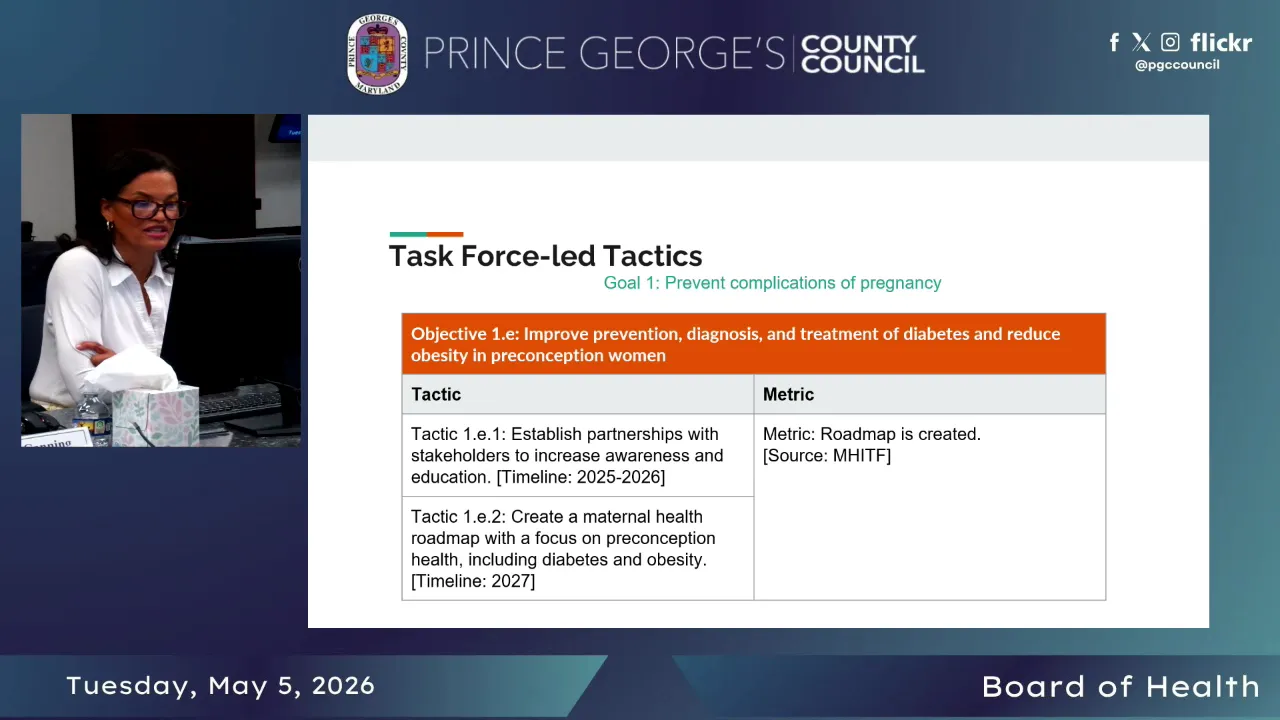
- 2019–2023: U.S. 24 per 100,000; Maryland 21.4 per 100,000. Disparities persist: Black non-Hispanic mothers in Maryland have significantly higher MMR than white non-Hispanic mothers across all periods. The leading cause of pregnancy-related deaths is behavioral mental health conditions. Severe maternal morbidity rates (per 10,000 deliveries) show increasing trends for Black, Hispanic, and Asian/Pacific Islander women. The task force developed a strategic plan with four goals: 1) prevent complications of pregnancy; 2) improve maternal mental and behavioral health; 3) support women and families with comprehensive services; 4) improve data collection and utilization. Objectives include increasing postpartum care attendance (two visits within 12 weeks), creating a preconception health roadmap, and training the perinatal workforce in mental health support. Metrics and tactics are defined for each objective. The task force is leading four tactics and partnering on six others. Key initiatives include convening stakeholders to ensure two postpartum visits, developing a maternal health roadmap (building on the Maryland Maternal Resource Map), and conducting a needs assessment for perinatal mood and anxiety disorder treatment. Key timeline: July 2026 – first draft of work plans; October 2026 – second draft; January 2027 – final plan; then two years of implementation; analysis by July 2030; reporting to federal government by end of 2030.
-
Council Member Questions and Comments: Vice Chair Eric Olson asked about postpartum depression follow-up. Dr. Neale emphasized training the perinatal workforce to identify and refer. Council Member Jolene Ivey shared personal experience with home visiting programs and asked about investment levels across jurisdictions. Jennifer Iverson noted that Frederick County invested $5–8 million in ARPA funds into postpartum home visiting, and that the Family Connects program costs $700–900 per family. Council Member Shayla Adams-Stafford inquired about using technology (hotlines, tele-visits) for postpartum support, education for partners on postpartum depression, pain management in hospitals, and preconception fitness programs. Dr. Neale responded that technology must be used critically (e.g., live human interaction vs. robocalls) and highlighted a postpartum hypertensive program at University of Maryland Capital Region that reduced readmissions by 30% and is exploring tele-visits. Dr. Neale also supported ideas for retreat-style postpartum stays and community-building initiatives. Chair Oriadha noted a Mother's First initiative in the county, a Black Maternal Health Bill of Rights passed in 2025 with $250,000 investment, and advocacy for more state-level funding.
Key Outcomes
- The briefing on the Maryland Maternal Health Improvement Strategic Plan was presented and discussed. No formal votes were taken on the plan.
- Council members expressed support for collaboration and alignment with county-level advisory board efforts.
- A motion to adjourn was made by Vice Chair Olson, seconded by Council Member Hunter, and carried unanimously at 12:38 p.m.
- The council planned to convene in executive session after the meeting.
- Next steps include ongoing advocacy for funding, potential expansion of home visiting programs, and alignment of county resources with state strategic plan objectives.
Meeting Transcript
Thank you. We have returned and are now sitting as the Board of Health. Again, today is Tuesday, May 5th, 2026. Madam Clerk, can I please have a roll call? I'm sorry, Madam Chair. Can we begin again? No worries. I thought so because I didn't see myself on the screen. No worries. Good afternoon. We have returned, and we are now sitting as the Board of Health. Again, today is Tuesday, May 5th, 2026. Madam Clerk, can I please have a roll call? Good afternoon, Chair over Kiada. Here, Mr. Adams. Ms. Adam Stafford. Present. Mr. Danoga. Present. Mr. Burroughs. Ms. Hunter. Here. Six members. Present at Roll Call. Thank you. And today's Board of Health. We have one briefing on the agenda from the Maryland Maternal Health Improvement Strategic Plan briefing. As my colleagues know, maternal health is one thing that is very important to me, especially the intersection of Black Maternal Health. I'm excited to be working with the county executive on this issue. We passed some transformative legislation last year, but there's so much more work to do. So I'll start with our staff for overview and orientation, and then we'll go into the briefing. Good morning, Madam Chia Oriada, and all council members and everybody who is present here today or who is watching this Board of Health session. Just for the record, my name is Anya McCarva. I'm senior advisor to Prince George's County Council City as the Board of Health. And as Madam Chair has mentioned, maternal and infant health continue to be a top priority for Prince George's County. Black mothers remain far more likely to experience pregnancy-related complications, preterm birth, have low birth weight infants, as well as experience maternal and infant mortality than their white counterparts. In Prince George's County specifically, Hispanic mothers and black mothers are most likely to give birth with late or no prenatal care at all. Disparities are driven by structural inequities, fragmented systems. Mothers face systemic inequities in access to care in quality of care, as well as various social determinants of health that contribute to negative outcomes. Maternal health and infant health are very complex matters. And in November of 2025, we already had a presentation on maternal health from our health department, which provided an overview of available data. We also reviewed maternal and child health programs and services which are being offered by the health department and examined opportunities to work with partners to improve maternal and infant child care. So once again, in the past we have focused primarily on what is currently being done through services provided by the health uh by the health department as well as opportunities to work with uh with other partners. Today we're really building upon those earlier discussions by focusing um by focusing specifically on what state plans and is doing to improve maternal health. And it is my pleasure to introduce Dr.
openpublica.com