Prince George's County ADU Task Force Meeting - May 14, 2026
STREAMING COPY IN PREPARATION — RECORDING AVAILABLE FROM THE ORIGINAL SOURCE
ADU Task Force Meeting Summary - May 14, 2026
The Prince George's County Accessory Dwelling Units Task Force met on May 14, 2026, to finalize recommendations with the Planning Department. The meeting focused on refining key provisions for an ADU ordinance, including definitions, height standards, zoning, setbacks, owner-occupancy, amnesty for existing units, and sprinkler requirements. The task force engaged in detailed discussions and reached several consensus points, while leaving some items for further deliberation.
Public Comments & Testimony
- Ms. Monroe raised concerns about height compatibility, illegal structures, and the need for consistent code enforcement. She emphasized that ADUs should not tower over existing homes and supported a maximum height of 22 feet with the requirement that attached ADUs not exceed the primary structure's height.
- Ms. Russell questioned whether the rear setback could be reduced from 5 feet to 2 feet to accommodate existing structures, but after hearing fire safety and cost concerns, agreed that 5 feet was feasible.
- Ms. Abrams Davis supported owner-occupancy with carve-outs (e.g., for the sandwich generation) and advocated for an amnesty program to legalize safe existing ADUs. She also highlighted the need for minimum height standards and referenced universal design.
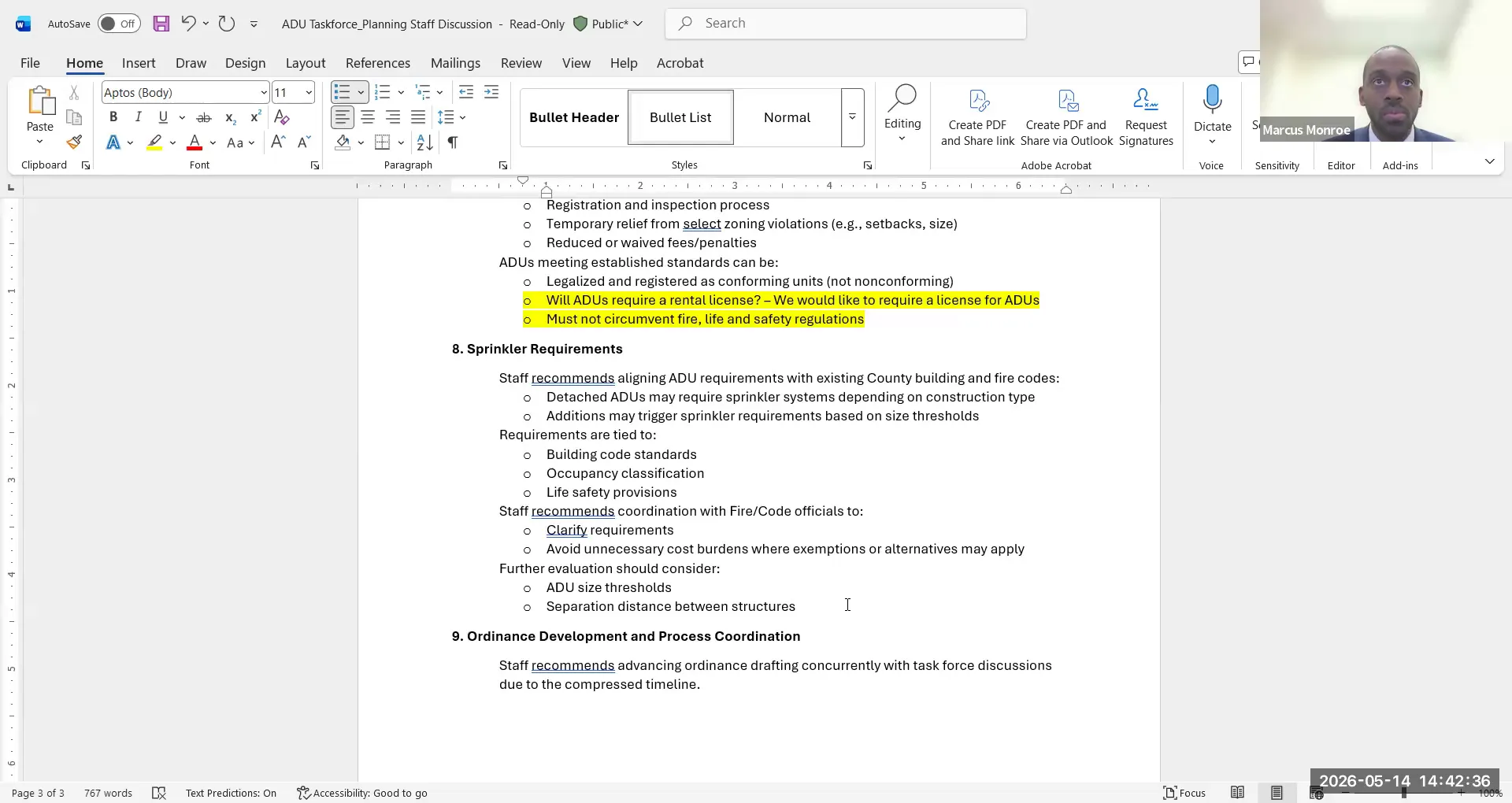
- Ms. Jo argued against mandatory owner-occupancy, stating it would unfairly restrict small homeowners who already rent out primary residences and wish to add ADUs for affordable housing. She urged the council not to overlook individual landlords in favor of large corporations.
- Ms. Sorrow strongly supported owner-occupancy to prevent ADUs from becoming investment businesses, noting that rental licensing already provides safety oversight.
- Mr. Campbell outlined added costs of small setbacks (surveys, access, fire safety) and supported 5 feet. He also noted the state bill HB1538 (requiring both internal and external ADUs) stalled in committee and is not law.
- Mr. Andrew supported amnesty but emphasized that life-safety requirements must not be waived. He cautioned against allowing ADUs to circumvent safety codes.
- Ms. Martin Russell raised concerns about maximum occupancy in ADUs and requested that occupancy limits be clearly referenced in the ordinance.
Discussion Items
- ADU Definition: The planning department recommended defining ADUs as a distinct residential use separate from accessory structures, explicitly as a self-contained dwelling unit with kitchen, bathroom, and sleeping area. Task force members agreed.
- Height Standards: The task force debated whether to restrict attached ADUs to the primary structure's roofline and set a 22-foot cap for detached units. Issues of slope and neighborhood compatibility were discussed. Consensus emerged: attached ADUs shall not exceed the height of the primary structure; detached ADUs shall not exceed 22 feet nor the height of the primary structure, with exceptions for slope to be addressed in code language.
- Zoning Applicability: The task force originally limited ADUs to single-family detached zones. Planning staff suggested allowing ADUs in all zones where single-family detached dwellings are permitted (e.g., RSFA, AG). A clear table for residents was recommended. The task force did not revisit the exclusion of townhouses.
- Setback Requirements: Planning staff recommended a minimum 5-foot setback for detached ADUs due to fire safety and livability standards. Task force members acknowledged the rationale and supported 5 feet, despite earlier consideration of 2 feet.
- Owner Occupancy: The task force had previously recommended that one dwelling unit be owner-occupied. Planning staff proposed flexibility for exemptions (e.g., medical, caregiving). After debate, the task force leaned toward requiring owner-occupancy with carve-outs for temporary absences and caregiving situations. No final vote was taken; further research was requested.
- Amnesty Framework: Planning staff presented a concept to legalize existing unpermitted ADUs by bringing them into compliance, focusing on safety rather than demolition. Several members supported the idea but stressed that life-safety codes must be met. The task force agreed to include an amnesty recommendation.
- Sprinkler Requirements: The existing county code requires sprinklers for new residential structures. Task force previously endorsed this. Planning staff raised cost concerns, especially for existing homes without sprinklers. Discussion included size thresholds and exemptions if the primary dwelling lacks sprinklers. No change was made to the recommendation, but staff were asked to explore cost-mitigation options.
Key Outcomes
- Consensus on Key Points:
- ADU definition as a dwelling unit with kitchen, bathroom, sleeping area, distinct from accessory structures.
- Height: Attached ADU not exceed primary structure; detached ADU not exceed 22 feet nor primary structure height, with slope considerations.
- Setbacks: Minimum 5 feet for detached ADUs.
- Zoning: ADUs by right where single-family detached is permitted; clear table to be created.
- Amnesty: Task force supports a framework to legalize existing unpermitted ADUs through safety compliance.
- Owner Occupancy: No final vote; task force directed further research on carve-outs and potential limitations.
- Sprinklers: Requirement affirmed; planning department to explore thresholds and cost relief.
- Drafting Authorized: The planning department will begin drafting ordinance language concurrent with finalizing recommendations.
- Next Steps: The task force may hold one more meeting to finalize recommendations before the June 8 legislative deadline. Members will vote by email on any updates to previous decisions. The chair will compile a unified document.
Meeting Transcript
We're ready to begin our accessory dwelling units task force meeting. This will likely be our last meeting. If we need to meet again, we will certainly reach out to all of the task force members to ask them to the availability for a new meeting. Today we're going to have a presentation from the planning department. Because they have looked over a lot of our recommendations. And as you all know, Mr. Marcus Munro is a task force member. So he's had access to a lot of information. Mr. Munro, may I turn it over to your staff to begin discussing some of the items that we have scheduled on our agenda today? Thank you. Can you hear me? Yes. All right. And so what we did is we framed it in the talking points document, Ms. I Tower. Can we pull that one up just to make it easier for everyone to follow along with pause there to see if that's possible? Yes, give me one second to share my screen. Can everyone see? For me, at least it says starting a oh, I see it now. Yes. Yes, I showed up. Okay. All right, excellent. And so I'm joined by a couple members of our our planning department staff. So what we wanted to do is one, just treat it as a conversation and a discussion. I understand that you know the task force has talked about a number of topics. And so what we did was really focus on key topic areas that we thought it was most important to provide more clarity around, provide more input, and that's around the definition, the high standards, zoning applicability and use permissions, set that requirements, you know, sort of permitting implementation clarity on our occupancy provisions, amnesty, um, and then a little bit of a discussion on spring clear and ordinance development overall. And so before I continue though, I want to make sure. Can I have our planning department staff or team members just introduce themselves? Hi everyone. Um I'm Andrea Gillis. Apologies if I'm coming in a little weird. Um I'm at planning board right now, but um I am the division chief of the community planning division. Um, and we work on various housing issues within the department. So happy to be here and thank you for all the work that you've been doing on this um this project. I appreciate it. Thank you. Hey, good afternoon, everyone. Um, my name is John Parks. I'm a staff planner uh working with the housing team. So just here to provide some uh additional information and support. And again, uh echoing Andrea's comments, I'm appreciative of all the work that the task force has has been doing. So looking forward to this conversation. And then John's being mild because he's also been part of the reason why we had some early information shared. So the ADU white paper that he and some of the team members working on, Karen who couldn't be here today, and then also the um ADU legislation um Excel document that sort of compared various legislation across the board. So he and his team have been really working hard on this uh for a number of years. So I just wanted to give you kudos for that. Um so Ms. ITR, what I want to do is just go through and as questions come up for each area, we can just fill them.
openpublica.com