Transportation, Infrastructure, Energy and Environment Committee Meeting – May 28, 2026
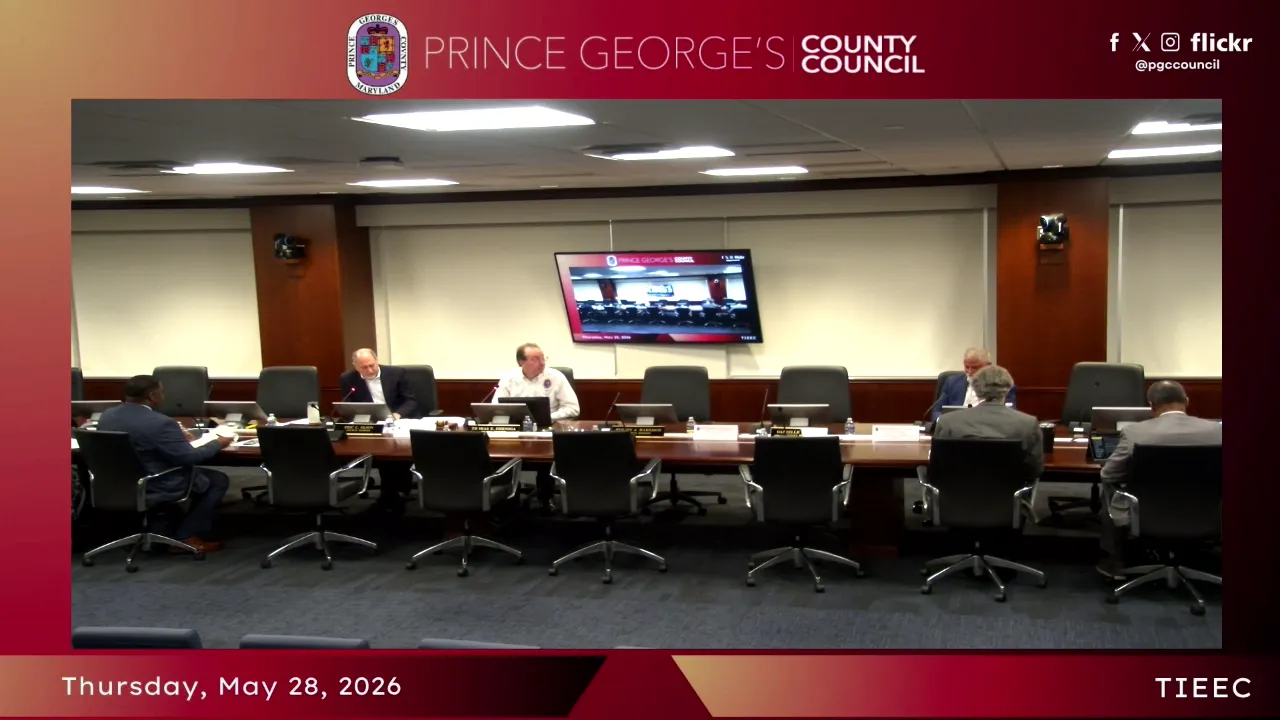
STREAMING COPY IN PREPARATION — RECORDING AVAILABLE FROM THE ORIGINAL SOURCE
Transportation, Infrastructure, Energy and Environment Committee Meeting – May 28, 2026
The Transportation, Infrastructure, Energy and Environment Committee of the Prince George's County Council met on May 28, 2026, at 10:07 AM in Committee Room 2027. Chair Thomas Dernoga, Vice Chair Eric Olson, and Council Member Sydney Harrison were present; Council Members Danielle Hunter and Timothy Adams were absent. The committee considered four legislative items, all of which were approved.
Discussion Items
-
CB-032-2026 – Housing and Property Standards for Non-Residential Property – This bill amends the county code to increase civil penalties for non-residential property owners who violate property maintenance standards. The current fine of $1,000 per violation would be replaced with a two-tier structure: $2,000 for the first violation and $5,000 for subsequent violations. Residential property fines remain unchanged. Sponsor Council Member Fisher explained the bill targets derelict commercial properties, including open green spaces that become attractive nuisances and sites for illegal activity. Committee staff noted the bill would have a nominal fiscal impact, with potential revenue increases. The Office of Law found it legally sufficient; the County Executive's Office took no official position but acknowledged the importance of addressing property vacancy. After discussion, a motion to recommend favorably carried 3–0.
-
CB-033-2026 – Vehicle Access and Recovery Emergency Act – This emergency act amends towing and impoundment laws to allow vehicle owners, authorized agents, and family members to redeem an impounded vehicle by providing specific identification and proof of relationship. The bill includes indemnification and a $500 fine for false statements. An amendment, proposed by Legislative Attorney Kathleen Canning and supported by sponsor Vice Chair Olson, removed the requirement that vehicle registration be issued by the Maryland Motor Vehicle Administration, thereby allowing registrations from any jurisdiction. The Office of Law found the bill legally sufficient; the County Executive's Office raised concerns about potential unintended risks but did not take an official position. The amendment passed 3–0, and the bill as amended was recommended favorably 3–0.
-
CR-034-2026 – Stop Sign Monitoring Systems, City of New Carrollton – This resolution approves locations for stop sign monitoring (cameras) in the City of New Carrollton. The city submitted all required documentation, including a request for up to 100 potential camera locations within a half-mile radius of three schools. Committee staff noted that not all locations would necessarily have cameras; the list provides flexibility. The resolution would have no fiscal impact on the county, as the municipality bears all costs and retains revenue. The Office of Law found it legally sufficient; the County Executive's Office had no position. A motion to recommend favorably carried 3–0.
-
CR-037-2026 – Stop Sign Monitoring Systems, Town of Bladensburg – This resolution approves similar stop sign monitoring for the Town of Bladensburg, which identified 48 eligible locations. All requirements were met. The Office of Law found it legally sufficient; the County Executive's Office had no position. A motion to recommend favorably carried 3–0.
Key Outcomes
- CB-032-2026: Recommended favorably (3–0). Moves to the full County Council.
- CB-033-2026: Amended (removed 'Maryland' from vehicle registration requirement) and recommended favorably as amended (3–0). Moves to the full County Council.
- CR-034-2026: Recommended favorably (3–0). Moves to the full County Council.
- CR-037-2026: Recommended favorably (3–0). Moves to the full County Council.
- The committee adjourned after completing its agenda. The next meeting is scheduled for June 25, 2026.
Meeting Transcript
Okay, good morning, everyone. This is uh Transportation Infrastructure, Energy and Environment Committee. Today is May 28th. Madam Clerk, please call the rolling Chair Danoga. Present. Vice Chair Olson. Here. Council Member Harrison. Three members present at roll call. Okay, thank you. So we have four items on the agenda today. I think they should go pretty expeditiously. So we'll jump right in with C B 32 2026, an act concerning housing and property standards for non-residential property. I'll turn to Mr. Battle. Thank you, Mr. Chair, members of the committee. CB32, uh amend subtitle 13, Division 7 to increase civil monetary fines for property standards and property maintenance violations on non-residential properties. Now these violations can uh include physical conditions that can be regarded as public nuisance uh that encourage trespassing, uh has sanitary sewage or plumbing facilities, constitutes an unsafe condition of structure, and in situations where facilities required by codes or regulations have been disconnected, destroyed, or removed. And on bottom line here, we're talking about unclean, unsanitary, littered with rubbish or garbage, or has uncontrolled growth of weeds. Um currently the subtitle has one fine structure for violations, uh, and that's $1,000 per violation for the responsible person. CB32 maintains the existing fine structure for residential property owners and establishes a new fine structure for non-residential property owners, as uh the new fine structure would be $2,000 for the first violation and $5,000 for second and subsequent violations. Um let's see here, and Mr. Chair, I think um at this point we can um hear some response remarks from the sponsor. Mr. Hurdle is here with the policy analysis and fiscal impact statement, and uh we can uh get some comments from the county execs office. I believe Mr. Oh, there he is. So Mr. Jackson is here from County Execs Office. Mr. Hurdle, anything to address good morning, Alex Hurdle, budget and policy analyst uh adoption of C B 32 2026 uh should only have a nominal fiscal impact on the county due to the mandated administrative duties cited in the legislation. Additionally, depending on the number of violations given out and actually paid this legislation could increase revenues overall for the county. I just wanted to note that uh we had not heard from the Department of Permitting Inspections and Enforcement. Um if they are here, I invite them to um provide any further analyst uh analysis. Thank you. Okay, let's uh hear from uh Ms. Fisher, the sponsor. Thank you, Mr. Chair, thank you, colleagues. I'm proud to introduce C B 32. Um as I was um going through solutions to issues uh throughout the county and my district in particular. I have found that it's been hard to keep non-uh residential property owners accountable for um basically attractive nuisance um that's going on in their properties and then um working with our uh Mr. Gonzalez and the other lawyers uh for um the council we found that the code already addresses it, but the fine structure really didn't match something um that's worthy to deter bad behavior. So this bill, as Mr. Battle went over, we'll just um separate uh residential property owners will be unaffected by this legislation. It'll stay the same for them, but for those that have any commercial utility, anything that's not residential, we'll be able to um find them at a higher rate so that they can get their um properties into compliance um and actually be incentivized to put structures in like a fence if they're it's caught their property. One particular property in my district's been basically a how a homeless encampment, and they refuse to basically put any money into enclosing their property, and so us being able to find at this rate um daily for that will hopefully incentivize them to actually invest in the property and clean it up. And I know um Ms. Adam Stafford has dealt with um some vacant commercial properties as well with similar situations.
openpublica.com