Committee of the Whole Meeting: Speeding Solutions Discussion - February 13, 2025
STREAMING COPY IN PREPARATION — RECORDING AVAILABLE FROM THE ORIGINAL SOURCE
Committee of the Whole Meeting: Speeding Solutions Discussion - February 13, 2025
This meeting was a presentation and discussion on strategies to address speeding issues within the city. Commissioner John Rooney (DPW/Engineering) and Police Chief (name not given) presented on engineering tools, enforcement efforts, and the need for a multi-faceted approach (education, enforcement, engineering). Alders asked questions and shared concerns about enforcement, road design, and consequences for reckless driving. No formal votes were taken; the meeting was informational and aimed at informing future budget decisions.
Discussion Items
-
Commissioner Rooney’s Presentation (Engineering Tools):
- Overview of DPW Engineering: Full staff of 5 project engineers, 4 engineering technicians, and a city engineer. Tools include traffic analysis, speed studies, and installation of traffic control devices per the Manual on Uniform Traffic Control Devices (MUTCD).
- Speed data collection: Pneumatic tube counters (seasonal), radar speed feedback signs (RSFS), and speed trailers. The 85th percentile speed is used to determine appropriate speed limits; drivers exceeding the speed limit by 10-11 mph are considered the problem group.
- Engineering strategies to reduce speed: Narrowing lanes, adding bike lanes, bump-outs, speed humps, and roundabouts. These create friction and slow traffic without enforcement.
- Speed hump process: Per recent ordinance, four property owners on a block can request a study; if conditions are met, a temporary hump is installed, and if effective, permanent installation is considered by the Common Council.
- Photo enforcement is not allowed in Wisconsin; state law change would be needed.
-
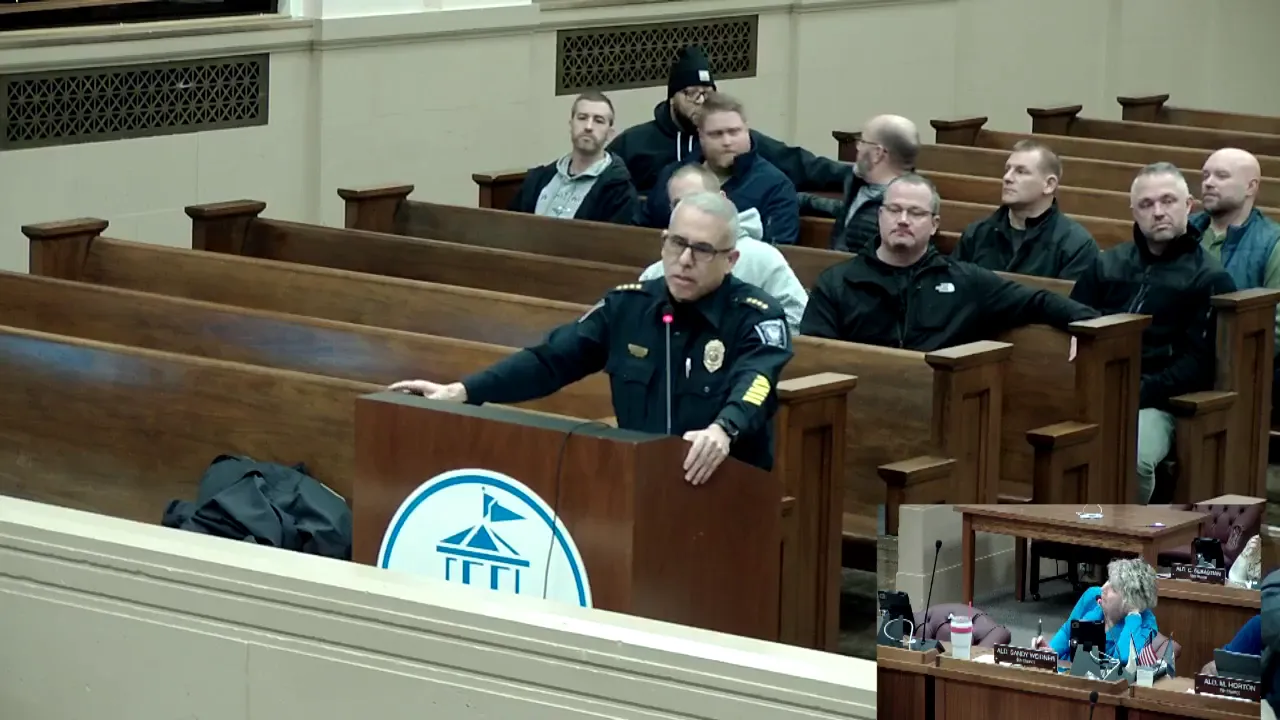
Police Chief’s Presentation (Enforcement):
- Enforcement statistics for 2024: 6,066 vehicles stopped (29% increase from 4,700 in 2023), and just under 6,000 traffic citations issued (26% increase).
- The department has 181 officers (authorized strength 196), but many are in training or on leave, limiting enforcement capacity.
- Speed trailers and speed boards are deployed based on complaints; nine pairs are currently in use, and 15 additional pairs (one per aldermanic district) are funded and will be installed.
- Chief emphasized the need for consequences: many drivers pay tickets or avoid points, and repeat offenders often continue driving without a license.
-
Alder Comments and Concerns:
- Alder Sebastian asked about pneumatic tube availability and requested more data collection. He noted the need for proactive vs. reactive measures.
- Alder Widener raised concerns about lack of enforcement of alternate side parking (affecting snow removal) and shared a personal story of a hit-and-run that totaled her car, with no prosecution due to lack of referral from Mount Pleasant Police. She called for better communication between police and the District Attorney's office.
- Alder Perez asked about the HAWK signal (high-intensity activated crosswalk).
- Alder Kelly asked about the speed hump request process and urged more enforcement.
- Commissioner Rooney suggested the council consider funding for friction-creating projects (e.g., protected bike lanes, bump-outs) in the 2026 budget, beyond the $100,000 previously allocated for speed humps.
Key Outcomes
- No formal decisions were made. The meeting was a discussion to inform future actions.
- Alders were encouraged to work with DPW to deploy speed data collection tubes and to request speed boards for their districts.
- The council was advised to consider funding for engineering measures (e.g., road narrowing, bump-outs) in the 2026 capital improvement budget.
- The police chief will continue enforcement operations and deploy the new speed boards as requested by alders.
- The issue of photo enforcement was noted as a possible legislative priority at the state level.
- The meeting concluded with a call for continued collaboration between DPW, police, and the council to address speeding and reckless driving.
Meeting Transcript
I didn't know, but I've heard several people say something. That's it. All right, we're ready ready to roll, guys. Good evening, everyone. Thank you for making it out for February 4th, committed to the whole meeting. We have a couple others that will not be here. That would be Alders Jones and Horton. And all their Caprellian will be coming late as far as I know. Today is simply a presentation and discussion. And the title is discussion, or excuse me, discuss solutions and strategies to assist with the speeding issues within the city. I have two speakers. Goal as always with one of these kind of things is to get the status and to ask of the department heads what they need from the council to keep things uh to advance the uh prevention of speeding in the city. So with that, and and in just a moment, I'll turn it over to Commissioner Rooney. Give me just a second. There you are. You've been promoted to city attorney here. Uh thank you, President McCarthy. Um I've got about a dozen slides I put together. So it's it's I thought it'd be like a little bit maybe of a you know, traffic 101, um, maybe helpful for some of the new alders. But just to give you an idea what DPW in particular engineering, um, what we can do and what we cannot do as it relates to um speeding and and just in general trying to uh uh do some things to help mitigate some traffic concerns. So with that, I'll kind of go through this and uh if you want to stop me as I go or wait till I'm done. Uh it's an entirely up to you. Um again, it's about a dozen slides, so if you can indulge me for that. Um just to you get started. A quick overview, you know, the tools that we have to address traffic safety. So we do have a full service engineering department. It's headed up by the city engineer. He is a professional engineer, and in that department we have five project engineers, three of them are professionals, and we have four engineering technicians on staff as well. So first time in quite a while, we've been fully staffed, so we have plenty of resources available to look into these things. I know we have in the past today. It's gonna take us a while to get back to you. Hopefully, we can shorten that up. Um, what do we do with our engineering staff? We can provide traffic analysis for recommended intersection control. So if you want to look at, you know, it's always stop, two-way stop, you know, yield uncontrolled intersections, we can look at those things. We can conduct parking studies. We also provide analysis for traffic signal timing, phasing, progressing of progression of traffic. We have in-house expertise in traffic signal detection devices. These are the induction loops, the video and the radar uh that uh detect vehicles and the controllers that run the intersections, whether they're pre-timed, semi-actuated, or fully actuated. We also have time-based coordinated systems that are networked by fiber optics that allow us to try to move traffic through corridors efficiently, provided those vehicles are driving at the posted speed limit. Um we can also uh conduct uh a study and provide recommendation for a speed up installation per the ordinance the common council just passed in November. So if you have uh constituent that's interested, uh have them and three of their neighbors get together and send me a letter and we'll get working on that. Um we can provide studies to collect data on traffic volume, speeds, directional split of traffic, what type of vehicles are going down the roadway. Those are usually defined by the number of axles. We can review accident reports from Recene Police Department to assess uh crash cause and recommend mitigation if needed. Sometimes ca crashes are are caused by things that cannot be fixed uh with traffic control. Uh and we have the ability to engage in uh several traffic engineering consulting firms uh for design study assistance if something's outside our expertise, and we also have uh TAPCO on board for technical support on our traffic signal devices as needed. So how do we do this? Again, we're professional engineers. We follow a number of uh handbooks to determine what we do for traffic control.
openpublica.com