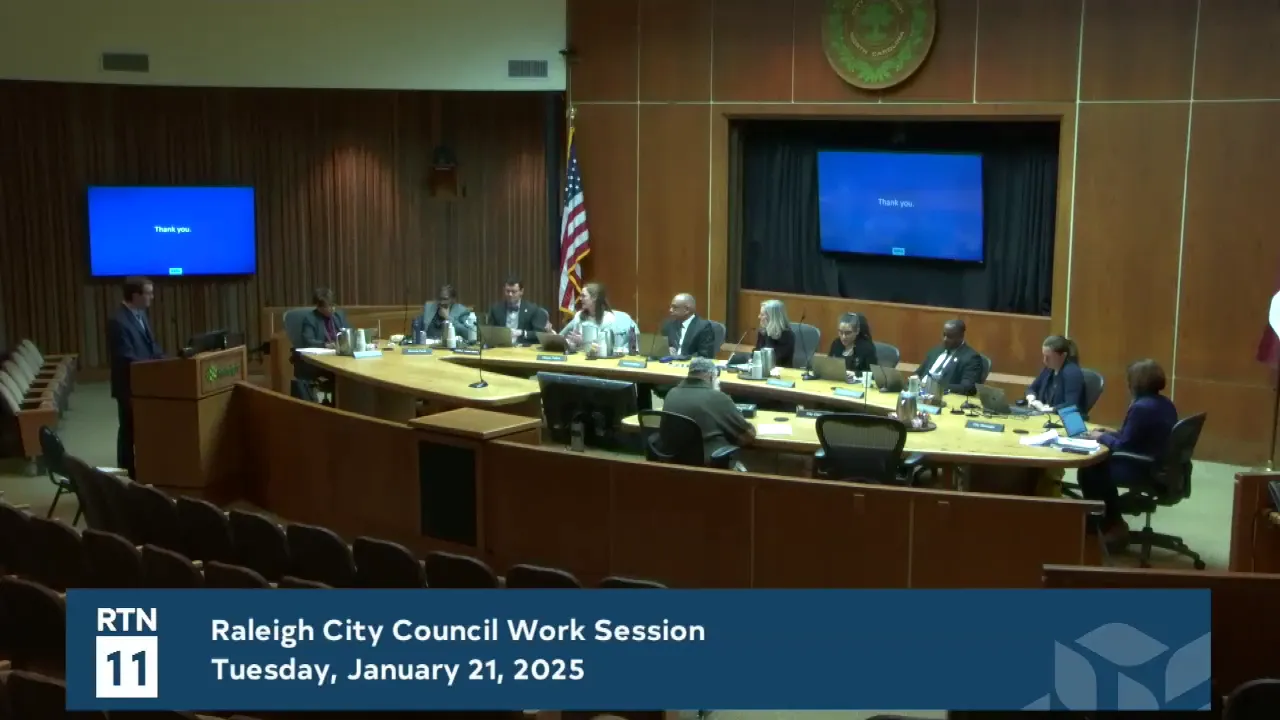
Raleigh City Council Work Session on Emergency Communications – January 21, 2025
STREAMING COPY IN PREPARATION — RECORDING AVAILABLE FROM THE ORIGINAL SOURCE
Raleigh City Council Work Session: Emergency Public Information & Crisis Communications – January 21, 2025
The Raleigh City Council held a work session on January 21, 2025, at 11:30 a.m. to receive an update on the city's emergency public information and crisis communication capabilities. The presentation was led by Communications Director Robin Deacle and Assistant Director Rand Northam, with contributions from the consulting firm Julie Parker Communications. The session focused on training, messaging tools, interagency coordination, and future preparedness.
Discussion Items
- Presentation Overview: Rand Northam explained that the city follows the National Incident Management System (NIMS) for crisis response. Since February 2024, the communications department has conducted three communication-specific trainings and developed message templates for anticipated emergencies. A contract with Julie Parker Communications (JPC) provides additional tabletop exercises; JPC has visited Raleigh twice with two more trainings planned in 2025. JPC representatives emphasized creating a safe space for mistakes during drills to build muscle memory and public trust.
- ReadyWake & Wireless Emergency Alerts (WEA): The city uses ReadyWake (Everbridge), hosted by Wake County, for subscription-based alerts and WEA for location-based, life-threatening alerts. Wake County Emergency Management is the sole authority to send WEA. The city has pre-drafted messages to expedite alerts. A recent incident on January 17, 2025 – an all-clear WEA sent countywide after an armed suspect was arrested – caused confusion because many residents did not receive the initial geofenced alert. Wake County is investigating the issue.
- Examples of Recent Activations: The Emergency Operations Center and Joint Information Center activated for election night (November 2024) and New Year's Eve. During Tropical Storm Debbie, the communications team worked with stormwater and Wake County to issue a flood warning that met national best-practice standards. A June 2024 drill involved nearly 30 city staff simulating a large tropical storm.
- Council Questions & Responses:
- Councilor Jones asked about the types of incidents that trigger WEA and clarified that Raleigh Police Department has used geolocated WEA for active searches. She noted confusion from the recent all-clear message without initial warning.
- Councilor Silver inquired about preparing for climate-change-related disasters (e.g., wildfires) not historically associated with North Carolina. Northam confirmed the city’s emergency operations plan includes all vulnerabilities, and templates are built accordingly. He also asked about communication during extreme heat/cold for vulnerable populations; Deacle cited partnerships with Wake County for white flag shelters and coordination with housing and police departments.
- Councilor Patton affirmed the value of learning from incidents in other cities (e.g., Los Angeles wildfires) and asked about setting regular update timelines. Northam agreed that establishing a cadence for updates – even with no new information – is a best practice.
- Councilor Harrison asked about social media strategy amid platform changes. Deacle reported the city maintains a presence on Facebook, X (Twitter), Instagram, YouTube, Nextdoor, Threads, and Bluesky. They avoid TikTok due to state security restrictions. The city has about 400,000 total followers, with roughly 1,000 engagements per post. Regarding misinformation, the city corrects factual errors but avoids prolonged back-and-forth.
Key Outcomes
- The communications department will continue training with Julie Parker Communications (two sessions in 2025) and work closely with the Office of Special Events for large permitted events like Dreamville.
- Rand Northam committed to providing Council with specific data on the average annual frequency of wireless emergency alerts issued in Wake County and how often the city activates an incident call center.
- The city will maintain its multi-platform social media presence and consider in-person outreach for community engagement.
- No votes or formal decisions were taken; the session was informational only.
Meeting Transcript
All right. We will call the work session to order, and I will turn it over to the city manager. Good morning, Mayor and Council. Hope everybody had a great MLK day of service yesterday, participating in events all throughout the city and the county over the weekend. And so today we're happy to be back in front of you with the 1130 work session. And the topic is emergency public information and crisis communication. The item is going to be presented by Rand Northam from the communications department. But Robin Deacle is going to tee it up. Thank you, manager. Good morning, Mayor and Council members. I'm Robin Deacle, the communications director. When I started interviewing about two years ago with the city, I had all these questions about crisis communications. What do you know about communicating in crisis? How can you help us do it better? Well, when I came on board, one of the first things I did was meet with our emergency management director, Chief Griffin, and we got to work. And the city follows operationally to respond to crisis, the national incident management system, which is a nice big name, for just a scalable system you can use to respond in crises, whether that is the event that happened at North Hills on Friday or the hurricane in the western part of the state, Helene, and all of the response that happened as a result of that. The most important thing you can do in those emergency situations is have a single point of contact, which is what the communications department is charged with covering. And I was very fortunate about a year ago to bring on board Rand Northam, who has overseen creating a lot of policies and procedures and practice to help us do that well. And I'm going to turn it over to him now. Thank you. Thank you, Robin. And good morning, Madam Mayor, City Council members, Madam Manager, Madam Attorney. I'm Rand Northam, Communications Department Assistant Director for Public Affairs. And today I'm going to briefly set the scene about crises and emergencies and how we communicate about them. We have been working hard to set us up better, including getting communication staff involved earlier in the process for large-scale events. A lot of that progress is thanks to strong focus on training. And we'll look ahead to what you can expect next. First, let's define a few things. PIOs are first responders. We are ready to respond when we are called, including nights, weekends, and holidays. An emergency may come on quickly. And like Chief Griffin says, it's not a matter of if, it's a matter of when. It is the city's duty to our residents and community members to be the reliable source for information, especially when it comes to public safety. Since I started with the city last February, we have held three communication specific trainings, in addition to other trainings and exercises hosted by emergency management and other outside agencies. We have developed templates for situations we can anticipate so that we are ready to get messaging to the community as quickly as possible. And we lead with the actions people should take to be safe. So this is a very basic example of an emergency alert message we may send. This brief version is an example of a message you might receive on your cell phone, and I'll talk more about that in a moment. We'll put similar messaging on other channels like social media and our website, where we can also give a few more details. In 2024, we signed a contract with Julie Parker Communications. JPC has been in Raleigh twice with two more trainings coming up this year. These trainings are open to all city departments. We look at local and national examples of communities that have experienced emergencies and crises, and we discuss how we would respond in those situations. We cover a wide range of topics and we make sure that there is a local focus during exercises to get as close to real world experience as possible. And here to hear directly from JPC, here are Julie and Christopher. We're here to help Raleigh get ready for communicating in a crisis. Cities will face a crisis. What we don't know is what exactly will that crisis be. When the crisis happens and all eyes are on you, that is your time to shine or to sink. Preparing for that through training is so important because it allows us to put the reps in of communicating with the public when a crisis is occurring, even though we're not sure yet what that future crisis will be.
openpublica.com