2025 City Council Retreat – Day 2 (January 25, 2025)
STREAMING COPY IN PREPARATION — RECORDING AVAILABLE FROM THE ORIGINAL SOURCE
2025 City Council Retreat – Day 2 (January 25, 2025)
The second day of the two-day retreat focused on housing affordability, smart growth, annexation impacts, and the structure of advisory boards and commissions. Council members engaged in a facilitated discussion on big ideas for the city, received detailed presentations from staff, and gave direction for future work. The day concluded with a team-building activity and closing reflections.
Discussion Items
Opening Reflections & Council Priorities
- The facilitator reviewed themes from Day 1: coordinating as a council, using data, leveraging individual strengths, staying close to the community, and navigating disagreement. Council members added a desire to discuss "big ideas" that drive the region.
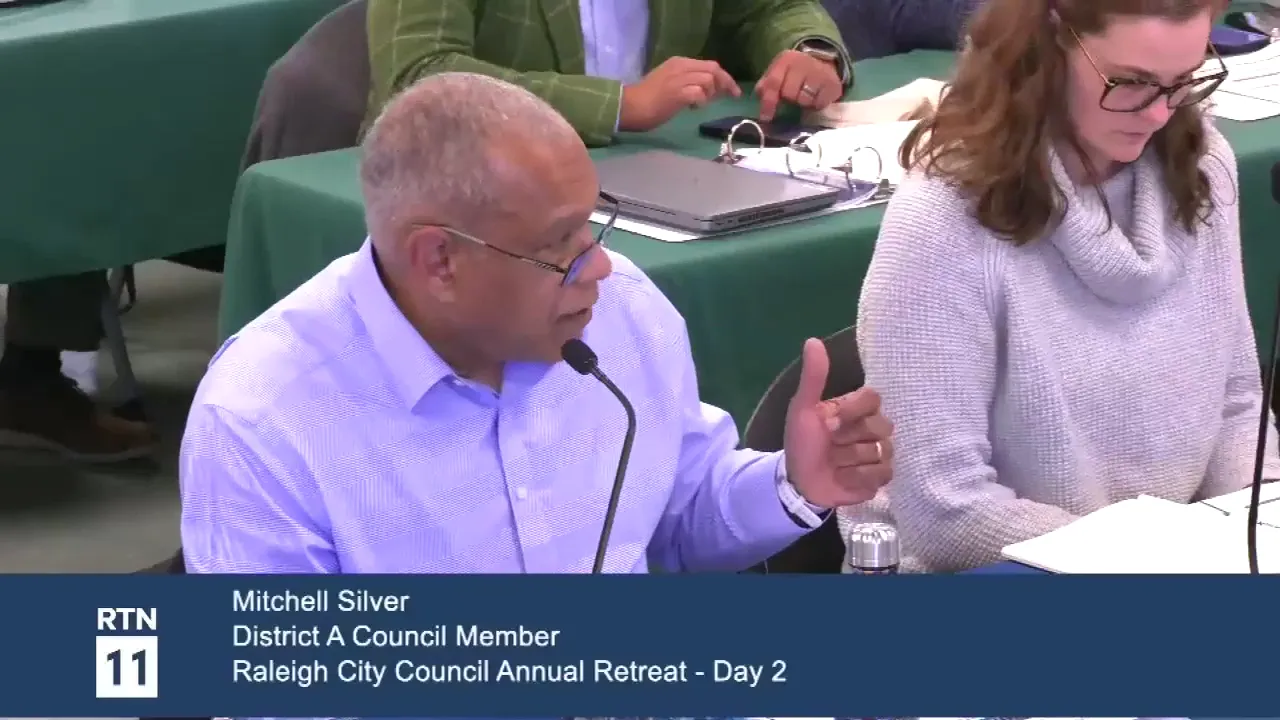
- Councilmember Silver highlighted past big ideas (e.g., Raleigh Union Station, downtown South, bus rapid transit) and urged a forum for new visions. Councilmember Forte emphasized balancing attention to areas outside downtown, such as Briar Creek and connections to Durham. Councilmember Jones mentioned streams, tree preservation, and activation of Triangle Town Center. Councilmember Patton advocated for greenways inspired by the Atlanta BeltLine. Councilmember Harrison noted the need to catalog past big ideas and track progress. Councilmember Silver clarified that big ideas are not always expensive; they set a focus and priority.
Housing Affordability Presentation
- Pat Young, Planning Director, presented on the housing affordability crisis. Key factors: high demand, land values, supply constraints, rising construction costs, and income inequality. He noted that 90% of housing is market-rate, and the city's missing middle reforms (2021–2022) have allowed over 3,600 units that would not have been permitted before, with about 30% of all new units being missing middle. Since 2022, rents and prices have stabilized.
- A video from Justine Underhill (Falls Church, VA councilmember) explained how new market-rate housing, even luxury, frees up lower-cost units through filtering chains, citing research that 100 new units free up 39 units in low-income neighborhoods. She addressed four common objections: supply skepticism, trickle-down economics, investor buying, and vacancies.
- Councilmember Forte questioned the filtering effect in a high-growth region with many new residents from outside; Young replied that 65% of movers are from the region. Councilmember Forte also noted the challenge for the lowest incomes, and the need for targeted affordable housing programs.
- Emily Sutton, Housing and Neighborhoods Director, presented on the city's affordable housing efforts. The city's 2016 goal of 5,700 units by 2026: 3,848 units built, 3,300 in pipeline, totaling 7,149 units. The 2020 affordable housing bond ($80M) is 75% allocated, supporting 1,100 units. She discussed the Bringing Neighbors Home pilot, which has enrolled 40 people, almost all housed, with a two-year support period. She highlighted the cost of homelessness vs. housing: sheltering costs $35,000–$96,000 per person per year, while housing with case management averages $8,000–$31,000. Peer cities (Houston, Dallas, Oklahoma City) have reduced unsheltered homelessness by 64% or more with similar programs.
- Councilmember Jones asked about the housing deficit; Young estimated about 35,000 units needed in Raleigh (based on 65,000 countywide). Councilmember Patton asked for a breakdown of units built vs. approved and data on income stratification. Councilmember Harrison requested a clearer dashboard of affordable housing projects.
Smart Growth and Annexations
- Pat Young, joined by Fire Chief Herbert Griffin, Interim Solid Waste Director Gregory Jenkins, Transportation Director Paul Callum, RPD Deputy Chief Rico Boyce, and Water Resources representative, discussed the impacts of growth on service delivery.
- Young presented three growth areas: city limits, ETJ, and potential future jurisdiction (urban services area). Since 2011, involuntary annexations are banned; the city only annexes by voluntary petition. Growth in the Northeast and Southeast (NESA/SESA) areas will accelerate with completion of I-540 in 2028.
- Low-density sprawl is more expensive to serve per acre. The city's current policies require annexation for utility connections, but state law (SB 382) limits the ability to require higher densities. The city is working on a fiscal analysis of these areas.
- Fire Chief Griffin: national standards call for 7-minute response time; lightweight construction can flash over in 7 minutes. Longer response times (15 minutes) increase firefighter and resident risk. He noted that new fire stations are needed and suggested dual police-fire stations.
- Deputy Chief Boyce: RPD will add a squad to the Southeast District (now three squads) and eventually a seventh district. A dual police-fire building was proposed to save costs.
- Transportation Director Callum: many annexation areas touch NCDOT roads; off-site improvements are limited. Challenges include funding for sidewalks, bike lanes, and congestion.
- Solid Waste Director Jenkins: adding routes strains thin staff and vehicle resources; maintaining weekly service is difficult.
- Water Resources representative: water supply planning is for 2070; climate models may extend the need for a new source to 2060. The Little River reservoir and Neuse River pipe alternatives are being evaluated.
- Councilmember Harrison expressed concern about continued sprawl and the disconnect between growth and service improvements. Councilmember Silver called for a policy decision to limit annexation and focus on infill development. Councilmember Branch noted the desire for homeownership requires land, which may be outside the city. Staff committed to providing a fiscally constrained plan for committed growth areas and options for uncommitted areas.
Advisory Boards and Commissions
- Evan (Assistant City Manager) presented on the structure of 29 boards/commissions, 26 on Granicus, 20 supported by Community Engagement. Demographic data shows members closely mirror the city's population. An exit survey revealed some dissatisfaction with board impact and support. Annual work plans are approved by council but often receive little scrutiny.
- Council discussed the need to evaluate the purpose and effectiveness of boards. Councilmember Jones noted that since 2020, five new boards were added without review. Councilmember Harrison suggested merger of boards with overlapping missions (e.g., historical resources and cemeteries). Councilmember Silver emphasized that boards are created by council and should be evaluated by council. Councilmember Patton proposed reorienting boards to provide advice on council priorities rather than planning events.
- Council gave direction to staff to provide the charter, purpose, and recent work plans for all 20 council-appointed boards, along with an assessment of whether each board is reactive or proactive. Staff will also benchmark against peer cities.
Key Outcomes
- Housing: Staff will provide a more detailed housing needs analysis, including income stratification, and a dashboard for affordable housing projects. The Bringing Neighbors Home pilot will be reported on in March with a budget request for continuation.
- Growth and Annexation: Staff will develop a fiscally constrained plan for committed growth areas (NESA/SESA) and explore options for uncommitted areas, including potential partnerships with neighboring towns. A fire master plan will be delivered in April. A consultant will estimate cost of services for these areas.
- Boards and Commissions: Staff will compile charters, work plans, and purpose statements for all 20 council-appointed boards, along with a categorization of each board as reactive or proactive. This information will be used for a future council discussion on potential mergers or restructuring.
- No formal votes were taken; all outcomes are directions to staff.
Meeting Transcript
To order, welcome to the second day of the two-day 2025 City Council retreat. Thank you, Mayor. Good morning, everyone. Happy Saturday. Welcome back to day two of your retreat. The way we're gonna start this morning is by taking a little bit of time to reflect. We have uh, as you all know, a pretty packed agenda with some really important topics that you all have asked for staff to come and present to you on. Um, but before we get into those topics, I want to take a few moments to reflect on what you all collectively sort of agreed upon, were the ways you wanted to spend your time in the next six months. Um, because I wanted to, and I've got them up here on in a more cleaned format than yesterday. I'm gonna read through them. I've added a little bit based on what I actually saw you all doing together during your time on Friday, um, and would be curious to hear from folks if there's ways that you want to make sure that we are able to do any of these specific actions today during the retreat that you haven't had a chance to do yet. So you sort of reflected individually and then collectively identified themes around how do we want to spend our time in the next six months. You said coordinating and collaborating as a council. You said uh collecting and understanding city data and national trends, and this came up many times yesterday. What data do we have as a city, and what data is there from partners that we can use to drive our decisions? Um leveraging your individual strengths and backgrounds. I know I heard from many of you sharing your experiences in different ways that you think can lend to the strength of the group. Uh staying close to the ground, making sure you're hearing from the community, taking care of yourselves so you can better serve the community, whether that's having something to eat, taking a nap, or sleeping it well at night. Um, and then successfully navigating disagreement and difficult conversations. And this one is fully one that I added, but I heard several of you really mention it outright, and I think successfully you did that yesterday with your public comment conversation where there wasn't full consensus, but everyone was able to have a conversation about something where you might not all had have agreed and found the similarities that you had and were able to also express the differences without it um becoming uh something that broke you all apart uh in the discussion. So those are uh the areas in which you've all identified you want to spend your time, and I'm curious if any of that feels like something you want to make sure we stress during today's retreat as something you would like to do that we haven't done yet. Yeah. Um, so this is what you want to spend your time together as a council doing. And if there's anything that we may not have gotten the chance to do yesterday, so I know I saw coordinating and collaborating as a council, um, hearing data from staff and using it to drive the direction that you wanted to give them, leveraging your individual strengths. So I know for example, your background, you've shared several times in the conversation yesterday about what you see, and I know several others did that as well. Um, hearing from the community and using that to drive your decisions, um, continuing to take care of yourselves. We're definitely going to give you breaks. So we're we'll take care of that one for you. And then successfully navigating disagreement. But curious if there's ways that you would hope to achieve that. Yeah, there's only one item. I know I put it on for our homework, and there wasn't a place to discuss it, but you know, what are reasons why I ran for council was about the big ideas. And I think this region was driven by the big ideas. And as we look at strategic direction, there was no place by the conversation. I know it was on the board, but we never discussed it, so it may not be now, but to me that's something I am very passionate about. What drives this region, whether it's uh bus rapid transit, uh Raleigh Eun Station, downtown South, transformation of Hillsborough Street. That there's an expectation, you know, Red Hat Amphitheater. There's an expectation about the big thing, big ideas. So just for you, it may not be today, but that's certainly an expectation I had that would like over the next few months for this council to spend some times on the big ideas. Yes. And I and this can be uh we won't have uh unlimited amount of time to do that, but if that would be something that the council would like to have a few moments to talk about, this would be a perfect time to do that before we get into presentation. So sort of talking about the reasons that you ran or that you re-ran or just the reasons you're sitting at this table that are big would be we can absolutely talk about that now. And if there's themes that emerge, I can jot them down as well. So I encourage you to share if you would like to. And um, yeah, I think it's one of the things that the public really gets excited about. Uh I don't want to be very specific, but certainly there were some opportunities. You know, Raleigh Magazine ran out a feature about the big ideas and solicited ideas, and it was their top article. I mean, people were very excited to talk about is it possible? We don't know, but just to aspire to some of the bigger things. For example, we talk about connection from downtown to Dix.
openpublica.com