Raleigh City Council Work Session: Wake Bus Rapid Transit Program Update (February 11, 2025)
STREAMING COPY IN PREPARATION — RECORDING AVAILABLE FROM THE ORIGINAL SOURCE
Raleigh City Council Work Session: Wake Bus Rapid Transit Program Update (February 11, 2025)
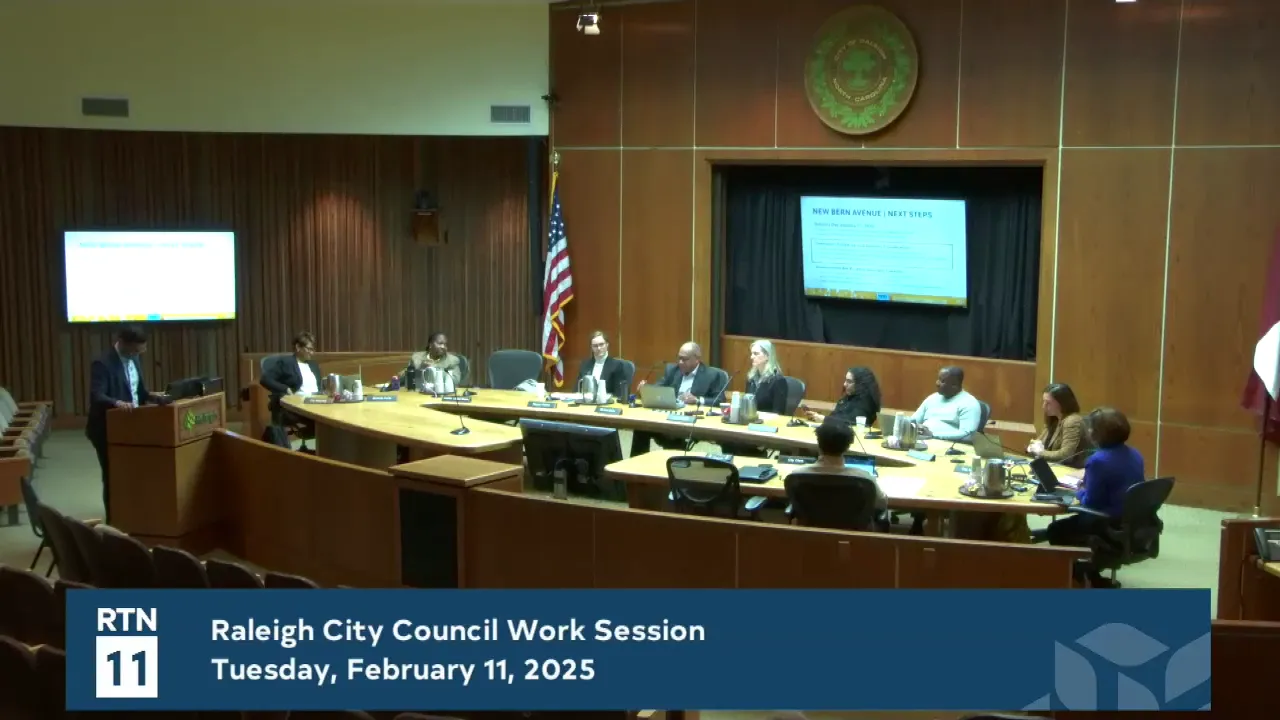
On Tuesday, February 11, 2025, at 4:00 PM, the Raleigh City Council held a work session to receive an update on the Wake Bus Rapid Transit (BRT) program. Staff from the Transportation Department presented the status of four BRT corridors—New Bern Avenue, Southern, Western, and Northern—covering design progress, construction bidding challenges, federal funding, and next steps. Councilmembers asked detailed questions about project viability, contractor interest, utility relocations, land use integration, and regional connectivity. The session concluded with an adjournment to the regular meeting at 7:00 PM.
Discussion Items
-
Program Overview: Staff (Hepatel) reviewed the 2016 Wake Transit Plan funded by a half-cent dedicated sales tax. BRT features include at least 50% dedicated bus lanes, enhanced stations with level boarding, 60-foot articulated buses, longer service hours (4 a.m.–midnight weekdays, 5:30 a.m.–midnight weekends), and 10-minute peak frequency. Dedicated lane types include curbside business-access/transit lanes, median-running transitways, and mixed traffic. Stations will incorporate solar panels to offset electric costs.
-
New Bern Avenue Corridor: This 5.4-mile corridor (3.8 miles of dedicated lanes, 10 stations, 7 CNG buses) has a full funding grant agreement with the FTA. After receiving no bids in March 2024 and one unacceptably high bid in October 2024 (rejected by Council in January 2025), staff are re-advertising the project in geographic packages: Area 1 & 3 (downtown and east of I-440) in late March/early April 2025, and Area 2 (median-running segment from Poole Road to Sunnybrook/WakeMed) in late June/early July 2025. Station construction will be bid separately after horizontal work is scheduled. Staff noted that private utility relocations are progressing and that market conditions, including construction demands from Hurricane Helene recovery, have affected contractor interest. Councilmember Silver urged careful street tree selection for shade.
-
Southern Corridor: A 5-mile corridor (3.8 miles of dedicated lanes, 9 stations, 7 CNG buses) including a new South Wilmington Street extension. At 30% design, with significant commercial property impacts. An $85.9 million federal allocation was made in May 2024. The project is expected to reach 60% design in early 2026, followed by condemnation authorization and right-of-way acquisition. Councilmember Forte asked about expediting the federal process; staff noted that reaching 60% design sooner would allow a risk review for a full funding grant agreement. Councilmember Silver questioned the choice of Wilmington Street over South Saunders Street; staff explained that South Saunders has heavy traffic and poor pedestrian crossings, while city-owned parcels along the Wilmington flyover offer redevelopment opportunities. The preferred alternative was adopted by the Town of Garner, CAMPO, and the City of Raleigh.
-
Western Corridor: A 12-mile corridor (7.5 miles of dedicated lanes, 18 stations, 10 buses) connecting downtown Raleigh to Cary via Western Boulevard and a new extension to Maynard/Chatham. It recently entered final design (contract authorized December 2024). A federal ratings application was submitted in August 2024; results expected in spring 2025 (the President's budget timeline). Buses may be electric or alternative fuel. Councilmember Branch noted the Buck Jones Road extension (new roadway) is part of the project.
-
Northern Corridor: Still in the major investment study phase (not yet in federal process). The study is examining two connections: downtown to Midtown (via Atlantic/Six Forks alternatives) and downtown to Triangle Town Center (via Capitol Boulevard/Atlantic alternatives). Two alternatives for each connection will advance to detailed screening. Staff clarified that these are separate projects, not an “either/or.” Public engagement on the detailed screening is planned for summer 2025, with a local preferred alternative selection to be brought back to Council. Councilmember Patton noted the existing high ridership on Route 1. Councilmember Silver emphasized that land use and transportation planning must proceed in tandem, given the enormous development potential north of I-440. Councilmember Jones raised concerns that District E (Glenwood Avenue area) is excluded; staff noted Glenwood is being considered in the broader Wake Transit Plan update. Councilmember Branch discussed coordination with NCDOT’s US 1 modifications and the S-line commuter rail project. Assistant City Manager Michael Moram confirmed that BRT and the S-line are complementary services. Councilmember Harrison and staff also discussed the need to connect BRT stations with first/last-mile pedestrian and bicycle infrastructure.
-
Federal Funding & Risk: For the New Bern corridor, the FTA grant is already being drawn down for design work, so there is no “money back” deadline. For Southern and Western, allocated funds may be at risk if not obligated under an executed contract. Staff acknowledged the uncertain federal environment. Councilmember Silver expressed confidence that the project is worthwhile but needs the right contracting approach; he noted that the unpredictability of underground utilities and subcontractor availability are key risks.
-
Other Topics: Councilmember Jones asked about the cost-effectiveness of solar panels on stations. Council suggested that if the articulated buses cannot be used on BRT service soon, the city should explore creative ways to deploy them in revenue service (though a federal waiver would be required). Councilmember Patton offered comfort to the public that BRT is still viable, citing similar projects in other states and the fact that dedicated bus lanes are essentially road-building work.
Key Outcomes
- Staff provided a status update on all four BRT corridors. No formal votes were taken, as this was a work session.
- The Northern Corridor study will proceed with two alternatives per connection proceeding to detailed screening. Council will receive a future report with locally preferred alternatives.
- The New Bern Avenue corridor will be re-advertised in two geographic packages in early and mid-2025, with a separate station construction package to follow.
- Staff will follow up on Council questions about solar panel cost analysis and federal funding ratings for the Western Corridor.
- Councilmembers reiterated the need for integrated land-use planning, pedestrian connectivity, and regional coordination with NCDOT and neighboring municipalities.
Meeting Transcript
Welcome to the work session. We will convene and I will hand it over to staff to talk about bus rapid transit. Good afternoon, Mayor and Council. We have the one item on the agenda today, and we have staff from transportation hit the tail and David Eatman here for the presentation and questions. Good afternoon, Mayor and Raleigh Council. My name is Hepatel. I'm with the transit division within the Transportation Department for the City. I will be providing the update on the bus rapid transit program. And our agenda today really again is to go over the overview of the program, the projects that are within our purview. Those are the four key corridors that were identified in the Wake Transit Plan, and then providing a project status update for each corridor. We always like to level set our presentations on the Bus Rapid Transit program with the initiation of the 2016 Wake Transit Plan and the Wake County Half Sense dedicated Sales Ta was passed by the county to improve the public transit network within the county. It identified four big moves connecting the region, connecting all Wake County communities, providing frequent reliable urban mobility and enhancing access to transit. Bus Rapid Transit really falls within that third big move, which is providing frequent reliable urban mobility. And I'm going to go over a few key features of bus rapid transit that make it stand out from the local bus service. So our system standards on the Wake Transit Plan identified that all of our corridors would have at least 50% dedicated bus lanes. That is an essential component of bus rapid transit. Uh enhanced stations. So these are stations that are a little bit larger than your regular bus shelter. Most of them will be level boarding. So again, when the bus pulls up to the station, the floor of the platform is level to the bus, and you can get on and off more easily. We will have specialized vehicles, which is the 60-foot articulated buses that have more capacity, standing room, seating room, as well as opportunities for bicycles to be loaded inside the vehicle as opposed to in front of the vehicle. Mr. Patel, I just um I wanted to say that um Councilor Lambert Melton is under the weather today, so he has an excused absence just so people aren't waiting for him to arrive. So sorry to interrupt. No problem. And I'm happy to pause after each project update if we want to do that. Uh or we can go through the entire presentation and take questions at the very end. Um, which one was so uh bus rapid transit features will also include a longer span of service, so they'll the buses will run from 4 a.m. to midnight on weekdays and 5 30 a.m. to midnight on weekends. That's about an hour more in either uh time frame than the regular bus service. And there will be more frequent service, so the buses will run every 10 minutes during peak hours in the morning and afternoons, and then it will match the high frequency network of the fixed route system for the rest of the day. From a program perspective, there are ways that we can achieve dedicated bus lanes on our corridors. Uh there are two different ways to do that. Within an urban environment like downtown and some of the one-way uh streets. We have buses that are running on the right curb of the road, so along the right side of the road. That rightmost lane turns into a bus-only lane. It is still open to vehicles that are trying to make the right turning movement into a driveway or a business, but that is predominantly meant for buses to operate within. And then we do have another visual of this kind of in the downtown environment again at Wilmington Street. Um, the red lane on the right side of the roadway, right in front of Taz. I did want to highlight from a station design perspective. We have gone through a system standards conversation that included uh the Transit Planning Advisory Committee at Wake Transit Plan as well as our key partner jurisdictions within the town of Garner and Town of Carey as our projects advance into their municipalities to really identify how we would have station customization options where there are elements that can be customized to meet the neighborhood context, architectural setting of that station, as well as in urban core environments where we have more flow and permeability in and out of the stations, more visibility for the businesses behind the stations themselves. Then we have a dedicated bus lane treatment within the median running transit way. These are dedicated bus lanes that are physically separated from the general purpose traffic. And so in this situation, the level of service for transit is the highest it can be. There are no conflicts with other vehicles. The buses can be more reliable to get from point A to point B. That helps with that on-time performance of our rapid bus uh transit service. We do also, from a station design perspective, have plans for solar on the BRT stations that can offset solar costs or electric costs to the station itself, whatever the electricity is being used at the station can be offset by solar that is producing that energy. We have another rendering here of the median running transitway.
openpublica.com