Raleigh City Council Work Session on Organics and Leaf Collection - April 8, 2025
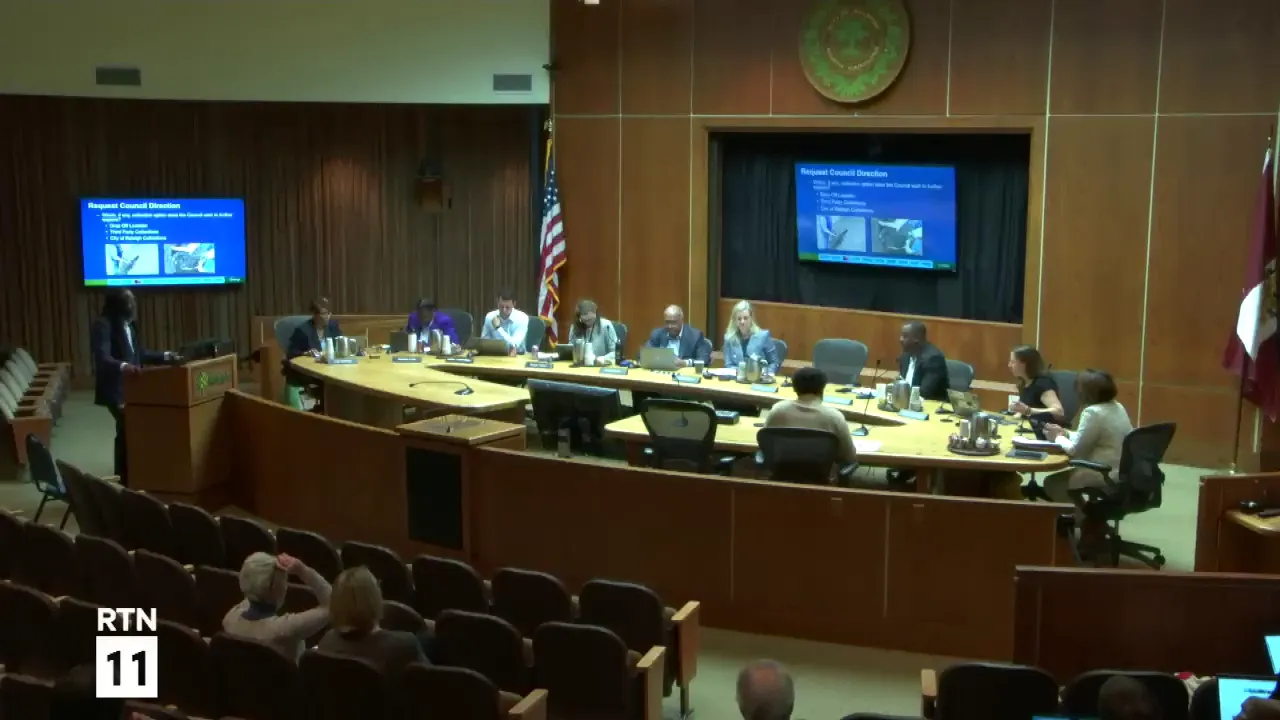
STREAMING COPY IN PREPARATION — RECORDING AVAILABLE FROM THE ORIGINAL SOURCE
Raleigh City Council Work Session on Organics and Leaf Collection - April 8, 2025
The Raleigh City Council convened a work session on April 8, 2025. Councilmember Jones was excused. The council discussed two major Solid Waste and Transportation initiatives: incorporating food waste into the Yard Waste Center program and evaluating the future of the Loose Leaf Collection program.
Yard Waste Center Organics Management Feasibility Study
Presentation: Gregory Jenkins, Interim Director of Solid Waste Services, presented feasibility options for composting food waste.
Key Statistics:
- 25% of landfill waste (25,000 tons per year) is food waste.
- Current permit allows for a short-term processing pilot at the Yard Waste Center.
Collection Options Discussed:
- Drop-off Sites: 18-20 convenience sites across the city.
- Third-Party Contract: Partner with an existing vendor offering curbside subscription services.
- City Curbside: City-run program requiring a fourth cart for single-family homes.
Council Positions:
- Councilor Branch: Opposed Option 3 due to cost and resident burden; supported a hybrid of Options 1 and 2 for the pilot.
- Councilor Silver: Supported starting with Option 1 (drop-off) to test resident engagement.
- Councilor Patton: Supported Options 2 or 3 for the highest waste diversion fidelity, expressing concern that drop-offs would yield poor participation and underestimate public interest.
- Councilor Lambert-Melton: Supported a hybrid approach to gather data from both collection methods.
- Mayor Cowell: Emphasized the need for accessible, free participation options, suggesting partnerships with parks for drop-off locations. Noted lessons from a past clothing recycling pilot.
Outcome: Council directed staff to explore a hybrid pilot combining drop-off sites (Option 1) and a third-party collection contract (Option 2), with a request for detailed cost projections.
Loose Leaf Collection Program - Overview, Challenges, and Recommendations
Presentation: Steve Halsey, Assistant Director of Transportation Maintenance, provided an overview of the program's challenges and four potential paths forward.
Key Statistics:
- 14,000 new collection points added between 2010 and 2023.
- No significant program changes since 2011.
- The program uses 61 staff (48 flexed from core maintenance duties).
- Average of 64,383 cubic yards of leaves collected annually in the last two seasons.
- Annual program cost: $3.1 million.
Options Presented:
- No Change: Acknowledged increasing resident dissatisfaction.
- Enhance Existing: Previously proposed as a budget note (2023), not adopted.
- Privatization: Contractor-based model (cited Henrico County, VA).
- Transition to Enhanced Yard Waste: Weekly/bi-weekly collection by Solid Waste Services (cited Greensboro, NC).
Council Positions:
- Councilor Lambert-Melton: Described the current program as unsustainable, stating none of the four options seemed fully viable but acknowledging change must happen.
- Councilor Branch: Strongly supported Option 4 (enhanced yard waste), citing existing equipment and green cart infrastructure.
- Councilor Silver: Supported Option 4, framing it as a public safety issue due to blocked bike lanes, sidewalks, and storm drains.
- Councilor Harrison: Supported a transition, asking about feasibility of on-demand bulk leaf pickup and a single-pass schedule as an interim step.
- Councilor Patton: Advocated for an "off-ramp" from the large-scale loose leaf program, including subsidizing biodegradable bags and partnering with groups like Trees for the Triangle for on-site mulching.
- Mayor Cowell: Acknowledged significant potential resident backlash but expressed support for Option 4, specifically requesting analysis of a paid "bulky load" on-demand service for residents with large properties.
Outcome: Council directed staff to conduct a detailed investigation of Option 4 (Enhanced Yard Waste Program). The analysis should include service frequency (weekly vs. bi-weekly), staffing models (new hires vs. existing), potential on-demand bulky leaf services, and resident transition support (e.g., free bags, education campaigns).
Meeting Transcript
Gavelus into order. And we have one excused absence. Councilmember Jones is not in town. Everybody else is here, so we will start it. This is the Yard Waste Center is the first item on the agenda, and we have Mr. Gregory Jenkins. The second. Good afternoon for the second day in the row here. Right. All right. I am the interim director of Solid Waste Services. This afternoon I'm going to be speaking to you about organics management feasibility study. The purpose of this presentation is to narrow down options for you to narrow down some options for us so that staff can get a more detailed and budget projections for future conversations. And then we will open it up for questions and discussion. Now we will transition to considering the process required to incorporate food waste into our collection and processing to the City Service offerings. Composting requires two distinct operational improvements. One, collections. How will Solid Waste Service collect, transport food waste from residential or public locations? Two processing. Once the food is collected, where and how will it be processed? Now we will discuss the processing. Here is a map of the compost processing facilities in our region. McGill Mary Oaks, 30 miles away, one way from the Yard Waste Center, accepts food waste, but has a limited capacity. NC State research NC State has a small facility and only processes food waste related to the university, and Brooks contract in Goldstone is 60 miles one direction and is the most utilized by third-party contractors operating in Wake County. Opportunity. Site improvements for stormwater and other needs are already in the budget in the CIP for future years. In order to consider the feasibility of the Yard Waste Center to accept and process food waste, staff recommend exploring an initial pilot to test food waste quantities, the compost mix and recipe operations and final compost product. Case studies demonstrate starting small and working up yields the best results. Because food waste is already being collected by a third-party vendor, the center could accept food waste as part of a pilot without incurring any expans any expansion in collection operations. Our current permit will allow for a short-term pilot. Collections. Now that we discussed the infrastructure improvement needs, let's transition to the operational concerns with food waste collections. For collections, we will discuss three options demonstrating a range of costs of investment and operational requirements. Staff recommends the following approach to piloting a processing program, piloting a processing program that will start similar to what we started got tongue-tag on that. We will pilot it very similar to our processing program where we will start small and work our way up. This approach will lessen the upfront capital and personnel investment. The city could install a food waste convenience site strategically located throughout the city. 18 to 20 locations could fully cover the city and yield the desired collection amounts. Service in the bins could be managed by either the city or a third party. The next option would be to establish a contract with an existing vendor that already has curbside subscription services to residents. This would be a benefit to the City for open offering a local processing at the Yard Waste Center, and the City would benefit by offsetting the need to expand operational expenses. The City and the third option would be for the City to, which would be also the largest, will be to actually collect curbside, which will be a huge investment. In order to accommodate curbside collection for the best practice and management, Solid Waste will need to acquire and distribute a fourth bin to each residence. Adding a fourth bin will flow will require an assessment to impact staffing, routes, vehicle infrastructure, customer service, and more. So our request in front of council today is to help us by giving us a little direction in which option do you want us to further explore? Questions and discussion. Thank you so much for the presentation. Councilor Harrison. Yeah, thank you so much. Really excited to see this study done and to see the various options.
openpublica.com