Raleigh City Council Work Session on Former DMV Site Update - June 17, 2025
STREAMING COPY IN PREPARATION — RECORDING AVAILABLE FROM THE ORIGINAL SOURCE
Raleigh City Council Work Session on Former DMV Site Update - June 17, 2025
The Raleigh City Council held a work session on June 17, 2025, at 11:30 a.m. to receive an update on the redevelopment of the former NCDMV headquarters site at 1100 New Bern Avenue. The session featured presentations from staff on community engagement, market analysis, and proposed next steps for the site's redevelopment. No votes were taken; the session was informational and discussion-oriented.
Discussion Items
- Community Engagement Overview: Taisha Mosley (Community Engagement Office) reported on 20 months of engagement, including over 50 community meetings, 13 project working group meetings, and a community survey. The project working group, which held its final meeting on June 12, 2025, identified six high-priority uses: affordable housing (targeting families under 60% AMI), retail (local businesses reflecting historic corridor), community space (multi-purpose, flexible), food incubator/co-op, universal site design (beyond ADA), and cultural recognition (art, markers). Low priorities included sustainability, varied architecture, and childcare options.
- Staff Proposal for Next Steps: Ken Bowers (Planning and Development) outlined a two-step process: first a market and feasibility study, then a request for qualifications (RFQ) followed by a request for proposals (RFP). He presented two options for the main 5.5-acre block: a single RFP for a development team (estimated 325 market-rate units and 110 affordable units, generating ~$10M land value) or multiple RFPs for subdivided parcels (likely lower unit yield and slower timeline). The smaller parcels south of Hargett Street would be handled separately via the city's small-scale development program.
- Questions and Comments from Council
- Councilor Silver: Asked about integrating open space into the site design and ensuring adequate sidewalk width along New Bern Avenue, especially given planned BRT. Staff noted the site would need rezoning to a CX district with higher height limits and wider sidewalks.
- Councilor Branch: Inquired about coordination with Martin Street Baptist Church (adjacent to the small parcels) and anti-displacement strategies. He shared insights from Austin, Texas, and urged exploration of anti-displacement mapping. He also emphasized the importance of creating jobs on the site, not just housing, to replace the 300 jobs lost when the DMV left.
- Councilor Patton: No questions.
- Mayor's Closing Remarks: Mayor Cowell thanked the community for their involvement and noted the city's commitment to responsible development of the site, which was acquired for over $20 million.
Key Outcomes
- Staff will issue an RFP for a market and feasibility study as early as June 18, 2025, with results expected in fall 2025.
- Following the study, the city will issue either a single or multiple RFQ/RFPs for the main block, with a recommended development partner expected in spring 2026.
- Council directed staff to explore anti-displacement strategies and to ensure job creation is a priority in the development.
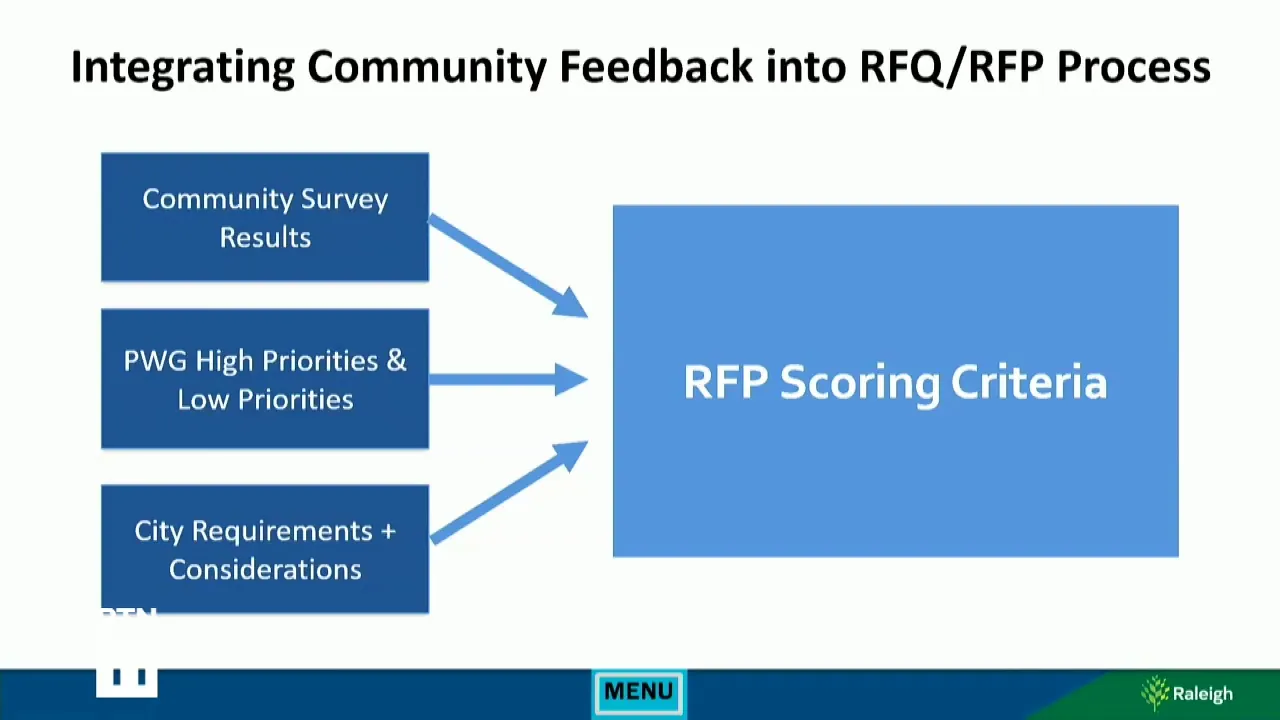
- The project working group's final list of community priorities will be incorporated into the RFP scoring criteria.
Meeting Transcript
Work session will come to order. Thank you. All right. Good morning, uh Mayor and Council. Today's work session, we have one topic, and that topic is an update on the DMV site. You will recall the city acquired this property from the state of North Carolina, and we've gone through an exercise of gaining community input and feedback into what could be some potential opportunities. So today we have a trio presentation. We have Nikki Jones, we have Taisha Mosley, and we have Ken Bowers here to present this item. Good afternoon, Mayor and Council. And I will work fast because I do think this presentation may go a little bit long. Nikki Jones, City Manager's Office. So as part of our regular cadence to bring this body major project updates, today we're going to talk about the DMV site. So today I have Director Mosley, Professor Bowers with us, and we will update you all on the work that they and their great teams have been working on. So if you didn't know, we have been engaging with the community for 20 months. And we anticipate demolition being complete on the big block side, if you will, uh this time next year. So with that, I'm going to pass it over to Director Mosley to talk about our community engagement efforts. Good morning, Mayor, Council, City Manager, Taisha Mosley with the community engagement office. So we spent a little bit of time talking about the site. As you can guess, we are now going to shift to discussing the community. This beautiful photo that you see here is a picture of residents who lived in the area in the 1950s. Community engagement was critical to this process because we wanted to honor and preserve the rich history of the Newborn Avenue Corridor. We also wanted to ensure that we understood the needs and the community's vision for the site. Many are in the audience today, if you don't mind standing for me, please. And just giving them a round of applause. All right. So I just want to remind council that the community engagement framework was the roadmap to our work. It included four steps. Step one was the research. This is when we began in October of 2023, having conversations and engagement with residents and trying to gain input and ideas around how we could best inform engagement for the site. We began conversations with organizations like Prosper Portland and Williams and Russell CDC, who had a lot of engagement, who had a lot of experience with engagement and redevelopment processes. And we took their experiences and best practices and we brought that back here to figure out how we can incorporate it in Raleigh. Step two was when we focused a lot of our time on temporary site activations. We knew that once that final group of state employees left the site that it was going to be vacant, and we had a couple of goals. One, bring people to the site, two, have conversations with them about what they felt and thought that the community needed, and then three, share information with them about how they can get involved in the process. Step three is where we spent the majority of our time learn and ideate. So I mean, excuse me, prioritize and curate. So we had a lot of community presentations, and by a lot, I mean over 50. This is when the project working group began exploring site opportunities. They actually held their last formal meeting on June 12th, which was last week, and they put the final touches on those site opportunities. And then step four of the process, Kim Bowers would talk more about the market study, the request for proposal, et cetera. So these project working group members are truly the authentic ambassadors to the broader community. They conducted a deep dive on redevelopment processes. So some individuals came to the working group who studied redevelopment in their free time. Others did not know much about the processes. And so thankful to our planning and development staff, they really conducted a deep dive. Their case studies ranged from local and national case studies on transit-oriented development, mixed-income housing, et cetera. And they had over 13 months of meetings and having conversations about how their legacy residents, neighborhood advocates could work together to turn the site into the community's vision. But in addition to the responsibilities of the group, they also created several milestones. And their biggest milestone was creating a vetted list that provides an overview of potential site opportunities that align with the community's vision. And I'm very happy to report that they accomplished that, and you will hear the details of that milestone in just a few.
openpublica.com