Redmond Planning Commission Study Session on Capital Facilities Plan 2050 – General Government – September 24, 2025
STREAMING COPY IN PREPARATION — RECORDING AVAILABLE FROM THE ORIGINAL SOURCE
Redmond Planning Commission Study Session on Capital Facilities Plan 2050 – General Government – September 24, 2025
The Redmond Planning Commission held a study session on the Capital Facilities Plan 2050 – General Government (CFP 2050), which will be adopted by reference into the Redmond 2050 Comprehensive Plan. Commissioners reviewed the plan’s contents, raised questions on prioritization, resilience, community outreach, and document clarity, and discussed an issues matrix in preparation for a public hearing scheduled for October 8, 2025.
Consent Calendar
- Unanimously approved the meeting agenda.
- Unanimously approved the meeting summary from August 27, 2025.
Public Comments & Testimony
- David Morton (Redmond 98053) spoke on the proposed strategies for the Environmental Sustainability Action Plan 2025 refresh. He commended staff for comprehensive work and the shift to a “five big moves” framework. He emphasized that community empowerment and financial accessibility are critical, urging that programs be low-cost and accessible to low-income households. He also stressed the need for clear, quantifiable metrics to track progress toward climate goals.
Discussion Items
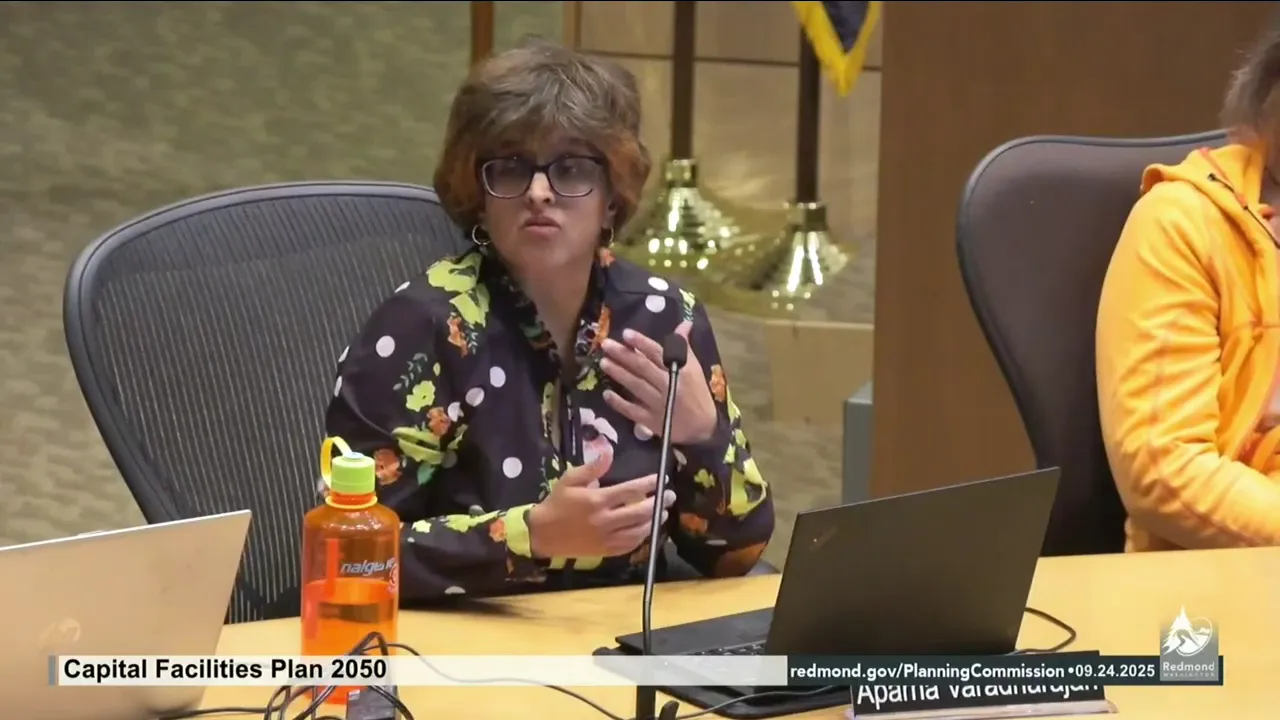
- Study Session on Capital Facilities Plan 2050 – General Government – Senior Parks Planner Cameron Zapata presented the CFP 2050, which forecasts capital facility needs to 2050 based on Redmond 2050 growth targets. The plan covers fire, police, maintenance/operations, indoor recreation, and administrative facilities. Key findings include: most facilities are in reasonably good condition except fire stations 11, 12, 13, and the old firehouse teen center; multiple buildings will reach end of service life before 2050; and environmental improvements from electrification can improve performance. Projects are prioritized into near-term (2027–2032), medium-term, long-term, and beyond-2050 buckets. A cost summary graphic showed spending spread across functional areas. Revenue sources include councilmanic, voter-approved, and revenue bonds, as well as impact fees.
- Issues Matrix Discussion – Commissioners reviewed existing questions and raised new ones. Commissioner Aparna Varadharajan requested adding resilience policies (e.g., FWCR2 from Redmond 2050) as key elements and asked about material specifications to improve durability under climate extremes. Commissioner Tara Van Niman noted the document’s organization but requested hyperlinks and clearer page references to help readers navigate, especially for the large administrative cost bucket. Commissioner Bryan Copley observed mismatched colors in the revenue sources chart. Commissioner Adam Coleman questioned why fire station renovations are not prioritized as number one in the timing of projects, given previous underinvestment. Staff explained that the plan is a high-level list of projects, not a budget, and that funding streams are separate; the fire functional plan addresses prioritization. Commissioner Denice Gagner asked how the city gathered feedback from vulnerable communities and how outreach is done for non-English speakers. Chair Susan Weston requested a crosslink to emergency preparedness expectations, noting concerns about access from Grasson. Vice Chair Jeannine Woodyear asked about contingency plans for revenue sources, particularly the 25% reliance on REITs, and staff clarified that the plan is a long-term guesstimate that will be refined during budgeting. Commissioner Coleman also inquired about the Redmond pool and aquatic center plans; staff noted that a council study session the previous night had more details. Other issues included the Grasson art studio not listed as a capital facility, and a well on the municipal campus with PFAS concerns that might be covered under a different plan.
Key Outcomes
- No formal vote or decision was taken; the study session was intended to gather commissioner input and refine the issues matrix.
- Staff will incorporate commissioner feedback into the issues matrix and update the document as needed.
- The next step is a public hearing on October 8, 2025, for the Planning Commission to make a recommendation on the CFP 2050 to the City Council. Commissioner Coleman will be absent from that meeting.
Meeting Transcript
All right. Welcome to the September 24th, 2025 meeting of the Redmond Planning Commission. I'd like to call this meeting to order. And we'll start with a roll call. Commissioner Aparna. Present. Commissioner Coleman. Present. Commissioner Copley. Present. Commissioner Gagnier. Present. Commissioner Van Nyman. Present. And Vice Chair Wood here. Present. All right. And I am Chair Weston. I'd like to thank the following staff for being present tonight. Glenn Coyle, Odra Cardenas, Cameron Zapina, Quinn Künhausen, and Chris Wyatt. I look for a motion to approve the agenda. So moved. I'm all in favor. Aye. All right, that's approved. And then also a motion to approve the meeting summary from August 27th, 2025. So moved. Second. All in favor? Aye. Aye. All right. And that is approved. Now it is time for us to hear public comment and items from the audience. I'd like to remind RCW 4217A555 prohibits any public comment in support of or opposition to ballot propositions, measures or candidates, and we'll keep the comments to three minutes. Glenn. Hi, uh, we have one person signed up tonight, David Moran. Please come up. All right, and you can start with your name and address. Good evening, Commissioners. I'm David Morton, Redmond 98053. I'd like to speak on the proposed strategies and actions for the environmental sustainability action plan 2025 refresh, an essential update to a vital city document. I want to commend staff for the comprehensive work and for building on the successes of the 2020 plan as shown in the crosswalk document. The shift from six focus areas to the five big moves framework provides a clear and powerful way to communicate the plan's priorities. First, community empowerment and financial accessibility are critical. The engagement summary highlights that financial barriers are a major concern for residents. While the plan proposes incentives and outreach, it's crucial that programs are designed to be easily accessible, low cost, and helpful to low-income households and vulnerable communities. Second, the plan must prioritize measurable outcomes. The proposed strategies are excellent, but their success hinges on establishing clear, quantifiable metrics to track progress. This will ensure that Redmond is implementing actions and achieving its climate goals efficiently and effectively.
openpublica.com