Redmond City Council Special Meeting for Council Vacancy Final Interviews – January 20, 2026
STREAMING COPY IN PREPARATION — RECORDING AVAILABLE FROM THE ORIGINAL SOURCE
Redmond City Council Special Meeting for Council Vacancy Final Interviews – January 20, 2026
The Redmond City Council held a special meeting on January 20, 2026, at 6:01 PM to conduct final interviews for three candidates vying to fill a council vacancy through 2027. The meeting was chaired by the Mayor Pro Tem, with Mayor Birney online and all council members present. Each candidate was allotted up to 20 minutes for questions. Per the agenda, following the interviews, the council planned to enter executive session to discuss qualifications and return to open session for a final decision and swearing-in.
Discussion Items
- Candidate Antoinette Smith – A 20-year Redmond resident and former Human Services Commission member. She emphasized regional collaboration on food access, proposing a pooled fund to respond quickly to crises. She discussed her experience with advanced payment models for human services grants, persistence in asking "why not," and centering community voices. Smith expressed interest in learning more about housing systems beyond human services. She stated that growth, while bringing beautiful buildings, has not enabled the people who make the city run to afford to live there. She defined ethical leadership as actively including everyone, even when difficult.
- Candidate Sina Parsi – A tech professional with experience at Microsoft and Oracle, and service on the Parks Commission. He prioritized tech policy and data privacy, environmental policies (e.g., PFAS in groundwater), and housing affordability. He described a difficult decision balancing parental leave protections against potential employer backlash. He distinguished governance from management, emphasizing collaboration, long-term precedent, and community voice. Parsi highlighted his connections with immigrant communities, small business perspectives, and proactive engagement with the Redmond Police on data policies regarding immigrants and federal employees. He sees growth and environmental protection as parallel, achievable with careful planning.
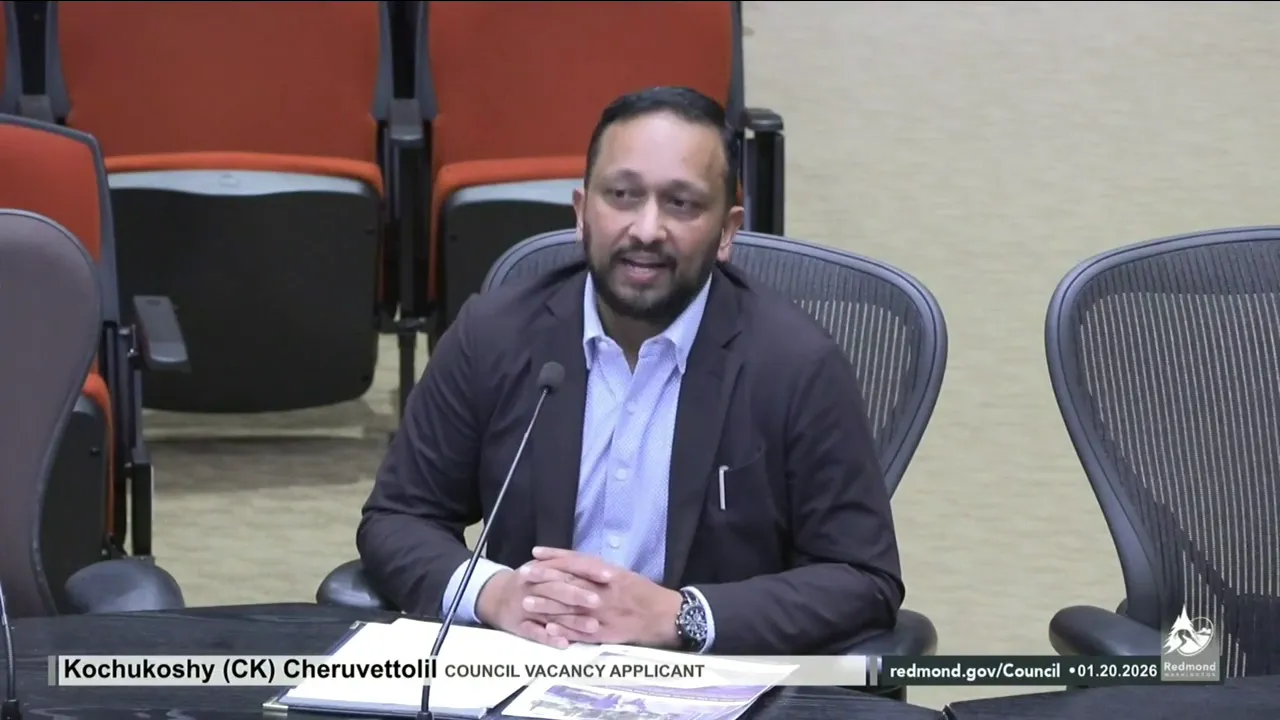
- Candidate CK (Kochikoshi Cherubatolo) – A long-time Redmond resident with experience at the Gates Foundation, World Bank, and in consulting. He advocated for using technology (e.g., AI) to make zoning and city information accessible, including in multiple languages. He described shifting from a data-driven to a storytelling and empathy approach when working with marginalized communities. CK cited an example of resisting pressure to approve a funding decision against his judgment, explaining he would stick to his principles. He praised the urban-nature mix in Redmond and wanted more small businesses and walkable areas. On housing, he cautioned against single metrics (citing Goodhart's Law) and argued for ownership as an ultimate goal, while ensuring rental communities have public spaces for connection. He positioned himself as an "intersectional candidate" bridging analog/digital, immigrant/American, and public/private sector experiences.
Key Outcomes
- No votes or final decisions were reached during the interview portion of the meeting; the transcript concludes at approximately 7:00 PM as the final candidate wraps up.
- The council was scheduled to proceed into executive session to discuss candidate qualifications, followed by an open session vote and swearing-in of the appointed member. This portion was not captured in the provided transcript.
Meeting Transcript
Tuesday, January 20th, 2026, commencing at 6.01 p.m. I will be chairing this meeting as Mayor Pro Tem. Mayor Bernie is online, and all council members are in attendance. This special meeting is being held to fill the council for final interviews for the council vacancy process. We have three final candidate interviews, and each interview will have up to 20 minutes. During the business meeting at 7 p.m. tonight, the council will go into executive session to discuss qualifications of the candidates and return to open session for final decision, and the appointed council member will be sworn in and seated at the dais. Our first candidate tonight, welcome back, is Ms. Antoinette Smith. Welcome. Thank you. Candidates, excuse me, council members. I will go ahead and start the timer. We have about 20 minutes for this interview. Who has a question for our candidate? Councilmember Forsyth. I will kick us off. Thank you. Hi, thanks for being here tonight. Thank you. Great to see you again. In recent years, uh the city of Redmond and our council has really become known as a leader on future focused forward thinking policies. What are some ways in which you hope to add to that or policy ideas that you might have to help us maintain that reputation? Yeah, and I do as a past member of the Human Services Commission and 20-year resident of the city of Redmond recognize that. One of the things that you know we really appreciate as a family and and why we've lived here as long as we have. So food access. So SNAP benefits were frozen for a lot of our neighbors. One of the things that came up for me in the work that I do in human services was this idea of we often think about shelter as a regional approach, meaning as cities, we pay for not necessarily individual resident served, but we are paying for space, right? Bed bed space. Right. And so this idea I was thinking about was how do we approach food access in the same way? Because when food access is limited or non-existent as it was, um, how do we provide a way so that we can all collectively on the east side mobilize? I was really proud of all the cities. I think everybody just stood up and did the things that they needed to do, and um there was a lot of um uh allocation of funding, right? If things were to be extended, and so I was really proud of that and was thinking about what if there was a way that regionally we could work in a swifter manner and collective, so that there is like a pot of money that we already have set aside instead of being more um reactionary uh to those needs that come up. So that's one of the things I I'm really proud of the work that we do collectively and collaboratively on the east side. Thank you. Thank you. Councilmember Kritzer. So I'll ask a follow-up question. You can use this as the example or something else. So if you wanted to get a new initiative or a policy pass that's that's something that's kind of net new as something that you're idea you're bringing forward, what what are the steps you think that you would take to make that happen? You know, how would you envision working with your colleagues, the mayor's office, staff, the public, um, to be able to achieve that? And what do you think is a reasonable timeline for getting something like that done? Yeah, that's a great question. So I mean, really, initially, those are conversations that you're having with community, right? Because those are the ideas. That's where we get those initiatives. Um, I think a lot of times the the work that we do, like like food access, right? That that was something that came from community.
openpublica.com