Redmond City Council Study Session: Police Technology Update and Council Talk Time - March 10, 2026
STREAMING COPY IN PREPARATION — RECORDING AVAILABLE FROM THE ORIGINAL SOURCE
Redmond City Council Study Session: Police Technology Update and Council Talk Time - March 10, 2026
The Redmond City Council held a study session on Tuesday, March 10, 2026, at 7:00 PM at City Hall (15670 NE 85th St). All council members and Mayor Angela Birney were present. The agenda included a police technology update and council talk time; the draft 8th Amendment to Council Rules of Procedure was removed following council direction last week. No formal votes were taken; the session was informational.
Police Technology Update
- Chief Darrell Lowe presented an overview of the department's public safety technology, governed by Policy 341, which emphasizes privacy, civil liberties, and public trust. Access is password-protected with two-factor authentication, and all searches require a case number and are logged.
- Body-worn cameras: all commissioned officers are equipped; 1080p video; in-car cameras also record. Data retained 90 days if not associated with a case; longer if evidence. Used for investigations, use-of-force review, complaints, and transparency. Redaction of public records requests consumes staff time.
- Drones as First Responders: pilot launched April 2024; expanded from 3 to 7 docks; sub-90-second response; year-to-date 455 calls flown and 25% ground unit cancellation (18% last year). Drones fly only to calls for service, not proactively; cameras face horizon during transit; thermal imaging and collision avoidance included. Officers are pilots; FAA beyond-visual-line-of-sight waiver; awaiting multi-to-one authorization. Video is uploaded to digital evidence management and linked to case numbers. A public dashboard updates near real-time.
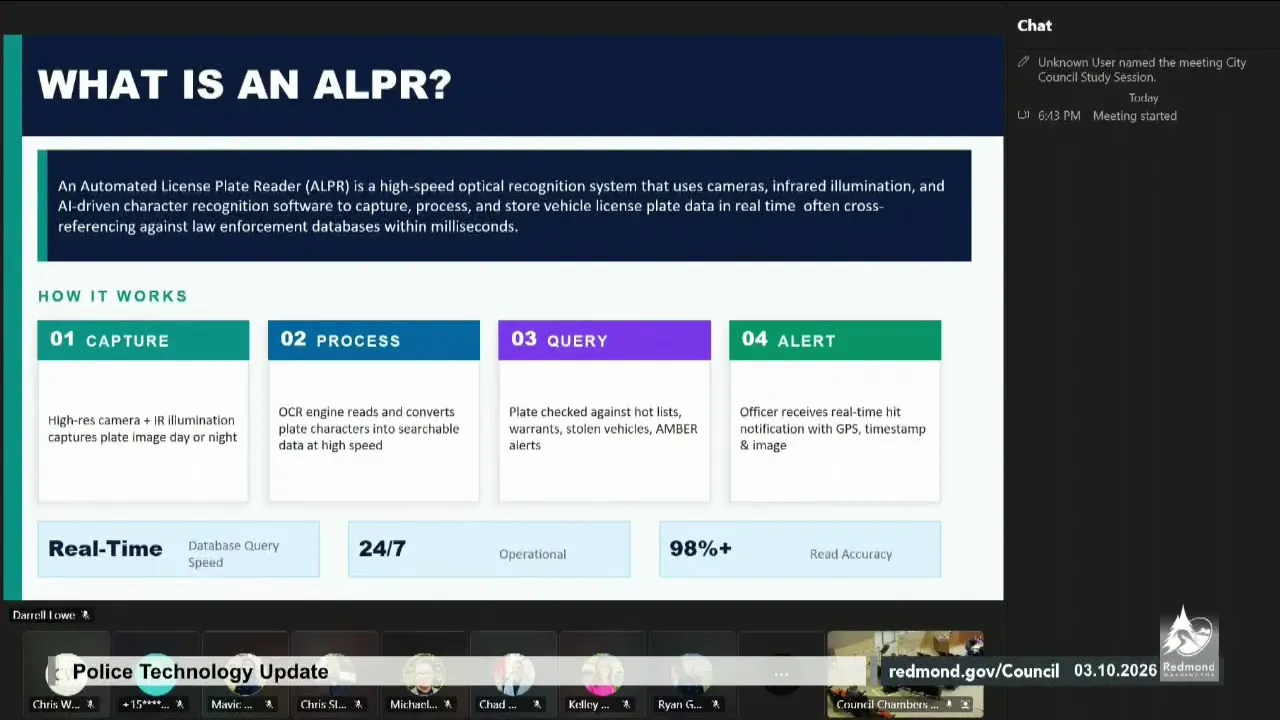
- ALPR: three categories (fixed/investigative, mobile/vehicle, parking enforcement). Fixed cameras (Flock) currently paused by council action in November; contract valid through 2027. Chief stated there is no opt-out for ALPR because there is no expectation of privacy in public. Parking enforcement ALPR is about 10x more efficient; contract award discussion upcoming. School zone cameras are on track for installation by end of school year; officer review of violations; trigger threshold likely 6 mph over posted speed.
- State law: Senate Bill 6002 (passed, not yet signed) establishes 21-day data retention, audit trails, and registration with the Attorney General's office; model policy due July 2026 and agency compliance by December 2027. Chief said all past Flock successes would still have been successes under 21-day retention. The data deletion process after retention will be clarified.
Councilmember Deliberation & Positions
- Councilmember Kritzer expressed support for maintaining the pause on fixed ALPR, citing community trust concerns and federal overreach. She asked to revisit data governance policies to add specificity on large-scale events, facial recognition bans, and drone usage.
- Councilmember Parsi questioned the lack of opt-out for ALPR and raised predictability/privacy concerns.
- Councilmember Prakriya asked about operating costs (drones ~$225,000/yr; body cameras ~$43,000/yr), ALPR read accuracy (98%), and whether past successes would have been affected by SB 6002 (no).
- Councilmember Forsythe asked about complaint timelines, ALPR opt-out admin burden, and requested exploring whether federal overreach would cause a material breach of the Flock contract.
- Council Vice President Nuevacamina emphasized the need to rebuild trust, noting concerns about program expansions and data access by the federal government.
- Councilmember Soni agreed with keeping Flock suspended, citing community fear and mental health impacts.
- Mayor Birney thanked Chief Lowe and Representative Salahuddin for work on SB 6002, and asked about demographic data disparities (80% unknown for arrests/field contacts vs 8% for traffic stops); Chief Lowe said he would have crime analysts investigate.
- Council President Stewart encouraged ride-alongs and fly-alongs for new councilmembers, highlighted the citywide data governance program, and acknowledged overwhelming community feedback on ALPR. No immediate support for the chief's recommendation to reactivate.
Key Outcomes
- No formal votes taken.
- Councilmembers requested future study session time to revisit police technology governance policies (data retention, storage, drone use at events, facial recognition).
- Councilmember Forsythe will ask the Flock vendor about federal overreach and contract material breach provisions.
- Chief Lowe will follow up with crime analysts on demographic data and report at the next public safety committee.
- Discussion on school speed camera details to occur before implementation.
- Councilmember Kritzer will send follow-up notes to council leadership.
Council Talk Time
- Councilmember Forsythe and Council President Stewart are finalizing a welcoming resolution; amended version expected next week.
- Councilmember Prakriya announced remote participation for the Committee of the Whole and for meetings on March 24; Vice President Nuevacamina will chair.
- Mayor Birney announced the State of the City tomorrow (March 11) at 3 PM, with a networking hour at 2 PM.
- Council President Stewart noted council picture day (March 17, 6 PM), council conversations at Redmond Middle School (March 19, 7-9 PM) with a Lake Washington School Board member attending, and first round of commission interviews on March 24 at 6:30 PM.
- Councilmember Soni has scheduled time in committee for a teen center/old firehouse update; Councilmember Kritzer confirmed prioritizing next steps.
- Mayor Birney won a World Cup sign at a networking event, which will be displayed in her office.
Meeting Transcript
Thank you so much. I'm calling this meeting to order. This is a Redmond City Council study session held on Tuesday, March 10th, 2026, commencing at 701 p.m. All council members are in attendance tonight, as well as Mayor Burney. There are two items on the agenda tonight police technology update and council talk time. The draft uh eighth amendment to the council rules of procedures has been removed from the agenda following council direction last week. The first item on the agenda tonight is a police technology update. Here to kick off this item is police chief Darrell Lowe. Welcome. Thank you, Council President. For tonight's presentation, uh I'll start with the uh Redman Police Policy section 341 for the public. Uh our entire policy manual is available uh on the website, uh redman uh.gov uh front slash uh police, and you can see our entire uh policy manual. Uh so policy section uh 341 deals with public safety technology and governance uh at a high level. Uh the purpose of the policy is to respect privacy, civil liberties, and public trust uh and to make sure that it's consistent with both state law, city policy, uh, and our uh accreditation standards. Uh the policy covers all public safety technology and it indicates that it will be used solely for uh law enforcement purposes. The storage of uh data, the storage and retention of data uh as it relates to uh the public safety technology. Uh it is uh CGIS, which is the criminal justice information uh system data security standards, as well as the city's cyber insurance carrier requirements, uh and those are the standards that we use to protect data from uh unauthorized access or breaches. Um generally the uh data is not stored for more than 30 days, however, we uh comply with the uh state's uh retention policy. So, for example, one of the uh first technologies that we'll discuss is uh body worn cameras. Uh so that technology uh per state law is uh kept for 90 days uh if it's not associated with the case. So uh all of our uh retention, uh like I said, is generally 30 days unless uh state law requires us to keep it for longer or if it's associated uh with an uh a criminal case, in which case that data is is retained throughout the um I'll say prosecution of the case until that case is resolved. Uh that data uh is retained because that is um uh evidence uh and it it is also part of uh the discovery process, which is uh all of the information that we have to provide to uh the defense uh in that particular case. Um as far as the uh review of data and who can uh access it, uh so uh access to all of these systems uh is logged in through uh password protected uh systems, uh two-factor authentication. Um as I said, it is CGIS compliant, so it it uh lives within our network, uh which has the uh two-factor authentication uh and essentially the one sign on. So when you sign into the city's uh network system, it requires two-factor authentication uh data systems that we utilize uh are uh I'll say behind that wall. So two-factor authentication uh is uh a standard to get into the system, therefore it transfers to those systems uh that we use because it's uh behind uh that wall, if you will. Uh as far as uh accessing the data, uh there is an audit trail for uh any searches that occur uh within those systems. Uh so again as password uh protected to get into it, it then logs a uh date and time uh that the employee or the officer goes in to search it. Uh and all of those systems require uh a case number and a reason for the search. Uh so as part of the audit trial, we can go back and see who searched what when and for what reason. Um and that is the the again the overall framework and and policy that covers um public safety um uh technology and data systems. Uh the first system that uh I will uh talk about and uh have a couple slides for you, just uh high level for you to go back and review uh later. It contains the high points of the system, and that is our uh body worn camera program. Uh so all commissioned police officers are issued uh body worn cameras. Uh uh it's a device uh looks like this. It's a uh audio and video uh recording device, uh typically worn on the uh officer's chest or lapel. Um it is uh activated uh on calls for service or uh any action, any type of uh police enforcement action. Uh it also requires the officer to uh notify the individuals that they're being audio and video recorded, uh also consistent with state law. It is against the law to uh surreptitiously record an individual without their knowledge. So even though we are the police and we are uh in a public venue, the officer will say uh you're being audio and video recorded. Uh individuals do have the right to uh uh request not to be recorded, um, and so that is uh something that the officer must uh must also consider uh depending upon the type of interaction uh that they're engaged in. Uh the video from it is uh 1080p high resolution. Uh there is a buffer um uh in the system. So uh the body worn camera system uh also coincides with the uh in car camera system. Uh so in of our in our police cars, we have uh in car cameras that record uh forward. Uh so the typical dash cam that you see. We also have one interior in the car, which records uh inside the back what I'll call the suspect area. So if a person is arrested, uh the back area where they are transported uh is also uh audio and video recorded uh inside the vehicles when the camera is activated. Uh there is a uh red light uh indicating that the cameras are on, uh similar to what you would see on a uh television camera or a studio, that type of thing. So again, uh there is no uh peekaboo a person knows that they are uh being recorded as indicated uh by that camera.
openpublica.com