Redmond City Council Study Session - March 24, 2026
STREAMING COPY IN PREPARATION — RECORDING AVAILABLE FROM THE ORIGINAL SOURCE
Redmond City Council Study Session - March 24, 2026
The Redmond City Council held a study session on Tuesday, March 24, 2026, commencing at 7:04 PM in person at City Hall and remotely. The agenda included four items: a parks signage and wayfinding standards plan, the 2027-2028 departmental budget overview for Parks & Recreation, a progress update on the Municipal Operations Center (MOC) campus redevelopment project, and council talk time.
Parks Signage and Wayfinding Standards and Strategy Plan
Parks and Recreation Director Lorreen Hamilton, Parks Planning Manager Lindsay Falkenberg, and consultant Chris from Tool Design presented the project. The discovery phase has been completed, including field assessments and community and stakeholder engagement. Key themes identified were "hidden gems" (parks lacking clear entry signage), "variety of experiences" (need for context-sensitive design), and "living landscapes" (keeping pace with growth). Community engagement included stakeholder sessions with organizations such as Outdoors for All, Move Redmond, and Hopelink, as well as internal cross-departmental workshops. Councilmembers asked about written reports, timeline for implementation (design completion expected summer 2026), accessibility considerations including QR codes, and regional connectivity. The council expressed strong support and anticipation for the project.
2027-2028 Budget Process: Departmental Budget Overview - Parks & Recreation
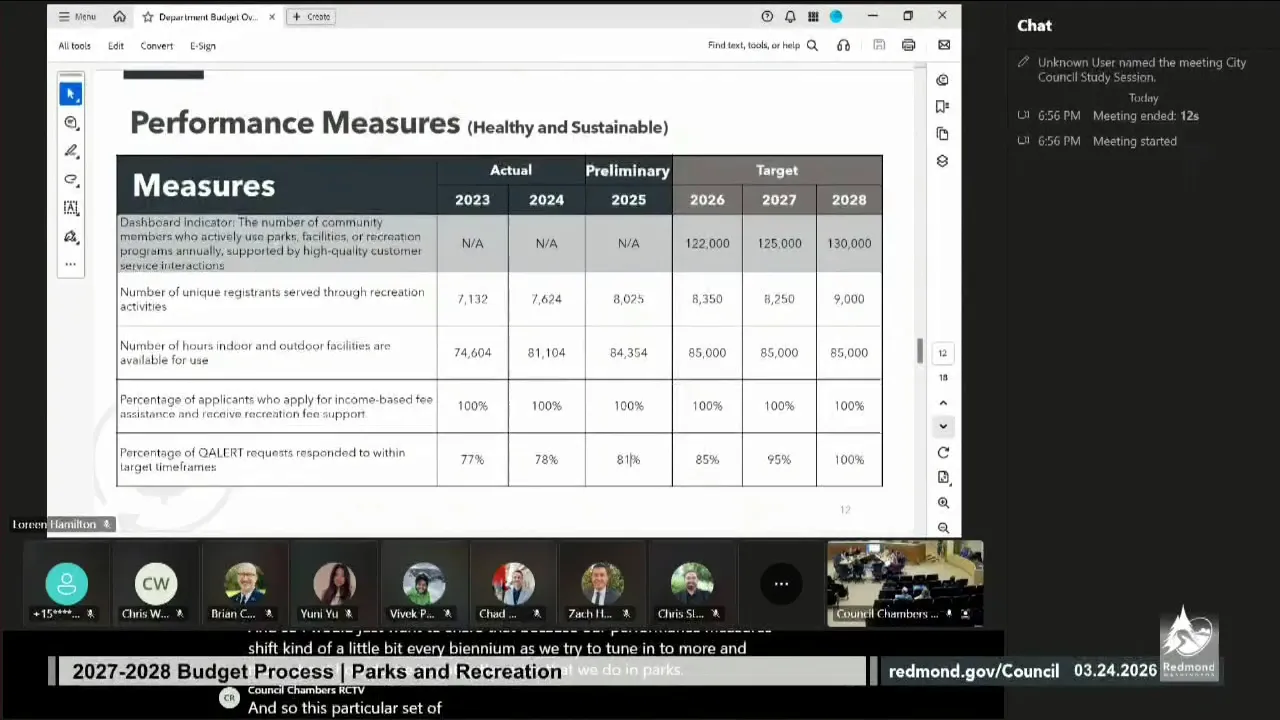
Finance Director Kelly Cochran and Parks Director Lorreen Hamilton presented the first departmental budget overview of the cycle. The presentation covered the department's structure (administration, recreation, arts, facilities, park operations), accomplishments in 2025-2026 (e.g., activation of the Senior and Community Center, expanded Redmond Lights, adoption of the Capital Facilities Plan), baseline budget projections, and performance measures. Key performance metrics included fee-based assistance rates (100% of applicants served), QAlert response times (increasing), active forest restoration acres, and facility condition index. Councilmembers discussed the 10% baseline budget increase (driven partly by community recreation fund), urban forestry staffing needs, and priorities for preventive maintenance and creative park amenities. No decisions were made; enhancements will be brought forward in the fall.
Progress Update - MOC Campus Redevelopment Project
Public Works Director Aaron Burt, Project Manager Amy Kim, and Lead Designer Claire Rennick from Miller Hull provided an update on the MOC redevelopment. The project is in the validation phase using progressive design-build. The team is evaluating three parallel work streams: site evaluation (including potential acquisition of the Cadman Heidelberg and King County Roads sites), dispersed operations for temporary relocation, and developing a baseline MOC project on the existing site. Two primary options are being studied: rebuilding on-site with dispersed operations or acquiring a new site for a consolidated campus. Councilmembers asked about quantifying inefficiencies of dispersed operations, fallback plans for service impacts, and the potential for monetizing existing assets. The council encouraged exploration of the King County partnership and noted the possibility of adjusting the bonding strategy if acquisition proceeds. No vote was taken; the team expects to return with a validation report in the coming months.
Council Talk Time
Councilmember Kritzer proposed reading a proclamation for Transgender Day of Visibility (March 31) at the April 7 business meeting, with text provided by Pride Across the Bridge. Several councilmembers expressed strong support, noting the city's prior resolution 1605. Council Vice President Nuevacamina suggested recognizing days before the actual date to avoid appearing as an afterthought. The council also discussed feedback from the March 18 Council Conversations event, including suggestions for the affordable commercial space, Red Link reliability, and more marketing for future events. Scheduling updates were shared, including the Cross Lake Connection events, the fifth Tuesday off on March 31, and upcoming commissioner appreciation events.
Key Outcomes
- Council directed staff to prepare and read the Transgender Day of Visibility proclamation at the April 7 business meeting.
- The MOC project team will continue the validation phase, with a report expected within the next month (or extended if site acquisition becomes viable).
- The budget process will continue with future departmental overviews; no action was taken on Parks & Recreation baseline or enhancements.
- Council will receive follow-up information from the retreat work product and discussion on cultural observations.
Meeting Transcript
So much. I'm calling this meeting to order. This is a Redmond City Council study session held on Tuesday, March 24th, 2026, commencing at 7.04 p.m. Councilmember Procrea is online with us tonight, and all other council members are in chambers tonight, as well as Mayor Bernie. There are four items on the agenda park signage and wayfinding standards and the strategy plan, the 2027-2028 budget process, our first departmental budget overview with parks and recreation, a progress update on the municipal operations center campus redevelopment project and council talk time. The first item on the agenda is the park signage and wayfinding standards and strategy plan. Lorreen Hamilton, Parks and Recreation Director will introduce this item. Welcome. Good evening, City Council. I'm Lorreen Hamilton, Parks and Recreation Director. I'm joined this evening by Lindsay Falkenberg, our parks planning manager and our consultant from Tool Design, who I will allow Lindsay to introduce. This item that we're bringing forward was an enhancement that came through the last budget cycle and has been a priority in our park plan and also a priority of our Parks Trails and Recreation Commission for many years. So we're very excited to be moving this project forward. And so I'm going to hand this off to Lindsay to get you all updated on this project. Thank you, Laureen. Again, I'm Lindsay Falkenberg, Parks Planning Manager. This is Chris and Losi, who is our consultant from Tool Design. We'll be sharing a little bit with you tonight about the work that we've completed to date. Specifically, we're going to focus on the system assessment that we have done as well as the community and stakeholder engagement. And we're going to share key takeaways and themes that have come out of the assessment engagement work that we have done and connect how those findings are going to be shaping our design and our strategy moving forward. Now we see if the slideshow works. Excellent. Oh as I just said. And I'm going to pass it off to Kristen to talk about our project goals and objectives. Thank you, green light. Okay. So the I'll start with the project goals and objectives, and you can see in the middle of the circle kind of the primary things, formal goals. So connecting people to Redmond's Parks and Trails, creating a signage and wayfinding system that enhances accessibility and increases equity. But in our conversations with city staff, a number of other items came up. And so those we included those outside the circle. And they have to do with both user experience and the ease of operations and maintenance of the system. So a desire for a really functional system that coordinates with other city operations, is straightforward to implement and maintain and is this and is sustainable. And then just getting people out about and exploring the parks, connecting to nature, connecting to transit. Again, a nice focus on user experience as well as what the staff need to get the system up and running. Next slide. So I'll just go through a quick highlight or a quick overview of what the project is about. There are three phases. So there's a discovery phase, a design phase, and then a documentation phase. So the discovery is what we've completed. So we did a review of plans and policies and documents. We went out into the field and looked at parks and trails. We met with stakeholder groups and have been in conversation with lots of city staff from that. We developed some sign assigned family that would respond to what we learned. We developed some mood boards that reflected how people felt about the city identity and things that we were inspired by. And then we'll be finishing out with kind of detailed design drawings, some best practices for how the system will be implemented, strategies around implementation, that kind of thing. Next slide. So I'm going to share a couple of the themes and key takeaways from what we learned. There's a lot more, but just a few to highlight. So the first is what we called hidden gems. So we found that at a lot of parks, when you arrive, there isn't a lot of signage that tells you what's there.
openpublica.com