Redmond City Council Study Session: May 26, 2026
STREAMING COPY IN PREPARATION — RECORDING AVAILABLE FROM THE ORIGINAL SOURCE
Redmond City Council Study Session: May 26, 2026
The Redmond City Council held a study session on Tuesday, May 26, 2026, at 7:00 PM at City Hall. The meeting included a joint session with the Planning Commission to review the commission's work plan and discuss Senate Bill 6026, followed by amendments to the city's noise standards, a briefing on grant funding for automated license plate reader (ALPR) cameras, and council talk time. Key discussions focused on balancing housing and economic vitality, resolving long-standing noise conflicts, and deciding the future of the ALPR program.
Joint Meeting with Planning Commission – SB 6026 & Work Plan
- Overview: Long-range Planning Manager Jeff Churchill introduced the Planning Commission's work plan for the next 12 months, centered on implementing Redmond 2050. Policy discussion leader Lauren Alpert explained Senate Bill (SB) 6026, which requires cities to allow housing in commercial and mixed-use zones, including Redmond's business park and manufacturing zones. The city must comply by August 31, 2027.
- Council & Commission Positions: Multiple members expressed concern about trade-offs between housing capacity and economic diversity. Council Vice President Nuevacamina emphasized the need for a "sustainable economy" with diversity. Councilmember Soni questioned whether existing infrastructure (water, sewer, power) could support increased residential capacity. Commissioner Aparna warned against becoming a "bedroom community" with reduced economic vitality. Councilmember Prakriya asked for numeric impacts on housing targets. Planning Commission Chair Weston stressed the importance of community outreach and fairness, noting that SB 6026 undermines the extensive public input behind Redmond 2050. Mayor Birney shared frustration that the bill ignores the city's comprehensive plan work.
- Drones & E-bikes: Commissioners raised concerns about commercial drone regulations (privacy, safety) and electric moped safety. Council acknowledged these issues and noted upcoming public hearings and potential state legislative action.
Amendments to RMC 6.36 Noise Standards
- Discussion: Planning Director Carol Heland and Jeff Churchill briefed the council on proposed updates, focusing on shooting range hours, mitigation options, and related noise issues. The draft recommends limiting a local gun range (ISA) to 10:00 AM – 2:00 PM on Saturdays and Sundays, with a mitigation pathway to expand hours. Council debated binary versus nuanced approaches, enforcement, and clarity.
- Key Points: Councilmember Kritzer supported the draft hours as a "solid first step" for neighborhood predictability. Councilmember Prakriya suggested staggered hours or noise-based shooting type restrictions but acknowledged complexity. Multiple council members favored clear, enforceable rules. The council also discussed property maintenance noise (leaf blowers, lawnmowers) and crane assembly/disassembly. Consensus emerged to bifurcate residential versus contractor property maintenance and to study three alternatives for mitigation: the current mitigation agreement, a development agreement, or business license provisions.
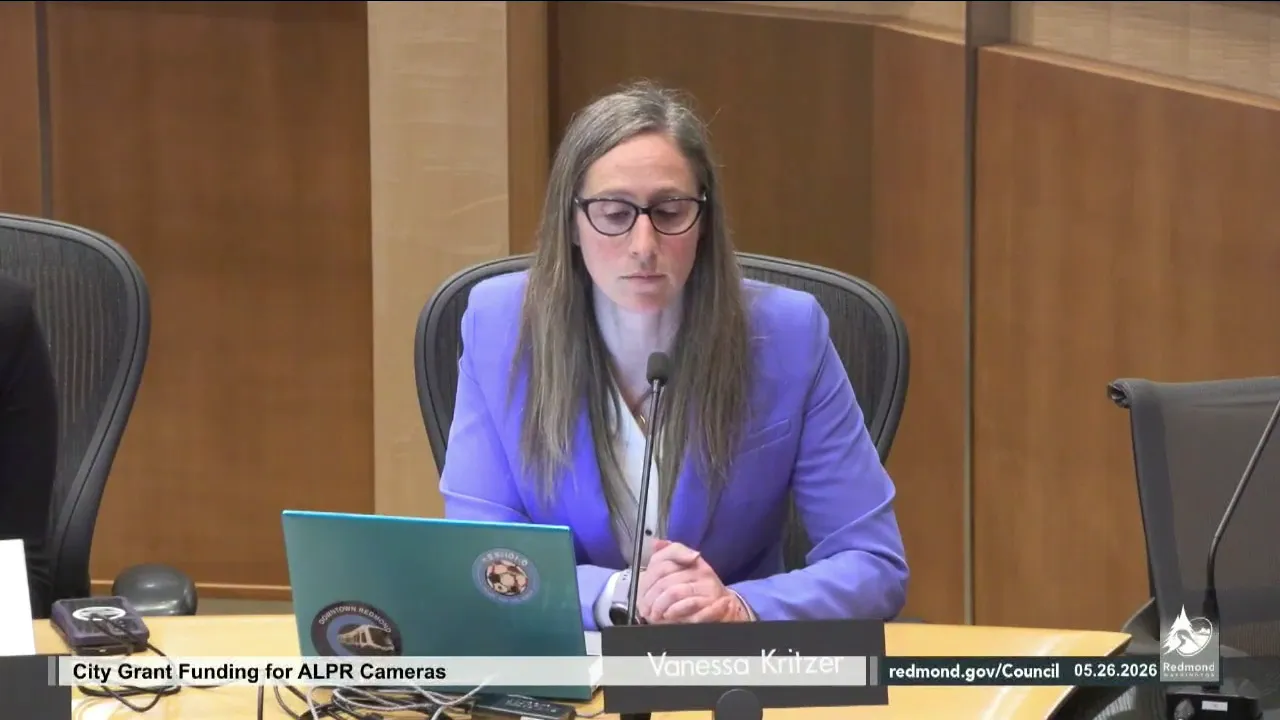
- Public Input: Councilmember Kritzer noted extensive public feedback, with some residents unable to attend in person. No public testimony was taken at the study session.
Background on ALPR Grant Funding
- Presentation: City Attorney Rebecca Mueller and Deputy Finance Director Haritha Nara reported on grant compliance for the ALPR program (funded by ~$44,000 from Washington Auto Theft Prevention Authority and ~$95,000 from WA Department of Commerce). Both grant agencies confirmed no compliance issues; funds were properly used and the program can be closed without repayment, unless the city receives a vendor refund.
- Council Direction: A majority of council members expressed support for scheduling action to terminate the contract with Flock. Councilmember Prakriya raised alternatives (different vendor, poison-pill data sharing clause), but others opposed, citing erosion of public trust and federal concerns. Council concurred to proceed with contract termination once closeout is finalized.
Council Talk Time
- Upcoming Events: Council discussed participation in Derby Days (July, with a booth on City Hall porch) and the Downtown Redmond Art Walk (September). Ideas included a council float in the parade, inviting commissioners, and interactive booth activities. Councilmember Forsyth suggested a budget theme for engagement.
- Council Conversations: Feedback from recent conversations in parks was positive; members preferred casual formats with good wayfinding. Planning for September's conversation will consider location and topic structure.
- Social Media Policy: Councilmember Parsi raised an existing draft social media guidance document. Members agreed to add it to new council member onboarding materials rather than adopt a formal policy.
- Senior Center Staff: Councilmember Forsyth highlighted a community member's story about a part-time parks staffer aiding stroke recovery. Councilmembers Parsi and Kritzer supported exploring whether to fund a full-time position for senior fitness programming. Mayor Birney asked that director conversations be copied to her.
Key Outcomes
- Noise Standards: Council directed staff to return with more detail on mitigation alternatives (development agreement vs. business license) and to draft bifurcation of property maintenance rules for residential vs. contractor use. Further deliberation on shooting range hours is needed.
- ALPR Program: Council gave direction to schedule a vote to terminate the contract with Flock and close out the program, pending final closeout documents. No support for pursuing a new vendor at this time.
- Council Talk Time: The social media guidance will be added to onboarding materials. Council will finalize dates and locations for the September council conversation. The senior fitness staff issue will be explored with relevant departments.
- Next Meetings: A business meeting on June 2, 2026, will include public comment on noise ordinance (public hearing). The council expects to take action on ALPR and noise standards in upcoming meetings.
Meeting Transcript
Good evening. I'm calling this meeting to order. This is a Redmond City Council study session held on Tuesday, May 26, 2026, commencing at 7 p.m. Council members in attendance include Council Vice President Nueva Camina, Councilmember Parsi, Councilmember Forsythe, Councilmember Sony, Councilmember PROCRIA, and myself, Council President Stewart. We are expecting our seventh council member, and I will announce her when she arrives. There are four items on our agenda tonight, and the first is a joint meeting with our planning commission, followed by amendments to the Redmond Municipal Code 6.36 noise standards and background on city grant funding for ALPR cameras in Redmond as well as council talk time. So for this first item, our joint meeting with the planning commission. Thank you all so much for being here. I'm gonna turn it over to our long-range planning manager, Jeff Churchill to kick off the conversation. Thank you, Jeff. All right, and good evening, Council members and planning commissioners. Uh it's good to be with you tonight. Each year, the city council and planning commission meet together to review the commission's work plan and to discuss policy perspectives on one or more topics that will be on the commission's work plan in the upcoming year. So tonight I'll provide an overview of the work program and introduce the policy discussion portion of the agenda that Lauren Alpert, um, who is also here with us will lead, uh which focuses on the city's response to Senate Bill 6026. And if you don't know what that is, by the end of the meeting, you will. Okay. Um, in one sentence, the commission's work program in the coming year focuses on implementing REBIN 2050. Uh many of you will recognize this slide from the dozens of study sessions, committee meetings, and business meeting during REBIN 2050. And we put it here to remind everybody that REBIN2050 encompasses a broad set of topics. That's shown in the top third of the slide. And for the planning commission, uh, which advises the city council on land use policies and regulations. Implementation of those policies can take the form of strategic updates and revisions to the policies themselves, which would be in the top third. Development and adoption of functional plans, strategic plans, action plans, such as for utilities, parks, transportation, and others. That would be in the middle third. And then uh development and adoption and adoption of updates to the Redmond Zoning Code, which is part of the bottom third of the slide. So this slide outlines some of the key work program items for the commission in the next 12 months. In the commission elected officers in April and also concluded its review of temporary non-commercial signs in May. That is coming to the council in June. Um, and the planning commission is beginning to review the 2026-2027 comprehensive plan annual amendment docket starting tomorrow evening. Next quarter, the commission will take up the annual code cleanup, receive early briefings on updates to design standards that will then come back again in 2027, and receive early briefings on updates to the tree code, which will come back again later in the year. In the fourth quarter, the commission will begin review of individual comprehensive plan amendment docket items that are added to the docket by the council in August and begin to take up permanent regulations for commercial drone ports and review code updates related to compliance with House Bill 2418 concerning permit review. That's one of two uh two house bills out of the legislature in 2026 that require a city response uh that involves the planning commission. And then in the first quarter of next year, we anticipate continued review of docket items and permanent regulations for commercial drone ports, in addition to reviewing code updates to comply with House Bill 2266 concerning step housing, which is emergency shelters. That's the S in step, transitional housing, emergency housing, and permanent supportive housing. And now I'm gonna turn it over to Lauren to introduce um the discussion topic for this evening, which relates to another bill from the legislature that you you that you saw on the previous slide as individual docket items because it's one of those. Thank you for the opportunity to discuss this this evening. Um so the purpose and key element of SB 6026, it's been discussed here before, is to facilitate construction of housing in commercial and mixed use zones. Um I will start there with an overview of SB 6026. So we all have the sort of the same basic information. Um it's intended to facilitate the construction of housing. Uh it's one of the one of the uh legislative um priorities uh that the state put together uh this year to address housing and affordability. Um requires local jurisdictions to allow housing in any commercial and mixed use zones. It limits the conditions that can be placed on the development of residential uses in such zones. So SB 6026 does not imply in industrial zones, it does not require the demolition of historic landmarks, it doesn't apply in any of our shoreline jurisdictions or where local regulations prohibit multifamily or mixed use development, and it doesn't apply in critical area buffers. Um the preemption condition the preemption on conditions that can be placed on residential development are also limited. So what does that mean? Uh cities can continue to require ground floor commercial square footage on 40% of the land area zoned for commercial and mixed use. So we can still require some mixed use. And when calculating the 40% figure, certain land is excluded. So station areas, areas where buildings get can be built at least 85 feet, um, and all of the areas listed on the the previous slide.
openpublica.com