Redmond Planning Commission Meeting – June 11, 2026: Annual Docket Hearing and Code Cleanup Study Session
STREAMING COPY IN PREPARATION — RECORDING AVAILABLE FROM THE ORIGINAL SOURCE
Redmond Planning Commission Meeting – June 11, 2026: Annual Docket Hearing and Code Cleanup Study Session
The Redmond Planning Commission met on June 11, 2026, at 16:15 UTC, with Chair Weston presiding and Commissioners Aparna, Gagnier, and Van Nyman present; Commissioners Copley, Coleman, and Woodyer were excused. The agenda included approval of prior minutes, a public hearing on the 2026–2027 annual comprehensive plan docket, and a study session on the 2026 annual code cleanup. Note: The agenda materials provided reference a June 10, 2026 meeting with the same agenda topics; the date used here is June 11, 2026 as specified.
Consent Calendar
- Agenda approved by unanimous voice vote.
- Meeting summary from May 27, 2026 approved by unanimous voice vote.
Public Comments & Testimony
- David Morton (Redmond 98053) gave general comments on the citywide watershed management plan (WMP). He said seven of the nine gaps between current water management programs and Redmond 2050 goals had been raised previously; he addressed Gap 8, noting the 2013 WMP is 13 years old, was prepared by Herrera Environmental Consultants for the Public Works Natural Resources Division, and predates Redmond 2050. He noted the plan called for updates every five years and annual progress reviews, but no formal update has been produced; its land use baseline extends only to 2030, and its climate data use precipitation records ending in 2008. He said Redmond needs both and referenced CR25.
- Linda Seltzer, a resident of a senior apartment complex on 80th Street, expressed disappointment that the docket failed to delete Redmond 2050 language that incentivizes redevelopment in her neighborhood. She said six apartment complexes on two square blocks could be eligible for property tax exemptions and redevelopment, displacing residents. She questioned the rationale for prioritizing redevelopment over housing preservation and the referral of the issue to the Human Services Commission rather than the Planning Commission.
- David Morton, speaking during the public hearing, said he reviewed all five proposed docket items and the staff memo and cumulative effects analysis. He expressed support for placing all five items on the docket. He offered conditional support for the stormwater and surface water systems plan, asking for rigorous evaluation of groundwater impacts and early community engagement before new industrial designations are finalized in Southeast Redmond, which lies within a critical aquifer recharge area. He fully supported the neighborhoods element update, but asked the commission to verify transportation master plan maps are complete before repealing the outdated neighborhood connections map. He enthusiastically supported adding the three shared-use path projects on Northeast 40th, 70th, and 72nd Streets, noting they improve safety, reduce car trips, and support a healthier environment. He submitted written comments.
Discussion Items
2026–2027 Annual Comprehensive Plan Docket Public Hearing
- Senior Planner Glenn Coyle presented, joined via Teams by Peter Holt (utilities), Francesca Liberty (transportation), and Lauren Alpert (industrial land study and neighborhood plans). He explained that state law allows the city to amend its comprehensive plan no more than once per year and requires concurrent review of amendments so cumulative effects can be assessed. The proposed docket contains five city-initiated amendments: (1) stormwater/surface water systems plan update, (2) updates to neighborhood plan/neighborhood element policies, (3) review and update of policies, maps, and regulations for the manufacturing, park, business park, and industry zones, (4) repeal of an outdated neighborhood connections map, and (5) an update to the transportation facilities plan to add projects.
- Commissioner Aparna asked how the cumulative effects analysis would handle concurrent amendments that have trade-offs or conflict with each other. Staff responded that the analysis is more speculative at the docket stage and will be updated as specific proposals are developed; docketing is the first step.
- Commissioner Gagnier asked budget-curiosity questions. Peter Holt explained that the stormwater/surface water systems plan was budgeted in previous city budgets, carried over, and the consultant contract was extended. Lauren Alpert said the neighborhood planning item has funding allocated for community engagement because it is a special project; the other items are part of the regular city work plan.
- The commission agreed to advance the docket. Chair Weston noted the four-member body made a quorum, and staff will prepare a report and recommendation for a formal vote at the June 24, 2026 meeting. No vote was taken on the recommendation.
2026 Annual Code Cleanup Study Session
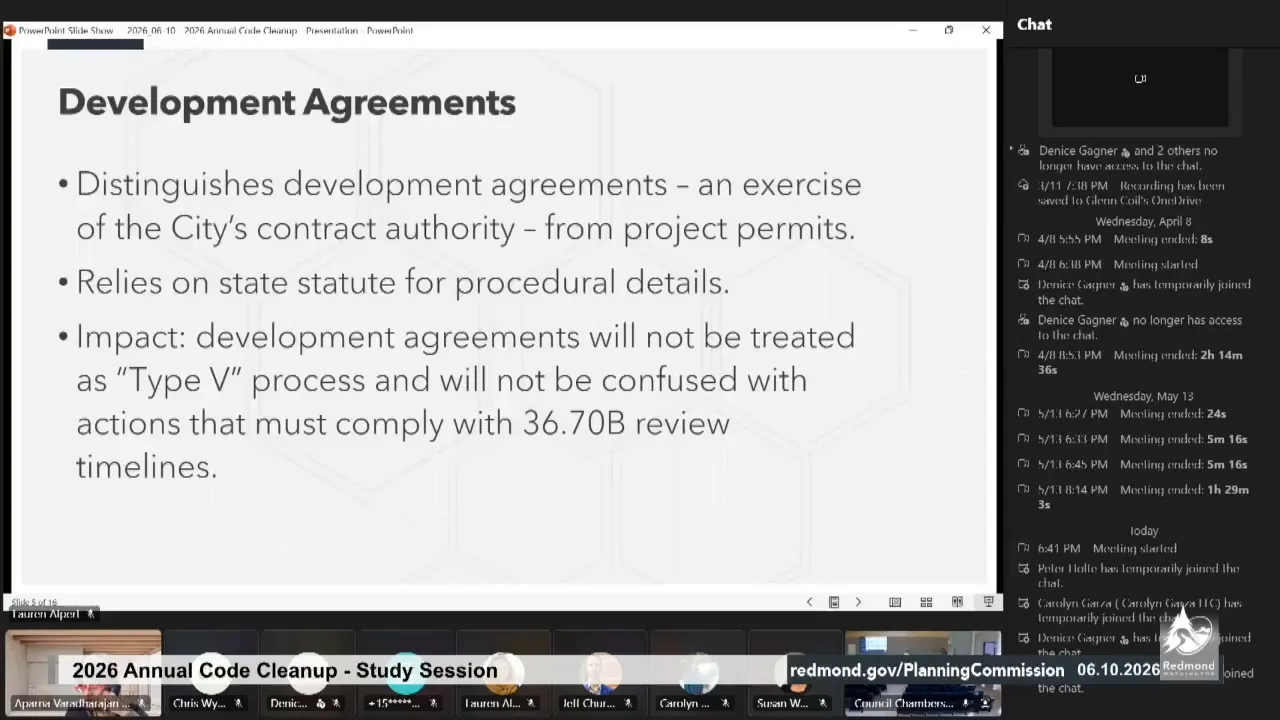
- Senior Planner Lauren Alpert presented minor code amendments, including correcting typos, incorrect references, and incorporating administrative interpretations. Highlights included: updating the list of documents underlying the city’s exercise of CEPA authority (adding water/wastewater plans, the fire department functional plan, and the capital facilities plan); clarifying that development agreements are an exercise of police power and contract authority rather than project permits; removing certain project permit criteria to align with comprehensive plan consistency; cleaning up the land use table (removing references to boarding houses, updating old zone names, clarifying food truck hours, and restating the 20% open space requirement for residential development); revising definitions such as culvert; and making miscellaneous typo and formatting fixes. She also noted that some updates to Appendix 3 were made by the technical committee and do not require Planning Commission approval.
- Commissioner Aparna asked how a development agreement can be both voluntary and an exercise of city contract authority. Jeff Churchill explained that development agreements are contracts under state law; entering into one is voluntary for both the property owner and the city, but once created the agreement is binding. He confirmed that state law requires a public hearing for development agreements. Commissioner Aparna asked for this explanation to be included in the issues matrix.
- Commissioner Van Nyman asked for more clarity on the open space changes, specifically whether a treatment preventing parking is required for an area to count as open space or whether the primary use is sufficient. Another commissioner asked whether the green building and verbiage changes were only typographical or could alter meaning. Staff took notes for the issues matrix and said items could be sent to staff by the weekend.
- Next steps: public hearing on June 24, 2026; a possible additional study session on July 8, 2026; and city council review later in the summer/fall.
Key Outcomes
- Approved the agenda and the May 27, 2026 meeting summary by unanimous voice votes.
- Advanced the 2026–2027 annual comprehensive plan docket recommendation; staff will prepare the formal report for vote on June 24, 2026.
- Closed the verbal public hearing while keeping the written comment period open.
- Directed staff to prepare an issues matrix for the annual code cleanup incorporating commissioners’ requests for clarification.
- Completed planning commission youth advisor interviews; a decision is expected shortly.
- Adjourned by motion.
Meeting Transcript
Commissioner Aparna. Present. Commissioner Gagnier. Present. Commissioner Van Nyman. And I am Chair Weston. Commissioners Copley, Coleman, and Woodyer are excused tonight. I'd like to thank the following staff for being present. Lauren Alpert, Jeff Churchill, Glenn Coyle, Chris Wyatt, Peter Holt, and Francesca Liberty. I look for a motion to approve the agenda. So moved. Second. All in favor? Aye. Aye. Thanks. That's approved. And any corrections to the meeting summary from last time. Nope. Okay. In that case, I look for a motion to approve the meeting summary from May 27th, 2026. So moved. Second. All in favor? Aye. Aye. Great. That is also approved. Next is time for us to hear a public comment and items from the audience. Who do we have tonight? For items of the audience, we have uh General Comments David M. Just a reminder to keep your comments to three minutes and state your name and address. Good evening, Commissioners. I'm David Morton, Redmond 98053. I spoke to this commission and to the city council about seven of the nine gaps between Redmond's current water management programs and the goals of the Redmond 2050. Tonight I'll address the final two, Gap 8. Redmond's citywide watershed management plan, or WMP, is 13 years old and predates Redmond 2050. The 2013 WMP was prepared by Herrera Environmental Consultants for the City's Public Works Natural Resources Division and adopted that November. The document is comprehensive, science-based, and grounded in a 50 to 100 year restoration vision for all 20 of Redmond's watersheds. The plan itself called for updates every five years and annual progress reviews, but no formal update has been produced. The plan's land use baseline, climate assumptions, and capital project priorities all predate Redmond 2050 by more than a decade. Its projections for parcels that are likely to develop or redevelop extend only to 2030, and its climate data are drawn from precipitation records ending in 2008. It does not reflect the land use changes, growth concentrations, or climate vulnerabilities identified in Redmond 2050. Redmond needs both. CR25 identified the path. Thank you. Next step. That's our last public comment for general comments. All right. Well, in that case, um, we are going to start our public hearing on the 2026-2027 annual comprehensive plan docket.
openpublica.com