Redmond City Council Study Session – June 23, 2026
STREAMING COPY IN PREPARATION — RECORDING AVAILABLE FROM THE ORIGINAL SOURCE
Redmond City Council Study Session – June 23, 2026
This study session of the Redmond City Council convened at 7:00 PM on June 23, 2026. Councilmembers present included Vice President Nuevacamina (presiding), Forsythe, Parsi, Prakriya, and Soni; President Stewart attended online from the Association of Washington Cities conference. Councilmember Kritzer was excused, and Mayor Birney was absent. The agenda included three items: a presentation on the joint Redmond‑Bellevue electric grid capacity study, proposed amendments to the Redmond Zoning Code (RZC) for temporary non‑commercial signs, and council talk time.
Joint Redmond and Bellevue Electric Grid Capacity Study
Sustainability Program Manager Jenny Liebeck, co‑lead Glenn Coyle, and AECOM consultants Aaron Cherry and Kenton Phillips presented findings from a year‑long collaborative study with the City of Bellevue and Puget Sound Energy (PSE). The study assessed the capacity of Redmond’s local electric distribution system through 2045, driven by growth (Redmond 2050) and electrification goals. Key findings included a projected 70% increase in electricity demand by 2050, with substation capacity sufficient for the next ten years but three of Redmond’s 12 substations (Avondale, Redmond, and Spirit Brook) expected to exceed capacity by 2045. PSE’s planned upgrades at four substations (Hollywood, Rose Hill, Totem Lake, Union Hill) were assumed on schedule. Sensitivity analysis identified population growth and electrification as the primary demand drivers; large loads like data centers were excluded but noted for future coordination. The study produced ten recommendations in three categories: harmonized forecasting and joint planning, streamlined regulatory processes and implementation, and strengthened grid flexibility and resilience. Councilmembers discussed cost burdens (deferred to PSE rate‑setting), the role of distributed energy resources, the timeline for an “electrify everything” policy (no barriers identified), undergrounding for resilience, and equipment failures (40% of outages). All speakers stressed the importance of continued collaboration with PSE.
RZC Amendments: Temporary Non‑Commercial Signs
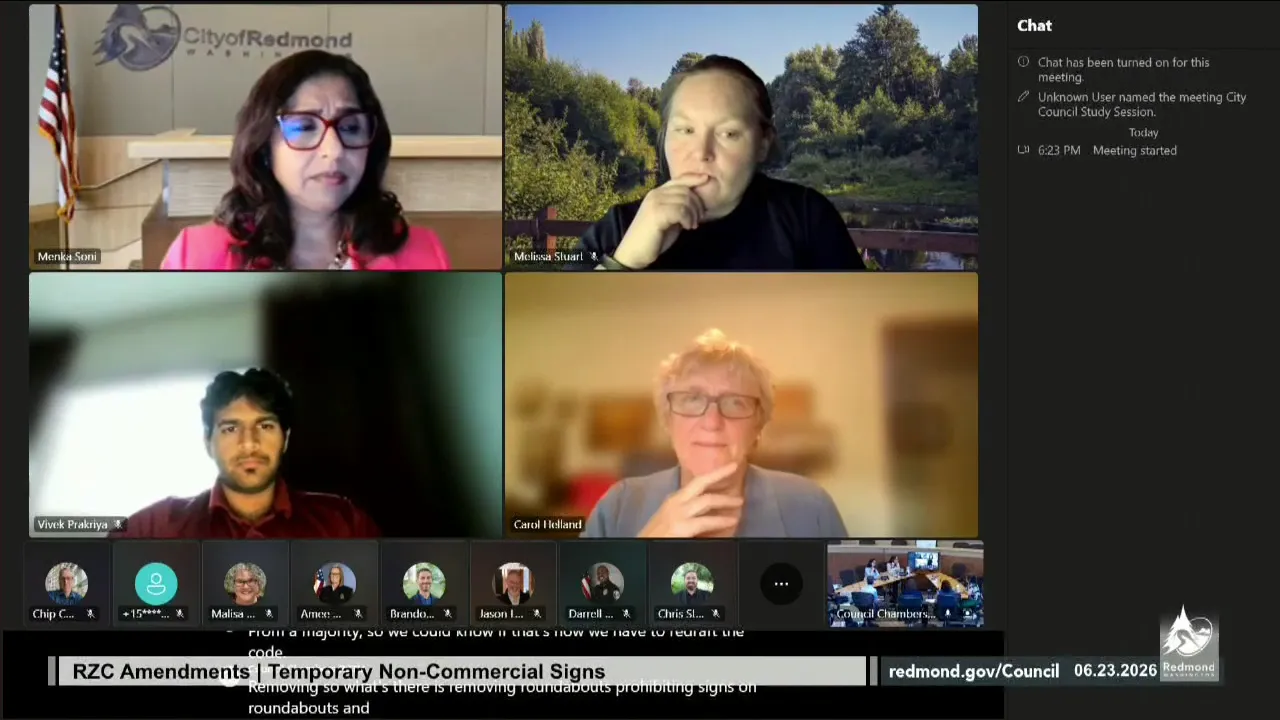
Planning Director Carol Helland, Lauren Alpert, Jeff Churchill, and Planning Commission Chair Susan Weston presented proposed code changes to make the city’s sign regulations content‑neutral, as required by 2015 and 2022 Supreme Court decisions. The amendments would regulate temporary non‑commercial signs (political, community event, and philosophical/religious messages). Staff recommended a permit system (60 days, renewable) to aid enforcement and reduce clutter, while the Planning Commission recommended no permits, allowing signs in medians and roundabouts, and relying on periodic sweeps. Council debate centered on enforcement burden, free‑speech implications, the feasibility of permitting, and safety (particularly in roundabouts vs. medians). Councilmember Forsythe, Prakriya, and others expressed concerns that a permit system would punish good actors while being ineffective against bad actors. Chair Weston noted that the permit system could chill speech and would be difficult to enforce. After extensive discussion, the council directed staff to bring forward the Planning Commission’s recommendation (no permit requirement, signs allowed in medians but prohibited in roundabouts) for adoption on the July 21 consent agenda, with an effective date of January 1, 2027. The permitting issue will be brought back separately for further consideration, including coordination with neighboring cities.
Council Talk Time
Councilmember Parsi raised interest in a council conversation about data center policy in Redmond, citing the grid study’s exclusion of such loads and Seattle’s recent decisions. Several councilmembers expressed support for exploring the topic, with the expectation it could be addressed at a future retreat. Council President Stewart reminded members of recent documents (Matrix Consulting development services study and data‑sharing agreement information) and noted that council responses to three public records requests are due by June 30. She also announced there will be no council meeting on June 30 (fifth Tuesday of the month). Councilmember Parsi further proposed stronger partnership with the Lake Washington School District, building on a joint session held in 2025; the idea was generally welcomed and may be discussed at the early‑2027 retreat. Councilmember Forsythe reminded everyone of the “Meet Me at Marymoor” event (July 19, free but ticketed, likely to sell out) and the council store deadline of June 30.
Key Outcomes
- No formal votes were taken on the grid capacity study; the council directed staff to continue strengthening coordination with PSE and to pursue a pilot project for substation upgrades.
- For the sign code amendments, the council directed staff to bring the Planning Commission’s recommendation (no permits, no signs in roundabouts, signs allowed in medians) to the July 21 consent agenda, effective January 1, 2027. Staff will return later with a separate proposal on the permitting system.
- Council expressed interest in discussing data center policy and in enhancing collaboration with the Lake Washington School District; both topics will be considered during future planning sessions.
Meeting Transcript
I'm calling this meeting to order. This is a Redmond City Council study session held on Tuesday, June 23rd, 2026, commencing at 7 p.m. Councilmember in attendance in person, our Council Member Forsyth, Councilmember Parsi, myself, Council Vice President Nueva Kamina presiding in lieu of Council Council President Stewart, who is attending AWC in Spokane today. She's joining us online along with Councilmember Prakriya and Council Member Sony. Councilmember Kritzer will also be absent from the meeting tonight. Is there any objection to excusing Council Member Kritzer from the meeting? Seeing none, she is excused, also just as a point of information, Mayor Bernie will also not be attending this evening. There are three items on the agenda tonight, and that is the joint Redmond and Bellevue Electric Grid Capacity study findings and next steps, along with the RZC amendments, temporary non-commercial signs, and council talk time. The first item on the agenda is the joint Redmond and Bellevue Electrical Grid Capacity Studies finding next steps. Jenny Liebeck, Sustainability Program Manager, will introduce this item. Welcome back, Jenny. Thank you, and good evening, Council. So again, I am Jenny Liebeck, sustainability manager. And with me tonight is the project co-lead, Glenn Coyle, as well as Aaron Cherry and Kenton Phillips from AECOM, and they both served as the technical consultants on this project. And also want to recognize representatives from Puget Sound Energy as well who are joining us this evening. But just to set the stage for our conversation, so your packet included the full report, which represents more than a year of work in partnership with the City of Bellevue and Puget Sound Energy, where we explored the capacity of our local electric distribution system. So we partnered with Bellevue given our similarities. So we're experiencing comparable growth. We share PSC infrastructure across our borders, and we have similar climate and electrification goals. And working together also allowed us to share costs and bring economies of scale to the project. So the report includes findings for both cities. And tonight I'm just gonna or we will all focus exclusively on the Redmond component for obvious reasons, but just wanted to flag that. So I also just want to note and encourage you to keep in mind that this study is a starting point for the city. So we're really seeing significant changes in how electricity is used and delivered. And this study is helping orient us in that landscape, just to better understand where future investments and coordination will be needed. So for today, our goal is to share what we've learned and where we're headed next as we continue planning for Redmond's future growth and electrification. So the report in your packet contains again that really technical analysis, and so today we're gonna try and bring that up a level and focus on the key findings and what they mean for from a planning perspective. We'll also touch on you know why we embarked on this project, the key questions that we're trying to answer, and the overall scope. And then I'm going to hand it over to Erin and Kenton to review the technical components of the study, including how they did the analysis and the key findings. And then finally, we'll briefly discuss, you know, what these findings mean for the city and some of the next steps that we're going to be taking. Um, but just to understand and give a little context as to why we undertook this work, it's just helpful to just take a step back. Um I think first and foremost, with the adoption of Redmond 2050, we know that we're planning for significant growth over the coming decades. We know there was going to be a growing population, new housing, um, more employment and businesses that are coming to Redmond. Um, and at the same time, meeting our climate goals means that we're transitioning much of our community away from fossil fuels and towards electricity that's powered by an increasingly clean electric grid. We have state policies, right, like the Clean Buildings Performance Standard, the Clean Energy Transformation Act, Advanced Clean Cars, and all of these policies are helping accelerate that transition and shaping how our community will look will use electricity in the future. And so together, these trends mean that electricity will play an increasingly critical role in supporting our community's transition from a suburb to a city, as we outlined in Redmond 2050. And at the same time, we know that we're already beginning to see signs of some of those increasing increasing demands. Um PSE is receiving larger load requests, and in some areas, those have been more challenging to accommodate in timely manners that support uh economic development and growth. But for all of the reasons I just outlined, we want to proactively understand where opportunities or constraints may exist so that we can better coordinate and plan long term. So looking at the goals for this process, you know, at its core, this study is designed to help us answer three questions. So, how much electricity will Redmond likely need as our community grows and electrifies? Is today's local distribution system capable of supporting that future demand? And if not, you know, where should the city and PSE begin planning together? And so to answer those questions, we evaluated the future electric electricity demand at the substation level. And Kessen will talk about that. Um we'll explain that why we focused on the substation level a little bit later in our discussion. Um but I did want just to flag that this is not an engineering design or replacement for PSE's own planning processes. They conduct really detailed and robust utility planning processes using their proprietary operational data. Um instead, this is an independent planning assessment. We used publicly available information and local planning assumptions just to better understand how our future demand compares with the system's available capacity.
openpublica.com