Redmond City Council Study Session – July 14, 2026
STREAMING COPY IN PREPARATION — RECORDING AVAILABLE FROM THE ORIGINAL SOURCE
Redmond City Council Study Session – July 14, 2026
The Redmond City Council held a study session on July 14, 2026, beginning at 7:00 PM. Mayor Angela Birney was absent. At staff request, agenda items two and three were flipped, so the order was: 2026 Annual Community Survey Results, Recreation Program Plan Overview, Pavement Management Program Update, Tenant Protections Update and Discussion, and Council Talk Time. No consent calendar or formal public comment period was on the agenda.
2026 Annual Community Survey Results
- EMC Research Senior Principal Sarah Labatt presented the city’s annual resident survey, conducted April 6–May 3, 2026, with 528 random-sample interviews and a margin of error of plus/minus 4.3 percentage points. It was offered in English, Spanish, Chinese, and Hindi and used mail, text, email, and phone outreach.
- Quality of life remained high: 81% rated Redmond excellent or good, including 32% excellent, the highest excellent rating measured in some time.
- The most frequently cited community problems were affordability/cost of living/taxes, growth/overdevelopment, and traffic; affordability was the top concern in all three geographic regions (downtown, east, west). Concern about growth was 7 points lower than in 2025.
- 67% rated the city’s overall job performance excellent or good. Ratings of the police and fire departments improved, with police excellent ratings rising from 24% to 33%.
- 90% of residents said they feel safe in Redmond and walking alone in their neighborhoods.
- A performance-versus-importance gap analysis showed managing police services and utilizing community feedback remain areas for improvement, while the pedestrian/bike-safety gap narrowed by 6 percentage points.
- Councilmembers asked for demographic crosstabs (notably for safety data), neighborhood-level detail, and future disaggregation of the affordability/cost-of-living/taxes category. The decrease in newsletter reach was attributed partly to the survey’s broader outreach methods.
Recreation Program Plan Overview
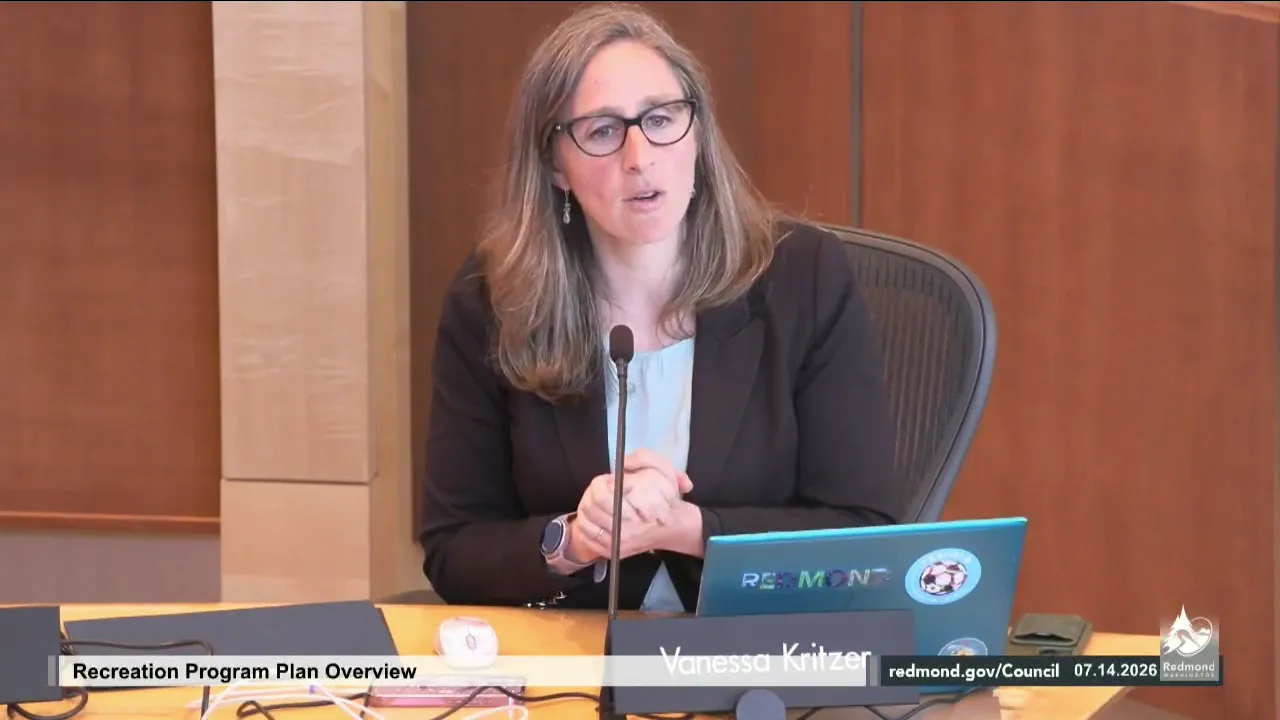
- Parks and Recreation Director Lorene Hamilton introduced the department’s first-ever Recreation Program Plan, developed with PROS Consulting; the contract was approved in May 2025 and the project began in June 2025.
- The plan was informed by staff focus groups, stakeholder interviews, a project website, an open-access online survey (over 333 responses), and a statistically valid resident survey focused on recreation (just over 400 responses).
- Key findings: 94% of residents visited a park or recreation facility in the past year; 39% participated in a program (above the 36% national average); and 61% visited the city’s recreation website but only 39% registered, creating an activation/conversion gap.
- The city has more than 240 distinct recreation offerings. Identified service gaps included adult programming, fitness and wellness, outdoor recreation/nature/environmental education, aquatics, youth sports, cultural/multicultural programming, and geographic gaps in Idlewood and Overlake.
- The plan is organized around five strategic pillars: growing/refining the program portfolio; improving access and discoverability; investing in facilities and infrastructure; addressing service gaps through partnerships and expanded programming; and modernizing staffing, training, and organizational tools.
- Councilmembers discussed how to evaluate underperforming programs while protecting programs that serve unique populations, and noted strong community interest in adult fitness/wellness and outdoor activities. No formal action was taken.
Pavement Management Program Update
- Interim Deputy Public Works Director Brandon Bueller and Senior Engineer Adnan Shabir presented the new Pavement Strategic Plan and Implementation Plan. The funding strategy will come with the mayor’s 2027–2028 budget in fall 2026.
- Pavement Condition Index (PCI) measures street surface health from 0 to 100. Of the city’s 362 lane miles: about 7% (25 lane miles) are in excellent condition (PCI 86–100); roughly half (150 lane miles) are PCI 71–85; about 14% are in poor condition (PCI 41–55); and about 1% (4 lane miles) are near failure (PCI 20s). Residential streets average PCI 71; arterials average PCI 64 and are declining faster.
- The city has invested about $1.7 million per year over the last six years and delivered about 21 lane miles of paving; meeting adopted level-of-service goals would require roughly 12 lane miles per year.
- The plan recommends a dedicated annual paving investment of $5 million beginning in 2027, escalating by $250,000 per year to about $8 million by 2039. Without increased funding, the network PCI could fall to about 54 within seven years.
- Staff described a new delivery model: separate utility contracts completed before paving projects, the capital division managing paving from project start, annual arterial rehabilitation, and expanded preventative maintenance on residential streets.
- Councilmembers requested additional budget scenarios, cost-avoidance estimates, and discussion of transportation benefit district revenues and regional coordination. No vote was taken.
Tenant Protections Update and Discussion
- The Tenant Protection Subcommittee (Councilmembers Prakriya, Kritzer, and Forsyth) presented options for policy and budget decisions. Staff-drafted amendments to Chapter 9.54 of the Redmond Municipal Code included clarifying rent-increase notices, distributing tenant-rights information with leases, fee-transparency and limits, and an opportunity-to-correct provision.
- The subcommittee reported that feedback identified concerns: removing the 180-day notice for rent increases over 10% could roll back protections because the new state law applies only to buildings 12 years or older; fee language needed clarification, particularly the difference between fees and penalties; and the opportunity-to-correct provision could be less effective if landlords repeatedly correct violations.
- Additional policy options included a rent-fixing software ban modeled on King County’s 2025 ordinance and updates to business-license posting requirements. The subcommittee recommended waiting on the rent-fixing ban until the King County executive’s enforcement report is available.
- Budget options discussed included a dedicated FTE/contractor for tenant assistance and enforcement, a funded work-plan item for planning staff, a renter’s handbook, and expanded tenant-rights communications.
- Councilmembers expressed support for meaningful, enforceable, non-adversarial tenant protections and for renter stability. Councilmember Nuevacamina emphasized the importance of renters’ civic voice; Councilmember Sony raised concerns about repeated violations under the opportunity-to-correct rule; Councilmember Parsi asked what provisions were not included and why.
Council Talk Time
- Planning and Community Development Director Helen gave a verbal update on the Interlake Sporting Association (ISA) business license renewal, which has been pending for more than a year. The renewal required more rigorous code compliance, including a surveyed range plan; ISA resubmitted materials in October 2025. After earlier consultant searches found no range examiner, the police department contracted a range examiner in June 2026 and is awaiting a schedule. The city attorney’s office will oversee remaining re-licensing work and potential code updates after Director Helen’s departure.
- Council also discussed the Flock automatic license plate reader contract. The requested closeout agreement had not been received. Councilmembers agreed to schedule a vote at the next business meeting to end the contract with Flock.
Key Outcomes
- Tenant protections: Council directed the subcommittee to continue work on a comprehensive policy package (Option D), to explore a dedicated FTE/contractor and work-item funding (with possible provisos), and to work with communications staff on improving tenant-rights website content, flyers, and FAQs. No code amendments were adopted.
- Flock contract: Council agreed to place a vote on ending the Flock automatic license plate reader contract on a future business-meeting agenda, likely the next business meeting.
- Pavement management: Staff will bring the funding strategy forward as part of the mayor’s 2027–2028 budget in the fall; additional budget and cost-avoidance scenarios were requested by councilmembers.
- Survey, recreation plan, and pavement update: These items were informational study-session presentations; no formal votes were taken.
Meeting Transcript
Are in attendance tonight. Mayor Bernie will not be present tonight. Following staff request, items two and three on tonight's agenda will be flipped. And following a council request, tonight's council talk time, we'll kick off with a verbal report from Director Helen regarding a business license update that came up in committee of the whole last week. So there are five total items on the agenda the 2026 annual community survey results, recreation program plan overview, pavement management program update, tenant protections update and discussion, and council talk time. The first item on the agenda is the 2026 annual community survey results. Deputy Director of Equity and Strategic Services, Zach Hoofner will introduce this item. Thank you, Zach. Thank you, Council President. Good evening, Council. I'd like to welcome and introduce Sarah Labatt, who is a senior principal with EMC Research Incorporated. And tonight, Sarah and team are here to present the results of this year's annual survey and answer any questions you might have. Welcome, Sarah. All right. Thank you. Thank you so much for having me. Sarah Labatt, Senior Principal with EMC Research. My colleague Sienna Ziggler is here as well in the audience, and she'll help with any questions as they come up. Hopefully, I'm close enough. And hopefully you can all see the screen. Okay, so I think we have about 30 minutes on the agenda today. So I'm going to move through this presentation. Happy to take questions. I'm hoping unless it's really critical that we can hold questions till the end just so that we can make sure we get through, and then I'm happy to take any questions that you have about our presentation. So, first of all, giving an overview of the work we did. This is a general satisfaction survey of Redmond residents about city government and resident priorities for planning and improvements in Redmond. We did the survey April 6th through May 3rd, 2026, so just wrapped it up a couple of months ago. We have done this survey with Redmond for a number of cycles. And as our industry is constantly evolving and how we contact people and what the best ways to listen, we uh also evolve our methodology. I know in years past when we've done this survey, we've talked a lot about methodology and how we contact our respondents. It's been primarily mail-driven in our last few iterations. Um we uh listened to the feedback and broadened our methods to get feedback here in this survey. It is still a random sample survey, but we used not just mail, we did use mail to generate um responses, but also did texting, emailing, outbound telephone interviewing to make sure that we are representing a broad, diverse and representative sample of Redmond residents. So we do think this helped to broaden our participant pool and really get a sample that's reflective of the community. Um we did 528 total interviews with a random sample of Redmond residents. So as we look at this data, it's a margin of error of about 4.3 percentage points when we're looking at citywide data. So as we look at any data point, you can think of a bar about four points plus or minus. And if we could have asked every single person, most of the time the answer would fall in that window. Um the survey was offered in English, Spanish, Chinese, and Hindi, and um most did choose to take the survey in English. We also asked them the language they spoke at home, and we did see more diversity of language than we saw in the um the the cho their choice to in the language that they participate. So we don't force them to take it in a specific language, rather, we offer the languages, and they can choose what to take it in. We will show a little bit more about language diversity here a little bit later in the deck of our respondents. Um, as I've said, we've uh been working with the city for a number of years. So we have a lot of time series data. Um, so we provide that perspective here in this report. And uh we are also currently in the field with an open access survey at Redmond Survey.com. It's available for people to take. It is an opt-in, it is not a random sample, but rather a you know, opportunity for anyone in the community to go and take the survey that is open now. Um, it will be open for another few weeks till the end of the month, and uh that's up to over 400 completed surveys at this point. It is a much higher response rate than in years past, and your staff has done a lot of work promoting that survey and really pushing it out to the community and making sure people know it's available.
openpublica.com