Redmond City Council Business Meeting - July 21, 2026: Presentations, Drone Regulations, Sign Code, and Flock ALPR Termination
STREAMING COPY IN PREPARATION — RECORDING AVAILABLE FROM THE ORIGINAL SOURCE
Redmond City Council Business Meeting - July 21, 2026
The Redmond City Council held a regular business meeting on Tuesday, July 21, 2026, at 7:00 PM at City Hall (15670 NE 85th St) and remotely. The meeting included presentations from Cascade Water Alliance and a Vision 2050 award, public comments on tree enforcement, signage, safety, and Flock cameras, a public hearing on commercial drone land uses, staff reports on the tree code update and the Southeast Redmond Manufacturing and Industrial Center (MIC) strategy, and a vote to terminate the Flock ALPR contract. All votes were unanimous (7-0) on major actions.
Consent Calendar
- Items Approved: The consent agenda (items 1-6, 8) was approved by a 7-0 voice vote. These included approval of minutes from July 7, 2026, payroll/claims checks, a construction contract with Earthworks Solutions for the Willows Road Watermain Extension ($1,323,740), a final contract with Coast to Coast Turf for synthetic turf replacement ($1,595,835), a services agreement with Technical Systems Inc. for control system upgrades ($2,409,370), Budget Adjustment #7 (Ordinance 3262), and the collective bargaining agreement with Teamsters Local No. 117 (Ordinance 3264).
- Item 7 (Temporary Non-Commercial Signs): Pulled by Councilmember Kritzer for discussion. Staff clarified that no permit is required for temporary non-commercial signs, the restrictions on affixing signs to poles/trees are existing code, and sight-line restrictions are also existing. The ordinance goes into effect January 1, 2027. A communications plan includes newsletters, press releases, and a 30-day hold for illegally placed signs. The item was later approved by a 7-0 roll-call vote (Ordinance 3263).
Public Comments & Testimony
- Tree Code Enforcement: Jay Hill and Catherine Moya (Marcrest neighborhood) highlighted a gap: tree code enforcement is unavailable on weekends, allowing unchecked tree removal. They requested an on-call enforcement system or a ban on weekend tree removal. Councilmember Prakriya noted the issue and staff confirmed a GIS permit tracking layer is being developed.
- Signage and Free Speech: Max Ruhlman and Wolf Adriatico urged caution on the sign ordinance, arguing it could restrict free expression and disproportionately affect individuals and small groups. They emphasized that government should protect speech, not limit it.
- Public Safety Concerns: Aaron Hamilton, a transgender resident, expressed feeling unsafe in Redmond, criticizing a recent survey that dismissed the 1% of residents who feel very unsafe. He shared personal experiences of harassment and noted the survey's demographic breakdown may underrepresent marginalized communities.
- Flock ALPR Cameras: Garrett Wilkes spoke against the cameras, citing ongoing distrust and fear of misuse among community members.
- Pickleball Court App: Prav Iyengar requested a 30-day pilot for a free crowd-sourcing tool for public pickleball courts (at Perigo Park, Meadow Park, and Municipal Campus) to help players find open courts. The mayor directed staff to follow up.
- Southeast Redmond MIC: David Morton requested baseline PFAS testing at the Evans Creek relocation site before construction and explicit consideration of aquifer recharge area overlaps in the zoning update docket.
- Public Hearing on Commercial Drones (Ordinance 3265):
- Adam Reinicke (homeowner) supported drone delivery cautiously, asking the council to steer drone ports to locations near highways to avoid traffic concentration and to act quickly before drones launch from outside city limits.
- David Morton supported the ordinance but requested direct stakeholder notification for residents near potential drone zones, precise definitions, early coordination with the FAA, and environmental review for sensitive areas.
- Katie Kendall (attorney for Zipline) expressed commitment to working with the city and suggested a temporary pilot program with a temporary use permit to gather real-world data for permanent regulations.
Discussion Items
- Cascade Water Alliance Presentation: CEO John Taylor and economist Andy Baker presented the Cascade Supply Program (connecting Tacoma water to King County over 40 years, $1.1-1.3 billion) and the proposed 2027-2028 budget. Rate increases of 9.5% in 2027 and 2028 were proposed to fund the program, translating to $0.33/CCF in 2027 and $0.35/CCF in 2028. Councilmembers questioned impacts on multifamily residents, water chemistry (blending Seattle, Tacoma, and groundwater), and the methodology for regional capital facilities charges. Vice President Nuevacamina highlighted that the alternative (sticking with Seattle) offered less water security. Councilmember Forsyth asked about inviting other jurisdictions; staff noted emergency access points are planned.
- Tree Code Update (Staff Report): Senior Planner Lauren Anderson and Senior Park Planner Cameron Zapata updated on the tree code revision, noting the current code is from 1998. The update aims to balance tree protection with state-mandated growth (population up 46% since 1998). Key changes include updated definitions, tree credit refinements, strengthened enforcement, and a tree protection zone. The timeline: public comment through July 31, 2026; Planning Commission review and public hearing October 14, 2026; Council adoption expected March 2027. Councilmembers urged sticking to the timeline, asked for a comparison to the 2022 draft, and raised concerns about weekend enforcement (staff confirmed a GIS layer is in development and cross-departmental discussions on enforcement are ongoing).
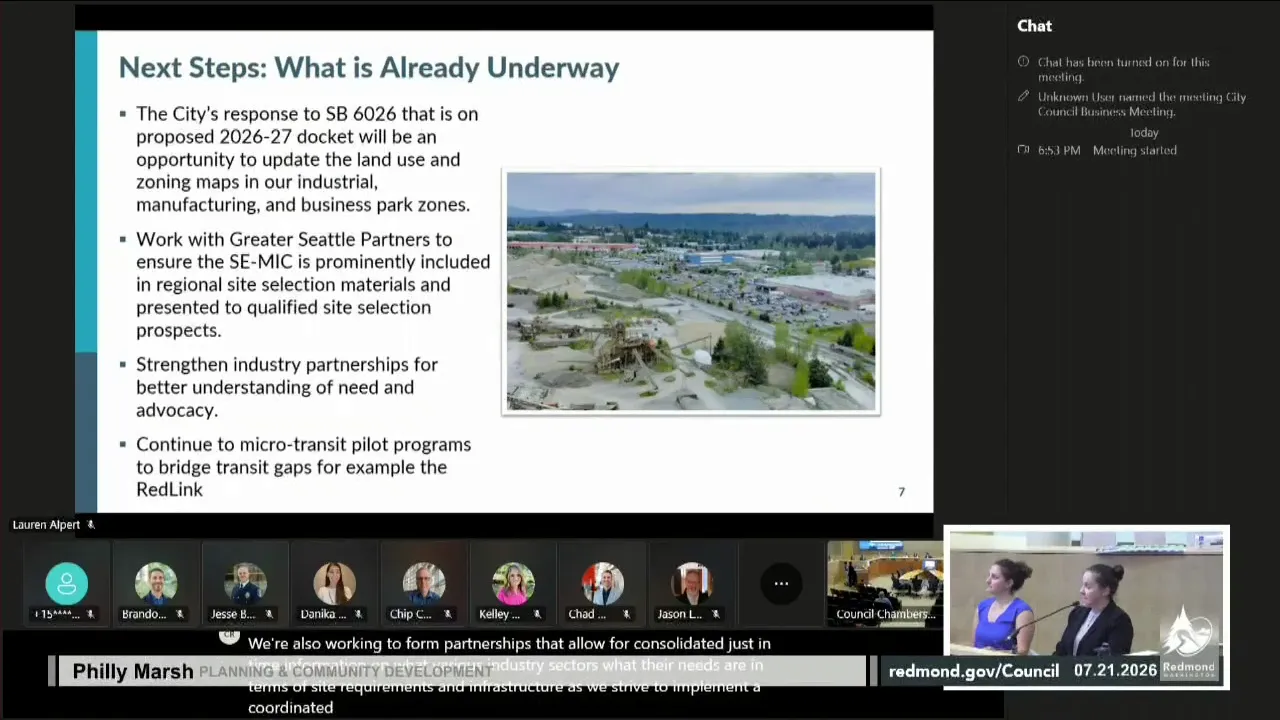
- Southeast Redmond MIC Strategy Guide (Staff Report): Deputy Director Serafie Allen, Senior Planner Lauren Alpert, and Economic Development Manager Philly Marsh presented findings from a market study. The MIC has a 3.6% vacancy rate (healthy is 5-8%), and there is strong demand for flexible industrial space. Power constraints are a concern. Strategies include zoning updates via SB 6026, partnering with Greater Seattle Partners, and exploring funding for vocational schools and city-owned property for makers. Council President Stewart emphasized the importance of economic diversification and asked about vocational school outreach. Councilmember Kritzer noted the need to accommodate businesses displaced from Marymoor. The next update will be October 6, 2026, with zoning docket items expected summer 2027.
Key Outcomes
- Consent Agenda: Approved 7-0, including all routine items and payables, with Item 7 (Sign Ordinance) pulled for discussion and later approved 7-0.
- Ordinance 3263 (Temporary Non-Commercial Signs): Approved 7-0 on a roll-call vote, effective January 1, 2027, with no permit required for non-commercial temporary signs.
- Ordinance 3265 (Commercial Drone Land Uses): After a public hearing, the ordinance affirming the interim moratorium on drone ports was approved 7-0. The interim control prohibits drone port land uses for one year while permanent regulations are developed (by April 2027).
- Flock ALPR Contract Termination: Council voted 7-0 to terminate the contract with Flock for automated license plate readers. The program has been paused since November 2025, and no additional financial obligation is incurred. The state grant funds are not required to be returned.
- Closed Session: The council adjourned to closed session under RCW 42.30.140(4)(b) for labor negotiations.
Meeting Transcript
I'm calling this meeting to order. This is a regular business meeting of the Redmond City Council held on Tuesday, July 21st, 2026, commencing at 7 o'clock PM. I will call roll starting with Council President Stewart here. Council Vice President Nueva Comuna. Here. Councilmember Forsyth. Here. Council Member Parkria. Here. Council Member Percy. Here. Councilmember Sony. Here. And Council Member Kritzer. Here. The first item on our agenda is a presentation from Cascade Water Alliance. I would love to invite the CEO. John Taylor up to the podium to share about Cascade. Thank you. Good evening, Council. I'm John Taylor. I'm the newly minted chief executive officer of the Cascade Water Alliance. I think I'm on week seven. Uh, and it is an honor to be here giving you all this presentation. Um, we're gonna cover a couple of things tonight. Uh, the first is going to be just a quick overview of the Cascade Supply Program, which is our audacious program to connect the Tacoma water supply with um the water supply down here in King County, or rather up here, I should say. And then uh my colleague Andrew Baker is going to be giving an overview of our budget and rate proposal for the upcoming biennium. Um, and so with that, oh, there's the agenda right there. Uh so I'll go to the next one. So just to ground people into Cascade Water Alliance. We are a wholesale purveyor of water to five jurisdictions and two water districts here in King County, serving about 400,000 residents to 380,000 employees. Um, and we currently are purchasing water from Seattle, have been for many, many years. We own Lake Taps, so the next time you're out on Lake Taps, uh, you're riding around on Cascade uh Alliance water. Um, and we now have a contract with Tacoma starting in 2041, and we will be transporting water from Tacoma into this region and using that as water supply for many of the many of the people in our service area. Um, and that's critical because it guarantees this region long-term water security, and it gives us a duplicity of sources for water here in King County that heretofore we have not had. Um that regional connection is going to create not only water resilience but climate resilience and resilience in the event of something really unforeseen happened with water supply in this region, for example, an earthquake, which uh is something that I think everyone here keeps in mind as we live in this region. Um the Cascade Supply Program, I'm just gonna provide a very quick overview. This is a really ambitious program. Um, but basically it rolls out in three phases. And the first phase is this green section on the map, which is the connecting with Tacoma's Pipeline 5. That is the southern boundary of that green segment. Um, and you'll note there is no route on that map yet. That's how early we are in planning for this. So uh ultimately we will determine a route and we'll run it north up to the other yellow line you see up there, which is the Bellevue Issaqua pipeline, and connect with that so that we can bring it into our service area. That's about 17, 19 miles of area that we have to traverse uh through a lot of jurisdictions and some water bodies. So it's a it's gonna be a complicated project. Um, but one that we feel very confident that we can deliver. The second phase is gonna be building out the infrastructure in the area that we serve once that pipeline gets here, so that we can deliver to all of our members. And then the last phase is connecting all of that with Lake Taps and building a treatment facility at Lake Taps. When you look at that map, you're looking at 40 years of investment in the region.
openpublica.com