OPENPUBLICA · PUBLIC MEETING RECORD
Record of Proceedings
Red Wing City Council Budget Workshop: Wastewater Plan and 2026 Levy – November 3, 2025
City Council — Monday, November 3, 2025
BodyRed Wing, Minnesota
SessionCity Council
DateMonday, November 3, 2025
StatusFILED
Video Record
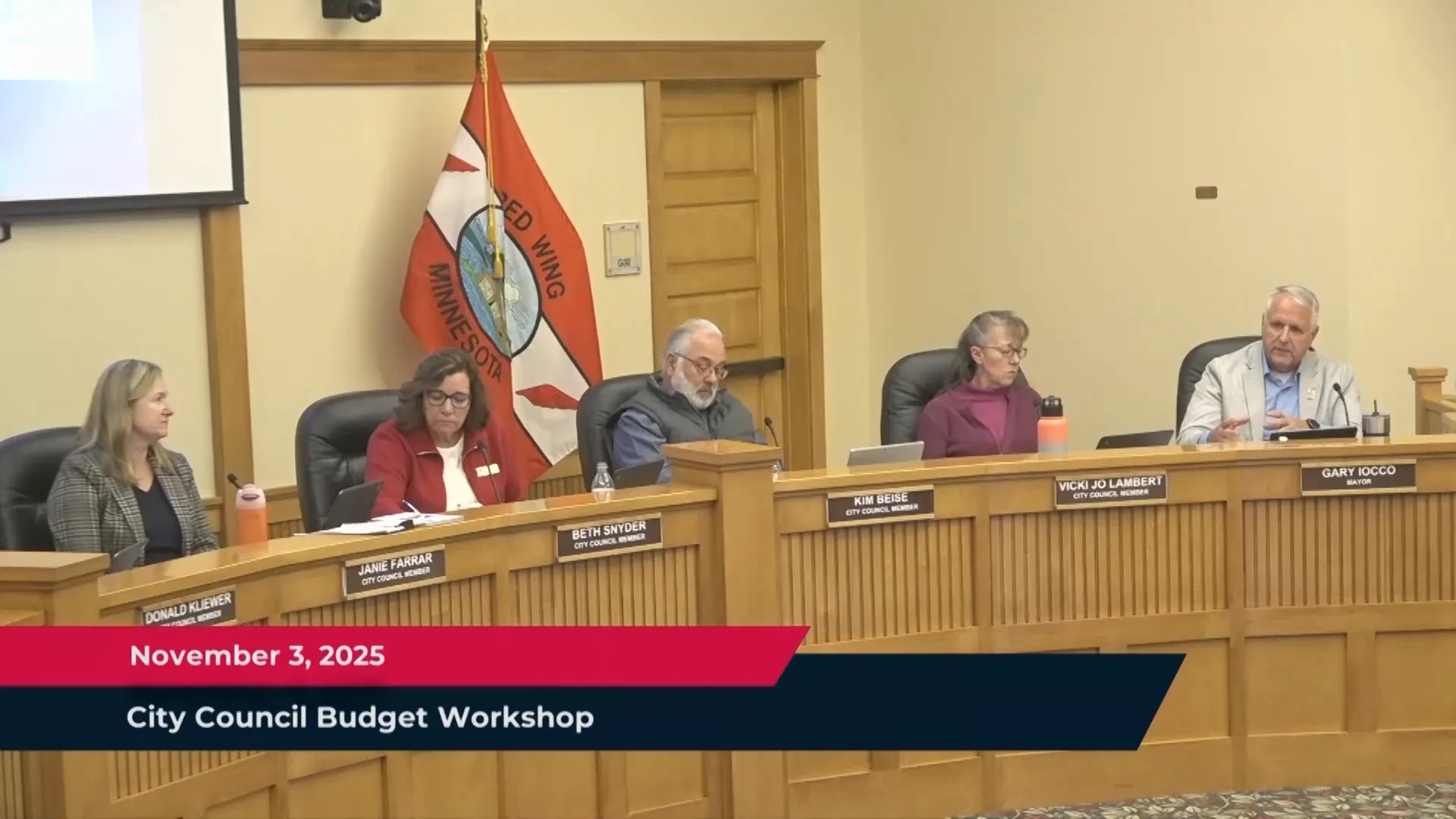
STREAMING COPY IN PREPARATION — RECORDING AVAILABLE FROM THE ORIGINAL SOURCE
Transcript — Verbatim
Speaker numbers apply only to this recording.
Discussion Breakdown — Share of Meeting
Water And Wastewater Management25%
Budget Equity Analysis13%
Engineering And Infrastructure11%
Capital Improvement Planning10%
Personnel Matters9%
Employee Benefits7%
Public Engagement7%
Energy Transition6%
Fiscal Sustainability4%
Summary of Proceedings
Red Wing City Council Budget Workshop: Wastewater Plan and 2026 Levy – November 3, 2025
On Monday, November 3, 2025, the Red Wing City Council held a budget workshop in City Council Chambers. The meeting was called to order at 5:01 p.m. and adjourned at 8:05 p.m. Council President Janie Farrar presided. Council members present included Vicki Jo Lambert, Beth Snyder, Kim Beise, Ron Goggin, and Donald Kliewer; Becky Norton was excused. Mayor Gary Iocco and city staff also attended. The workshop focused on the Wastewater Treatment Facility Plan and the proposed 2026 levy and budget.
Wastewater Treatment Facility Plan
- Utility staff and Bolton and Menk consultants presented a 20-year wastewater facility plan covering current plant condition, future needs, permitting requirements, alternatives assessment, funding opportunities, and a proposed improvement schedule.
- The original plant was built in 1960 and is approximately 65 years old. The “do nothing” option was described as not viable due to aging infrastructure and anticipated future permit limits, including a likely future nitrogen limit.
- The recommended alternative is Alternative 5, a biological aerated filter (BAF). Estimated capital cost is $142 million in 2025 dollars, including a 20% contingency and soft costs. The alternative was selected for its smaller footprint, expandability, and operational flexibility on the constrained four-acre site between the Mississippi River and a railroad.
- The current average monthly sewer bill is $48.00 per the 2025 fee schedule. A 6% increase is proposed for 2026, and a rate study is underway. Consultant Pichelmann noted Red Wing’s rates are relatively low compared with other cities.
- Funding opportunities identified include up to $12 million from the Point Source Implementation Grant and up to $10 million from the Water Infrastructure Fund, for a combined potential of $22 million, plus possible special appropriations bond requests. Bolton and Menk stated they have a dedicated funding team and a lobbyist to assist.
- The draft facility plan was completed in October 2025. A public hearing and council resolution are expected between December 2025 and February 2026, with submission to the Minnesota Pollution Control Agency by March 6, 2026. Construction could begin as early as 2028 with completion around 2031.
- Council members asked about alternative scoring, nitrogen removal, construction sequencing, expansion capacity, grant success rates, and the $142 million turnkey estimate. Mayor Iocco asked about design costs, which were not yet determined.
Proposed 2026 Levy and Budget
- Finance Manager Tony Schultz reported that with administrative changes, the proposed levy stood at a 3.25% increase and the fund balance draw had been reduced to just below $1 million. Based on workshop decisions, staff said it was reasonable to consider a slight reduction toward 3% and a further reduction in the fund balance draw.
- Staff requested direction on several vacant positions and budget items:
- Engineering Field Tech I: Engineering Director Regnier requested funding for this vacant position, citing project needs and consultant cost savings. Council member positions varied: Ron Goggin opposed; Janie Farrar was hesitant, preferring specific numbers for 2027; Beth Snyder, Kim Beise, Vicki Jo Lambert, and Donald Kliewer expressed support.
- CIP Manager reclassification: Staff proposed replacing the vacant CIP Manager position with a lower-level accounting position to provide capacity, cross-training, and grant support. Some council members supported this option with conditions, while others requested comparative data from other cities before deciding. No consensus was reached.
- Green fund e-bike: Staff proposed using $4,900 from the green fund for a police department e-bike. The green fund has $115,000 and no planned contributions this year or next. Council members discussed using green funds for invasive species prescribed burns and requested a list of eligible uses.
- Contingency: Staff recommended lowering the council contingency from $250,000 to $200,000, consistent with recent usage.
- Invasive weed control: Postponing $10,000 in Barn Bluff invasive species control was discussed, pending a potential grant.
- Fire standards of coverage study: Chief Warner proposed an in-house option saving $35,000 from the preliminary budget.
- Minnesota Paid Family and Medical Leave (PFML): The council reached consensus to use the MetLife private option at the half-funded level (employer pays half, employee pays half). Finance staff noted the employee cost would be approximately 0.0041% of annual wages.
- Administrative changes: Staff presented various operating and CIP adjustments, including increased police revenue estimates, additional police uniforms, winter planners, and reclassified CIP items. Engineering Director Regnier noted the railroad crossing quiet zone scope could be reduced through road channelization instead of a quad gate system, likely saving significant costs.
- Performance pay program: Discussion centered on the $308,000 annual budget. Several council members criticized the lack of measurable metrics. Janie Farrar proposed budgeting $100,000 for a hybrid system while developing a new program; Beth Snyder and Mayor Iocco supported $100,000. Ron Goggin suggested $154,000; Donald Kliewer and Kim Beise preferred $0; Vicki Jo Lambert supported the full $308,000 and expressed frustration. No consensus was reached, and staff requested clearer direction.
- City memberships: Staff reviewed memberships including the League of Minnesota Cities, Coalition of Greater Minnesota Cities, Coalition of Utility Cities, Nuclear Waste Strategy Coalition, and Southeastern Minnesota League of Municipalities. Annual costs exceed $100,000. Council members expressed differing views: Janie Farrar and Donald Kliewer questioned the value, Vicki Jo Lambert was not ready to drop memberships, Kim Beise saw value in all, Beth Snyder questioned the Coalition of Utility Cities, and Ron Goggin preferred waiting for relicensing clarity before dropping the utility coalition. No final decision was made.
Public Comments & Testimony
- No public comment was offered during the workshop.
Key Outcomes
- Consensus to support the MetLife private option at half funding for PFML.
- Staff was directed to bring updated levy and budget figures to the November 24, 2025 council meeting, reflecting the night’s discussions and fund balance options.
- No formal votes were taken during the workshop; decisions will be folded into the 2026 budget and levy process.
Meeting Transcript
All right, we'll do the official start. This is November 3rd. City Consul workshop, and we have a couple items. First, workshop item in the wastewater treatment facility plan. So I will hand it over to Sean and Kelsey. And welcome to our consultants. Thanks for being here tonight. Good evening. Including your packet is the draft wastewater facility planning document. It's uh I think just 400 pages, so I assume everybody's read that word forward to have some notes. Perfect. Yeah, okay, great. Um anyway, so we're gonna we've got our friends here from Bolton and Mink that are going to go through a PowerPoint, kind of give some uh a high-level overview of that, which should be done in four or five hours. And moving on. Kelsey had a couple things on timeline she wanted to highlight. And yeah, just uh reminder, this has been sort of a three-year process. In 2023, we started with a feasibility study with SEH, and they kind of outlined some of the needs that we had moving forward. Um 2024, we had an RFQ for an engineering fund that could do the facility plan. And Bulletin was selected, and they spent almost two years working on this plan. So the first year was a lot of um asset information, gathering what we have on our at our um facility, and then the next year was planning out the alternatives and all that sort of thing. So it's been a long time. They've been working on it. Um we have Jake Eckleman with Bolden Bank, Brian Hillgartner, and then Hannah Partnow. I think you can see that. Well, thank you. It's good to see everyone again. I think last time we were in April, we did the uh wastewater plan tour, so hopefully that was a good experience for everyone, and uh you got to see uh the full extent of the need out there, right? Um so that's the goal, and there's a lot of important decisions that got to be made here uh by the city council. So that's what we'll be talking about today. I know your time is valuable, so I'll try to keep it to something like 15 to 20 minutes, and then uh if there's any questions along the way, don't hesitate to stop me. So, what are we talking about? It's a wastewater facility plan. As Kelsey stated, you know, this is a about a two-year process that we started in 20 uh 24 in the spring, and it's kind of led to this moment. So, what what is the wastewater facility plan cover? It's a 20-year planning document, so we're looking at uh the city of Red Wing's needs over the next 20 years. That can be uh from a permitting perspective, a capacity perspective, basically your ability to treat your wastewater over the next 20 years is what's encompassed in this report. So uh we looked at things like community growth, uh that includes your both residential and uh industrial uh projections. You do support uh six industrial users in town at the moment. Um design conditions, your flows, uh your loading capacity at the plant, and then ultimately looking at your existing infrastructure evaluation. What is your ability to meet those 20 year needs with the existing infrastructure that you have, and what kind of improvements do you need to consider uh into the future? Uh so that includes permit regulations, that's a big consideration. You know, your ability to meet your current permit limits and what possibly could come in the future that could impact the type of processes you have out there and the type of money that you would need to spend to do that. Um, and then looking at all those types of alternatives, uh basically throwing everything at the wall and seeing what sticks and making sure there's no stone left uh unturned uh to be thorough in this process.
SUMMARIZED BY OPENPUBLICA AI
TRANSCRIPT VIA PUBLIC VIDEO
openpublica.com
openpublica.com