OPENPUBLICA · PUBLIC MEETING RECORD
Record of Proceedings
Red Wing City Council Workshop Discusses Open Meeting Law, Rules of Order, and 2026 Schedule on November 24, 2025
City Council — Monday, November 24, 2025
BodyRed Wing, Minnesota
SessionCity Council
DateMonday, November 24, 2025
StatusFILED
Video Record
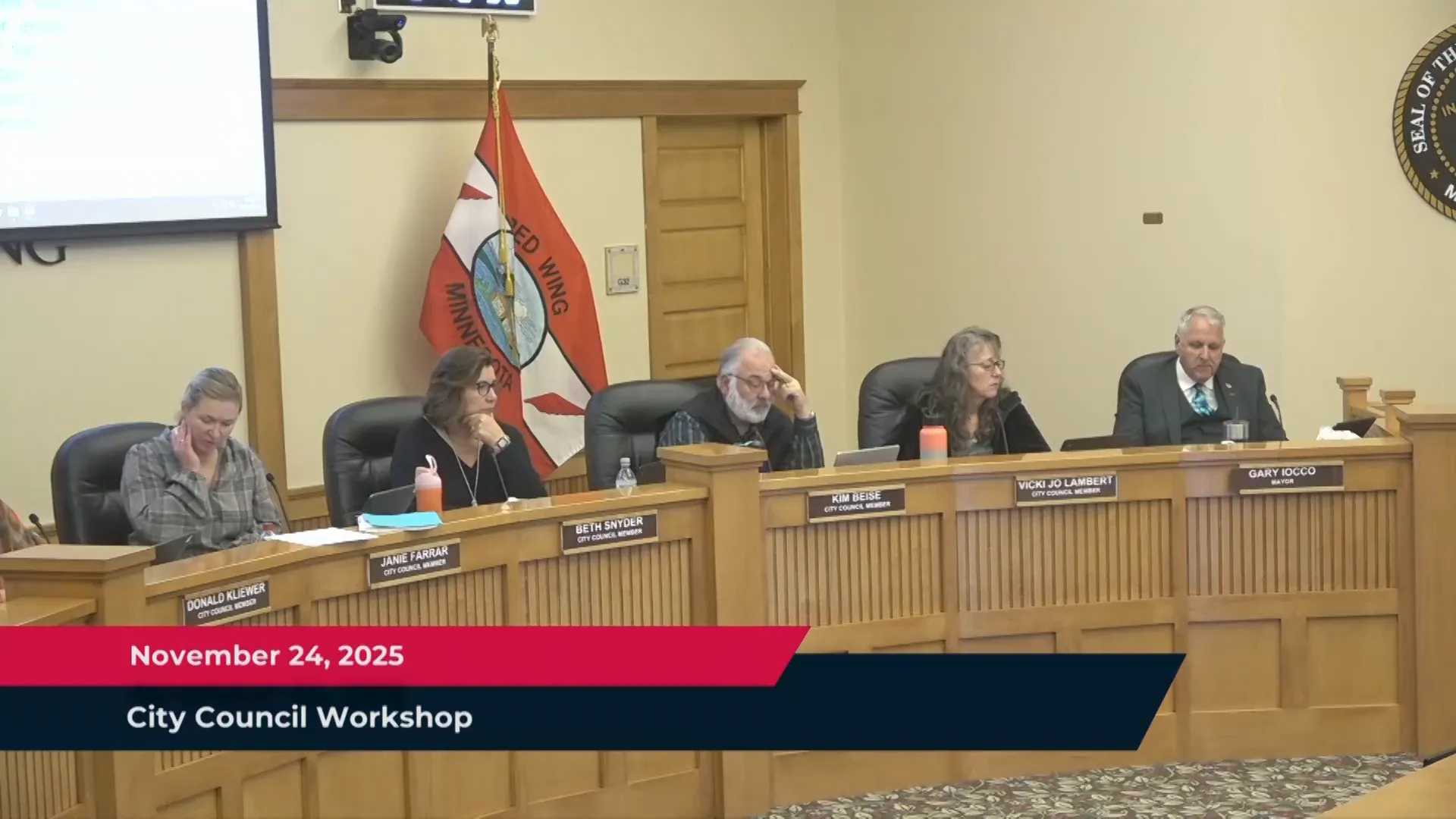
STREAMING COPY IN PREPARATION — RECORDING AVAILABLE FROM THE ORIGINAL SOURCE
Transcript — Verbatim
Speaker numbers apply only to this recording.
Discussion Breakdown — Share of Meeting
Open Meeting Law62%
Governance Structure19%
Procedural12%
Legal And Compliance7%
Summary of Proceedings
Red Wing City Council Workshop – November 24, 2025
The Red Wing City Council held a workshop on Monday, November 24, 2025, from approximately 5:01 to 5:59 p.m. in City Council Chambers at 315 West Fourth Street, Red Wing, Minnesota. All seven council members were present, along with Mayor Gary Iocco, City Attorney Zachary Cronen, and city staff. The workshop covered a legal refresher on the Open Meeting Law and ex parte communications, potential updates to the Council's Rules of Order and Procedures, and a proposed 2026 City Council meeting schedule.
Discussion Items
Open Meeting Law and Ex Parte Communications
- City Attorney Zachary Cronen reviewed Minnesota Statutes Chapter 13D, including the definition of a meeting, serial meetings, email/text risks, committee meetings, social and chance gatherings, special and emergency meetings, closed meetings, and ex parte communications.
- Council members asked about attending invite-only events and public informational events where a quorum may be present. Cronen advised that truly social gatherings can be acceptable but warned that discussing city business or having only council members present can raise concerns; posting a notice is the safest practice.
- Becky Norton asked about committees without decision-making authority and whether they must remain below a quorum. Cronen confirmed they should, noting that a quorum of council members at a committee can create open meeting law concerns even without delegated decision-making authority.
- Donald Kliewer asked whether Mayor Iocco's presence affects quorum calculations; Cronen confirmed it does.
- Cronen said communications intended for the council should go through the City Administrator, and he advised directing constituent questions about specific projects to staff rather than discussing quasi-judicial matters such as conditional use permits outside public meetings.
- Vicki Jo Lambert asked about the difference between a developer meeting council members individually and a constituent offering general comments. Cronen said individual developer meetings should generally be avoided when a pending application exists, while general constituent feedback is acceptable until a quasi-judicial application is active.
- Becky Norton noted she had anxiety because of past investigations; Cronen said he wanted to do a deeper review before giving more detailed guidance. Council Administrator Chris Heineman noted that many cities post notices when a quorum may attend without turning the event into a public meeting.
Council Rules of Order and Procedures
- Public Information and Engagement Officer Michelle Leise reviewed items council members had previously flagged: meeting schedules and virtual meetings, order of business, creating and amending the agenda, removing items from the consent agenda, public comment, and workshops.
- Becky Norton questioned formalizing the consent agenda removal process, saying an informal process already exists; Leise said the item could be removed if the council was comfortable.
- Kim Beise asked to discuss whether council liaisons on boards and commissions are necessary.
- Mayor Iocco raised the total number of boards and commissions and policies related to them; Leise noted some council rules are tied into the boards and commissions policy booklet.
Proposed 2026 City Council Meeting Schedule
- Council Administrator Chris Heineman proposed adding monthly workshops before the second regular meeting of the month and quarterly topic-specific sessions or tours, with some meetings starting at 7:00 p.m. to allow 75-minute workshops.
- Janie Farrar supported the draft schedule. Ron Goggin asked whether quarterly meetings would be budget workshops; Heineman said they could be budget workshops or tours. Goggin said he preferred stacking meetings rather than adding additional meeting dates.
- Kim Beise accepted 7:00 p.m. starts as long as meetings end at a reasonable time. Becky Norton supported consistency for the public but expressed concern that the number of workshops could feel excessive; she also asked staff to limit the number of items per workshop.
- Vicki Jo Lambert discouraged inconsistent meeting times and said workshops immediately before council meetings often feel rushed. Mayor Iocco said workshops would likely make regular council meetings shorter by allowing earlier discussion.
- Heineman noted staff already had about 10 workshop topics waiting and that workshops could be canceled when not needed.
Key Outcomes
- No formal votes were taken at the workshop.
- Council members were asked to email additional comments on Rules of Order and the proposed meeting schedule to Heineman or Leise.
- The proposed 2026 meeting schedule will be brought back for adoption at the December 8, 2025, City Council meeting.
- City Attorney Cronen will do additional research on quorum-attendance notices before providing further guidance.
Meeting Transcript
First. And our first item of business, we have three tonight, but first one is open meeting law and communications presentation by our city attorney Zachary Cronin. I hope I got that correct. Yep. Thank you. All right. Good evening. So tonight we're going to be just doing a refresher on open meeting law and ex parte communications. I'm sure most of you are very familiar with these issues, so it's not intended to be a deep dive into these, but more just to kind of walk through them, keep them fresh in everyone's mind, because these issues do come up and questions do come up pretty frequently. So turning to the uh we'll start with the open meeting law. So the open leading meeting law creates a presumption that all meetings of governing bodies are open to the public. The statutory reference, if you ever have questions, is Minnesota statutes chapter 13D. So the primary purpose of the law is allowed is to allow interested members of the public to be fully informed on a government body's happenings. So to that end, the open meeting law is construed liberally in favor of granting access to the public. So the first question that inevitably comes up when you're looking at open meeting law issues is what is a meeting? So whenever the city council meets, it must comply with the open meeting law. So for purposes of the open meeting law, courts have defined a meeting as a gathering of a quorum or more members of the governing body at which members discuss, decide, or receive information as a group on issues relating to official business of that governing body. So obviously when the council meets in chambers, those are meetings. Like that is pretty straightforward. A question more often comes up when you're dealing with sort of these kind of unique issues, such as telephone or video calls. So meetings occur if a majority of the council members participate in a conference call or some other sort of virtual communication, whether it's Zoom or Skype. Another issue that comes up is serial meetings. So serial meetings are meetings consisting of less than a quorum. But the sort of a non-quorum is looking to gather consensus by sort of doing pockets of different non-quorum members of the council. So if you're trying to get gather consensus through sort of skirting around quorum rules, that would be a serial meeting and not consistent with the open meeting law. One that comes up quite a bit for our clients is emails, text messages, and chats. We're going to talk through a couple opinions from the data practices office as well as a court case that addresses this. It was seven members of the board. They were using reply all, which I know you all know is a no-no for city councils. But we're using reply all, and based on their comments, the board chair was able to draft a press release on behalf of that task force. And a citizen filed a complaint with the data practices office, and they issued an opinion saying that this constituted a meeting because a quorum of the board here, all seven members, were on this email thread, and they reached a consensus. So that just shows, according to the data practices office, that these type of sort of email threads, text threads, those sort of things could constitute a meeting law violation. However, the Court of Appeals did issue a decision about 13 years ago in O'Keefe v. Carter, where this involved the township, three members of the township supervisory board were on an email thread. Two they were discussing the amount of fuel storage that the township had and whether they needed to purchase more. One of the township board members sued the other two, so that was definitely some conflict on that township. Sued the other two, alleging that this email thread violated the open meeting law. And in that case, the Court of Appeals found that this was not a violation of the open meeting law because they said there in this case that officeholders must communicate orally.
SUMMARIZED BY OPENPUBLICA AI
TRANSCRIPT VIA PUBLIC VIDEO
openpublica.com
openpublica.com