OPENPUBLICA · PUBLIC MEETING RECORD
Record of Proceedings
Red Wing City Council Workshop Discusses Perpetual Flowers, Organics, Ladder Truck, Tipi Project on January 26, 2026
City Council — Monday, January 26, 2026
BodyRed Wing, Minnesota
SessionCity Council
DateMonday, January 26, 2026
StatusFILED
Video Record
STREAMING COPY IN PREPARATION — RECORDING AVAILABLE FROM THE ORIGINAL SOURCE
Transcript — Verbatim
Speaker numbers apply only to this recording.
Discussion Breakdown — Share of Meeting
Fire Safety Equipment20%
Waste Management19%
Budget Equity Analysis18%
Facility Management14%
Environmental Protection6%
Emergency Medical Services5%
Public Safety5%
Parks and Recreation5%
Capital Improvement Planning4%
Summary of Proceedings
Red Wing City Council Workshop - January 26, 2026
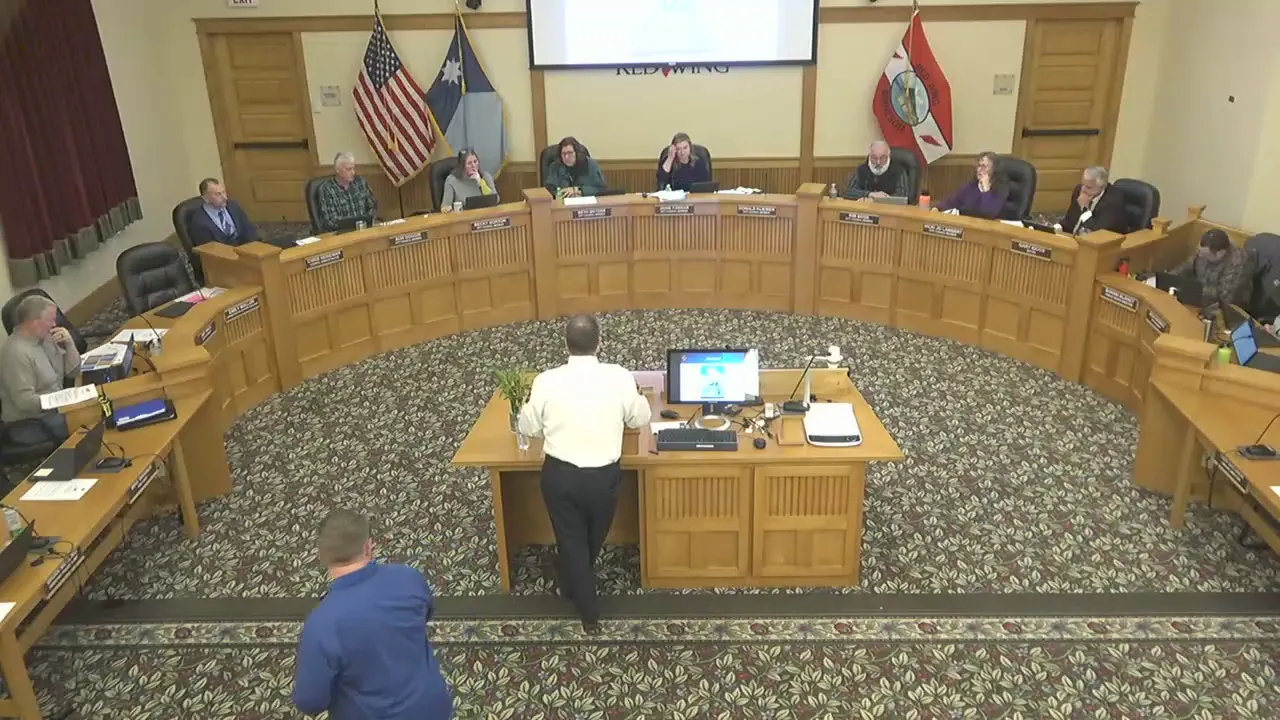
The Red Wing City Council held a workshop on Monday, January 26, 2026, from 5:01 p.m. to 6:21 p.m. in the City Hall Council Chambers, 315 West Fourth Street. Council President Janie Farrar presided. Council members present were Vicki Jo Lambert, Beth Snyder, Kim Beise, Ron Goggin, and Becky Norton; Don Kliewer was absent. Mayor Gary Iocco arrived at 5:22 p.m. The workshop covered the Perpetual Flowers program, the 2025 Organics Collection and Composting Feasibility Study, a proposed ladder truck purchase, and the Bay Point Park Tipi Area Project. No formal votes were taken.
Perpetual Flowers
- Deputy Director Patrick Ramaker and Cemetery Superintendent Josh Holz presented. The program dates to 1905, with 2,067 flowerpots planted annually at an estimated cost of about $60,000 per year, or $28.85 per pot.
- The original design used a one-time fee to fund a self-sustaining perpetual care program. From 1960 to 1994, prices rose by only $50 total, which did not keep pace with inflation. Interest earnings were insufficient, so in 2000 the general fund began subsidizing the program. The fund has grown from about $300,000 to more than $1 million, but staff reported a remaining shortfall of about $485,000.
- Reducing the number of flowers last year saved about $14,000 annually. Staff said further reductions would make the displays look sparse. Staff proposed amending the policy to use 50% of annual interest from the fund to help reach self-sustainability.
- Administrative Business Director Marshall Hallock said leaving the current policy unchanged would allow full funding in about seven years; using some interest from the perpetual fund would extend that to about ten years. Recent annual sales ranged from 12 to 117 pots.
- Ramaker said comparable programs in Manitowoc and Two Rivers, Wisconsin stopped accepting new entrants in 1992 and 1975, respectively.
- Council members asked about resident versus non-resident pricing, soil and pot reuse, inflation assumptions, and the legal meaning of perpetual. Council Member Ron Goggin expressed concern about using general fund dollars to subsidize flowers for people with no remaining family. Council President Farrar said she supported changing the policy to remove general fund support. Mayor Iocco said the fee structure should be changed and suggested considering a 10-, 20-, or 25-year term.
Organics Collection and Composting Feasibility Study
- Solid Waste Deputy Director Jeff Schneider presented the study, funded by a $140,625 grant from the Minnesota Pollution Control Agency. He stated there is no recommendation for a full-scale organics program at this time, only discussion of feasible next steps.
- A pilot collection ran from September through November 2025 in the Upper Burnside neighborhood, with 32 households participating. It collected 482 bags totaling almost one ton of material, averaging about 34 bags per week, with 1.5% contamination. Combined with a drop-off site, more than 2.25 tons were collected.
- The pilot found that separate organics carts were not preferred, and compostable bags were inexpensive but labor-intensive to recover at the waste processing facility. On-site composting was not considered feasible or cost-effective, with an estimated cost above $5 million for a facility able to manage about 1,000 tons per year. Off-site composting was found feasible and cost-effective and is the recommended approach.
- Council Member Ron Goggin noted that organics make up about 32% of the waste stream and asked about landfill quantities; Schneider responded that about 30% of the 1,900 tons sent to landfill last year was organics.
- Staff proposed one 65-gallon food-scrap kiosk to start, costing about $3,000 initially and about $1,000 per year to operate. Participants would receive an access code and use city-provided compostable bags; about 1,000 bags cost about $200. Two drop-off locations were under discussion.
- Council members asked about participation logistics, the effect of removing moisture from solid waste, bag costs, and possible grant funding. Schneider said the plant manager indicated removing organic material would not be a problem. No formal action was taken at the workshop.
Ladder Truck Replacement Discussion
- Fire Chief Mike Warner, joined by Tom Soland of McQueen Emergency Services, presented the request to replace the department's ladder truck.
- The current truck is a 2003 Pierce 100-foot aerial with a 350-gallon water tank and 2,000-gallon-per-minute pump. It is 23 years old, has about 33,000 miles, and is noncompliant with current National Fire Protection Association standards. Major repairs have included a rebuilt pump, and the coolant system repair is estimated at about $20,000. Its initial cost was $737,500, and potential trade-in value is about $30,000.
- NFPA guidance for frontline apparatus is 15 years of service, with a major refurbishment and retirement at 25 years. The current truck would be 27 years old by 2030. Warner said the average replacement age among regional fire departments is 21 years.
- The proposed purchase is a Pierce Enforcer 100-Foot Ascendant Tower, Bid No. 1284, in the amount of $2,415,625.20, through McQueen under consortium pricing. Lead time is 48 to 52 months, so delivery is expected around 2030. Payment would be due on delivery, and the purchase is funded in the 2028 comprehensive plan. Warner said signing now would lock in today's price, save an estimated $48,000 in the near term, and avoid more than $600,000 in expected increases by 2030.
- Warner said the vendor was selected because of its service history, and he did not recommend going out to bid. Council members discussed used trucks, other vendors, and refurbishment. Council Member Vicki Jo Lambert was not in favor of a used truck but was open to other new vendors. Council Member Kim Beise supported buying new for safety. Council Member Becky Norton wanted to see lower-cost alternatives. Council President Farrar expressed concern about the taxpayer cost and asked staff to explore other avenues.
- Chief Warner was directed to work with City Administrator Chris Heineman on next steps and to bring back usage data and pricing information on comparable apparatus. No purchase decision was made.
Bay Point Park Tipi Area Project
- Community Development Director Kyle Klatt and Public Information and Engagement Officer Michelle Leise provided the update.
- The tipi facility is about 40 to 45 years old, has weathered and unreadable plaques, and faces maintenance issues. It is considered a key city landmark and an opportunity to continue partnership with Prairie Island.
- According to staff, the Council set aside $50,000 in 2024 and another $50,000 in 2026 for the project; none of the funds have been spent. The city has decided not to hire consultants and instead work with local organizations to stay within budget.
- Planned work includes new signage and plaques focused on the river and Native American communities, new sidewalks, new concrete under the tipi, and artwork in partnership with the Red Wing Arts Association and Honorary Dakota team. Staff plan to return to the Council later in 2026 with a more complete plan, with work possible in summer 2026.
- Council Member Vicki Jo Lambert confirmed the work is above ground and noted the site's flooding concerns. Council Member Becky Norton asked staff to bring back information on past and present Prairie Island sites from historians if the scope is expanded.
Key Outcomes
- Perpetual Flowers: Council members expressed support for changing the policy to reduce or eliminate general fund reliance and for defining perpetual. Staff are expected to bring forward a policy amendment.
- Organics Feasibility Study: Council received the study; no formal action was taken at the workshop. Staff indicated they would seek approval for the kiosk proposal at a later council meeting.
- Ladder Truck: No vote. The Fire Chief was asked to return with usage numbers and pricing on comparable new apparatus from other vendors; the Council generally did not support pursuing a used truck.
- Bay Point Park Tipi: Council endorsed the direction and expects a more detailed proposal later in 2026.
Meeting Transcript
Ready them. All right, I'll call us to order them. This is the January 26th workshop meeting that we'll we'll have again. Call us to order and we'll go on to our items. We have till about 6 15, which our regular board meetings city council meeting is at 6 30. So I know we have a little bit of time slots, usually about 15 minutes each, but I think we gave our fire department fire chief about a half an hour. So maybe if we can keep that on par and work toward that together, so we can get done at an appropriate time before the business meeting. And I think first we have our perpetual flowers. So if Josh, Patrick, or just Sean coming up, all right. Oh no, so I'll just introduce I'm just a pretty face, these guys are the brains. Oh, okay. So they'll give you a presentation on this. They are by far better experts in this than I am. So thank you so much. Thanks for having us. Pat Raymaker, deputy director of buildings grounds. This is uh Josh Holes, our superintendent. He's he's the real expert. Um, so we'll try to be quick here at the PowerPoint. Um, just touch on some of the highlights. Um, so you got time to discuss. Um the perpetual flowers program's been around a long time. 1905 is our first record. Um, obviously divided designed as a compute community-based beautification program. We plant 2,067 flower pots annually. Um, and this program is heavily dependent on seasonals and our Iquick crew with Josh heading that up, um, and the occasional volunteer group group that comes in and helps us dumping or filling pots. Um, the original financial intent, it's a one-time fee. Um, it goes into a perpetual care fund, and that fund is intended to keep continue to grow and then um fund the program through the costs earned um through a shared net income. So the original intent is for it to be self-sustaining. Here's just an example of the certificate that the purchaser gets at the time of purchase. Um historical pricing, it was all over the board until what 1960. Um, I think some of that had to do with different style pots, um, bigger flowers, more flowers planted, depending on who it was and what the location was. Those prices stabilized in 1960 to 200 from two uh 1960 to 1994, they increased 50 total. Um, there's a bigger breakdown in the um information, but it it went up very incrementally, small increments over that price did not keep up with inflation, did not keep up with the true costs. Um, one important note the pricing structure for everything at the cemetery changed for residents and non-residents with non-residents being charged more in 2008. Impact um the interest was has not was not sufficient to cover the annual costs. So in 2000, it was decided that um the program would be funded by the general fund, um, and so to subsidize all the operations, and it would that would allow the the uh perpetual flower fund to grow.
SUMMARIZED BY OPENPUBLICA AI
TRANSCRIPT VIA PUBLIC VIDEO
openpublica.com
openpublica.com