OPENPUBLICA · PUBLIC MEETING RECORD
Record of Proceedings
Red Wing City Council Workshop - February 23, 2026
City Council — Monday, February 23, 2026
BodyRed Wing, Minnesota
SessionCity Council
DateMonday, February 23, 2026
StatusFILED
Video Record
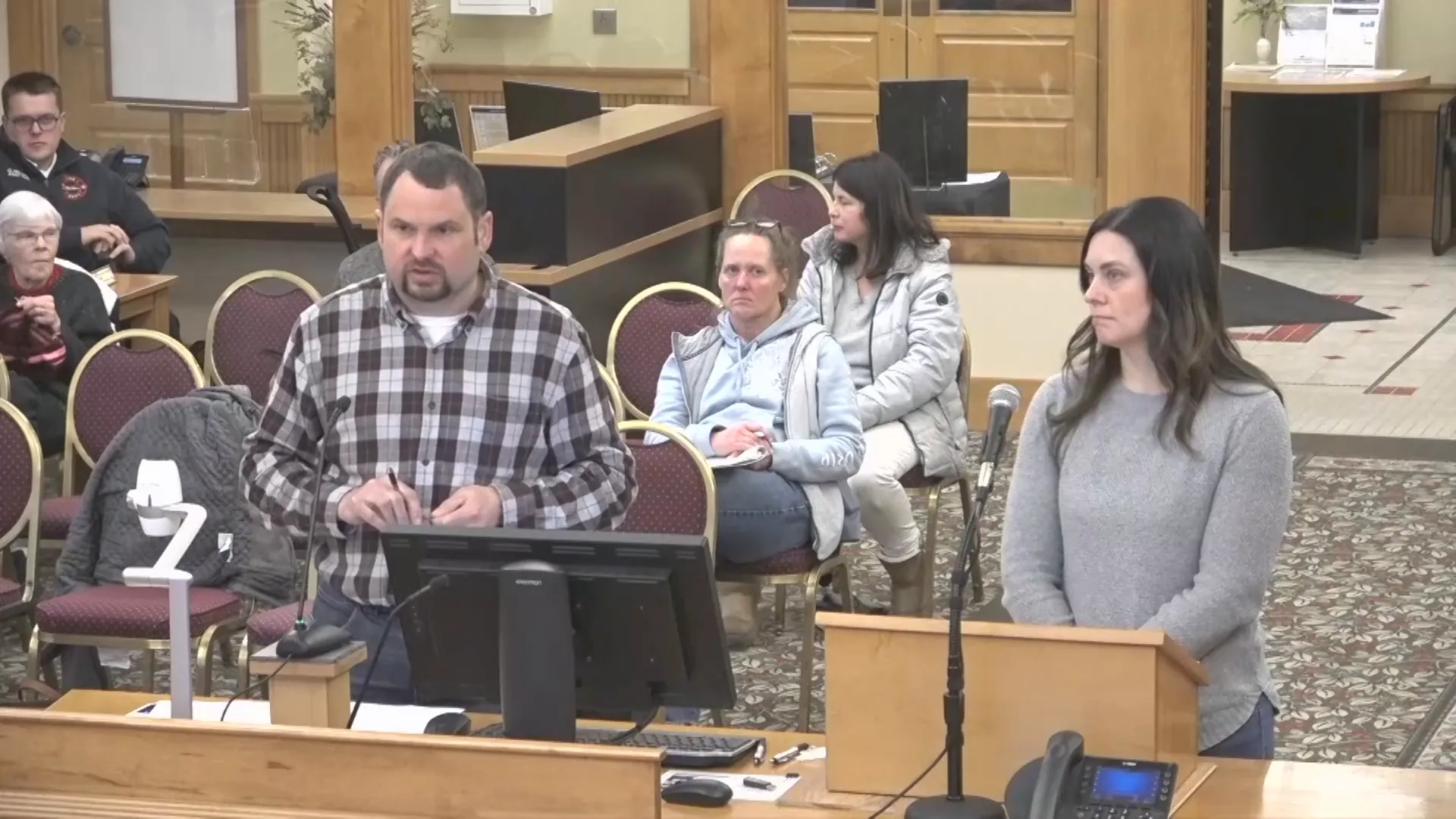
STREAMING COPY IN PREPARATION — RECORDING AVAILABLE FROM THE ORIGINAL SOURCE
Transcript — Verbatim
Speaker numbers apply only to this recording.
Discussion Breakdown — Share of Meeting
Water And Wastewater Management31%
Engineering And Infrastructure22%
Facility Management11%
Affordable Housing9%
Emergency Medical Services8%
Procedural8%
Capital Improvement Planning7%
Budget Equity Analysis2%
Insurance1%
Summary of Proceedings
Red Wing City Council Workshop — February 23, 2026
The Red Wing City Council held a workshop on Monday, February 23, 2026, at 5:01 p.m. in the City Council Chambers. Council President Janie Farrar presided, with all council members present (Beth Snyder attending virtually) along with Mayor Gary Iocco, Fire Chief Mike Warner, Public Works Director Shawn Blaney, Deputy Director of Utilities Kelsey Prall, Finance Director Marshall Hallock, and other staff. The workshop covered three major topics: the purchase of a new ladder truck, a proposed ordinance requiring a master water meter in manufactured home parks, and a lease amendment request from the Goodhue County Historical Society. The meeting adjourned at 6:16 p.m.
Discussion Items
1. Ladder Truck Presentation Fire Chief Mike Warner presented a follow-up to a prior workshop, reviewing the feasibility of purchasing a used ladder truck. The department evaluated three used options but found all had significant drawbacks: one had a single-axle configuration unsuitable for Red Wing’s terrain, another was too tall to fit in the fire station, and all carried risks of undisclosed mechanical issues and limited availability. Chief Warner also reviewed other manufacturers (e.g., Rosenbauer), noting that a comparable new Rosenbauer would have a base price of $2.4 million plus ~$313,000 in necessary add-ons, versus the recommended Pierce ladder truck at a base price of $2.1 million plus the same add-ons, for a total of approximately $2.4 million. He explained that avoiding a formal bid process (using published consortium pricing) is actually less expensive and preserves vendor relationships. Chief Warner highlighted that Ladder 1 responded to 70 incidents in 2025, including medical emergencies, motor vehicle accidents, structure fires, brush fires, downed power lines, and industrial incidents. He emphasized that the recommended mid-mount, five-section ladder design offers better maneuverability in tight downtown areas and improved turning radius (e.g., from 9th Street onto South Park). He requested council direction on how to proceed.
Council members expressed strong support for purchasing the new Pierce truck. Council Member Kim Beise stated that the used options do not meet requirements (smaller engine, height issues) and supported the new recommendation. Council Member Becky Norton agreed, noting that locking in the price now is fiscally responsible because costs will only increase. Council Member Beth Snyder voiced support for the same reasons. Council Member Vicki Jo Lambert asked about pricing negotiations; Chief Warner confirmed prices are published so no deals are available. Council Member Ron Goggin inquired about the firmness of the price lock over a four-year build time; Chief Warner cited the example of an engine currently in production where the price was locked two years ago. Council Member Donald Kliewer asked about future technology updates; Chief Warner stated the specs are fixed at order but the manufacturer provides the latest available components at time of manufacture. Finance Director Marshall Hallock noted the truck would be funded through the Capital Improvement Plan (CIP), currently fully funded in 2028, and that early payments could reduce the total cost.
2. Discussion on Adopting a New Ordinance for Manufactured Home Parks Public Works Director Shawn Blaney and Deputy Director of Utilities Kelsey Prall presented a proposed ordinance requiring manufactured home parks to install a single master water meter serving the entire park. Currently, Red Wing has two such parks: Grandview Mobile Home Park (no master meter) and Pepin Woods (already has one). The current system results in inconsistent billing, undetected leaks, and the City bearing costs for repairs on private infrastructure. Grandview sends individual bills to each of about 70-77 tenants (with copies to the park owner) and unpaid bills are assessed to the owner annually. The park owner has argued that he is unaware of delinquencies. The proposed change would require one master meter installed at the park entrance, with the park owner responsible for all private infrastructure beyond it. The City would supply and install the master meter; the park owner would fund the meter vault, with an initial estimated cost of $150,000–$200,000. Billing would shift to a multifamily rate structure (65% of single-family availability), which data from 2019–2025 shows closely matches actual average consumption per unit (~390 cubic feet per month). The presenters illustrated that under the new system, per-unit costs would decrease (from ~$130/month to ~$113/month before any owner administrative markup), and setup fees would be eliminated. Staff sought direction on four areas: policy support for the ordinance, implementation timing, potential cost-sharing, and billing unit calculation.
Council discussion included concerns about the financial impact on residents. Council Member Ron Goggin noted that while the availability charge would drop for tenants, the park owner would likely raise lot rents to cover the upfront cost and ongoing infrastructure maintenance, resulting in no true savings. He pointed out the owner has made many recent improvements. Council Member Vicki Jo Lambert supported the ordinance and noted the owner is already familiar with master metering from another property. Council Member Kim Beise supported the ordinance but advocated for a phase-in schedule (similar to street reconstruction assessments). Council Member Beth Snyder agreed. Council President Janie Farrar expressed concern about the cost to residents and the speed of implementation. Council Member Becky Norton asked about how to determine the number of units; staff noted they would rely on the park owner to report, but an inspection could be done. Mayor Gary Iocco asked about prior discussions; staff confirmed the owner’s concerns include capital cost and administrative burden. Council Member Donald Kliewer asked about typical costs for new homeowners; Public Works Director Blaney explained availability charges exist but didn't have exact figures. Staff noted that a leak in Grandview since January 24, 2025, had been running unmeasured, with the City absorbing the water loss. Council Member Kim Beise raised liability issues if City staff work on private infrastructure. Staff recommended continuing conversations with the owner about financing options, such as an assessment agreement.
3. Goodhue County Historical Society Lease Amendment Discussion Finance Director Marshall Hallock provided background on a request from the Goodhue County Historical Society for relief from property casualty insurance premiums that are passed through in their lease. The premiums have doubled since 2020, largely due to the League of Minnesota Cities Insurance Trust restructuring rates for civic structures. The City previously reduced costs by dropping historical coverage. Hallock noted the lease is old and combines rent plus insurance as separate charges; he was unclear on the specific relief requested (anything from $1 to the full premium). He also stated that the only other city-owned leased property with a similar pass-through is the Sheldon.
Council members discussed whether this is standard practice. Council Member Beth Snyder requested more information on other city-leased properties, their rent, and insurance arrangements. Council Member Becky Norton noted the Marine Museum and Mississippi National Golf League leases; Hallock clarified that the City pays property casualty insurance on all city-owned buildings, but lease terms vary. Council Member Kim Beise questioned why the City charges rent at all, suggesting a nominal $1 lease might be possible, but Hallock explained the historical context: a public campaign funded the building with the condition that the City own it to ensure its preservation. Mayor Iocco asked if the City could sell the building for $1; Hallock noted the remaining lease term (from 1989) and the City’s significant maintenance costs (e.g., $616,000 in state bond funds for roof and HVAC in 2018, plus $250,000–$275,000 for corner repairs). Council Member Ron Goggin emphasized the ongoing maintenance burden. Council Member Beth Snyder said she lacked enough information to decide and asked for a clearer statement of the Society’s actual request, along with a survey of other city-leased properties’ insurance arrangements.
Key Outcomes
- Ladder Truck: The council broadly supported proceeding with the purchase of a new Pierce ladder truck and directed staff to bring a formal resolution to a future regular meeting for a vote. The truck is expected to be delivered around mid-2030, with funding to be incorporated into the Capital Improvement Plan across multiple years.
- Manufactured Home Park Ordinance: The council provided direction to proceed with drafting the ordinance, but with a phased implementation schedule to be developed in coordination with the park owner. Staff will explore financing options (e.g., assessment agreements) and continue dialogue with the owner about cost and timeline. A first reading is tentatively scheduled for March 9, 2026, but will depend on the final implementation plan.
- Historical Society Lease: The council determined that more information is needed before making a decision. Staff will gather details on insurance arrangements for all city-leased properties and clarify the exact relief requested by the Historical Society. A follow-up discussion will be scheduled at a future meeting.
Meeting Transcript
Hey, good evening again. This is the February 23rd City Council workshop. I'll call us to order. And I know I don't think any of us have our agendas in front of us, but I do have it up on online. So our first item of business. We do have three this evening on our schedule, but ladder truck presentation. Hello, Chief Warner. Hello. I'll hand it over to you then. Okay, good evening. Good evening, council, council president, Mr. Mayor, staff, Mr. Administrator. Here tonight to talk about a follow-up on the ladder truck. Again, this is a follow-up from the council workshop that we had about a month ago. And um the council and the mayor raised some questions, so we're gonna discuss them. So if at any point you want me to stop and we can uh answer any of the questions, if not obviously at the end. But we're gonna um talk tonight about exploring availability and feasibility of purchasing a used ladder truck, evaluating additional manufacturers that produce similar types of apparatus, and provide clarification on how the frequent ladder truck, or I'm sorry, and how the frequency of the current ladder truck that we have responds to incidents within the city of Red Wing. So then at the very end, staff is gonna be requesting that city council and the mayor give direction to all of the staff here or how to move forward on what we need. Thank you. So, in regards to a used ladder truck, we did look at some options. We did um look at the market and figure out what was out there. A couple things to note on this. One to limited availability nationwide, you know, going down to the local Ford dealer or what have you to find a fire truck is not exactly the easiest. So there are there are fire trucks and ladder trucks, but they could be halfway across the country. So going out there and looking at it, also getting it back, whether we ship it, whether we drive it, significant time of concerns to be able to get a used apparatus back, and then difficulty verifying the full maintenance history. So we would need to go out there and make sure that everything is actually working as it should and that it continues, and that also is a full mechanical review of the engine, setting it up, working with it, and making sure all of that. And then making sure all of our required paperwork is submitted. You know, we're required to do pump testing annually and aerial ladder testing, and we want to make sure that all the paperwork is good. And then the risk of the undisclosed mechanical and structural issues. Why is somebody selling it? Really comes down to the question. If we're looking at a newer vehicle that is used, why is a city or an agency selling it? They don't just typically sell them just to get rid of them, they typically use them until they can no longer use them, or then they put them in as a reserve status. So why is that? And then really again, that unknown reason. So when we look at the minimal cost saving compared to a long-term operational risk and what is gonna be have, but with that being said, we did find a couple, so I want to talk about these. One, it's a single axle configuration.
SUMMARIZED BY OPENPUBLICA AI
TRANSCRIPT VIA PUBLIC VIDEO
openpublica.com
openpublica.com