OPENPUBLICA · PUBLIC MEETING RECORD
Record of Proceedings
Red Wing City Council Workshop: Emergency Declarations and Retaining Walls (March 23, 2026)
City Council — Monday, March 23, 2026
BodyRed Wing, Minnesota
SessionCity Council
DateMonday, March 23, 2026
StatusFILED
Video Record
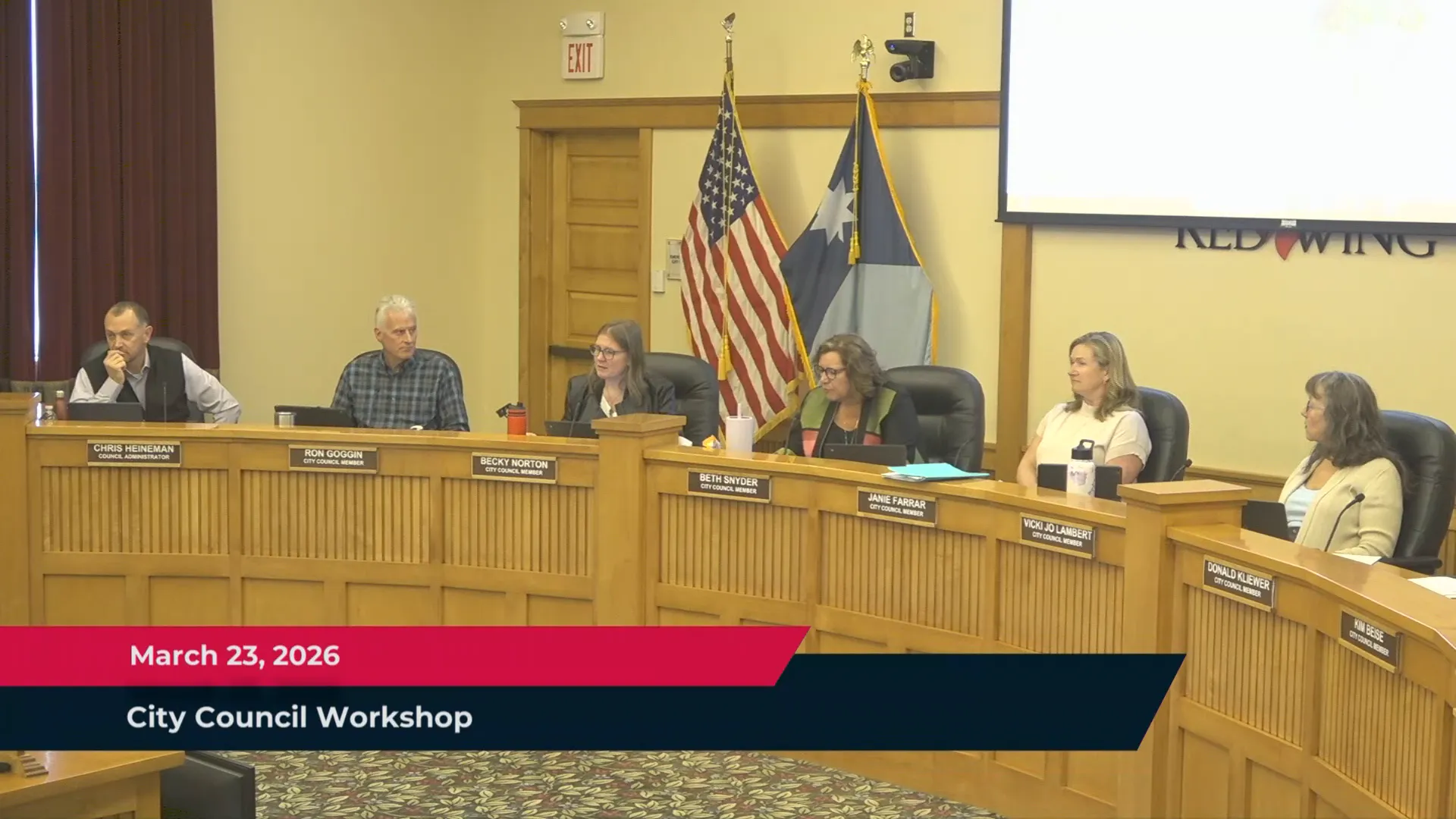
STREAMING COPY IN PREPARATION — RECORDING AVAILABLE FROM THE ORIGINAL SOURCE
Transcript — Verbatim
Speaker numbers apply only to this recording.
Discussion Breakdown — Share of Meeting
Engineering And Infrastructure43%
Emergency Medical Services23%
Public Engagement12%
Capital Improvement Planning6%
Procedural3%
Fiscal Sustainability3%
Public Safety3%
Disability Rights3%
Historic Preservation2%
Summary of Proceedings
Red Wing City Council Workshop: Emergency Declarations and Retaining Walls (March 23, 2026)
The Red Wing City Council held a workshop on March 23, 2026 to receive an educational session on the process and implications of declaring a local emergency and to discuss the significant infrastructure challenge posed by failing retaining walls throughout the city. The workshop was convened by Council President Janie Farrar at 5:02 p.m. and concluded at 6:02 p.m.
Educational Session on Emergency Declarations
Fire Chief Mike Warner introduced presenter Greg Hayes, Emergency Medical Coordinator for the Metropolitan Emergency Services Board, and Assistant Fire Chief Grady Nelson, the City's Emergency Manager. Mr. Hayes explained the framework of emergency management anchored in Minnesota Statutes Chapter 12. He detailed that the Mayor holds sole authority to declare a local emergency, which must be ratified by the City Council within three days. The declaration does not immediately bring state or federal resources but enables the city to expedite spending above normal administrative thresholds, impose curfews, and activate the Emergency Operations Center. It was noted that response costs in the first 48 hours of a significant disaster can reach approximately $150,000. Mr. Hayes confirmed the city has the right to manage its own response rather than deferring entirely to the county. Council Member Vicki Jo Lambert asked clarifying questions regarding the Mayor's exclusive authority and whether statistics exist on the frequency of human-made versus natural disasters.
Discussion on Retaining Wall Failures
Public Works Director Shawn Blaney presented the findings of a field-based inventory that identified approximately 415 individual retaining wall segments abutting the public right-of-way, totaling roughly 20,186 linear feet (55,559 square feet) with a high-level total replacement cost estimated between $3.5 million and $5 million over several decades. He noted that ownership and maintenance responsibility are not clearly established, as current City Code assigns responsibility to the abutting property owner, though a legal memo provided to the Council indicates this language is subject to debate. The Woodland Drive and West Maple Street area, where walls were installed as part of a 1990s sidewalk project, contains the most deteriorated wall segments. Staff presented three options for Council consideration: (1) identifying the most precarious walls for capital projects, (2) investigating responsibility and incorporating walls into street reconstruction projects, or (3) establishing a recurring Capital Improvement Plan (CIP) amount.
Council members discussed the complexity of determining responsibility. Council Member Becky Norton expressed support for a cost-sharing structure or flowchart and suggested exploring how other river communities like Winona handle similar issues. Council Member Ron Goggin advocated for clear, objective criteria and standard city specifications to avoid setting inconsistent precedents. Council President Janie Farrar raised the role of the Heritage Preservation Commission in the Downtown area and suggested a rating system similar to bridge inspections. Council Member Lambert questioned the city's responsibility for stairs associated with walls and noted a specific property on East 7th Street where a homeowner replaced a failing wall with boulders and wire. Council Member Beth Snyder questioned the city's liability for trip-and-fall hazards near a partially failed wall on West Maple Street and suggested evaluating sidewalk consolidation in some areas where sidewalks do not meet ADA standards. City Council Administrator Chris Heineman noted that walls exceeding four feet in height require engineering certification and that the city likely did not obtain permanent easements for many existing walls. Engineering Director Zach Regnier stated that much of the design and construction work would likely need to be contracted out due to geotechnical requirements. Director Blaney confirmed that no walls require immediate action in the current year and that the West Maple Street area can be managed with available options in the near term.
Key Outcomes
Council did not take formal votes but provided direction for staff to continue investigating wall ownership and responsibility, develop a wall rating and evaluation system, and prepare a line item for the upcoming Capital Improvement Plan (CIP) workshop scheduled for Monday, June 1, 2026. Council President Farrar acknowledged the topic is complex and will be a long-term item for future workshops.
Meeting Transcript
This is the March 23rd Red Wing City Council workshop. Our first item, I'm gonna first just say time frame wise, um, again, I know we go till about 6.15, 620 if we can, but especially on our on our A option emergency um presentation, maybe again if you can stick within that 20 to 25 minutes of a presentation, because I know there'll probably be some questions so that we can get on to our next item too. But I will hand it over to Chief Warner. Sorry, I should have started walking sooner. Good evening, good evening, counsel. We're here tonight in a workshop to be able to provide an education on emergency declaration. The presenter is Greg Hayes, and he'll be there'll be time for questions afterwards. And also, if you need assistant chief Nelson is going to be here again, he's the city's emergency manager, so he'll be walking through the process. So that then we can hand it over to public works. So, Greg. All right, thank you. And Chief Nelson and I did talk. If I get to that 20 minutes, he's just gonna walk me right out the door. So promise to keep you uh right on time. With uh with what was in your packet, uh, the description of your packet and what we're present in front of you, just it's a very quick overview of emergency management, the process, and really the why. Why would the why does the city uh have an emergency operations plan? Why what is this emergency operations, emergency management stuff, and why is it important to me? And and I'll leave some time, I'll make sure to keep keep uh before the 20 minutes. So if you have questions, you can certainly grill me with the questions at the end here. And so with that, emergency management. It's different than in my world of 30 plus years and fire EMS law enforcement, all those other things. Well, we're on the street, we're we're uh driving somewhere in fire trucks, ambulances, squad cars. Emergency management is a function of getting those groups together, bringing policy members together, bringing a command group together, and bringing a coordination group together, those three groups to help respond and recover from a given disaster. In our world today, we think we call it all hazards, so it can be a tornado, a fire, or a flood, it can be things that we saw on TV today, which went into which at LaGuardia uh International Airport to really anything to the parade. And so emergency management as defined by FEMA is just really a framework, and it operates inside of a emergency operations plan, which the city has. And so with that, within the state of Minnesota, where all of this is anchored is underneath chapter 12. Now I'm not a state agency, you know, employee. I'm not the director of uh homeland security emergency management for the state. I'm just a person that's been doing emergency management for a long time, and I work with a work in inside the metro area with a multi-jurisdictional group between all of the uh all of the counties and the city of Minneapolis, and we do emergency management. I've also helped throughout my years with that emergency management function. And so I for me doing this professionally, it always anchors us back to chapter 12. Great thing it outlines emergency management. The the areas of improvement, it is gray language if you look at it from a legal perspective, which is we want to know from a policy group is what exactly do I need to be doing? What are those functions? And when the disaster comes to town, how is it that I'm gonna how is it that I'm gonna get help? And that help many times is financial assistance. And there's where it gets gray, as we that's chapter 12 outlines the process, but does not outline exactly what are those fundamental things, how how is it that we have to navigate through it? So that's where our our cities and county emergency manager will walk us through there. But chapter 12 outlines that cities, cities uh can have an emergency management program, much like what you have here in Red Wing. It requires that counties do, and it requires a program at the state because FEMA requires a program. What is a program? It is having emergency managers doing fundamental things, having a uh emergency operations plan. Cities have all of the power and authority underneath chapter 12 that counties do.
SUMMARIZED BY OPENPUBLICA AI
TRANSCRIPT VIA PUBLIC VIDEO
openpublica.com
openpublica.com