OPENPUBLICA · PUBLIC MEETING RECORD
Record of Proceedings
Red Wing City Council Workshop – April 27, 2026: Evaluations, Facility Use Policy, and Ordinances on Homelessness, Panhandling, and Drones
City Council — Monday, April 27, 2026
BodyRed Wing, Minnesota
SessionCity Council
DateMonday, April 27, 2026
StatusFILED
Video Record
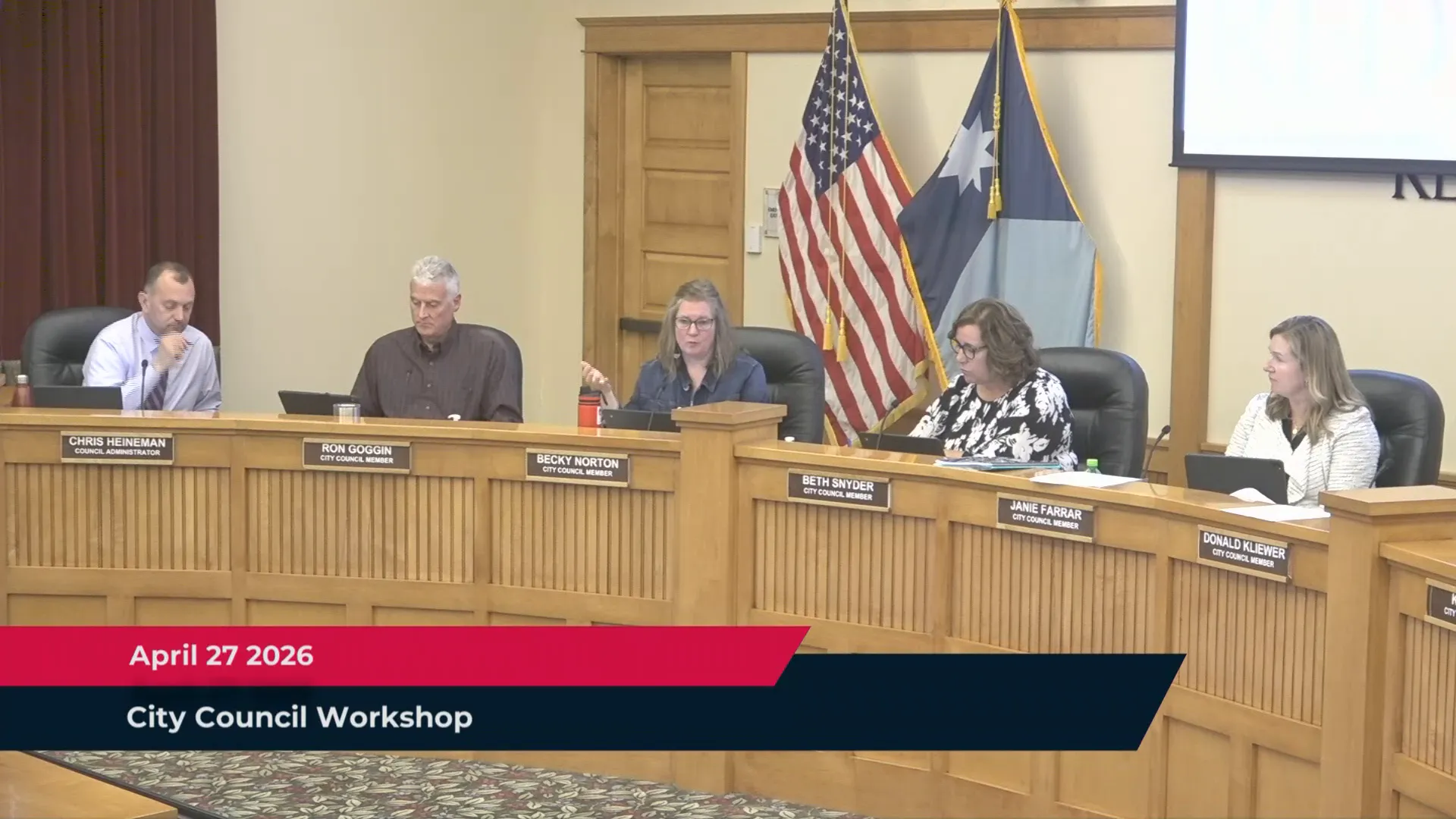
STREAMING COPY IN PREPARATION — RECORDING AVAILABLE FROM THE ORIGINAL SOURCE
Transcript — Verbatim
Speaker numbers apply only to this recording.
Discussion Breakdown — Share of Meeting
Public Safety28%
Public Engagement18%
Homelessness18%
Technology and Innovation9%
Facility Management6%
Community Engagement5%
Legal And Compliance3%
Affordable Housing3%
Zoning Regulations3%
Summary of Proceedings
Red Wing City Council Workshop – April 27, 2026: Evaluations, Facility Use Policy, and Ordinances on Homelessness, Panhandling, and Drones
The Red Wing City Council convened a workshop on April 27, 2026 at 5:00 PM to discuss City Administrator Chris Heineman's evaluation, a proposed Public Facility Use Policy, and three draft ordinances addressing unauthorized use of public spaces, aggressive panhandling, and unmanned aircraft systems. Council members provided extensive feedback and direction for staff to revise policies before formal adoption.
City Administrator's Evaluation Summary
Council President Janie Farrar read the evaluation summary from a closed session held on April 13, 2026. Administrator Heineman was deemed strong in strategic plan leadership, government and policy knowledge, and fiscal organization. He requires improvement in organizational culture, communication, and trust-building.
Draft Public Facility Use Policy
Administrator Heineman introduced the draft, which consolidates disparate facility policies into a single master policy with supplemental appendices for each facility.
- Council Member Vicki Jo Lambert strongly objected to the prohibition on political events in park facilities, arguing that any group willing to pay should be allowed to reserve park space regardless of political affiliation. Council Members Beth Snyder and Becky Norton agreed, with Norton suggesting extending similar flexibility to the library's meeting room.
- Council Member Donald Kliewer raised a legal concern about viewpoint discrimination; City Attorney Amy Mace clarified that the city has more discretion in limited public forums if restrictions are content-neutral.
- Mayor Gary Iocco expressed concern about political signage at city-owned venues creating the appearance of endorsement.
- Council President Farrar and Administrator Heineman identified a conflict in the draft regarding the Fire Station Training Room, which Fire Chief Mike Warner clarified was originally built for neighborhood use at no charge.
- Council Member Ron Goggin worried about increased workload and liability for city employees.
- Council Member Kim Beise opposed charging fees for the Fire Station 2 community room, stating it was built for free neighborhood use.
- Library Director Dan Brower provided context on library meeting room policies.
- City Clerk Melissa Hill summarized council consensus: allow paid political events in parks, remove the blanket prohibition on political events, and return the policy with clearer categorization of spaces and approval authorities.
- Council President Farrar requested staff at each facility be consulted, and each facility's policy should identify an approval authority and contact.
Draft Amendment of Ordinance Section 10.30 – Unauthorized Use of City Sidewalks, Right-of-Way, Stairwells, and Parking Ramps
Police Chief Nick Sather presented the ordinance, noting since 2025 the city has identified 72 unhoused individuals and recorded 865 calls for service. He emphasized the Third Street Walkway as a particular concern, with residents reporting feeling unsafe. Chief Sather stated the primary objective is education, outreach, and connection to supportive resources; enforcement would be a last resort.
- Council Member Snyder raised concern about the breadth of "sleeping in parks" language, suggesting focusing on overnight or after-hours use.
- Council Member Norton agreed, recommending narrowing the ordinance to specific behaviors and locations.
- Council Member Lambert expressed strong reservations, arguing the ordinance is premature given the lack of adequate housing resources and shelter capacity. She cited Housing First research and called for prioritizing housing options before restricting where unhoused individuals may be.
- Council Member Beise acknowledged the need for housing solutions but emphasized the immediate public safety issue in the Third Street Walkway, where harassment has occurred.
- Council President Farrar balanced both perspectives, highlighting Chief Sather's stated focus on education and outreach.
- Mayor Iocco asked if the ordinance could be revisited after passage and inquired if Council President Farrar would lead an effort to identify space for unhoused individuals.
- Community Development Director Kyle Klatt informed the council that the Planning Commission will present recommendations at the next meeting to add definitions and permitted uses for emergency housing and transitional housing to the zoning code.
- Council Member Norton encouraged increasing budget support for community organizations working with unhoused individuals, noting that funding had decreased in recent years.
- Council Member Goggin supported the ordinance as a balanced approach but raised concerns about the city's capacity to support an expanded unhoused population.
- Chief Sather will revise the ordinance to include a step-by-step process before enforcement and will reach out to Council Member Lambert to explore a focus group with county agencies and community organizations.
Draft Ordinance on Aggressive Panhandling
Chief Sather introduced the ordinance, which addresses threatening, intimidating, or obstructive behavior, not the act of asking for money or holding signs. The ordinance targets behavior such as blocking pedestrian or vehicle access, approaching individuals at ATMs, running into traffic, or using obscene language. City Attorney Mace noted that aggressive panhandling ordinances are an area of evolving law, and the tailored approach in the draft is preferable to broader versions that face constitutional challenges. Council members did not raise significant objections.
Draft Ordinance on Drones (Unmanned Aircraft Systems)
Chief Sather explained that the city has limited authority to regulate drones, as the FAA is the primary regulator. The ordinance provides basic information about where drones may be flown, requires a permit for large public events (e.g., River City Days), and gives officers a local ordinance to cite when responding to complaints. Chief Sather noted that the draft was narrowed after community consultation.
- Mayor Iocco requested adding the band shell to prohibited locations, especially for Wednesday night concerts.
- Council Member Norton asked about distinguishing between toy drones and more sophisticated equipment, and suggested including a non-emergency contact number for reporting violations. She also raised concerns about enforcement challenges due to drone range.
- Council Member Beise suggested adding the Field of Honor and Memorial Day ceremonies to prohibited locations during ceremonies.
- Chief Sather agreed to consider these additions and will work on a permit process.
Key Outcomes
- The council provided direction to revise the Public Facility Use Policy to allow paid political events in parks, remove the blanket prohibition on political events, and clearly categorize reservable vs. non-reservable spaces with defined approval authorities. (No formal vote)
- The unauthorized use ordinance will be revised to narrow language on sleeping in parks, require a step-by-step process before enforcement, and potentially include input from a focus group with county agencies and community organizations. Chief Sather will revise and return the item for further consideration; no action was requested at the workshop.
- The aggressive panhandling ordinance received general support without major changes; staff will refine language.
- The drone ordinance will be amended to add the band shell, Field of Honor, and possibly a non-emergency contact number and distinctions for toy drones. Chief Sather will include a permit process for events.
- The Planning Commission will present zoning recommendations for emergency and transitional housing at the next council meeting, which may inform the unauthorized use ordinance.
- Administrator Heineman noted that revised policies are expected back for council consideration within the next two to four meetings.
Meeting Transcript
I'll call us to order. It's Monday, April 27th, and we'll start our workshop. Calls to order again. Workshop items. Again, we have about an hour and a half till 6.15, 6:30 or so before we go into our business meeting. But two A is our City Council Minister's evaluation summary. And I'm going to read that. He needs improvement in organizational culture, communication, and building trust. So that will conclude again our city council's administrators evaluation summary for tonight and for this year. So again, moving on to two B is our draft public facility use policy. We'll have a discussion about this. And again, in workshop, we're getting feedback, giving direction to the staff on where to go next. So I think Chris, you're gonna start this though. Sure. So and I don't have a large lengthy um presentation for you. Uh just wanted to uh open this up as uh the the uh there's a memo in your packet that provides the the basic overview. Um it is I think prompted by um certainly uh a need for a clear policy, and uh we've been working from a staff level for actually uh couple months on that that uh initiative looking at um some of the disparate policies that we've had for different facilities and being um while related um somewhat different on their on their core uh contents and certainly part of that is driven by the different needs of each of those facilities on how uh public meeting spaces or or meeting spaces are reserved. Um part of it is has been um how they were initially developed um or or together, and certainly making sure that uh those have the same um same basic principles guiding them uh in in the process. We have um a master policy that is also attached to your your uh agenda item there, and that sort of provides the basic guidelines, and then uh that has been reviewed by each of the departments. There's uh appendix appendices A through D, which have specific language for the um uh differ for the different facilities, including uh the fire station or fire station number two meeting space, the actual uh Sheldon Theater, the library, and the fourth one, which I'm not looking at. The parks, yeah, the park facilities, which actually have a separate reservation process. And so we uh have also had that reviewed by our our city attorney. Um each of the independent um uh language or or draft policies as well as the master policy or the overall policy, and uh just wanted to have a discussion with you this evening and and kind of talk through each of those policies and and how to move forward if there's um significant changes needed or if it's something that you uh you see that is meeting the the expectations of meeting spaces for the city of Redwick going forward. Anyone want to start with beginning comments or questions? I um I appreciate the uh the staff report and um and looking at all the different policies. The only one that I have to um strenuously object to is an appendix A park facilities. Um it's on page one of four, the first bullet there where it says events or activities that are sponsored, coordinated, or paid for by candidate for public office, a political party or and so on. All of that. Um I think because the park facilities have a separate reservation process and they can pay for it. I think that they should be open to the public, and I don't think it should be limited. And I I think that if a candidate wants to pay for the property and reserve a space, they should be able to do that in our park facilities because they're open to the public. I and it doesn't matter what party it is. I think that if a person wants to have a meeting there and they're paying for the space, they should certainly be allowed to do so. I
SUMMARIZED BY OPENPUBLICA AI
TRANSCRIPT VIA PUBLIC VIDEO
openpublica.com
openpublica.com