Rochester City Council Study Session – September 16, 2024
STREAMING COPY IN PREPARATION — RECORDING AVAILABLE FROM THE ORIGINAL SOURCE
Rochester City Council Study Session – September 16, 2024
The Rochester City Council held a study session on September 16, 2024, beginning at 3:30 p.m. in the Government Center Council Chamber. Council Members Molly Dennis and Kelly Rae Kirkpatrick arrived at 3:32 p.m. The session covered four presentation items: an update on the historic Clock Tower, the yearly Unified Development Code (UDC) cleanup, Rochester Public Utilities (RPU) Power Supply Resource Plan, and the upcoming study session schedule. No formal votes were taken; the session was informational and preparatory for future council actions.
Clock Tower Update
- Presenter: Fire Chief Eric Kerska, speaking as a board member of the nonprofit "Bring Back the Clock Tower." He clarified the project is not a city project but a public-private partnership.
- History: The clock was originally installed in 1899, moved multiple times, and has been in storage since the civic center expansion. The current tower is being built in phases on First Avenue and Fourth Street Southwest.
- Finances: $448,000 raised to date, $261,000 spent, leaving a balance under $200,000. Construction costs have increased by over $200,000 due to inflation. Labor unions have donated over $38,000 in cash and materials, with verbal pledges for future phases. A $100,000 pledge from Alan Calavano was matched by the community.
- Challenges: Rising costs and coordination with other downtown projects (Sixth Street bridge, Unbound, Broadway expansion). The clock will be mechanically operated, not computerized, to ensure reliability.
- Next Steps: The nonprofit continues fundraising and working with the city to align the project with other construction. The goal is to donate the completed tower to the city along with a maintenance fund.
Unified Development Code (UDC) Yearly Clean-Up Update
- Presenters: Community Development Director Irene Woodward, Planning Supervisor Ed Caples, and Urban Design and Heritage Preservation Coordinator Molly Patterson-Lungren.
- Themes: Consistency across the document, clarity and typo fixes, and new items. Specific changes include:
- Increasing a setback by 5 feet to match buffer yard requirements.
- Reducing parking garage drive aisle length from 20 to 18 feet.
- Updating access spacing standards, sidewalk widths, and landscaping.
- Clarifying use-specific standards, UDC references, and the definition of "school."
- Heritage preservation overlay: aligning with Secretary of Interior standards and redefining the historic inventory list as a work plan.
- New items: adding definition of air transportation, permitting lot line readjustments in all zoning districts, allowing stacking of parking reductions, restricting barbed and energized fences to industrial and government districts, and permitting recreational uses in MXT and MXD zones.
- Process: Staff collected input over 12 months. The changes will go through public hearings at the Planning Commission and Heritage Preservation Commission before final council adoption. Council members requested advance access to the detailed text amendments and summary documents.
- Council Questions: Concerns about utility coordination for lot line readjustments, agricultural fencing exemptions, and the absence of bird-safe glass provisions. Staff noted that bird-safe glass is not currently in the UDC but could be considered in future updates.
Rochester Public Utilities Power Supply Resource Plan
- Presenters: RPU General Manager Tim McCollough and Director of Power Resources Bill Bullock.
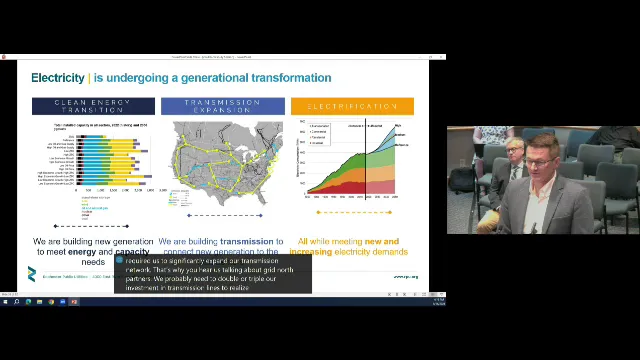
- Context: RPU's contract with Southern Minnesota Municipal Power Agency (SMMPA) ends March 2030. The utility must replace 216 MW of capacity from Sherco 3 coal plant and meet the community's goal of 100% net renewable electricity by 2030.
- Proposed Resource Mix:
- 350 MW of wind (likely via power purchase agreements)
- 50 MW of solar
- 3 MW of existing hydro
- 100 MW (400 MWh) of battery storage
- Natural gas peaking plant (firm dispatchable generation, capable of dual-fuel operation)
- Continued demand response and conservation programs (already avoided building 50 MW of generation since 2006)
- Costs: Total investment estimated at $1.2 billion. Preferred scenario (Scenario 2) uses PPAs for wind to keep rate increases below inflation. RPU will own the solar, battery, and combustion turbine, taking advantage of Inflation Reduction Act tax credits. The 2025 RPU budget includes initial down payments and procurement activities.
- Timeline: Interconnection application for the new peaking plant filed. Requests for information to be issued soon. Major borrowing ($300–$400 million) expected in 2027–2028. Debt service on Sherco 3 will roll off in mid-2026, providing wholesale rate relief.
- Reliability: RPU commits to maintaining 99.997% reliability. The plan includes capacity accreditation for all seasons, addressing wind droughts and winter peak demands.
- Council Discussion: Questions about rate impacts, technology risks (battery costs, natural gas price volatility), hydrogen blending potential, and partnerships with other utilities. Council members expressed support for the utility's direction while emphasizing affordability and reliability.
Study Session Schedule
- Presenter: City Administrator Alison Zelms.
- Next Session: September 30, 2024, topics include legislative session recap, an update on the Supporting Transformation projects (phasing and layering), and a sales tax update.
Key Outcomes
- No formal votes were taken.
- The council received the Clock Tower update and will continue to monitor fundraising and construction coordination.
- The UDC text amendments will proceed to public hearings at the Planning Commission and Heritage Preservation Commission; staff will provide council with advance text and summaries.
- RPU will proceed with its power supply plan, including the 2025 budget request, interconnection application, and procurement activities. The council will consider the RPU budget later this year.
- The next study session is scheduled for September 30, 2024, at 3:30 p.m.
Meeting Transcript
Recording in progress. Hello, welcome everyone to our September 16th study session. I'm still getting settled in, but I'm pleased to turn it over to Administrators Elms to introduce our first topic led by Chief Kerska. Uh thank you, Council President, Council members, Mayor Norton, members of the public. We do have Chief Kerska here today to walk us through a brief history of time for um the uh historic clock uh and bell. And so without further ado, I will turn it over to him. Mayor, council president, city council, thank you for having me today. I'm not speaking to you today as the fire chief. I am a board member of a nonprofit organization called Bring Back the Clock Tower, which this is not a city project. This is a this is uh working under your permission. Um just to try to clarify that a little bit of the history goes back to 1898 when the uh when the city built a new fire station at four and a half south broadway, right in the middle of Broadway. They desired to have a community clock because that was the center of downtown back then. So they um uh appointed a citizens committee. The the president of the city council appointed a three three-person fundraising committee, and for a for one year they went around to businesses and and uh raised funds and they were able to buy fifty raise fifty percent of the money needed to buy the clock. At the time that was the Apple Watch of 1899, the Seth Thomas clock, the best technology in the world, and uh the city council kicked in the the second 50 percent and they installed the community clock into the central station in in June of 1899, uh or correction, September of 1899. In 1930, the state said City Rochester, you can't have a fire station in the middle of our our state highway 63, and so they they forced the city to tear down the central station. The clock was put into storage and disappeared for 45 years. In 1975, it was discovered in a sewer building on North Broadway, and Chief Merckz uh drove the effort to bring the clock back in in the late 70s. The bell, just as a side note, the bell was a fire department belt in 1884 that was used to await the volunteers in the event of a fire, and then in 1899, the bell was clied to the tied to the clock to ring ring to make noise every at the quarter of hour. So in eight nineteen eighty-two they erected a tower on First Avenue and Fourth Street Southwest, just one block west of the original site. Uh pictures there in front of you what it looked like. In 2001, Parks and Rec Board, they drove the effort to bring back the clock and and move it to the set or not bring it back, move it to the civic center where it stayed for 14 years. When the civic center expanded, uh the clock came down again and went back into storage. And right now, as we speak, just as in that 45 years, it's it's currently sitting in a sewer building in storage, ready to go. Alan Alan Calavano, he uh rate uh pledged 100,000 dollars if the city could match. Chief Martin, uh, my predecessor, he he led that effort, came up with 100,000 to match, so we we were given that gift. Some past council actions. In uh 2015, there was a council resolution supporting the public-private partnership to bring back the clock. In 2020, the council approved uh contract between the city and the Rochester Fire Department Relief Association. In 2021, we had to amend that. The council amended that contract when we learned that the relief association wasn't the correct type of nonprofit to be able to handle this fundraising and moving the money. We needed a 501c3. The relief association was a 501c4. So we amended the contract in 2021. Additionally, the council approved the building of the tower in phases. The plan that's been in existence for a few years now is this nonprofit uh was formed. We're raising funds, we're continuing to raise funds, we're selling pavers as well as uh getting donations from from businesses from labor unions. Uh once it's completed our the contract is we'll donate the tower back to the city. Um, and and our goal is to have a fund from fundraising uh a fund to continue maintenance into the future. Work to date, we got a building permit from the city in 2023 or correction in 22, 23 was the groundbreaking. The trades unions have been extremely uh they've been great. Uh to date they've donated 38,000 plus dollars and in money and materials. For example, the footings, all the rebar was donated by the steel steel union. The bricklayers union has donated 15,000. We have raised 448,000 to date. We have spent 261,000 to date. The balance there's in front of you just short of 200,000. Unfortunately, as many people uh recognize building in Rochester uh goes up steeply every year. Um inflation for for commercial buildings keeps going up. So our cost to finish this keeps going up.
openpublica.com