City Council Study Session – Strategic Planning Kickoff – January 28, 2025
STREAMING COPY IN PREPARATION — RECORDING AVAILABLE FROM THE ORIGINAL SOURCE
City Council Study Session – Strategic Planning Kickoff – January 28, 2025
Note: The agenda and minutes list the meeting date as January 27, 2025, but the provided information indicates January 28, 2025. This summary uses the latter date as instructed.
The Rochester City Council held a study session focused on launching a strategic planning process. Consultant Julia Novak of Raftelis facilitated the session, which included exercises to identify strengths, limitations, opportunities, and challenges (SLOC) and to articulate what the council values today and hopes for the future. The meeting also reviewed the upcoming study session schedule. No formal votes were taken.
Discussion Items
A.1 Strategic Planning Session
- Council members and the mayor introduced themselves, sharing their tenure and hopes for the process: alignment, clarity, unity, and incorporation of community input.
- Julia Novak outlined the strategic planning approach: answering three questions (where are we, where do we want to go, how will we get there) over a 3–5 year horizon.
- The consultant presented the timeline: one-on-one interviews with each council member, a virtual meeting with the city’s leadership forum on February 11, 2025, and a follow-up workshop on March 24, 2025.
- The council participated in a SLOC exercise in small groups, reporting out on strengths (e.g., strong staff, collaboration, core services, financial health), limitations (e.g., funding constraints, geographic isolation, trust issues, staffing stability), opportunities (e.g., community engagement, downtown growth, Mayo Clinic’s $5B expansion, diverse perspectives), and challenges (e.g., pace of growth, federal funding uncertainty, maintaining partnerships, execution of commitments).
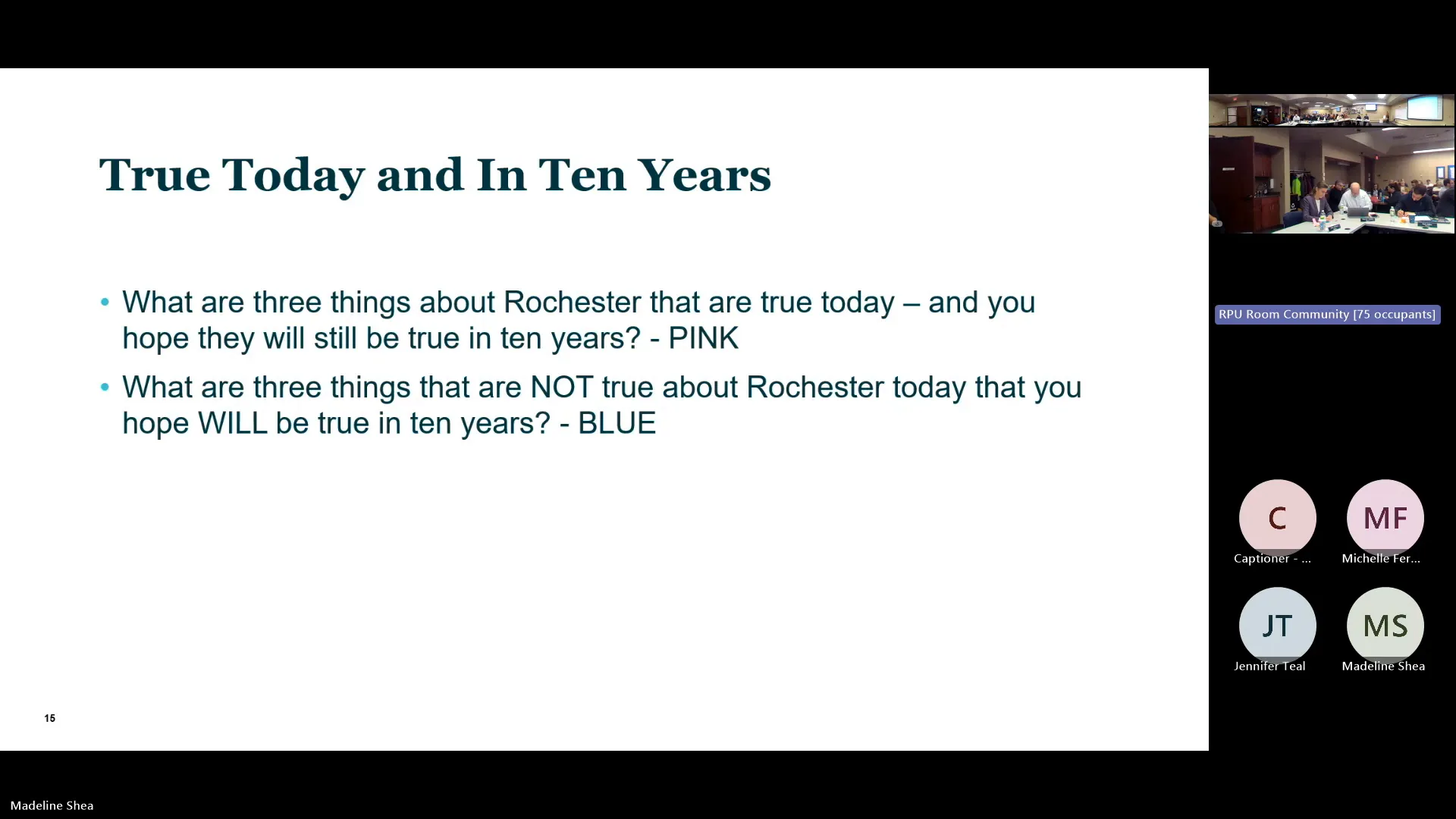
- A sticky-note exercise asked members to list three things precious about Rochester today (e.g., safe city, park/trail system, caring community) and three things they hope will be true in ten years (e.g., sufficient housing, sustainability leadership, diversified economy, elimination of homelessness).
- Discussion focused on the existing strategic priorities (affordable living, quality services, economic vitality/growth management) and whether they should be modified. Some members expressed a desire to review foundational principles and the number of priorities.
- Council President Schubring noted the importance of using “other business” time for committee reports.
A.2 Study Session Schedule
- City staff proposed adjustments to upcoming study session agendas to accommodate potential closed sessions and to allow more time for strategic planning items, including updates on PICA clauses, Vision 2050, the action plan, and other topics. The schedule for future meetings was reviewed without formal action.
Key Outcomes
- The strategic planning process will continue with one-on-one interviews with council members, a leadership forum on February 11, and a workshop on March 24.
- The council will consider modifications to the strategic priority areas and foundational principles during the process.
- The next study session (February 10) will include adjustments to the agenda as proposed by staff.
- No votes or formal decisions were taken; the meeting was informational and collaborative.
Meeting Transcript
We are here to do some strategic planning, and we're really grateful for members of the public being here to observe this process. We also are tables right behind the council and the mayor, our city staff, and so they're recording kind of replicating some of the studies of the prioritization as we go forward, and uh I just have to say you know the river is not public comment during this, but uh we welcome you from observing your breaking up in different groups uh that are all being this room and involved as your words. So with that, I am going to turn it over to our city administrator Allison Sales. Thank you, Council President Show Green, Council members, Mayor Norton, members of the public. We have uh Julia Novak with Rath Tellis consulting here today. Um does this all across the country, primarily for cities and counties. So I'm excited to uh get started with her facilitated conversation. She will make sure you get to the end of this with uh high level orientation. This is the beginning of a process, and she will describe some of that for you, and I will just turn it over to her to introduce some of the other team members she has with us online. Okay, sounds good. So again, my name is Julie Novak. What I'm gonna do is just briefly introduce you to the team, and then we'll kind of go through uh what our meeting plan is for today. Um, so three of my colleagues are gonna be working on this project here. Um, Michelle Ferguson is an executive vice president with Ref Tellis. She does a lot of strategic planning, as do I, um, all over the country. She's a great facilitator, former deputy city and county manager, and she and I have been working together for about 20 years, which I don't know how that's possible, except we started in middle school, I think. Um, then there's Jennifer Teal. Jennifer Teal is a senior manager, um does a lot of the strategic planning work, helps us with implementation and really focusing organizations on executing on strategic plans. Former city administrator also, um, and uh she's a uh leads a lot of the training through our Reftel's Performance Academy that we do in innovation and all kinds of different uh leadership training. And then Maddie Shea is also there online. She just waved to y'all, and Maddie is a consultant with our team, and uh she's been doing strategic planning work for local governments um for about three years, maybe a little longer, Maddie. You can you can tell them what if I'm wrong. But um, but anyway, she's been she and I've worked together on a couple of recent exercises. She's fantastic, and so great team of people supporting your organization on this project. So we'll jump on to the agenda slide. Uh what we're gonna do here is just I'm gonna find out who you all are and what you want to get out of the process. Um, give you a little bit of background on strategic planning, kind of what I use that word, what am I talking about, what do I mean? Um, and then we'll talk about our approach to this particular process, do a quick um strengths, limitations, opportunities, and challenges. You might have heard of a SWAT, strengths, weaknesses, opportunities and threats, afterwards, kind of the same idea. Um, and then we'll have a discussion about your hopes for the future of the community, kind of things you love and things you'd like to see that you don't have, and get you out of here um at a reasonable hour tonight. At least that I'll be done in a reasonable hour. I have no idea what Alison has planned. But we'll start next slide with just a uh a quick overview of uh strategic planning. I I find that when I walk into a room, um, I have people at all different ends of a spectrum. How many of you all uh participated in the last strategic planning process uh that the city did? So a couple people raising their hand, okay, great. What about city staff? Were you also maybe all around when that happened? So there's there's been a strategic plan. Other people have maybe never done strategic planning before, they aren't sure what it is, they feel like they should know, and they're pretty sure it's complicated because it's strategic, right? So my job is to make um the process approachable for everyone. And so I talk about strategic planning as simply the answer to three questions. What do we know to be true today? So where are we? What do we hope will be true in the future? Where do we want to go, and then how are we gonna get there? What's our plan? And so the process that we've designed is to really get you to those points, understanding what you're where we are all in a common understanding of that, where we are today, and then move you forward. You know, one of the realities next slide for cities is that you have lots of plans. Um, so typically there's some kind of a comprehensive plan that looks at the vertical development of your community.
openpublica.com