Rochester City Council Study Session - February 10, 2025
STREAMING COPY IN PREPARATION — RECORDING AVAILABLE FROM THE ORIGINAL SOURCE
Rochester City Council Study Session - February 10, 2025
The Rochester City Council held a study session on February 10, 2025, from 3:30 p.m. to 6:19 p.m. (local time). The session included three presentations: an update on the Supporting Transformation initiative, the Rochester Vision 2050 community visioning project, and proposed improvements to Peace Plaza. No formal votes were taken, as this was a study session, but future council actions were identified.
Supporting Transformation Update
- Deputy City Administrator Cindy Steinhauser, joined by DMC Director Jamie Rothe, presented on coordinating the city's response to unprecedented public and private investment, including Mayo Clinic's $5 billion Bold Forward Unbound project.
- Staff detailed guiding principles (providing best experience through construction, connectivity, communications) and tools such as construction coordination meetings, GIS maps updated weekly, and the upcoming website downtownrochesterconstruction.org.
- A $500,000 donation from Mayo Clinic to the Rochester Downtown Alliance (RDA) was announced to support downtown marketing during construction.
- Council members discussed the "business forward" strategy, with Councilmember Keane seeking to balance minimizing disruption with maintaining construction schedules, and Councilmember Palmer questioning the point of contact for business forward efforts and the status of BRT bids.
- Councilmember Palmer also raised concerns about electrical inspector shortages and the need for reimbursement contracts with Mayo. Staff noted that a development agreement and a construction coordination agreement with Mayo are expected by June.
- The council will see future actions on Link BRT (March 3), a national transportation consultant, and various agreements with Mayo Clinic.
Rochester Vision 2050 Update
- Consultant Roger Mader of Ampersand presented the results of a community visioning process using an AI-powered survey platform. The survey gathered 1,004 respondents (92% residents), with a statistical validity of 99% confidence ±4% error.
- Top themes included youth and child care, community events, education funding, housing affordability, teacher pay, economic diversification, accessible healthcare, and improved public transit (including interest in low/no-cost, 24-hour service).
- The steering committee developed six necessary elements for action: mandate, leader, plan, resources, governance, and sustainability. Recommendations for each focus area were outlined.
- Councilmember Keane noted the importance of considering the 25-year horizon and not treating the findings as immediate to-do items. Councilmember Palmer expressed skepticism, criticizing the survey as potentially biased and underrepresenting the community (less than 1% of population). Mayor Norton and Administrator Alison Zelms emphasized that the results would inform the council's strategic planning.
- The report and data will be made public and shared with relevant organizations and boards.
Heart of the City Peace Plaza Improvements
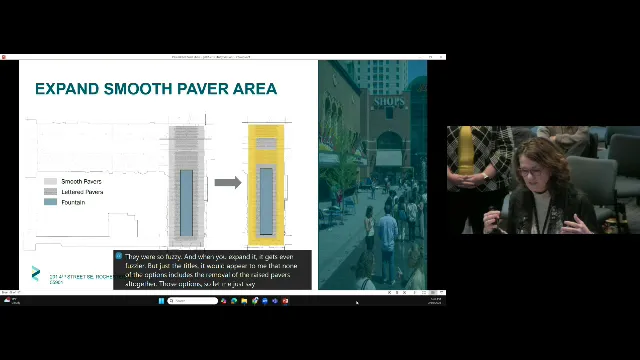
- Cindy Steinhauser presented proposed improvements to Peace Plaza following feedback from users with mobility, vision, and neurological challenges. The raised letter pavers, while meeting ADA standards, were reported to create navigation difficulties.
- An incremental plan was proposed: first, widen the smooth paver path on the east side (from 10–12 ft to 14–16 ft), add signage, planters, and reset pavers. The DMC board approved $175,000 for this initial phase (March–August), including engineering analysis for future options.
- Many council members expressed dissatisfaction with the incremental approach. Councilmember Wall said he would be a "really hard sell" for additional study. Councilmember Palmer: "We've been digging a hole, let's stop digging" and advocated turning pavers over to make them flat. Councilmember Doering : "I will also be a hard sell" and opposed further study. Councilmember Friederichs suggested simply flipping the pavers and compacting them, noting the raised letter height (average 1/8 inch). Councilmember Miller inquired about incident data and suggested including families/children in stakeholder groups. Councilmember Keane observed a conflict between staff's desire to protect the design and the public/council's call for decisive removal of the hazard.
- Staff countered that incremental work can be done quickly with hand labor, minimizes disruption, and allows testing. Mayor Norton supported the incremental approach to preserve the artwork if possible.
- The item will come to the council for formal action at the next meeting.
Study Session Schedule
- A cover page and calendar were provided; no discussion.
Key Outcomes
- No formal votes were taken; all items were presented for discussion.
- The $175,000 DMC authorization for Peace Plaza improvements will be brought to the city council for action.
- Future council actions expected: March 3 BRT update, development and construction coordination agreements with Mayo Clinic, and a contract for a national transportation consultant.
- Vision 2050 findings will be used to inform the council's strategic planning and will be shared with community organizations.
- The council will receive weekly construction updates and the downtownrochesterconstruction.org website will launch at the end of February.
Meeting Transcript
Welcome to our February 10th 2025 Rochester City Council study session. We have three items on our agenda tonight. One is supporting transformation update that I think Cindy's going to lead, and then we'll turn it over to the mayor on a presentation on our Rochester Vision 2050 update. And then I think it's back to Cindy on the heart of the city peace plaza improvement. I just want to also add that immediately after our study session today, we will take a break and then we will convene in room 104 a special session of the city council. We will then immediately go into closed session. So and I will repeat that at the end of our study session here. Cindy, take it away. Thank you, Council President Shubring, Mayor Norton, members of the city council, Cindy Steinhauser, Deputy City Administrator. Excited to be here with you this evening to or this afternoon to provide an update on our supporting transformation. Also with me are two members of our key partner organizations, Aaron Sexton from Mayo Clinic and Jamie Rothi from Destination Medical Center, who is talking to me right now, but we'll be in shortly to also be available to answer questions at the end of my presentation. So just want to do some context setting as we talk about coming with you before you with an update on supporting transformation, and to remind you and those watching at home that what we're talking about is unprecedented level of investment in Rochester over the next five to seven years. When we realize not only what's happening in the public sector with the work that we're doing with a lot of projects I'm going to mention in a few minutes, but also what's happening in the private sector. And so these are just some of the things that are informing the things that have passed here recently or announcements that have passed in the last year or so that are informing this transformation, uh transformational investment in Rochester and in the state of Minnesota. Um obviously the biggest of that is Mayo Bold Forward Unbound, their five billion dollar investment, but it doesn't just stop there, right? We have seen uh we continue to break levels uh records um in the last number of years over commercial investment in Rochester. Um so what's roughly Mayo Bold for one and bound, obviously five billion dollar project in a roughly 35 square block area, so adjacent and in the heart of downtown, so very tight geographic area where uh a lot of this work is happening, but there's also a lot happening throughout the rest of downtown in our community, uh not only with Link BRT with the West Transit Village Redevelopment with Sixth Street Riverfront Bridge and Neighborhood Safety and Connectivity, um work at Silver Lake, work that we're doing on South Broadway. There's a lot of infrastructure and public component projects happening that are also part of that transformation story. Um again, just to reminder when we think about Mayo's investment in this community. It is truly the largest project the state of Minnesota has seen. It's almost double what was the largest projects the state of Minnesota had seen about a year ago with the improvements at the airport. And so thinking about that, um, as partners, we came together to say when we to develop what we're calling guiding principles. They're in your packet. Uh these are a draft guiding principles, and we did this because we said there's a lot of work happening uh not only by us, not only by our partners, but the rest of the private sector. And so understanding and developing uh a set of guiding principles to align our efforts and to think about um what is our North Star and what we want to achieve as we work together with these improvements. And so they're in these five different buckets that uh we want to talk about but to uh or that we want to show, but today I want to talk about um and emphasize the work that we're doing in three of these guiding principle areas. What we're doing around um the principle that we call providing the best experience possible through construction and really key for you to understand um some of the things that are informing this principle are things like optimizing and aligning schedules across our projects to minimize disruption to the community, right? We're not gonna get it right every single time, but to if we have this goal of trying to minimize disruption uh as our at the forefront of our work, it's really really important. Thinking about intuitive and creative approaches to wayfinding and movement around these construction areas, thinking about our business forward model and having that solutions-oriented approach, thinking about immediate needs, but always with that eye towards the future. What is it that we want to deliver at the end of all of this work? Connectivity is another guiding principle to talk about today. And again, this is thinking about connections to the neighborhoods through downtown, thinking about connectivity, not only at grade systems, but we have a subway and we have Skyway, and how does wayfinding and signage come into play? How do we think about technology informing that? You're going to hear me talk about high-tech and high touch, right? There's a people component and there's a technology component that we can use to our advantage in guiding this work. And then communications and engagement. I actually was thinking afterwards I should have inserted the IAP2 spectrum of engagement because engagement goes from everything from informed to fully engage. There's five layers to engagement and all are appropriate at different points of time in this work. Some it is literally just to inform, some is help walk alongside us in design. But what we also want to talk about with communication is engagement is that it's timely, it's actionable, and it's coordinated across not only our organizations, but across the audiences that we need to deliver the information to that it's ongoing, that it's meaningful, it's meeting people where they're at. So they you and your constituents have the information they need to understand what's going on in Rochester during this time. So let's first talk about providing the best experience possible through construction. And you know, we're not in this journey alone. Like we have five major partners helping us, walking with us in this journey, whether not only Mayo Clinic and DMC, but also downtown Rochester Inc., RDA, the Chamber of Commerce, Experience Rochester, and Ready. These are the organizations that also make up the downtown task force, and we are at the table in regular conversations and action about making sure that we provide the best experience possible through construction. When we talk about construction coordination, right? That's that's at very basic level we're talking about here is how are we coordinating all of this work happening in this tight geographic area. It's really about how do we deliver solutions. And for us, some of the tools are things like business forward, it's a good communications and engagement strategy. It's thinking about creative solutions, it's about process improvement.
openpublica.com