Rochester City Council Study Session – March 25, 2025: Strategic Planning & DMC Update
STREAMING COPY IN PREPARATION — RECORDING AVAILABLE FROM THE ORIGINAL SOURCE
Rochester City Council Study Session – March 25, 2025
Note on meeting date: The agenda lists March 24, 2025, 3:30 p.m., but the prompt specifies March 25, 2025, 9:30 a.m. This summary follows the prompt’s date; the discrepancy is acknowledged.
The City Council held a study session focused on two major items: a continuation of the strategic planning process (led by facilitators Michelle Ferguson and Maddie Shay) and an update from the Destination Medical Center Economic Development Agency (DMC EDA) delivered by Patrick. The session included discussion of the environmental scan, council member priorities, and several DMC projects.
Discussion Items
Strategic Planning Session
- Facilitators presented findings from the environmental scan, which included quantitative data (population growth, aging trends, housing costs) and qualitative input from individual council meetings, city leadership, and board/commission chairs.
- Data discrepancy: Councilmember Paul challenged demographic figures in the scan, noting that the percentages for Hispanic (stated 18.5% vs. 6.4%) and Black (stated 13.7% vs. 8.6%) residents appeared to be national averages, not local. Facilitators said they would review and correct. Similarly, the 41% increase in the 60+ population was questioned; facilitators cited the Rochester Council of Governments long-range transportation plan.
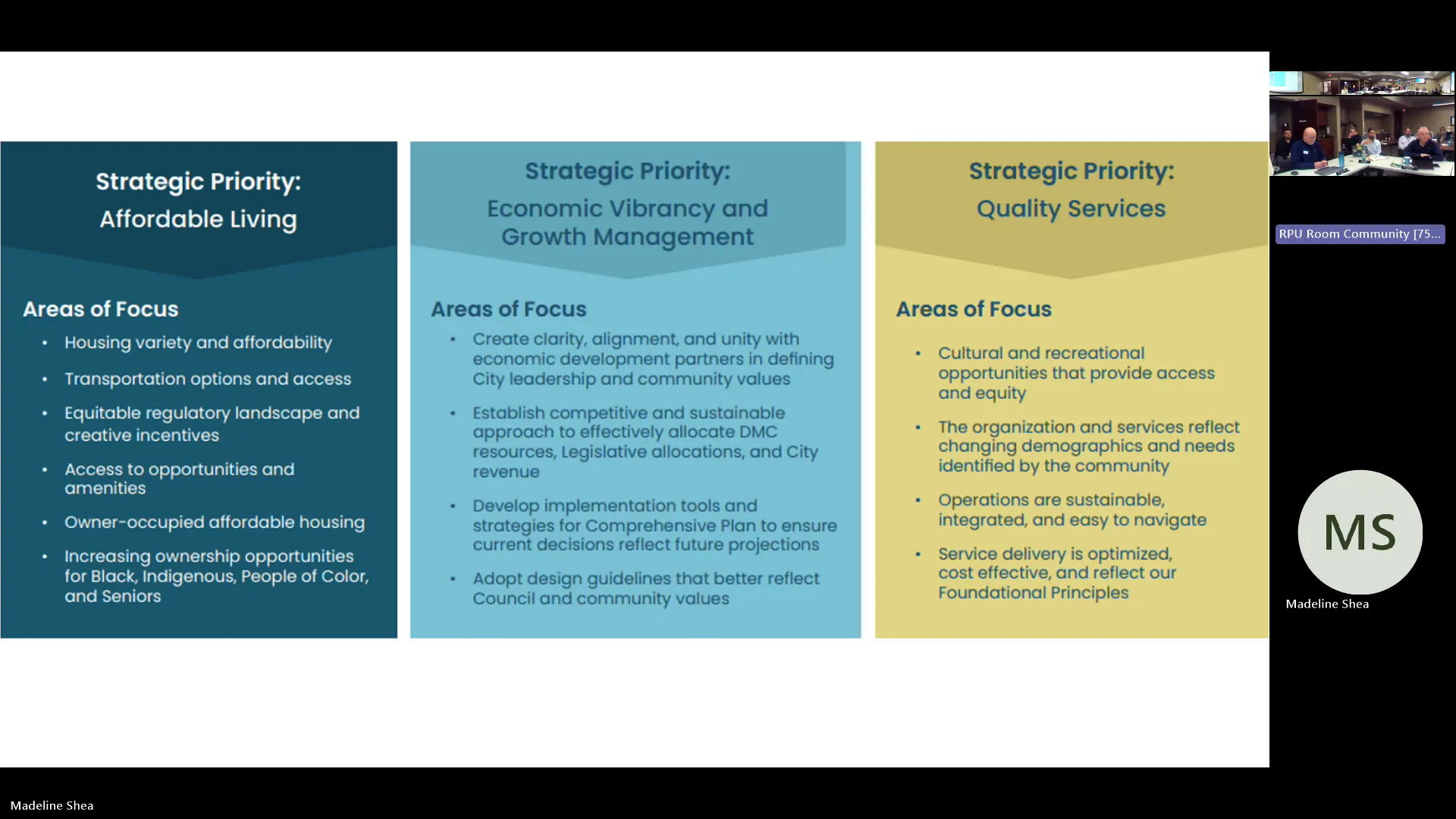
- Councilmembers debated the three existing strategic priorities: affordable living, quality services, and economic vibrancy/growth management.
- Key positions expressed:
- Councilmember Keene advocated for a priority on executing major projects (e.g., BRT, sports center, Sixth Street Bridge) to a schedule and budget, with the city operating within its means.
- Mayor Norton urged raising environmental stewardship from a foundational principle to a strategic priority, saying it has been overlooked.
- Councilmember Palmer emphasized public safety as a top concern and wanted quality services defined with clear standards (e.g., snow plowing, fire response).
- Councilmember Fredericks cited rising taxes as the number one community concern and stressed fiscal responsibility.
- Councilmember Doring raised equity and accessibility, noting that BIPOC, LGBTQIA+, and immigrant communities do not feel safe; he proposed public safety as a strategic priority.
- Councilmember Miller highlighted the need to address housing affordability, including rental options for short-term workers and trainees, and the lack of uptake on ADU incentives.
- Councilmember Wall supported focusing on city work and ensuring residents can afford to stay in their homes.
- After extensive discussion, the group tentatively agreed to:
- Move quality services from strategic priorities to foundational principles.
- Replace it with a new priority around delivering on transformational capital projects (executing commitments on time and budget).
- Keep affordable living but sharpen its definition, with a strong emphasis on housing (including affordable, accessible, equitable, and sustainable housing).
- Explore adding environmental sustainability and stewardship as a strategic priority (mayor’s suggestion, supported by several councilmembers).
- Consider sustainable growth management as a priority that integrates planning, transportation, and smart growth.
- The facilitator and city staff will synthesize the discussion into a draft for council reaction at a future session. No vote was taken.
Destination Medical Center (DMC) EDA Update
- Patrick (DMC EDA) provided an update on partnerships, project sequencing, and private investment attraction.
- Key points:
- DMC does not build projects; it stewards $585 million in commitments and attracts private investment.
- Decision-making follows a development framework (updated in 2020, being updated again), annual joint budgeting, and project-by-project collaboration to avoid surprises.
- Affordable housing: Examples include Berkman (no affordability requirement) and BRIC on Broadway (entire building at 50-80% AMI). The BRIC developer requested raising income eligibility to 110% AMI to fill 80% AMI units due to higher local wages; request was under review.
- Peace Plaza: City staff are committed to improving the experience this summer; DMC will evaluate after September.
- Riverfront: Planning funds approved; interim activation (bike node, screenscape) planned for 2025.
- Sixth Street Bridge: Update scheduled for April 21 council meeting; federal funding is expected but not yet under contract.
- Private investment focus: Med tech, housing/hotels, retail/dining/entertainment, with a “grow our own” and “attract new” strategy.
- Councilmembers asked about timing of DMC decisions relative to council input; Patrick emphasized collaborative process.
Key Outcomes
- No formal votes or motions were taken; the session was discussion-only.
- Staff and facilitators will produce a refined draft of strategic priorities for council consideration at a subsequent study session.
- DMC EDA committed to continuing coordination with city staff on projects and will provide further updates on West Transit Village, riverfront, and Sixth Street Bridge.
- The next study session schedule was not altered; council will take a week off (no meeting the following Monday).
Meeting Transcript
So this is a continuation of what you're talking about on the report, the environmental scams in the packet, and I did just want to let you know what a wall is on this way, so we'll be here shortly. No, I don't know how shortly what is it. Area, she will be here. So with that, I think I would turn it over to Michelle and Maddie to kind of go through their process. Well, good afternoon. As Alison said, my name is Michelle Ferguson, and with me is my colleague Maddie Shay, and it's a pleasure to be with all of you this afternoon. I'm a little shorter than my colleague Julia who was here back in January. And you all look a little different from when Maddie and I were up on that screen back in January. So we're excited to be with you as you continue the conversation about really establishing the strategic plan elements, and in particular, today's conversation is really about coming to consensus around what the strategic priorities are in your strategic plan. We're gonna share a couple of pieces of information with you, but um just as was the case back in January, um, a big portion of this conversation this afternoon is really going to be among among all of you to really come to consensus around what you believe are the most important strategic priorities to advance as part of your strategic plan. So as we talk about uh this conversation today, um I always like to share a couple of norms. These are probably ones that look familiar from uh from January, uh, but these are just some some guiding principles as we go about this afternoon's conversation. Um, as we engage in the conversation, we certainly encourage you all to continue to treat each other with respect as I know that you will, one person speaking at a time, to listen to each other and really uh be attentive to the conversation at hand. Um you may hear things as part of this conversation that you may not necessarily agree with, and that's that's okay. Part of this is to have that conversation to understand where those areas of consensus, where those areas of agreement are in your kind of big picture strategic priorities for the strategic plan. Um we're gonna ask you to look for those opportunities for agreement. Um even when you disagree, we ask that you do so agreeably again. That's part of just treating each other with respect. Um, and certainly we're gonna encourage you as you think about the future of this great community to be bold. You know, what are those important things that this governing body really does want to prioritize as part of the strategic plan? And we're gonna spend time today really defining what those priorities are. We've had an opportunity, um, my colleagues and I in different forms to speak with each of you to hear your reflections on the existing strategic plan. And one of the things that we heard was um some of the the strategic priorities that you currently have aren't as well defined as you would like them to be. Well, this is your opportunity to really engage in some conversation about what those collective definitions need to be to help provide guidance, not just for the organization, but also for the community. And I think that's gonna be a really important part of also your conversation and what we heard is how to involve the community's voice in in the strategic plan as well, too. Um Maddie. So we're gonna just do quick introductions in just a moment, um, and then we're gonna spend a little bit of time reviewing the environmental scan. Hopefully, you all had a chance to peruse that at least briefly. We'll share with you some feedback that we received from the conversations that we had as well as of some of the research that we've done. And then, as I said, we'll spend a good portion of the time really engaging in conversation around the elements of the of the strategic plan. And then I just want to remind you of this of the elements that you currently have within your strategic plan. We heard a lot from the conversations that we've had to date about general agreement around the city's vision that that's still a very important uh touch point, really that North Star for this community. And but we're gonna spend our time today really looking at these strategic priorities. And I'll ask you probably more than once in our conversation. You have three strategic priorities right now in your strategic plan. After you hear some of the feedback that we heard in the environmental scan, I'll ask you, are those still the right strategic priorities? If not, which what should they be? And once you come to agreement on what those strategic priorities are, then how do you define them? Let's be specific about what they mean so that when you look at the strategic plan, you all have an understanding of what you mean by each of the terms that you put in for those strategic priorities. So that's really again this area right here. That's going to be the focus of our conversation this afternoon. So with that, I'm gonna um go around. I'll ask you just to um do quick introduction introductions. I know you all uh know each other and certainly have nameplates, but uh for the sake of the owl as well as uh the microphones that are on, I'll ask you to introduce yourself and then um just a thought that you have an expectation that you may have for today's conversation. I'll be back in the go first or last. I'll go last. Okay. Well, uh that means that he volunteered the person to his left to go second. So Andy, that means you're wonderful. My name's Andy Fredericks, I represent Lauren Fourier in Rochester, Minnesota, and my expectation for a conversation today.
openpublica.com