City Council Study Session April 14, 2025: Language Access, Equity in Development, Library Master Plan, and Comprehensive Plan Update
STREAMING COPY IN PREPARATION — RECORDING AVAILABLE FROM THE ORIGINAL SOURCE
City Council Study Session - April 14, 2025
The Rochester City Council held a study session on April 14, 2025, at 3:30 p.m. in the Government Center Council Chamber. The agenda included presentations and discussions on language access and accessibility, equity in development compliance, the Rochester Public Library Master Plan, the PS2 Comprehensive Plan five-year update, and a preview of upcoming study sessions. The meeting concluded with a closed executive session to discuss pending litigation.
Language Access and Accessibility Education and Update
- Jacob Metz, a Bloomberg Harvard City Leadership Initiative fellow, presented an update on language access and accessibility efforts. He noted that approximately 7,100 community members have a non-English language preference (NELP), with the top five languages being Spanish, Somali, Arabic, Khmer, and Mandarin. Four main initiatives were outlined: a language line for 311 and six departments, a language pay differential pilot with 10 employees, an internal process for interpretation/translation requests, and two part-time community connectors for Spanish and Somali communities.
- For accessibility, Metz reported that about 12,000 residents (10%) have a disability according to census data. A National Community Survey showed that disabled residents feel less engaged and represented, and only 9% of respondents with disabilities view affordable housing options favorably. A cross-disability focus group and benchmarking with other cities informed a draft Accessibility Change Management Plan covering seven areas: transportation, housing, infrastructure, disability awareness, digital accessibility, parks and recreation, and employment.
- Council members asked about succession planning (Metz's fellowship ends July 10, 2025), the city's benchmarking position (Metz stated Rochester is in the middle of the pack for language access but has a long way to go for accessibility), and data reliability. Councilmember Keene expressed concern about overreach, emphasizing that city business is conducted in English. Mayor Norton noted the importance of accessibility given Rochester's role as home to Mayo Clinic.
Compliance Update - Equity in Development
- Edgar DeVera, compliance specialist, presented on prevailing wage, targeted business utilization, and workforce participation. From 2020 to 2024, the city invested $128.8 million in infrastructure projects, with 6.8% awarded to targeted businesses. Workforce participation goals are 9% women and 15% minorities; actual participation was 3.83% for women and 18.21% for minorities. DeVera recommended expanding accepted certifications and allowing waiver requests for bidders who do not meet goals, as well as a proposal to award contracts to bidders meeting goals even if their bid is up to 10% higher than the lowest bid.
- Council discussion focused on accountability for contractors who fail to meet commitments, the need for more data on bid trends, and whether the program has a sunset. Councilmember Keene questioned if the program is corrective or permanent. Councilmember Doring asked about enforcement. Council President Schuberg requested additional information on bid packages and outcomes. Mayor Norton asked for tracking of repeat non-compliant bidders.
Rochester Public Library Master Plan Study
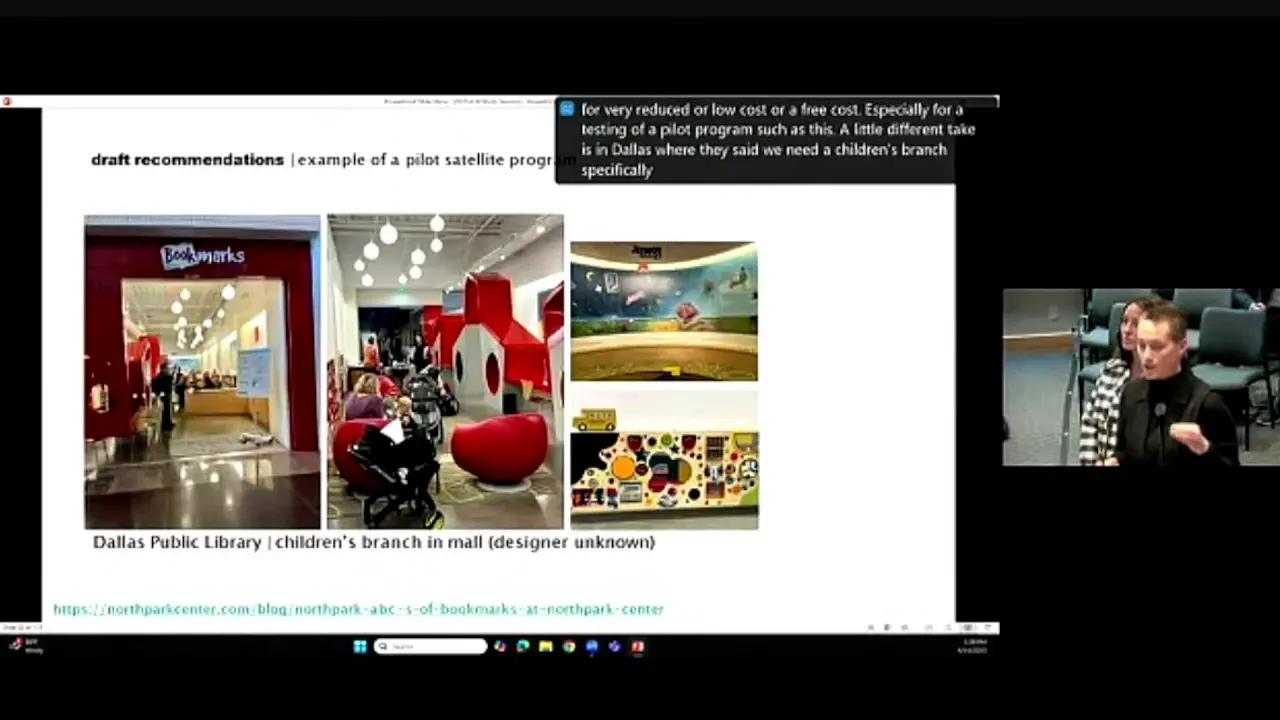
- Tracy Lesnesky from MSR Design and Holly Yoakum from Pathway Group presented draft recommendations for the library master plan. Key themes included: raising the library's profile, aligning operations with future needs, fostering innovation, and exploring distributed services. The downtown location poses barriers (parking, accessibility, construction). Recommendations included piloting satellite locations, exploring a smaller downtown footprint, renovating the existing building for better use, and expanding bookmobile services. The presenters emphasized the need for community input and further cost analysis.
- Council members provided feedback. Councilmember Wall asked about cost specifics. Councilmember Fredericks supported a two-hour parking validation pilot and noted the need for small meeting rooms for telehealth and interviews. Councilmember Miller highlighted the upcoming bus rapid transit line and asked about income-limited parking programs. Councilmember Keene expressed concern about trade-offs between a main library and satellites, noting that branches typically offer fewer services. Councilmember Palmer questioned the survey methodology (non-users were not randomly surveyed) and expressed skepticism about libraries taking on community education roles. Mayor Norton supported innovative, cost-effective distribution and asked for examples of creative libraries. Councilmember Fredericks also requested data on active cardholders.
PS2 Comprehensive Plan - Five-Year Update
- Elliot Mueller from Community Development and Christy Triska from Bolton & Mink presented a technical update to the 2018 comprehensive plan. The update focuses on residential, mixed-use, industrial, and emerging trends, incorporating the Maxfield Housing Study, diversity/equity/inclusion analysis, and updated maps. The plan is on track for adoption by July 2025. Councilmember Miller asked about including fiscal sustainability mapping (e.g., property value per acre). Councilmember Palmer requested a map of available R1 and R2 lots and questioned how the Maxfield study's findings on housing shortages would be addressed. Mayor Norton noted the timing misalignment with the council's strategic planning process and requested coordination.
Study Session Schedule
- Deputy Administrator Aaron Parrish previewed the April 28 study session, which will cover factors influencing the budget, outside agency process, draft fee schedule, and city council rules and procedures. A closed session on labor negotiation parameters is also planned. The May study session will include a city council bus tour.
Key Outcomes
- No formal votes were taken during the open session. The council provided feedback on all agenda items, requesting additional data (e.g., bid trends, active cardholder metrics, accessible housing availability) and asking staff to return with more detailed proposals. The language access plan and accessibility change management plan are expected to return to the council for further review. The library master plan will undergo a second round of community input and cost analysis before final recommendations. The comprehensive plan update is scheduled for adoption in July 2025, with the draft to be shared with the council well in advance. The council adjourned to a closed executive session at approximately 5:50 p.m. to discuss pending litigation (Molly Dennis v. City of Rochester, Patrick Keane, and Kim Norton) pursuant to Minnesota Statute 13D.05 Subd. 3(b).
Meeting Transcript
Recording in progress. Welcome everybody to our April 14th, 2025 uh City Council study session. We have four agenda items on our uh actually five agenda items on our meeting today. Uh first we're gonna hear about language access and accessibility, then we'll hear uh uh on uh report on our compliance update on equity in development, and then we'll hear a Rochester Public Library Master Plan study update, and then a PS2 uh comprehensive plan five year update, and then we will recess from this room, and then the council will go into an executive session after that. So with that, uh administrators elms, you have any additional items. I will call uh Jacob Pet to the um podium to give us a presentation on language access and accessibility education. Now am I on? Yes, that's better. Thank you. Uh okay. So just as a quick overview, I think I've met some of you already, and I presented to the council before in February of twenty twenty-four, but just as uh an update, my name's Jacob Metz. I am here as part of a two-year-long fellowship through the Bloomberg Harvard City Leadership Initiative. Uh so I started in July of 2023 after I got my master's degree in public policy from the Harvard Kennedy School. Since that time, I've worked with uh Chow as well as um uh Aaron on uh language access and accessibility as a whole. And uh what really brought me here is I'm honestly very grateful to be here and working on equity in a city in the Midwest again, because I was working for the then deputy mayor of racial equity uh for the city of St. Louis uh in 2017, so right after the protests in Ferguson. So there was a large focus on what does it look like to make sure that there are equitable services to any and all community members, regardless of their background, the neighborhood they live in, their identity, the language they speak, and so how do we see what those disparities are and what can we do to be able to address and then close those disparities so that there are more equitable outcomes. I know that's the mission of us here at the City of Rochester. I know it's uh Chow's mission as well. So with that, um, the focus on um for my fellowship was on language access and accessibility. And as I understood it, the scope really boiled down to two main questions. The first one being for language access, how can the city of Rochester best serve and work with community members with limited English proficiency? And then for accessibility, the exact same question. How can the city of Rochester best serve and work with community members with disabilities? So I'll start on the language access portion, and there's a copy of the language access plan that was in the packet for your review, so just noting that. So throughout this presentation, I'll actually refer to uh the community members uh who would be able to use these services as non as having a non-English language preference or NELP. The reason for that is just to make sure that we're using more value neutral language when describing community members as opposed to saying limited English proficiency, which you would typically see in government documents. We're choosing to use the phrase NELP instead. So just as a quick overview of NELP community members here, according to the last numbers from the American Community Survey, a little over 7,100 community members are uh uh our NELP. And for reference, Byron has just around sixty-five hundred. So that's basically like a Byron-sized community of folks who we have language barriers with pretty consistently. So the top five non-English languages within Rochester are Spanish, Somali, Arabic, Khmai, and Mandarin. And this was found through a combination of census data, Olmsick County court interpreter requests, and then also data from the school district as well. So also it's a staggering number. 86 home primary languages are spoken in Rochester Public Schools. So we really do have a wide breadth of language diversity here in our community. And these are examples of where city teammates have encountered language barriers in their work. This was found through surveys, talking with community organizations who connect with and represent NELP community members, NUP community members themselves. So just as a quick example on some of these, like paying a utility bill or explaining services in the field for RPU, or paying a parking ticket and getting a license for a business with the city clerk's office, or like conducting pretrial prep work for the city attorney's office. So we see these language barriers come up again and again that teammates have tried to navigate and at points can struggle to navigate when our teammate doesn't know or speak or can write in the same language as community members who are trying to reach. So as a result, and all of these initiatives you can see in the language access plan, this is what we've tried to do about it since 2024. Four main language access initiatives, the first being language line for 311 and six other city departments. So we have a negotiated rate with the state of Minnesota for a dollar and five cents a minute for whenever we use language line, which is an outside service that provides 24-7 on-demand uh access to interpreters in a wide variety of languages. So one of my favorite examples with this is I had a teammate in community development say that what used to take 30 minutes to talk to someone in like tortured Spanglish, their words suddenly only took five minutes because of language line. So for $5.25, that's a pretty good deal in my eyes. One of the second ones is teammates receiving the language pay differential. So we modeled a pilot program. The pay differential is a pilot program off of what we've seen other cities do and other counties do. So if you know and can demonstrate proficiency through testing with an outside service, and we use ALTA language services, that you know one of those top five non-English languages that I showed on the other slide, then you're able to get a stipend on top of each paycheck. And the goal for this is there's a stipend for if you're able to help translate a document, so from written word to written word, interpret, which is spoken, or both.
openpublica.com