City Council Study Session: Strategic Planning and Rules Discussion – May 28, 2025
STREAMING COPY IN PREPARATION — RECORDING AVAILABLE FROM THE ORIGINAL SOURCE
City Council Study Session: Strategic Planning and Rules Discussion – May 28, 2025
At a study session on May 28, 2025, the Rochester City Council reviewed and refined its strategic priorities, foundational principles, and council rules of procedure and code of conduct. The session was held at the RPU Community Room due to county use of chambers on Tuesdays. Council members provided extensive feedback on five strategic priorities, deliberated on changes to meeting protocols, and outlined expectations for future action plans and agenda glide paths.
Discussion Items
Strategic Priorities and Foundational Principles
- The council reviewed a five-item strategic priority list (economic resilience, housing access, inclusive growth management, responsible environmental stewardship, transformational capital projects) tied to foundational principles (social equity, fiscal responsibility, sustainability, quality services, inclusive decision-making).
- Responsible Environmental Stewardship: Most members favored the alternate language that extends the city's role to promoting environmental action throughout the community, rather than limiting to city operations. Councilmember Keene cautioned that broadening the language does not imply increased investment.
- Housing Access: Councilmember Palmer expressed concern that the priority was watered down from a focus on owner-occupied housing, citing the Maxwell study indicating Rochester lags in homeownership. Other members supported the broader language to encompass renters, new residents, and a variety of housing types. It was noted that action plans could prioritize owner-occupied affordable housing.
- Economic Resilience: Discussion centered on diversifying the local economy, supporting small businesses, streamlining permitting, and coordinating with entities like REDI, DMC, and Experience Rochester. Councilmember Palmer stressed the need for a balanced regulatory environment and business retention. Mayor Norton added child care as an economic resilience component.
- Inclusive Growth Management: Topics included infill vs. edge development, transportation planning, municipal consent, land use/transportation coordination, and ensuring equitable service distribution. Councilmember Miller emphasized the need for strong public transit, noting frequent route cancellations. Councilmember Palmer questioned the inclusion of some items as strategic priorities.
- Transformational Capital Projects: Councilmember Keene urged focus on executing major projects (e.g., Link, Sixth Street Bridge) on time and budget, warning that delays constitute government failure. Mayor Norton cautioned against overloading staff, emphasizing judicious use of resources. The council agreed that a shared understanding of which projects are transformational is needed.
- Environment/Data Tracking: Councilmember Miller suggested key performance measures for each priority, and Councilmember Palmer proposed a dashboard for environmental metrics (emissions, waste). Support for organized garbage collection study was mixed; Mayor Norton and Councilmember Palmer cited past public preference for choice.
Council Rules of Procedure and Code of Conduct
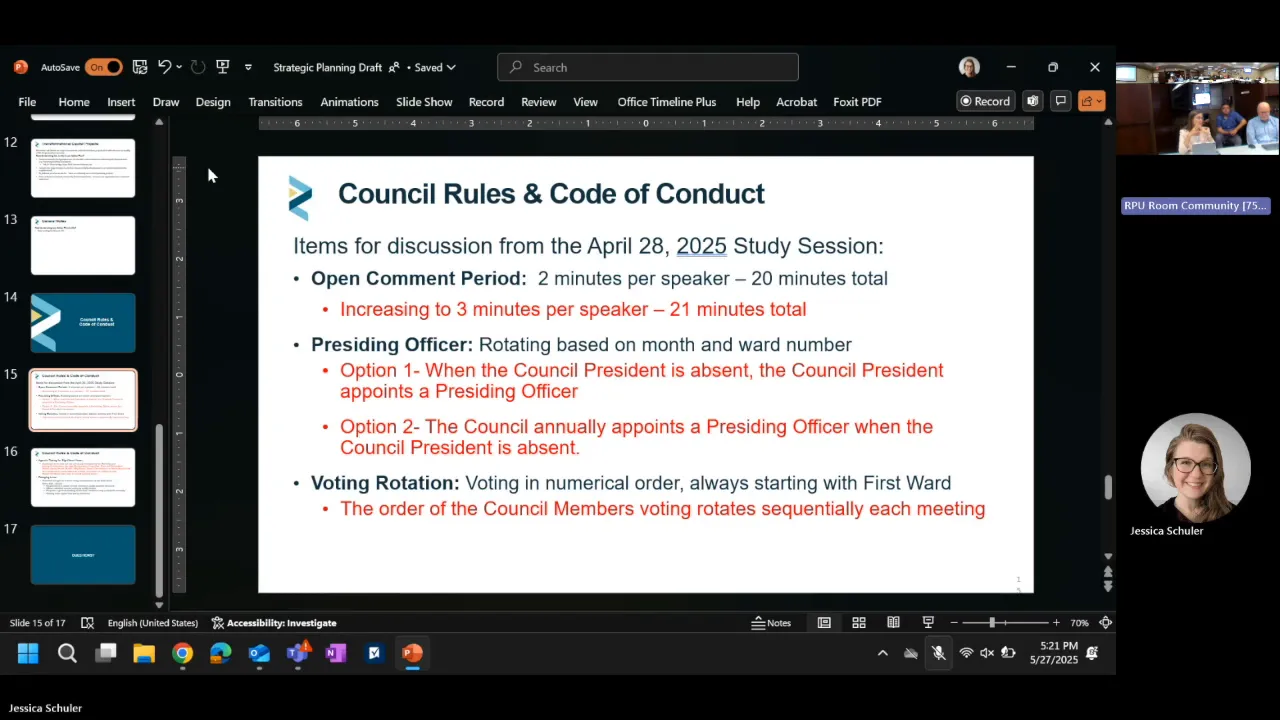
- Open Comment Period: Proposal to extend from 2 to 3 minutes per speaker. Some members favored 3 minutes (Miller, Keene) for more grace; others (Fredricks, Palmer) preferred concise 2 minutes. Mayor Norton noted the change was made a year ago and saw no problems. If extended, agreement to increase total time from 20 to 30 minutes.
- Presiding Officer & Acting Mayor: Discussion on whether to replace the monthly ward rotation with a system where the council president appoints a presiding officer when absent. Mayor Norton requested ability to work with the council president to appoint acting mayor. Majority support for option 1 (council president appoints), but charter language requires council involvement. No final decision.
- Voting Rotation: Little interest in changing the current ward-order rotation. Councilmember Palmer raised it but found no support.
- Agenda Glide Path: Council expressed desire for significant items (e.g., major contracts or projects) to be previewed in a study session or report and recommendation at least two weeks before a decision vote. Staff acknowledged challenges due to timing and negotiations. Council agreed to pursue this as guidance rather than a rule change.
- Board/Commission Appointments: Councilmember Wall proposed returning to a seniority-based rotation system for appointments to council committees and outside boards. Current process: council president nominates, council approves. Only limited support for change; most felt the current system worked.
- Remote Participation: New state law allows more remote participation. Council expressed caution, preferring to limit remote attendance to 3 times per year per council member for important items. Mayor Norton noted non-voting participation is less problematic. Staff will bring proposed rules adjustments after the governor signs the bill.
Key Outcomes
- The council provided clear direction on strategic priorities: endorse the broader environmental language, retain housing access with emphasis on homeownership, focus economic resilience on business retention and regulatory streamlining, and prioritize execution of transformational capital projects.
- Staff will bring the refined strategic priorities to the second regular council meeting in June for formal endorsement, followed by a detailed action plan.
- No formal votes were taken on rules changes. Staff will incorporate guidance on open comment timing, presiding officer procedures, and remote participation limits into a future rules revision.
- The next study sessions are scheduled for June 9 and June 23, covering facilities assessment, parking policies, legislative update, audit, and budget updates.
Meeting Transcript
Alright, thank you. We're gonna do a lot more listening than talking today, and um I think hopefully some validation, but one, I just want to let you know we are not uh at RPU because we have moved here and are transitioning through our construction schedule. This is really because we're meeting on a Tuesday, the county has the chambers on Tuesdays and Thursdays, so when that happens, just as a note, we have to find somewhere else to meet. But thank you for being here tonight. Um we just really want to wrap around on two of your previous conversations to city council strategic priorities as well as um some of the rules conversation you have. So just look at the guidance as we bring these forward to you that meets your expectations. So, first and foremost, um, I think the city vision uh and all the strategic priorities, as well as the foundational principles. I thought the last time you all talked about this, there was a fairly strong amount of alignment. I'm just gonna have to go to the strategic priority slide, Jess. Um, there's a fairly strong amount of alignment uh within that space, and maybe the one open question uh was really in this environmental stewardship area, and so we have the original language as well as some alternate language. The original language really just focuses on our role in environmental stewardship as an organization. Um, the alternate language kind of tries to pick up that conversation that the council had in terms of whether that extends into the community. So maybe two things. One, uh, if there's alignment and agreement on the part of the council that all those other items, the vision of foundational principles and these strategic priorities, uh meet your expectations, and then which uh environmental stewardship option you prefer. So I turn the conversation over to you for that. Why don't we start with um uh the all of the other uh strategic priorities uh besides uh responsible environmental stewardship? Anything that folks want to add to those. Uh council member. I just have a question. In the report, there is an additional strategic priority of robust public safety that's not in the slides. Can you yeah, so we uh see if you go back to the foundational principles slide, Jess? Um we really left robust public safety in the foundational principles. Yes. Any other uh uh administrators? I just want to point out on the other slide. I'm pretty sure it's reversed that the original language is the alternate language, so just if that's case. Okay, sorry. So it's fine. I mean they're both in there. It's just option A or option B. Councilmember uh Palmer. Yeah, the housing access to me is is just a general statement that we like housing. Um before we had that, we wanted to have um home ownership, and this is basically the I like housing, which I think everybody agrees that that's important. The Maxwell study says we're doing well with with um um apartments. We are way, way behind in home ownership, and I think that that kind of waters that down. So I can maybe offer one piece of perspective here, and I should have maybe uh provided this context going into it. We're trying to get your broader priorities, and previously you had affordable living, and within affordable living, you've made your topic goal, owner-occupied housing, right? Um we did that year to year to try to put definition and emphasis and in those areas. Um what we're working toward, and then we'll talk more about this in a moment, is let's identify what those strategic priorities are, and if housing access captures it or doesn't capture it, I think that's what we're here to understand. Then we're gonna talk about what is housing access look like and mean to you, and as the staff goes forward and develops an action plan, um, if you want to anchor that in owner-occupied affordable housing, I think that's the direction we're looking for, and then we would try to bring you back an action plan that had goals that and actions that tried to accomplish that. Other thoughts on that one. I I like range of housing types there. I think it keeps it open, and um uh council member Palmer, uh I don't know that the rest of us has seen the revised uh Maxfield study, so I'm not sure if that goal is still as strong as it was in the first uh first uh iteration of the study. Well, it is in that I don't know why you haven't seen it, sure they're sent to you. Um but to me, you talked about all types of housing for all to meet the needs of all residents. I don't know how you achieve that. Other thoughts? Um council member Miller. I'll just add when I think about housing access, I think about our residents who are not necessarily permanent residents when they arrive and access to housing as an important piece. People who might be in situations where they're not ready to buy a house and maybe don't even have a job offer that's long enough to consider home ownership.
openpublica.com