OPENPUBLICA · PUBLIC MEETING RECORD
Record of Proceedings
Rochester City Council Regular Meeting — November 2, 2026
City Council — Monday, November 2, 2026
BodyRochester, Minnesota
SessionCity Council
DateMonday, November 2, 2026
StatusNEW · FILED
Video Record
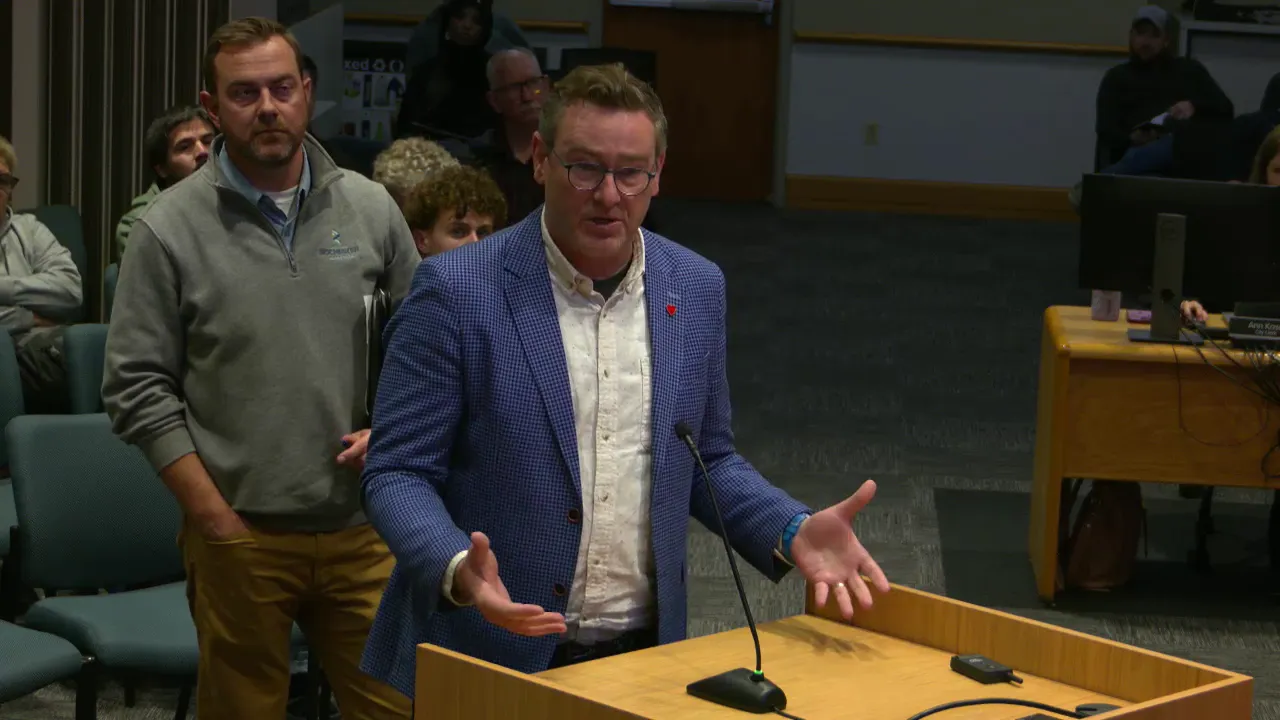
STREAMING COPY IN PREPARATION — RECORDING AVAILABLE FROM THE ORIGINAL SOURCE
Transcript — Verbatim
Speaker numbers apply only to this recording. Names come from transcript evidence. “Possibly” marks uncertain attribution.
Discussion Breakdown — Share of Meeting
Sewer And Water Management20%
Public Works18%
Public Hearings12%
Community Development Block Grant11%
Procedural8%
Public Hearing6%
Downtown Development5%
Public Comment4%
Homelessness4%
Summary of Proceedings
Rochester City Council Regular Meeting — November 2, 2026
The Rochester City Council held its regular session on November 2, 2026, at 6:00 p.m. in the Government Center Council Chamber. All seven council members and Mayor Norton were present. The meeting included open comment on automated license plate readers and Salvation Army housing assistance, four public hearings, a report on private sewer lateral cost assistance, and ordinance readings.
Consent Calendar
- The agenda was approved as presented (Miller moved; Keene seconded).
- The consent agenda was approved in full with no items pulled (Fredericks moved; Miller seconded). It included minutes from October 19, 2026; accounts payable totaling $65,176,428.94, including $24,997,618.72 in investment purchases and $40,178,810.22 in accounts payable; authorization for Electric Utility Revenue and Refunding Bonds, Series 2027A; a temporary two-hour free parking program in City ramps from December 1–31, 2026; FY2026 Edward Byrne Memorial Justice Assistance Grant application/acceptance; MnDPS 2027 Traffic Enforcement grant acceptance; and multiple contract amendments and agreements (including Toole Design $60,283.95, Widseth $96,720, Kimley-Horn $25,120, Bolton & Menk $445,883, amended Farmland LLC annexation of about 188 acres, Mayo Clinic B3/B4 coordination, and a settlement related to the Tap House litigation).
- During consent, a council member clarified that the MnDPS 2027 traffic enforcement grant (F6) covers salaries for enforcement activities such as distracted driving, DWI, and speed—not equipment.
Public Comments & Testimony
- Adam Sechla and Sarah Jackham spoke against automated license plate readers (ALPRs), which they associated with Axon/Flock cameras. They asked that the MnDPS 2027 traffic enforcement grant not fund ALPRs and urged the Council to cancel current ALPR contracts, remove equipment, and commit to no further installations. Jackham cited United States v. Kyle (case no. 426 CR00189) as finding ALPR use an unconstitutional warrantless search and listed numerous Minnesota communities and counties that she said had paused or suspended ALPR use. The speakers expressed concerns about privacy, data sharing, and wrongful tracking.
- Major Randy Halstrom, commanding officer of the Salvation Army in Rochester, thanked the city for a block grant. He said the $12,000 grant would help 10 to 16 additional households remain in their homes this year; the Salvation Army averages 12 households per month receiving rental assistance but receives about 30 calls per month it cannot cover. He said more than 40 households call weekly because they are not secure in their housing and described the need as greater than available resources.
- John Creasel opposed the proposed 4% increase in 2027 Downtown Special Service District charges. As a street-level business owner, he cited difficulty for clients accessing his facility, lack of handicap parking on Third Street, and street closures during downtown events; he said downtown retail businesses were not seeing 4% growth.
- Linda Parker urged the Council to embed rigorous fraud-prevention and oversight measures in the CDBG Annual Action Plan, including sub-recipient audits, progress-to-payment disbursements verified by city inspectors, data matching against county property records, and a public-facing CDBG contract tracker.
- No public testimony was offered during the vacation petition (G3) or Cassidy Heights final plat (G4) hearings.
City Administrator and Mayor Reports
- City Administrator Zelms noted that election day was the next day and that Rochester Public Transit would provide free rides to polling places. He announced a Rochester Public Library event on Friday, November 6, 2026, from 6 to 8 p.m., and a Sound School performance by Dusky Waters at the Historic Chateau Theater on Saturday, November 21, 2026, at 7 p.m. with a $10 entry fee.
- Mayor Norton responded to the ALPR comments by saying Rochester does not use Flock cameras but uses Axon, which she said is not used to track citizens. She cited a June town hall with RPD, strict access rules, in-house data retention, and regular deletion unless needed for court. She also mentioned a recent shooting at 41st and 52 in which no one was shot but a car was hit, said a 41st Street camera had been vandalized and was not active, and encouraged residents to contact Chief Franklin with questions.
- Mayor Norton also announced the League of Minnesota Cities Mayor for a Day contest through December 11, a free all-ages fifth-anniversary New Year’s Eve celebration on December 31 from 11 a.m. to 7 p.m., several board and commission vacancies, and a December event to recognize board and commission members.
Discussion Items
- 2027 Special Service District Service Charges (G1): Josh Johnson explained that the Downtown SSD is a self-imposed charge supported by downtown property owners, not a traditional city property tax levy, and funds Rochester Downtown Alliance services. The district was renewed in 2024 for 10 years. Staff recommended a 4% increase, within a 4%–8% range, producing approximately $425,893 in total 2027 service charges—about a $16,000 year-over-year increase and about 30% of the RDA annual budget. Sean Fagan described RDA programming, including 424 free live musical performances in summer/fall, marketing, and a Sunday market pilot; he said one business reported its busiest Sunday in months, another reported an 11% sales increase, and a survey found 60% of attendees came downtown for the event and 60–65% planned to explore more of downtown. Council members discussed the RDA role, accessibility parking, and the December free-parking program. Public Works noted that hang-tag holders can park four hours at any downtown location and that accessible parking would be inventoried and addressed block by block during upcoming downtown reconstruction projects over the next four to five years.
- 2027 CDBG Allocations (G2): Brent Svenby presented the 2027 Annual Action Plan. The city projects $650,000 in HUD CDBG funds plus $75,000 in program income. Public-service requests totaled about $260,000, but the 15% cap allowed about $97,500. The plan included about $97,500 for public services, $145,000 for administrative activities, $70,000 for housing coalition affordable-housing planning, $250,000 for single-family rehab loans, $125,000 for rental rehab loans, and $107,000 for rehab-program administration. Svenby said public-service grantees are reimbursed after expenses, monitored, and subject to agreements; rehab work is inspected before payment. Councilmember Doring asked whether any grantee had fallen out of compliance or been accused of fraud; Svenby said he was not aware of any, and noncompliance would result in funds not being released.
- Vacation Petition CD2026-008VAC (G3): Elliot Muller presented a request from Pougiales SE Rochester LLC to vacate an unused 10-foot-wide utility easement south of Center Street East and west of Sixth Avenue Southeast. Public Works and RPU supported the vacation with a future easement; new utility easements would be dedicated through site development and minor subdivision. The overall project is a six-story, 211-unit multifamily development. The Development Review Team recommended approval with one condition. Applicant engineer Craig Britton acknowledged the developer would pay relocation fees for a service serving the adjacent property and that RPU Electric required certain facilities to remain until relocation. Councilmember Keene asked about notification; Britton said the relocation affects the home to the south and other lots would be consolidated.
- Cassidy Heights Final Plat CD2026-028PLAT (G4): Muller presented a final plat by RJR Land Development LLC to subdivide 12.7 acres (agenda: 12.77 acres) into 18 residential lots and one outlot at the terminus of Cassidy Ridge Drive Northeast. The roadway would be extended and temporarily terminated in a cul-de-sac for fire access, with future extension. The major land subdivision was approved September 9, 2026, and the final plat was consistent with the general development plan and major subdivision. The Development Review Team recommended approval with four conditions. Applicant Dan Horsch of SEH said the applicant would meet the conditions.
- Private Sewer Lateral Line Cost Assistance Research (H1): Aaron Luxtein reported on a 2025 action-plan item. Under current ordinance, homeowners are responsible for private sewer laterals from the main to the house, and right-of-way work can be costly. From January 1, 2021 through September 17, 2026, the city recorded 84 permits for private lateral repair or replacement—an average of 14 per year, with a high of 18 in 2024. Luxtein said 59% of permits included work from the main to the house and characterized the split as roughly 70% full main-to-house work versus 30% only within the street/sidewalk area. Staff evaluated expanding RPU Service Assured, shifting responsibility to the curb/right-of-way, grants or low-interest loans, and voluntary private insurance. Staff did not recommend the first three because of staffing/funding, rate increases, or lack of Rochester-specific inflow/infiltration need. The recommended option was a voluntary third-party insurance program through Oncourse Home Solutions: up to $30,000 coverage, average repair about $1,000 but potentially $15,000 when sidewalks/streets are involved and up to $30,000 in worst cases; a discounted introductory rate (transcript records $699 per month) rising to just under $10 per month after the first year; 95%+ claims approval; no city funds; opt-in with no minimum policies; and a one-time $25,000 community partnership fund for hardship assistance. Administrator Zelms noted the proposal has no deductibles or service fees. Council members debated the value of the program, prior logo-use concerns, geographic distribution, homeowner responsibility, and whether to bring Oncourse in for more discussion. Palmer raised concern about a prior program using the city logo; Zelms said the earlier use was unauthorized and not a city partnership. Keene estimated about 80 repairs over roughly 40,000 services, about two per 1,000 over five years.
- Ordinance Readings: First readings were introduced for Zone Change CD2026-002ZC by 75th AZ, LLC (15.75 acres at the northwest corner of 60th Avenue Northwest and Valley High Road from H Holding to MXC Mixed Use General); Zone Change CD2026-001ZC by Stencil Group (about 3.83 acres northwest of Superior Drive Northwest and Badger Hills Drive Northwest from MX-S to R-3 Medium Density Residential); and a stormwater management criteria text amendment to Rochester Code Title 6, Chapter 6-4, Section 6-4-12. The 2027 Master Fee Schedule ordinance received its second reading and was adopted.
Key Outcomes
- Consent agenda approved in full; no items were pulled.
- G1: Adopted a resolution authorizing $425,893 in 2027 Downtown Special Service District service charges (Doring moved; Fredericks seconded; voice vote, no opposition noted).
- G2: Adopted a resolution approving the 2027 CDBG Annual Action Plan (Fredericks moved; Miller seconded; voice vote, no opposition noted).
- G3: Adopted a resolution approving Vacation Petition CD2026-008VAC with one condition (Fredericks moved; Keene seconded; voice vote, no opposition noted).
- G4: Adopted a resolution approving Final Plat CD2026-028PLAT, Cassidy Heights, with four conditions (Fredericks moved; Doring seconded; voice vote, no opposition noted).
- H1: A motion to maintain the current approach on private sewer lateral cost assistance failed on a roll-call vote; Fredericks and Palmer voted aye, Keene, Miller, Doring, and Schobring voted nay, and Wall’s vote was unclear in the transcript. A subsequent motion directing staff to bring Oncourse Home Solutions to a study session or report and recommendation for continued discussion of a voluntary insurance program passed 6–1 (Fredericks voted nay; Keene, Miller, Wall, Palmer, Doring, and Schobring voted aye).
- K1: The 2027 Master Fee Schedule ordinance was adopted (Keene moved; Wall seconded; voice vote, no opposition noted).
- The meeting adjourned after a motion by Miller, seconded by Wall.
Meeting Transcript
For the Pledge of Allegiance. I pledge to the United States of America. And to the republic, which is one nation under the individual with liberty and justice for all. Welcome everybody to our November 2nd, 2026 Rochester City Council meeting. We begin every city council meeting with our open comment period. This is an opportunity for uh anyone from the public to speak on items that we will not be taking public testimony on during a public hearing later in the agenda. Each person has up to two minutes to speak for a total of 20 minutes. I will be keeping track of time through two methods. One is the stoplight here at the dais, and the other is the digital clock that is uh to my left uh on uh on the wall there. Um we I ask each speaker to be concise to allow more people to speak during the period and participants are also uh encouraged to limit comments generally to topics that are within the scope and jurisdiction of the council's ability to affect policy. Council members and staff do not respond directly to your comments during public comment period, but will instead follow up on any specific requests separately. If you have materials to share with the council, you may give them to the city clerk, Miss Ann Caseel over there, uh, and she will distribute them. So you will be invited up in the order which you signed up, and we will start with Mr. Adam uh Schlickla. I hope I'm you guys I messed that up, but you can tell me what it is. That is absolutely fine. Um Good evening, Mayor Norton, counselors. My name is Adam Sechla, and after me will be Sarah Jackham. We were excited to move back to Rochester last month after a few years away. So it was with great disappointment that we learned that on our very street, we have uh two uh axon automatic license plate readers installed in the time we were gone. ALPRs are also known as flock cameras, are raise major practical, moral, and safety concerns. Foremost, because these cameras are part of a national infrastructure, there is no practical way for citizens to hold parties accountable for abuses. And there are countless cases of proven abuses with wrongful arrests, stalking, and even cases of federal agencies using the staff the systems to track uh citizens without warrants. This is all with most evidence pointing towards ALPRs not providing meaningful safety improvements or crime deterrence. We come with two requests to of the council. First, regarding agenda item F6. We want to know that the grant money coming to our city for traffic safety is not being used to fund ALPRs or their use. Instead, that funding should go to proven safety improvements, like those recommended by the Federal Highway Administration or the CDC. Second, we ask that the council act to cancel the current ALPR contracts, remove the existing equipment, and commit to not installing more. I came to Rochester because in Minnesota, we care for our neighbors. We trust each other and we build a healthy communities using ALPRs to track each other's movements and to enable outsiders to track each other's movements, doesn't live up to those ideals. Thank you. Thank you. Next up we have uh Sarah Jackham. Good evening, Mayor Norton and Councillors. Um my name is Sarah Jacum, and it's as Adam just introduced. We are here to speak about the use of ALPRs in Rochester. Last month, the United States in United States versus Kyle, case number 426 CR00189. The court found that the use of ALPRs is an unconstitutional warrantless search, specifically violating expectations of privacy in the whole of a person's movements. Basically, while we do not have a right to privacy in public, we do have a right to not be constantly stalked. Following intense nationwide debate over the last few months, it is clear that these companies have lost the trust of the public. Many communities across Minnesota have paused or suspended ALPR use, including Brooklyn Park, Champlain, Columbia Heights, Crystal, Dayton, Duluth, North Branch, Plymouth, Shorewood, St. Paul, West St. Paul, and Winona, as well as Isantee County, Itasca County, Sherburn County, and St. Louis County. Many of these decisions have occurred in the last few months, citing the poor data sharing protocols and lack of public trust. Therefore, I am reiterating our two requests for the council. First to ensure that the Minnesota Department of Public Safety 2027 traffic enforcement grant is not used to fund additional ALPR contracts or equipment.
SUMMARIZED BY OPENPUBLICA AI
TRANSCRIPT VIA PUBLIC VIDEO
openpublica.com
openpublica.com