San Francisco Budget Committee Hears Economic Update and Approves Early Education Plan on November 18, 2020
STREAMING COPY IN PREPARATION — RECORDING AVAILABLE FROM THE ORIGINAL SOURCE
San Francisco Budget and Appropriations Committee Special Meeting – November 18, 2020
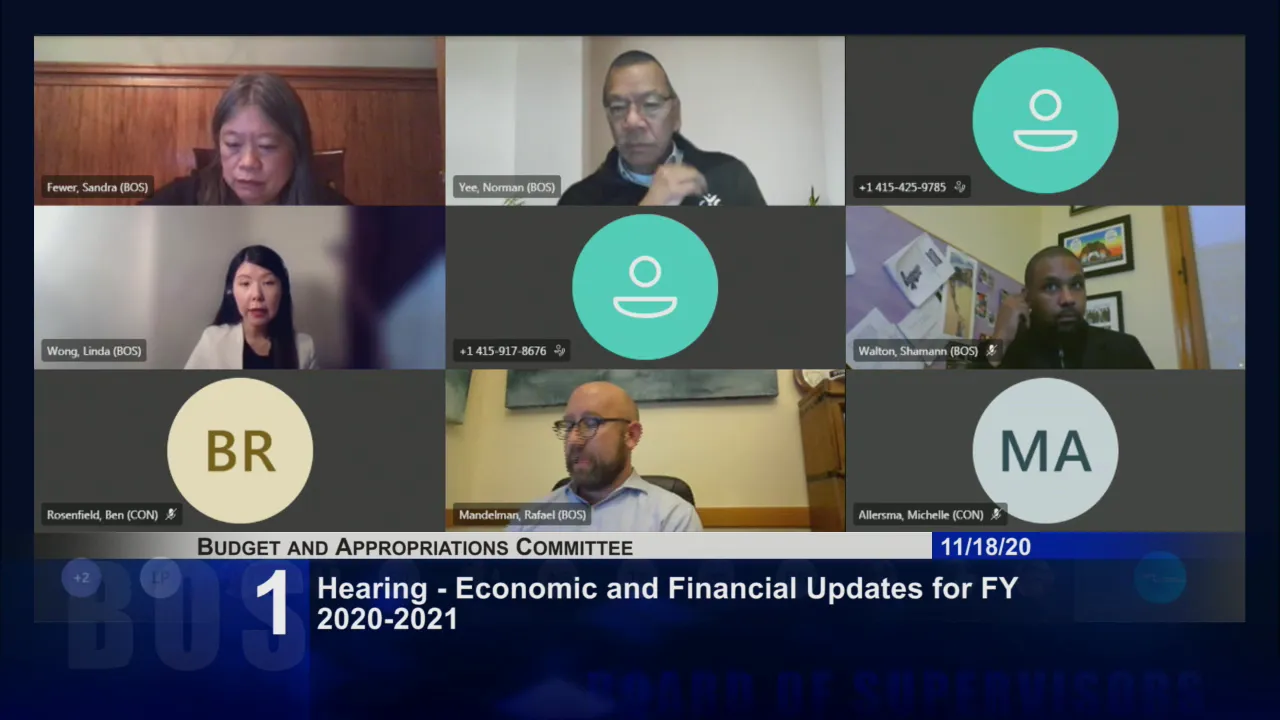
The Budget and Appropriations Committee, chaired by Supervisor Sandra Lee Fewer, convened a special meeting on November 18, 2020, originally scheduled for 1:00 p.m. but delayed due to scheduling conflicts. The committee received an update on the city's economic and fiscal outlook for FY 2020-2021 and approved a five-year spending plan for the Early Care and Education for All Initiative (Babies and Families First Fund). Key takeaways include a projected $116 million general fund shortfall, driven largely by business tax losses due to telecommuting, and a unanimous vote to send the spending plan to the full board.
Discussion Items
- Economic & Financial Update (Item 1): Controller Ben Rosenfield, economist Ted Egan, and Michelle Allersman presented the first quarter report for FY 2020-2021. Key findings: a $116 million projected general fund shortfall, including $99 million from business taxes due to higher-than-expected telecommuting (100% of office workers assumed telecommuting through September, then 75% for the rest of the year). Sales tax revenue was down 43% in Q2 (April–June), the largest drop of any California county. Hotel tax revenue loss doubled from a 30% decline to 60% decline in RevPAR. The sheriff's department faced an $11.5 million overtime shortfall due to training and relocation from County Jail 4. Controller Rosenfield noted potential upside from Prop F passage (removed a major budget risk), Prop I (transfer tax increase estimated at $11 million), and possible federal stimulus. However, he cautioned about downside risks from a slower economic recovery, especially in hospitality and office sectors. The committee discussed the connection between telecommuting and the city's business tax apportionment, with Supervisor Walton and others expressing concern that Prop F did not fully address the tax base erosion from remote work. The hearing was continued to the call of the chair.
- Early Care & Education Spending Plan (Item 2): President Norman Yi introduced the resolution approving the Office of Early Care and Education's (OECE) five-year spending plan for the Babies and Families First Fund, funded by Prop C (stuck in court) and unlocked by Prop F. The plan prioritizes workforce compensation, subsidies for low/middle-income families, and whole-child services. OECE Deputy Director Denise Cervino highlighted extensive community engagement in 2018–2019 and noted ongoing adjustments due to the pandemic. President Yi announced the creation of an Early Care and Education Economic Recovery Grant and Loan Program to support child care providers during COVID-19. The resolution passed unanimously (4-0-1, with Supervisor Ronin absent).
Public Comments & Testimony
- Item 1: David Pilpel commented on the telecommute mandate's impact on business taxes and asked for budget instructions timelines. He requested the staff presentation be posted to Legistar.
- Item 2: A speaker asked about digital learning platforms for children during the pandemic, suggesting satellite spaces and following UN refugee camp models. June Bug, a parent leader with San Francisco Parent Voices, expressed support for the spending plan but called for transparency and specific strategies to reduce the 3,000-child waitlist, increase voucher amounts or slots, and support centers affected by the pandemic.
Key Outcomes
- Item 1 (Hearing): Continued to the call of the chair. The committee did not take a vote on the hearing itself but will revisit after more data, including the five-year forecast and ERAF guidance expected in December.
- Item 2 (Spending Plan): Approved with a positive recommendation by a vote of 4 ayes (Supervisors Walton, Mandelman, President Yi, Chair Fewer) with 1 absent (Supervisor Ronin). The resolution will appear on the Board of Supervisors agenda on December 1, 2020.
- Next Steps: The controller's office, mayor's budget office, and budget analyst will publish a five-year financial forecast in early December. A mid-year rebalancing proposal from the mayor is expected around the same time. The committee will receive a six-month report in early February 2021.
Meeting Transcript
This is the budget and this is the November 18th, 2020 special budget and appropriations committee meeting. This was originally um scheduled for one o'clock. And I'm sorry, due to our schedule, we had to um set that back a little and to convene it this later in this afternoon. I want to thank everyone for their patience. Um I am Sandra Lee Feuer, Chair of the Budget Um and Appropriations Committee. I am joined by committee members, Supervisor Shaman Walton, Rafael Mandeman, Hillary Ronin, and President Norman Yi. Our clerk is Ms. Linda Wong. I would like to thank Colina Mendoza from SFGov TV for broadcasting this meeting. Madam Clerk, do you have any announcements? Yes, Madam Chair, due to the COVID-19 health emergency and to protect board members, city employees, and the public, the Board of Supervisors, Legislative Chamber, and Committee Room are closed. However, members will be participating in the meeting remotely. This precaution is taken pursuant to the various local, state, and federal orders, declarations and directives. Committee members will attend a meeting through a video conference and participate in the meeting to the same extent as if they're physically present. Public comments will be available on each item on this agenda. Both Channel 26 and SFGTV.org are streaming the number across the screen. Each speaker will be allowed two minutes to speak. Comments or opportunity to speak during public comment period are available via phone call by calling 415 65501 again, 415 65501. Meeting ID 146 7347302 again, 1467 34, 7302, then press down twice when connected. You will hear the meeting discussions, but you will be muted and in listening. When your item of interest comes up, star three to be added to the speaker line. Best practices are to call from a quiet location, speak clearly and slowly, and turn down your television or radio. Alternative you may submit public comment in the following way. Email to myself, the budget and appropriate committee clerk at L-I-N-D-A.W-G at SFGOV stock or give public comment via email, it will be forwarded to the supervisors and will be included as part of the official file. Finally, items acted upon today are expected to appear on the Board of Civil Side of the agenda of December 1st, unless otherwise stated. Thank you very much, Manuel Clerk. Could you please call item number one? Yes, item number one hearing on updates related to the economic landscape for San Francisco and the fiscal impact on the city and county with regards to revenue short foralls and financial planning for fiscal years 2020 to 2021 and requesting the controller, mayor's budget office and budget and the set of analysts to report members of the public who wish to provide public comment on this item. She call 415-655-0001, meeting ID 146, 734702, then press pound twice. If you have not already done so, please start star three to lineup to speak. Assistant prompt will indicate you up raise your hand. Please wait until the system indicates you have been unmuted and you may begin your comments. Thank you very much. So colleagues, you might remember this is an item that we have continued for this committee. And today we have with us Ben Rosenfield, the controller, Ted Egan and Michelle Alerzma from the controller's office. Of course, you know, Ted Egan is our economist. Ashley Groffenberger from the Mayor's Budget Director. I mean, she's the mayor's budget director. Also Cheryl Davis, she's the director of Human Rights Commission. The floor is yours. Thank you, Chair Fiewer and members of the committee for having us here today. Ted is going to pull up the PowerPoint presentation that you have in your package, and I believe it's available online as well. Briefly, as you're aware, our office is charged in the charter with providing periodic updates to the board, the mayor, and the public regarding how the budget is performing. You know, kind of what trends are we tracking and what's coming in better and worse than expected. We do this every year at the six-month and nine-month models of the fiscal year. This year, as is often the case when things are more fluid, um, we're going to be doing that updating more often. So we published a first quarter. Excuse me, Ben. Um when you talk, you keep on sending in and out. I mean, so I'm, you know, I'm kind of deaf.
openpublica.com