Budget and Appropriations Committee Hearing on Affordable and Supportive Housing Spending - May 10, 2023
STREAMING COPY IN PREPARATION — RECORDING AVAILABLE FROM THE ORIGINAL SOURCE
Budget and Appropriations Committee Hearing on Affordable and Supportive Housing Spending - May 10, 2023
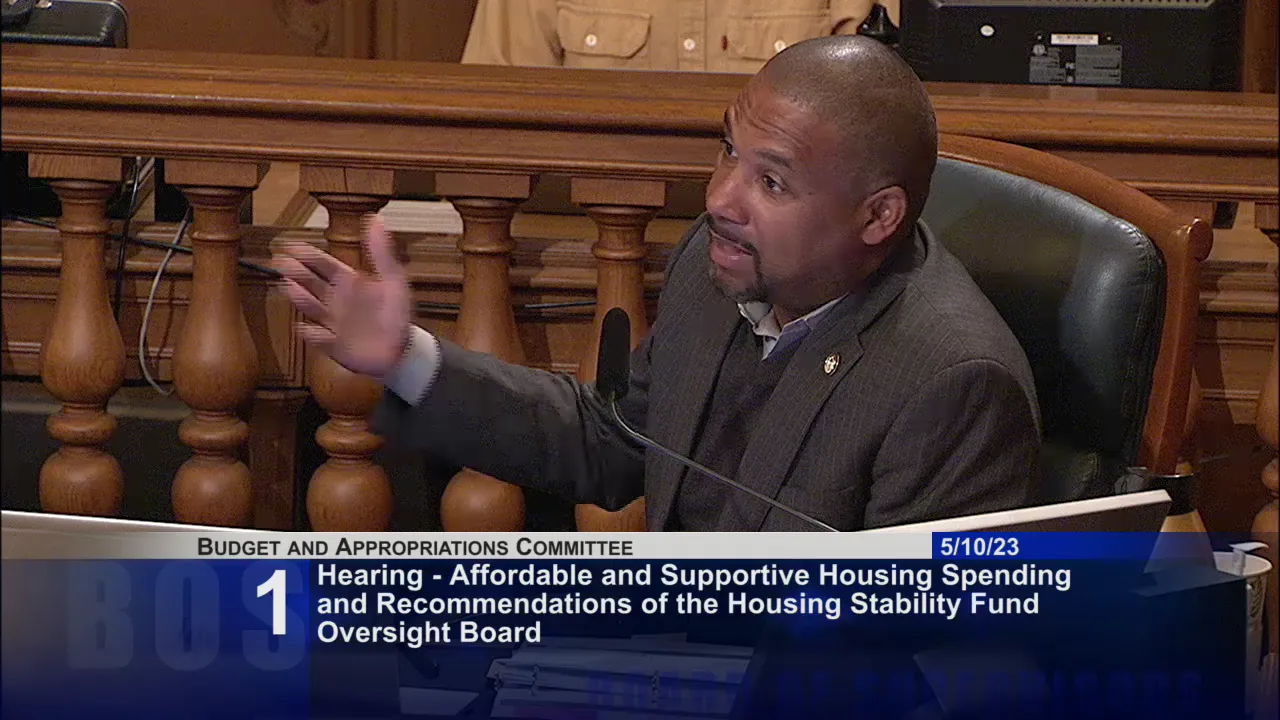
The San Francisco Board of Supervisors Budget and Appropriations Committee held a hearing on May 10, 2023, to discuss affordable and supportive housing spending, revenue sources, and recommendations from the Housing Stability Fund Oversight Board. The hearing featured presentations from the Department of Disability and Aging Services (DAS), Department of Homelessness and Supportive Housing (HSH), Mayor's Office of Housing and Community Development (MOHCD), and the Council of Community Housing Organizations (CCHO) along with the Housing Stability Fund Oversight Board (HSFOB). Public comment was limited to one minute per speaker. The committee continued the item to the call of the chair.
Public Comments & Testimony
- Grace Can (retired senior): Stated monthly income of $1,500, cannot afford $1,000 rent, appealed for low-income senior housing.
- Anonymous senior: Monthly retirement of $1,100, after Medicare only $800-$900, cannot pay more than $700 rent; urged government help.
- Manson (Self-Help for the Elderly): Highlighted critical need for senior operating subsidies to prevent seniors from becoming homeless; noted income changes and family composition reductions.
- Nick McCoy (formerly homeless): Advocated for community-based solutions and criticized harsh treatment of Supervisor Ronan; suggested involving existing street workers in clean-up jobs.
- Stephen Spano (AIDS Legal Referral Panel): Urged continued funding for rental subsidies, calling them the fastest, most effective, and cheapest way to keep people housed (approx. $1,500/month vs. many thousands for project-based).
- Ms. Colorado (senior, disabled): Facing eviction for two years; noted only 40% of past housing goals met for low-income units; asked for $82 million in new Prop I funds for affordable housing.
- Stephanie Gott (Catholic Charities): Described a housing subsidy program for HIV-positive individuals (90 to 160 clients); paused new enrollments due to uncertain funding; subsidies are life-changing and quick to implement.
- Caroline Fang (MEDA): Emphasized that affordable housing funding creates healthy community outcomes and supports small businesses; asked for funding for both production and preservation.
- Peter Papadopoulos (MEDA): Noted 55% spike in Latino homelessness during COVID; stressed the need to fund frontline community organizations.
- Fernando Marti (HSFOB Vice Chair): Highlighted unmet needs including elevator repairs, HUD-funded co-ops, and new housing innovations like social housing; urged preservation funding.
- Julian Johnson (SF Community Health Center): Supported housing subsidies for people living with HIV; requested $3.6 million to house 200 individuals per year.
- Kristin Nation (SF Community Land Trust): Requested $300,000 general operating capacity grant for FY24-25 to ramp up capacity for small sites program and support BIPOC CBOs.
- Rosheen Eisner (SF Tenants Union): Urged dedicating new Prop I revenue to affordable housing as voters intended; noted it's only 0.5% of the budget.
- Teresa Imperial (Bill Sorrow Housing Program): Urged adoption of HSFOB and CCHO budget recommendations; emphasized need for bilingual tenant services and capacity building for preservation in SOMA.
- Mayra Ordonnez (client of Bill Sorrow): Expressed gratitude for help obtaining permanent housing after living in shelter with children; asked for continued support.
- Julian Ball (Bill Sorrow): Noted that affordable housing lottery process is challenging; tenants need dedicated support to navigate document requests and language barriers.
- Mia Laktibi (Bill Sorrow): Shared personal story as DV survivor and formerly homeless; with help from Bill Sorrow secured affordable housing and now helps Arabic-speaking community.
- Dana (DV survivor, single mom): Lost job but with Bill Sorrow's help avoided homelessness; asked for continued support.
- Peer advisor (Brave Button program): Described peer-led overdose response button in Minna Lee building; saved lives; asked to expand to more buildings.
- Yasmin Kuchosfahani (Legal Assistance to the Elderly): Thanked supervisors for no proposed cuts to Tenant Right to Counsel (TRC); noted 90% of clients stay housed; TRC costs $5,500 per eviction vs. $30,000 for homeless services.
- Kim Cruz (LAE): TRC saved 455 tenancies in 2022 (90%); 22% of clients in subsidized housing, 60% below poverty; urged continued subsidies.
- Jessica Juarez (TRC lawyer): Provided examples of clients helped in Districts 9 and 11; asked for increased subsidies for seniors, disabled, and people with HIV/AIDS.
- Maria Samudio (SF Anti-Displacement Coalition): Urged full funding of HSFOB recommendations; said funds raised by Prop I should be spent; outreach served 11,000 tenants last year.
- Cody Keene (DISH): On behalf of Supportive Housing Providers Network, requested funds for peer-led overdose response, safety/security, food security, and capital improvements in permanent supportive housing (PSH).
- Jeff Dolgar (AIDS Legal Referral Panel): Warned that $3.7 million cuts to nonprofit grants would severely impact ability to represent tenants; employment and immigration services tied to housing stability.
- Tramisia Garner (Swords to Plowshares): Requested $205,000 from MOHCD for legal representation for veterans; would leverage $4 million in VA benefits.
- Gabriel Medina (La Raza Community Resource Center): Asked for continuity of rental assistance programs; noted 55% increase in Latino homelessness since pandemic.
- Evan Amos (La Raza): Helped 2,000 families with $10 million in rental assistance; personal recipient of ERA program; urged continued support.
- Ustakia (La Raza): Described emergency help for a family with a newborn; many families need financial assistance.
- Zabrina Olivaris (La Raza): Works with families with children under 5; provides strollers, cribs, utility bill help; hears heartbreaking stories daily.
- Meg Heisler (TNDC): Stressed need for capital improvements in legacy buildings and programs for food security and overdose prevention; urged preservation of affordable units.
- Anya Worley Zygman (DISH): Read letter from peer responder Susan; peer responders have saved multiple lives; requested funding for peer overdose prevention programs.
- Adrian Mendel (Eviction Defense Collaborative): TRC prevents homelessness; 88% of tenants with full representation remain housed; program on track to serve 2,400 tenants this year; urged full funding.
- Lisa Kim (Bay Area Legal Aid): In 2022, over 60% of TRC clients had disabilities, 33% were Black; TRC is vital for racial and disability equity.
- Hope Williams (SF Community Land Trust): Requested $300,000 operating grant for stability of services.
- Emily Van Loon (TNDC): Urged funds for housing preservation program; many multifamily buildings coming to market at good prices; now is time to buy and preserve.
- Mitch Mankin (SF Housing Development Corp.): Supported $45 million for small sites program; 53 families would stay in SF; urged maintaining current funding for CBOs.
- Tanis Canallen (Safe & Sound): On behalf of Family Resource Center Alliance, requested $13.9 million additional for emergency rental assistance.
- Anonymous caller: Criticized one-minute public comment limit as undemocratic.
- Stacy (D5 resident): Rent-controlled building at risk due to seismic retrofit; urged full $85 million funding for small sites; said voters will lose faith if Prop I funds not spent as intended.
- Marnie Regan (Arkin Street Youth Services): Requested no cuts to MOHCD nonprofit contracts; use unspent funds from DLA audit to keep contracts whole.
- Zach Weisenberger (Young Community Developers): Urged city not to balance budget on backs of communities; support Black-led organizations to stabilize Black residents overrepresented in precarious housing.
- Lupe and Jamie Aguilar: Resident in small sites building purchased by MEDA in 2018; asked for more funds to preserve buildings for families.
- Reina Fayo (FLID): Supported HSFOB and CCHO budget recommendations; need subsidies for low-income under 30% AMI; prevent homelessness.
- Anastasia Yolinopolis (SF Tenants Union): Urged full funding of HSFOB recommendations; tenants at greater risk as eviction moratorium ends; tenant counseling and legal services critical.
- ECS representative: Supported capital improvements and tenant services investments for PSH sites.
- Saki Daly (SF Community Land Trust): Requested $45 million for small sites program and $300,000 operating grant for SFCLT; supports BIPOC CBO capacity.
- Lucia Aragon (SF Latino Parity & Equity Coalition): Asked to keep all CBO budgets whole; Latinos now 30% of homeless population (55% increase); called for continued services.
- Cheron Nerrera Licona (Latino Task Force): Supported housing stability; senior subsidies from MOHCD crucial; COVID funding critical for stabilizing households.
- Athena Caldus (La Raza): Urged continued funding for emergency rental assistance program; Latina community at high risk of homelessness.
- Ivan Crado (Latino Task Force): Asked to preserve $3.7 million MOHCD cuts; Latino safety net at risk; homelessness increased 55%.
- Eliana Bender (GLIDE): Supported HESPA budget request; urged expansion of rental assistance for seniors, disabled, and people with HIV; 11% of disabled adults in SF homeless.
- SRO resident: Participated in Narcan training pilot; asked for funding to expand overdose prevention across city; Narcan costs $20 vs. ambulance $3,000.
- Teresa Flandric (North Beach Tenants Committee): Urged full adoption of HSFOB and CCHO recommendations; voters intended Prop I funds for affordable housing.
- Anonymous caller: Noted city promised 46,000 new affordable units but only built 8,000; urged right investment.
Discussion Items
- Department of Disability and Aging Services (DAS) – Susie Smith: DAS oversees approximately $10.2 million in housing programs (9% of its community-based services budget). Programs include a rental subsidy program ($4.8 million serving 380 seniors/disabled adults at risk of eviction), a bridge housing program ($3.2 million for 110 people leaving institutional care), senior operating subsidy program ($3.2 million), supportive services at 20 older adult housing sites ($1.7 million), veterans housing services ($400,000), and housing advocacy ($174,000). All are general fund programs. The need for senior subsidies far exceeds current capacity.
- Department of Homelessness and Supportive Housing (HSH) – Gigi Whitley: HSH's adopted FY23 budget is $672 million, with 42% from general fund, 10% federal, 7% state, and the rest from other local sources. 58% ($489.8 million) goes to housing, but 90% of that sustains existing housing for 11,000 households already housed. Permanent Supportive Housing (PSH) totals 11,000 units (9,500 site-based, 1,500 scattered site). Rapid rehousing is 6% of budget (~$24 million, serving 1,600 households). Shelter budget is $154 million for 2,700 shelter beds plus crisis intervention and transitional housing. The five-year strategic plan aims for 50% reduction in unsheltered homelessness, 15% total reduction, with 85% of those exiting homelessness not experiencing it again. Goals include 3,250 new permanent housing units (not all PSH) and 1,075 new shelter beds (additive).
- Pier 94 closure (HSH) – Emily Cohen: Approximately 116 people at Pier 94 trailer site; 70 determined eligible for housing, 24 not eligible. All will be offered alternative shelter or housing; no one will be asked to leave without an offer. HSH requested extension from Port Commission to end of year to wind down. Supervisor Walton criticized lack of a concrete plan and expressed doubt about housing placements. Supervisor Ronan raised concerns about good neighbor policy around shelters, especially in the Mission District, and asked HSH to take ownership of coordinating cleanliness and safety. HSH noted they are hiring a community engagement manager.
- Mayor's Office of Housing and Community Development (MOHCD) – Benjamin McCloskey: MOHCD's FY23 budget is $210 million, but 60% does not go through annual appropriation. Proposed FY23-24 budget is $183 million (eliminating one-time items). Budget instruction targets: $3.1 million reduction in Year 1, $4.9 million in Year 2, with all cuts proposed from CBO grants. Multifamily housing development: approximately $700 million in anticipated funding (including GO bonds), with $306 million in anticipated loans for FY23-24 ($46 million capital maintenance, $77 million Hope SF infrastructure, $43 million pre-development). Small sites program: $91 million available, $45 million programmed for next fiscal year. Senior operating subsidies: $9.2 million general fund carried forward, plus $52 million state funding through 2028. Tenant-based senior subsidies: $2.7 million through Catholic Charities. Tenant Right to Counsel: $18 million proposed. Supervisor Preston pressed on land acquisition strategy and use of Prop I revenue; MOHCD stated they have an open NOFA for land acquisition ($40 million) but need a strategy to actually build units. Deputy Director Lydia Ely noted the funding gap for RHNA goals is $19 billion in local funds and $30 billion in state/federal funds.
- Council of Community Housing Organizations and Housing Stability Fund Oversight Board – Lee Levitt and Shanti Singh: Prop I has generated over a quarter billion dollars since November 2020. HSFOB recommended $85 million in new spending: $30 million for land acquisition, $30 million for capital funding for new affordable/social housing (prioritizing essential workers), $18 million for building upgrades and repairs (including elevators in SROs), $5 million for affordability for seniors and people with disabilities ($4.5M senior operating subsidies, $500K pilot for accessible housing), and $2 million for housing innovation. CCHO added a joint ask of $90 million, including at least $45 million for small sites preservation, plus asset management, PSH services, and tenant support. They emphasized the gap between past RHNA (8,000 affordable units built) and new RHNA (46,000 units needed).
Key Outcomes
- The committee voted 3-0 to continue the hearing to the call of the chair (Supervisors Chan, Mandelman, Walton, and Ronan absent for the vote? Actually transcript says: Vice Chairman Mandelman, member Safai absent, member Ronin absent? Wait:
Meeting Transcript
Good afternoon. The meeting will come to order. Welcome to the May 10th meeting of the budget and appropriation committee. I'm Supervisor Connie Chan, Chair of the Committee. I'm joined by Supervisors Hillary Ronan and Shaman Walton. Uh shortly by Vice Chair Rafael Mendelman and Supervisors Asha Safai. Our clerk, it's Brent Halipa. Like to thank Jason Gohammer from SFGov TV for broadcasting this meeting. Mr. Clerk, do you have any announcement? Thank you, Madam Chair. With our return to the chamber, just a friendly reminder for those in attendance to please make sure the sell-ins all cell phones and electronic devices. The Board of Supervisors and its committees are now convening hybrid meetings that allow in-person attendance and public comment while still providing remote access and public comment via telephone. The board recognizes that equitable public access is essential and will be taking public comment as follows. Those attending in person will be allowed to speak first, and then we will take those who are waiting on the telephone line for those watching remotely and streaming through sfgovtv.org. The public comment call in number is streaming across the screen and when connected, you will hear the meeting discussions, but you'll be muted and in listening mode only. When your item of interest comes up in public comment is called. Those joining us in person should line up to speak, and those on the telephone should dial star three to also be added to the speaker line. If you're on your telephone, please remember to turn down your TV and all listening devices you may be using. Each speaker will be allowed up to two minutes to speak unless otherwise stated. Alternatively, you may submit public comment and writing in either of the following ways. Email them to myself, the budget and appropriations committee clerk at B-R-E-N-T dot J A L I P A at SFGL V dot or G. If you submit public comment via email, it will be forwarded to the supervisors and also be included as part of the official file. Dr. Carlton be good to place room 244, San Francisco, California, 94102. And Madam Chair, that concludes my announcements. Thank you, Mr. Clerk. Um I would love to give a uh overview just about uh what the presentation actually looked like today. I have um I will ask each uh department to make their presentation. Uh colleagues, you're more than welcome to ask uh clearing fine questions uh when the presentation is ended, but um if possible, hold off sort of this di like in-depth questioning, maybe after all the presentation it's our completed because maybe some of the questions can be answered by at uh you know a presentation from another agency. So today we will start off with Department of Disabilities uh and aging services, then the Department of Homelessness and Support of Housing, and then the mayor's office of housing and community development, and last but not least, presentation by um the council of community housing organizations and um the housing stability fund oversight board. Um I want to also acknowledge Supervisor Dean President is here with us today, who's also a co-sponsor of this hearing. Um today, colleagues. I I think that we understand housing has been a critical issue uh facing the city. Um the affordability crisis uh really has been going on for quite some time, if not more than a decade. Um, the conditions that we're seeing on our streets, but most importantly, that the people in the community that we know that have been continuing to price out uh for a long time uh is really due to the lack of affordability uh with housing. And I think some of the challenges and issues that we face uh has to really uh be addressed in the core, and housing is that core. Um so we I have asked these presentation, and of course uh you're more than welcome to branch out uh beyond what is presented to you. Um the presentation today I have asked specifically is really focusing on spending. Um really the total spending of each city department, uh, the programming and uh services provided, and uh so and each of these programming and and um services, how much are they spending on and also funding sources? That helps understand that how the dollars are being spent, uh, where are they coming from, uh, especially critically for this body to have to decide uh spending on general fund in the upcoming budget year. Um it gives us a better um idea uh where this money has been spent. Now, the presentation today is also going to focus on the last uh fiscal year, not the upcoming fiscal year. So that again give us some context of what's been going on and so that we actually have a better understanding where we want to head in the future. Uh, with that, I want to just make sure that if Supervisor Preston, you have any opening remark, and should we just go right into the presentation? My my apologies. Oh, calling the item. Yes. I always forget that in the afternoon.
openpublica.com