SF Budget & Finance Committee Hearing on Residential Treatment Beds - February 21, 2024
STREAMING COPY IN PREPARATION — RECORDING AVAILABLE FROM THE ORIGINAL SOURCE
Budget and Finance Committee Hearing on Residential Treatment Bed Expansion (February 21, 2024)
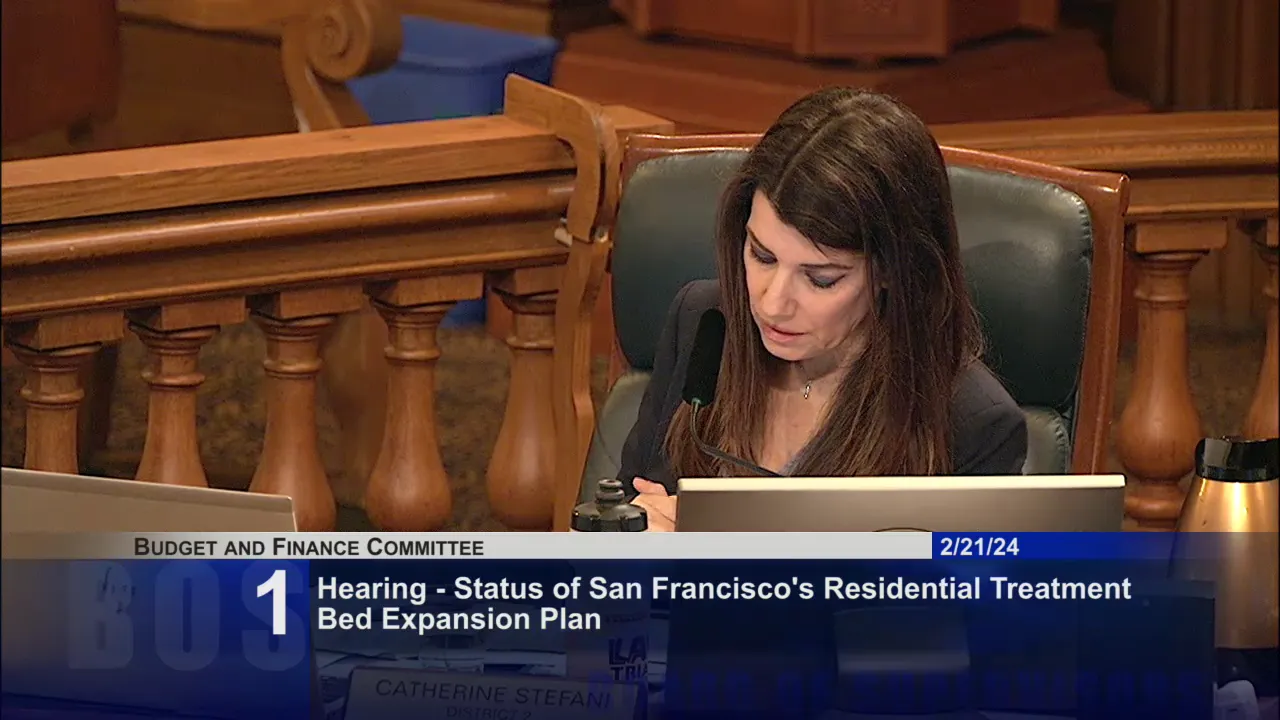
The Budget and Finance Committee of the San Francisco Board of Supervisors convened on February 21, 2024, at 18:15 UTC to hear a status update on the city's Residential Treatment Bed Expansion Plan. Chaired by Supervisor Connie Chan, with Vice Chair Rafael Mandelman and Supervisor Myrna Melgar, the committee heard presentations from the Department of Public Health (DPH) and the Department of Disability and Aging Services (DAS) regarding the current inventory of behavioral health residential beds, progress on expansion goals, emerging needs, and challenges related to workforce, procurement, and data. The meeting concluded with a motion to continue the item to the call of the chair, which passed unanimously.
Consent Calendar
- No consent calendar was presented; the agenda contained a single hearing item.
Public Comments & Testimony
- Adrian Maldonado, Director of Harbor Light Center, described a dramatic increase in program utilization and staffing at his facility, crediting the 'treatment on demand' approach. He reported that Harbor Light's census grew from 30 to over 100 residents and that the program now has over 60 city-funded beds and additional beds funded by the Salvation Army. He emphasized the cost-effectiveness and success of such programs, urging the city to prioritize them.
- Adam Francis, Senior Director of Advocacy and Policy for the San Francisco Marin Medical Society, highlighted the human cost of the bed shortage and the demoralizing effect on healthcare providers. He stressed that immediate workforce incentives could fill the 15-20% of beds currently unstaffed, and he encouraged creative approaches to recruitment and retention.
- Andrea Ayello, Director of the Castro Community Benefit District, reported visible improvements in street conditions since late 2023 and credited the Health Street Operations Center (HSOC) for its outreach efforts. She noted that many individuals on the street have case managers and are known to the city, yet the services offered often do not match their needs, suggesting a need for more tailored options.
Discussion Items
- Opening Remarks and Context (Supervisor Mandelman): Supervisor Mandelman set the stage by referencing the 2020 behavioral health bed optimization analysis by Dr. Anton Nagusa Bland, which identified a gap of 50 locked subacute/skilled nursing beds. He also cited UCSF's 2023 study estimating that up to 80% of homeless individuals have mental illness. He voiced concerns about how progress is measured and noted that DPH's new analysis identifies a need for 55-95 locked subacute beds, indicating that the city may be running in place.
- DPH Presentation (Dr. Hillary Kunins): Dr. Kunins presented DPH's current inventory of 2,551 residential beds, a nearly 20% increase over the baseline of 2,200. She reported that since 2020, DPH had opened nearly 400 new beds, with 44 more pending. She identified several ongoing challenges:
- Workforce recruitment and retention, which at times reduces effective capacity by 15-20%.
- The competitive market for 'as needed' beds, especially out-of-county facilities, which are shared with other counties.
- The need for 50 additional mental health residential beds, 20-40 enhanced RCFE beds, and 20-30 SUD residential step-down beds.
- DAS Presentation (Kelly Dearman): Director Dearman provided data on assisted living capacity. She noted 2,700 RCFE beds (mostly in large facilities) and 417 adult residential facility (ARF) beds. Since 2021, San Francisco lost 5% of small RCFE facilities but gained 16% in overall RCFE beds; ARFs lost 5% of facilities and beds. She also highlighted three DAS programs that subsidize assisted living for low-income seniors, with the average monthly subsidy at $4,400.
- Committee Questions and Deliberation: Supervisors raised concerns about the accuracy of bed counts, the impact of staffing shortages, the lack of data on how many San Franciscans are actually using 'as needed' beds, and the adequacy of the city's approach to board-and-care homes (ARFs). Supervisors Melgar and Ronan called for a more strategic, infrastructure-based approach, including using Prop 1 funding and the Laguna Honda campus for new facilities.
Key Outcomes
- The committee voted unanimously (3-0) to continue the hearing to the call of the chair, allowing for follow-up on data reconciliation, tracking of actual bed usage by San Franciscans, and coordination on ARF needs.
- DPH committed to providing follow-up information on:
- The breakdown of out-of-county beds.
- The methodology behind the bed need estimates.
- Progress on the competitive solicitation waiver for procurement.
- The impact of SB 43 and Prop 1 on bed needs and funding.
- The committee will continue to work with DPH and DAS to develop a strategic plan for behavioral health residential capacity, including potential capital investments.
Meeting Transcript
Good morning. The meeting will come to order. Welcome to the February 21st, 2024 meeting of the Budget and Finance Committee. I'm Supervisor Connie Chan, Chair of the Committee, and I'm joined by Vice Chair Rafayan Mendelman and Supervisor Malgar. Our clerk, it's Brent Halipa. I'd like to thank Helena Mendoza for from SFGov TV for broadcasting this meeting. Mr. Clerk, do you have any announcements? Thank you, Madam Chair. Just a friendly reminder to those in attendance. So please make sure to silence all cell phones and electronic devices, so as to not crowd proceedings. Should you have any documents to be included as part of the file that should be submitted to myself, the clerk. Public comment will be taken on the hearing on this agenda. When public comment is called, please line up to speak on the west side of the chamber to your right, my left long those curtains. While not necessary to provide public comment, we do invite you to fill out a comment card and leave them on the tray by the television to your left by the doors. If you wish to be accurately recorded for the minutes, alternatively, you may submit public comment in writing in either of the following ways. Email them to myself, the budget and finance committee clerk at B-R-E-N-T.jT SFGO V dot O R G. If you submit public comment via email, it will be forwarded to the supervisors and also included as part of the official file. You may also send your written comments via U.S. Postal Service to our office in City Hall. That's one. Dr. Carlton, B good the place, room 244, San Francisco, California, 94102. And that concludes my announcements, Madam Chair. Thank you, Mr. Clerk. And just want to welcome Supervisor Hillary Ronin and Supervisor Catherine Stephanie joining us today at the Budget and Finance Committee. And I think we're ready to call the sole item on today's agenda. So Mr. Clerk, please go ahead. Thank you. And this is the sponsor of this hearing is by Supervisor Rafael Mendelman, our vice chair. And so I'm gonna hand it to him to Chair and to uh hold the rest of the hearing. Thank you so much. Thank you, Madam Chair. Thank you for making time for us to um have this conversation here at this committee this morning. Um it's a little bit of a reunion for uh Supervisor Ronan and I, who I feel like have been having this hearing uh intermittently for um many, many years. Um I want to thank uh Supervisor Ronan for her co-sponsorship. I also want to thank uh Supervisor Stephanie um for her leadership on behavioral health issues generally and for her co-sponsorship. Um and then I want to thank uh uh Dr. Hillary Cunnins and Tanya Mara from the Department of Public Health and Jail Health Services and Kelly Deerman from the Department of Disability and Aging Services who are gonna be presenting today. They and their teams um do amazing work every day, uh work incredibly hard. Um I think there is a tendency in the public and um and in uh among elected officials uh to see the clear evidence of the ways in which government is not working um and to not see the people who are trying really, really hard to make government work. And so even though it's my job and our job to highlight failure sometimes or to point out the ways in which we are missing the mark, I do um want to again thank the people who uh know way more than me and are trying really really hard every day. So um now. Um it is the impacts of of uh San Francisco and California's mental health and addiction crises are painfully clear uh to all of us, and we know there is a connection between the lack of appropriate placements for people with severe mental illness uh and the crisis we see on our streets. The California statewide study of people experiencing homelessness conducted by UCSF last year, estimated the prevalence of mental illness among the unhoused to be as high as 80 percent. Um we are also I think familiar with the uh sad and story sorry history of the state's retreat over the last half century from its historic role as primary mental health provider for indigenous indigent Californians with severe mental illness. As the state pulled back, the burdens on local government uh have grown, um, especially in the state's major metropolitan centers and very much especially here in San Francisco. Um at some level, I think most of us understand that many of the people who might have once experienced care in state mental hospitals are today cycling among San Francisco's emergency rooms, our acute psych services in lots of hospitals, our jails, uh, and and our sidewalks.
openpublica.com