San Francisco Government Audit and Oversight Committee Meeting - October 21, 2021
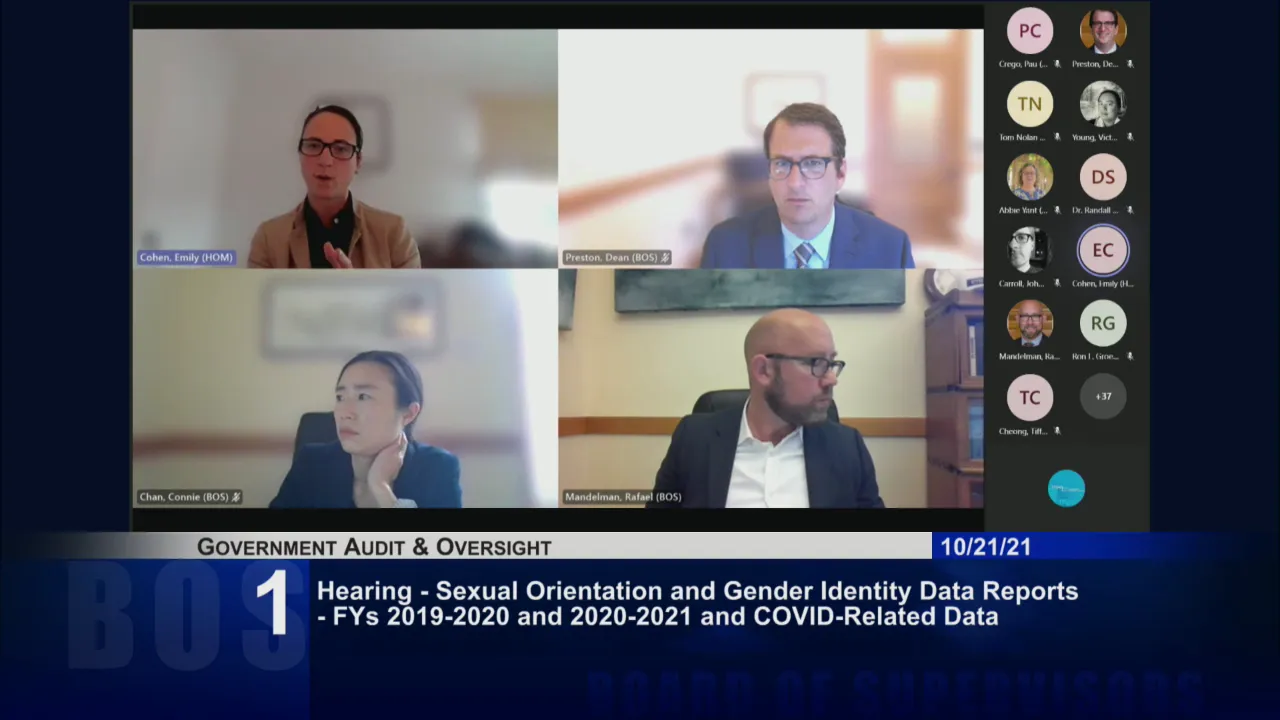
STREAMING COPY IN PREPARATION — RECORDING AVAILABLE FROM THE ORIGINAL SOURCE
San Francisco Government Audit and Oversight Committee Meeting - October 21, 2021
The Government Audit and Oversight Committee of the San Francisco Board of Supervisors met on October 21, 2021, chaired by Supervisor Dean Preston, with Vice Chair Connie Chan and member Supervisor Rafael Mandelman. The committee heard two major hearings: one on the city's collection of Sexual Orientation and Gender Identity (SOGI) data for fiscal years 2019-2021 and COVID-related data, and another on Kaiser Permanente's behavioral health services. The committee also approved annual reports for the Union Square Business Improvement District and the Fisherman's Wharf Community Benefit District, and a settlement of an unlitigated claim.
Public Comments & Testimony
- SOGI Hearing: No public comments were received.
- Kaiser Hearing: Two callers provided public comment. One speaker (Mr. DeCosta) criticized the use of stimulus funds and urged a task force for mental health. Another speaker (Josephine Rodville) shared personal and friend's stories of long waits for Kaiser mental health care, including 63 days to start therapy and denial of referrals due to "too severe" symptoms.
- Union Square BID and Fisherman's Wharf CBD: No public comments were received.
Discussion Items
Hearing on SOGI Data Reports (FYs 2019-2020 and 2020-2021)
Supervisor Mandelman introduced the hearing, noting that this was the third such hearing. Presentations were given by:
- Pal Crago (acting director, Office of Transgender Initiatives) – outlined successes (improved data collection, use for action) and challenges (decentralized data, outdated standards, workforce capacity, limited community input). Recommended a coordinated approach to update SOGI standards.
- Emily Cohen (Deputy Director, Department of Homelessness and Supportive Housing) – reported that 14-15% of households served identify as LGBTQ; 2% transgender, 3% gender nonconforming. Highlighted progress in data systems and targeted programs (e.g., SIP hotels, LGBTQ floors, youth navigation center). Acknowledged gaps in serving trans men and trans women.
- Dr. Blake Gregory (substituting for Dr. Ayana Bennett, DPH) – reported SOGI data collection rates plateaued at 40% in primary care, down from 60% pre-pandemic due to EHR transition and COVID-19. DPH data showed disparities in COVID-19 positivity and vaccination rates for trans male patients.
- Gloria Wu (MOHCD) – reported about 13% of clients identify as LGBTQ; 1.4% as transgender or gender nonconforming. Noted 12 LGBTQ-focused projects funded in FY2020. Data collection completeness declined from 85% to 74% in FY2020, partly due to pandemic.
- Wally Abrazaldo (DCYF) – presented data on transitional age youth: 8% bisexual, 8% gay/lesbian, 6% transgender. Challenges from pandemic included reduced reporting and staff turnover. DCYF reinstated youth survey requirement.
- Susie Smith (HSA and DAS) – reported on multiple programs, with 11 different data systems. Highlighted a mental health study of LGBTQ+ older adults: nearly 8% had seriously considered suicide, and depression symptoms tripled during COVID. HSA allocated $55,000 in gift cards for food through Give2SF.
Discussion focused on gaps in serving trans individuals, especially in MOHCD and HSH, and the need for a working group to improve SOGI data collection across departments.
Hearing on Kaiser Permanente Behavioral Health Services
Supervisor Chan introduced the hearing, noting the pandemic's exacerbation of mental health needs. Presentations:
- Abby Yant (Executive Director, San Francisco Health Service System) – presented key findings: variable data reporting, workforce shortage, and system transformation. Showed that for HSS's book of business, urgent care access (within 48 hours) was met 77% of the time, non-urgent (10 business days) 91% of the time. Emphasized the need for better data on member experience.
- Kaiser Permanente Team (Ron Groper, Kate Ferrante, Leanne Jones, Dr. Maria Koshi) – reported that Kaiser meets California regulatory standards for first appointments over 90% of the time. Hired 600 therapists in California from 2016-2020; on track to double hiring in San Francisco. Noted that 90% of behavioral health visits are now virtual. Claimed 98.7% of urgent and 96.2% of non-urgent appointments met DMHC standards. Internal follow-up access met 84% of the time. Discussed collaborative care and digital tools.
- Alana Marcucci Morris (therapist, Kaiser call center) – testified that initial assessments are only 30-minute intakes; actual therapy appointments often have 3-month waits. Criticized the 84% metric as a template artifact, not true clinical need. Stated workforce retention is a problem due to burnout.
- Jeffrey Chen Harding (LCSW, Kaiser San Francisco) – provided specific wait times as of October 15, 2021: secondary intake for general track was 3 months away, for mild-moderate track over a month, for moderate-severe over 2 months. Described pressure to document unrealistic follow-up times.
- Cynthia Gomez (Kaiser patient) – shared her experience of paying out-of-pocket for therapy despite having Kaiser insurance, and never receiving regular individual therapy through Kaiser.
Discussion focused on the disconnect between Kaiser's reported metrics and patient/clinician experiences. Supervisor Preston pressed for clarity on follow-up wait times; Kaiser stated no standard exists beyond the treatment plan. Supervisor Mandelman noted the two conflicting narratives. The hearing was continued to the call of the chair.
Union Square Business Improvement District Annual Report (FY 2019-2020)
Chris Corgas (OEWD) and Karen Flood (outgoing executive director) presented. The district has a $6 million budget, 73% on clean and safe services. Met all financial benchmarks. Renewed for 10 years in 2019. During COVID, pivoted to meal donations, surveys, and economic recovery task force. Marissa Rodriguez introduced as new executive director. The resolution was approved unanimously.
Fisherman's Wharf Community Benefit District Annual Report (FY 2019-2020)
Chris Corgas and Randall Scott (executive director) presented. The district includes both a landside (property-based) and portside (business-based) component. Both met benchmarks. The portside district sunset at the end of 2020 due to lack of renewal support. The district continued operations during COVID, assisted with PPE distribution, and maintained security. An affiliate program was created for former portside members. The resolution was approved unanimously.
Settlement of Unlitigated Claim – Sandeep Lal ($59,000)
The committee approved a settlement of $59,000 for an employment dispute without convening closed session. The resolution was forwarded as a committee report to the full board.
Key Outcomes
- SOGI Hearing: Filed (motion passed 3-0). Supervisor Mandelman committed to forming a working group to improve SOGI data collection.
- Kaiser Hearing: Continued to the call of the chair (motion passed 3-0). Supervisor Chan committed to working with HSS to increase data transparency and accountability from all health plans.
- Union Square BID Annual Report: Recommended to the full Board of Supervisors with positive recommendation (motion passed 3-0).
- Fisherman's Wharf CBD Annual Report: Recommended to the full Board of Supervisors with positive recommendation (motion passed 3-0).
- Settlement of Claim: Recommended as a committee report to the full Board of Supervisors (motion passed 3-0).
Meeting Transcript
Good morning. This meeting will come to order. Welcome to the October 21st, 2021 regular meeting of the Government Audit and Oversight Committee of the San Francisco Board of Supervisors. I'm Supervisor Dean Preston, chair of this committee, and I am joined by Vice Chair Supervisor Connie Chan and committee member Supervisor Raphael Mandelman. Our committee clerk is John Carroll, and wanted to uh thank uh Maria Pena and Jason Goldhammer from SFGov TV for staffing this meeting. Mr. Clerk, do you have any announcements? Thank you, Mr. Chair. The minutes will reflect that committee members are participating in this remote meeting through video conference. The same extent as though there are 50% that public access to city services is essential and invites public participation in the following ways. First, public comment will be available on each item on this agenda. Either cable channel 26, 78 or 99, as well as sfgovtv.org are streaming the public comment call-in number across the screen at this time. Each speaker will be allowed two minutes to speak. Comments and your other opportunities to speak during public comment periods are available to you via phone by dialing 415-65501. The meeting ID for today's meeting is 2493 2447467. Following that, you should dial the pound symbol twice to connect to the meeting. When you are connected, you will hear the meeting discussions, but your line will be muted and in listening mode only. When your item of interest comes up, dial star followed by three to be added to the speaker line. Best practices are to call from a quiet location to speak clearly and slowly, to turn down your television, your radio, your streaming device, whatever you may be using to access today's proceedings. Alternatively, you may submit your public comment in writing. You can do so by emailing me. I'm the government audit and oversight committee clerk, and my email address is J-O-H-N period C A R R O L L at SFGOB dot O R G. Or you can send your written comments via U.S. Post to our office in City Hall. That is the clerk's office, room 244 in City Hall's address is one, Dr. Carlton B. Goodlick Place, San Francisco, California 94102. Mr. Chair, items acted upon today are expected to appear on the Board of Supervisors Agenda of November 2nd, 2021, unless otherwise stated. And before uh I pass it back to you, if I can request anyone else who's connected to this call, we have a lot of folks who are on this meeting. We have substantial amounts of presentations that are coming in. If you can keep your microphones muted and your cameras off until you are addressed by the panel, we would appreciate that. Mr. Chair. Thank you, Mr. Clark. Let's go ahead and call our first agenda item. Agenda item number one is a hearing on the city's collection and analysis of sexual orientation and gender identity data for fiscal years 2019-20 and 2020-2021 and any COVID-related SOGI data as available. Members of the public wish to provide public comment on this hearing should call the public comment call-in number. I'll repeat it. Today's meeting ID is 2493-244-7467. Following that, press the pound symbol twice to connect to the meeting and then press star, followed by the number three to enter the queue to speak. And the system prompt will indicate you've raised your hand. Please wait until the system indicates that your line has been unmuted and that we begin your opportunity to provide your comments. Mr. Chair. Thank you, Mr. Clerk. And I want to thank Supervisor Mandelman for uh calling for this hearing.
openpublica.com