Government Audit and Oversight Committee Meeting – November 2, 2023
STREAMING COPY IN PREPARATION — RECORDING AVAILABLE FROM THE ORIGINAL SOURCE
Government Audit and Oversight Committee Regular Meeting
Date: November 2, 2023 | Time: 18:15 UTC | Location: City Hall, San Francisco
This regular meeting of the Government Audit and Oversight Committee (GAO) convened at 18:15 UTC to address seven agenda items, including a memorandum of understanding for the San Francisco Public Library, annual financial audit reports for FY2021-2022, three civil grand jury reports (teacher shortage, hiring crisis, and small business support), and a hearing on the impact of downtown business closures. The committee was chaired by Vice Chair Supervisor Catherine Stefani, joined by Supervisors Connie Chan and Joel Engardio. Supervisor Dean Preston was excused.
Consent Calendar
- Item 1 – MOU with Friends and Foundation of the San Francisco Public Library: Approved unanimously (3-0) with a positive recommendation to the full Board. The 10‑year MOU defines roles, responsibilities, and fiscal support for library fundraising, operations, and capital projects. No public opposition was voiced.
Public Comments & Testimony
- Item 1: Carrie Blanding (interim executive director, Friends and Foundation) expressed full support for the MOU. Matthew Keniston (board member and treasurer) advocated for approval.
- Item 3 (Civil Grand Jury – Hiring Crisis): Continued to the call of the chair at the request of Supervisor Preston (absent); no public comment.
- Item 4 (Teacher Shortage): Two public speakers: Michael Kerboy praised the grand jury report and urged close oversight of SFUSD; Lawrence Lee (former grand jury member) described HR and payroll failures as a “house on fire.”
- Items 5 & 6 (Small Business Report): No public comment.
- Item 7 (Downtown Business Closures): No public comment.
Discussion Items
Item 1 – Library MOU
Maureen Singleton (COO, San Francisco Public Library) summarized the MOU’s key articles, including annual fiscal support, capital projects, grant applications, and a 10‑year term. The committee asked no questions and moved the item forward.
Item 2 – Annual Comprehensive Financial Reports & Audit Plans
Presenters: Annie Louie (MGO), Kathy Lai (Crowe LLP), and Todd Ristrom (Deputy Controller). For FY2021-2022, the city received unmodified opinions (highest assurance) with no deficiencies in internal controls or compliance. The audit plan for FY2022-2023 was introduced, covering over 20 deliverables, including new auditors for SFO and MTA. Supervisor Chan asked for clarification on “single audits” (federal grant audits required when expenditures exceed $750,000). The hearing was filed unanimously.
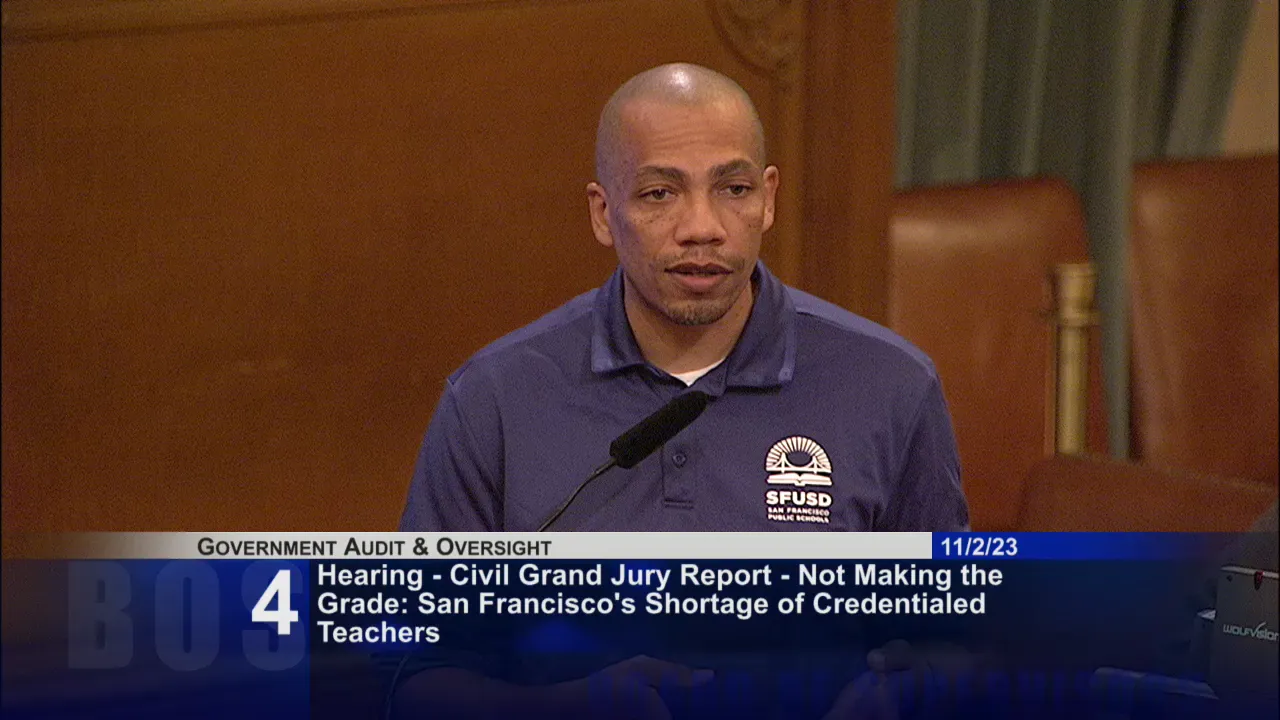
Item 4 – Civil Grand Jury Report: “Not Making the Grade: San Francisco’s Shortage of Credentialed Teachers”
Presented by jury member Pauline Sofa. Key findings:
- Only 83% of classrooms statewide are staffed by fully credentialed teachers; San Francisco is second-worst in the Bay Area (ahead of Alameda).
- San Francisco has more than twice the state average of “ineffective teachers” (teachers without correct credentials).
- Starting teacher salary in SF is only about 60% of the federal low‑income threshold and lags behind many Bay Area districts.
- The district lost 9–10% of teachers per year; recruitment suffers from low pay, a payroll crisis (11,000 tickets at peak, reduced to ~2,086), and poor publicity of benefits.
- Six recommendations were issued: the district agreed to most; the controller’s office declined to research the payroll fiasco.
SFUSD response (Hong Mei Pang, Head of Communications; President Kevin Boga; HR Director Swan Irvin):
- The district acknowledges the challenges but notes the teacher shortage is statewide/national.
- Since the report, they hired ~600 teachers, reduced payroll tickets to ~2,086, and reached a tentative agreement with UESF including a $9,000 raise for teachers in 2023-24 and an additional 5% in 2024-25.
- Out of ~4,500 teachers, “approximately” 1,700 employees (including teachers) have open payroll cases; many are clerical but some have taken months.
Supervisor Chan pressed for specific numbers on teachers with unresolved payroll issues beyond one pay period. The district promised to follow up. The hearing was filed.
Items 5 & 6 – Civil Grand Jury Report: “Taking Care of Business: San Francisco’s Plan to Save Its Small Businesses” & Board Response Resolution
Presented by jury member Rob Chancellor. Key findings:
- Proposition H (30‑day permit processing, elimination of neighborhood notification) and the “First Year Free” program (waived fees for new businesses) are underutilized due to poor tracking and technology gaps.
- Only 68% of eligible businesses in some areas (e.g., zip 94104) recovered; downtown business openings dropped 20% post-pandemic.
- Nine recommendations were made, including making First Year Free permanent, extending Proposition H protections for three years, integrating cross-departmental technology, and requiring supervisors to hold quarterly small business meetings.
Vice Chair Stefani proposed a resolution with the Board’s positions:
- Finding 1 (First Year Free benefits modest): Agree.
- Finding 9 (perception that city is inhospitable): Partially disagree – city has deployed resources but cannot confirm sufficiency.
- Recommendation 1 (make First Year Free permanent): Requires further analysis; BLA to study financial impact by June 30, 2024.
- Recommendation 5 (extend Prop H protections to Dec 2026): Not yet implemented but will be by June 30, 2024.
- Recommendation 7 (technology integration): Not yet implemented; will not be implemented until BLA study complete.
- Recommendation 8.5 (quarterly supervisor meetings): Will not be implemented because districts are unique and most offices already hold such meetings regularly.
- Recommendation 9 (marketing campaign): Has been implemented through existing resources (Shop Dine SF, videos, handouts).
The resolution was adopted 3-0, and the hearing was filed. However, the committee later rescinded the vote to keep the hearing open for final adjustments; the item was then continued to the call of the chair.
Item 7 – Hearing: Impact of Downtown Business Closures
Lead sponsor: Supervisor Engardio.
Chief Economist Ted Egan (Controller’s Office):
- Downtown businesses (sales-tax remitting) declined ~20% from 4,000 pre-pandemic to ~3,200 in 2023.
- Non-downtown recovery is stronger (~90% of pre‑pandemic levels).
- Retail recovery downtown <80%; restaurants ~90%.
- Office vacancy ~30% ; office attendance ~42% of pre‑COVID. However, San Francisco saw the largest year‑on‑year office attendance gain in the US (July 2022–2023).
- Five largest tech companies pay ~$70M/year in business taxes; they face 20–100× higher tax burden than South Bay cities.
- “Doom loop” not currently present, but risks exist if business tax reforms are not pursued.
- Proposed shift from payroll‑based to sales‑based tax allocation to reduce incentive for firms to leave.
- Housing prices have come down: condos now ~4× national average (down from 6×).
Sarah Dennis Phillips (OEWD):
- Downtown recovery is slow but improving; retail changed permanently; tourism rebounding (Asia-Pacific tourism still lagging).
- Mayor’s “Roadmap to Recovery” focuses on safety, retention, activation (e.g., night markets), and public spaces.
- 67% of pre‑pandemic foot traffic recovered, despite 42% office attendance – indicating people come for other reasons.
- Examples: Mission Rock, East Cut, The Crossing (pickleball) are models for mixed‑use downtown.
- Strategic challenges: HCSO healthcare costs burden businesses; office‑to‑residential conversions are financially infeasible for most buildings.
The hearing was filed unanimously (3-0).
Key Outcomes
- Item 1: MOU approved and sent to full Board.
- Item 2: Hearing filed; audit plans accepted.
- Item 3: Continued to call of the chair (motion passed 3-0).
- Item 4: Hearing filed; district asked to provide data on teacher payroll issues.
- Items 5 & 6: Resolution adopted (3-0) directing clerk to prepare Board responses; hearing initially filed but later rescinded and continued to call of the chair for final adjustments.
- Item 7: Hearing filed (3-0).
- Other: The committee excused Supervisor Preston (2-0, Chan absent). All roll‑call votes were 3-0 in favor of motions.
Meeting Transcript
Good morning. This meeting will come to order. Welcome to the November 2nd, 2023 regular meeting of the Government Audit and Oversight Committee of the San Francisco Board of Supervisors. I am Supervisor Catherine Stephanie, Vice Chair of the Committee, joined by soon to be Supervisor Connie Chan and Joel Angardio. The committee clerk today is Stephanie Cabrera and our thanks to whomever is helping us at SFGov TV. I will mention that person when I have that name. But thank you, SFGov TV. Madam Clerk, do you have any announcements? Yes, thank you. On October 17th, 2023, the Board of Supervisors approved a motion discontinuing remote public comment and participation at all board and committee meetings. Going forward, all public comment will be taken in person with remote access only being provided to those who require an ADA accommodation. Alternatively, you may submit public comment in writing in either of the following ways. Email them to the government audit and oversight committee clerk at alisa.org. If you submit public comment via email, it will be forwarded to the supervisors and also included as part of the official file. You may also send your written comments via U.S. Postal Service to our office in City Hall at one Dr. Carlton B. Goodlit Place, Room 244, San Francisco, California 94102. During this meeting, please be sure to science all cell phones and electronic devices. Documents to be submitted included as part of the file should be submitted to the clerk. Items acted upon today are expected to appear on the Board of Supervisors agenda of November 14th, 2023, unless otherwise stated. Thank you. Thank you, Madam Clerk. Before we call item number one, I would like to make a motion to excuse Supervisor Dean Preston. Thank you. And on that motion, Member Chan is absent. Member Engardio. Engario I, Vice Chair Stephanie. Aye. Stephanie I, you have two eyes. Thank you. Will you please call item number one? Item number one is a resolution approving the memorandum of understanding between the Friends and Foundation of the San Francisco Public Library and the San Francisco Public Library to establish roles and responsibilities of each party for purposes of fundraising, enhancing operations and capital projects for a term of 10 years effective upon the approval of this resolution, and to authorize the San Francisco Public Library to enter into amendments or modifications of the MOU prior to its final execution by all parties that do not materially increase the obligations or liabilities to the city and are necessary to effectuate the purposes of the MOU or this resolution. Thank you. Thank you. This item is a draft memorandum of understanding between the San Francisco Public Library and the Friends and Foundation of the San Francisco Public Library. And to discuss, we will be hearing from the San Francisco Public Library's Chief Operating Officer Maureen Singleton. Welcome, the floor is yours. Mentioned is Maureen Singleton. This proposed MOU before you uses that template and as such generally defines the roles, responsibilities, and obligations of the entities involved in the MOU. I'm going to walk through some of the key articles in this MOU to review with you at a high level what is contained in the MOU. Article 2 describes the types of fiscal support that the Friends of provides to the San Francisco Public Library. Specifically, there is an annual support that provides funding for programming, and that is typically assumed and provided uh as part of our annual accept and expend resolution with the budget process. The other type of fiscal support that the Friends typically provides the library is for capital and special projects. And usually for capital that includes furniture fixtures and equipment. Under Article 3, you'll see the description of our roles and responsibilities with respect to the annual fund and the capital sources. This describes how we request funding support from the Friends and the disbursement process. It also talks about the reconciliation of expenditures for the for the library over the time the applicable time period. As I've already mentioned, we do do an annual accept and expend as part of the budget process for the annual support funds. With respect to any capital needs that may be an annual accept and expend or an accept and expend that is done either with the budget process or separately, depending upon the timing of the request.
openpublica.com