San Francisco Gov't Audit & Oversight Committee Reviews Civil Grand Jury Reports - Sept 19, 2024
STREAMING COPY IN PREPARATION — RECORDING AVAILABLE FROM THE ORIGINAL SOURCE
San Francisco Government Audit and Oversight Committee Reviews Civil Grand Jury Reports - September 19, 2024
The Government Audit and Oversight Committee of the San Francisco Board of Supervisors, chaired by Supervisor Dean Preston and joined by Vice Chair Catherine Stefani and Supervisor Connie Chan, held a regular meeting on September 19, 2024, starting at 9:00 AM. The committee heard presentations and responses on five civil grand jury reports from the 2023-2024 term, covering flood management, city commissions, infrastructure, budget and governance, and illegal fireworks. The committee also received public comment and voted on board responses. The civil grand jury foreperson, Michael Carboy, noted that the jury's 19 members (5 women, 14 men) contributed approximately 18,400 work hours and conducted over 260 interviews. He expressed concern that 75% of the jury's findings were fully or partially disagreed with by city departments.
Public Comments & Testimony
- Dr. Himsa Porter Sum Chai (Hunters Point Biomonitoring Program) urged recognition of current flooding impacts, citing damage from atmospheric storms in 2022-2023 at his property in District 10, and submitted findings of atomic bomb radioactivity residues in community members.
- Shirlita Holmes Box emphasized that flooding is a present reality, not a future threat, and submitted photos of the atmospheric river in District 10. She noted groundwater mercury contamination from the Navy and called for city-wide attention.
- Brian Adam (resident) recommended consulting city staff when implementing process changes and cited existing examples of coordination (Office of Civic Engagement and Immigrant Affairs, Controller's auditing division) that could be expanded.
Discussion Items
1. Flood Management (Items 1 & 2) – Civil Grand Jury Report: "Come Hell or High Water"
- Grand Jury Presentation (Ralph Lane): The jury found that Climate SF governance is inadequate for implementation, funding for adaptation is hampered by a self-imposed debt cap, formal flood coordination is lacking, and the city fails to communicate climate impacts. The mayor's detailed response disagreed with all four findings sent to her, despite her letter agreeing. The jury urged the board to use oversight authority and consider increasing general obligation bond capacity. Over 23,000 residents are at risk of inland flooding; the Army Corps waterfront study estimates $13.5 billion in total costs, with the city responsible for a portion.
- City Response (Brian Strong, Office of Resilience and Capital Planning): Strong partially disagreed with findings, noting existing coordination through Climate SF (since 2019) and the Sea Level Rise and Flood Hazard Coordinating Committee. He emphasized the city's 10-year capital plan and debt policy (only issuing new bonds as old ones retire) has been successful, with over 90% bond approval. He acknowledged the need for better project identification and funding for climate adaptation, but noted fiscal constraints.
- Controller (Greg Wagner): Explained that the debt cap is a policy decision that has built stakeholder confidence. He noted there is room under the state's 3% assessed value limit for general obligation bonds.
- SFPUC (Sarah Minick): Described a recently launched governance and policy project to develop a more holistic flood management structure, with case studies and stakeholder engagement.
- Port of San Francisco (Adam Barrett): Discussed the Waterfront Resilience Program and the Army Corps study. The draft plan released in January 2024 recommended $13.5 billion in adaptation strategies. The city is working on a non-federal funding plan.
- Board Discussion: Vice Chair Stefani led the item. Supervisor Chan asked about incorporating the Army Corps plan into the capital plan. Chair Preston noted the debt cap is a policy choice that could be revisited, especially if Proposition 5 (lowering bond approval threshold from 2/3 to 55%) passes. The board proposed responses partially disagreeing with findings F1, F3, F5, F6, and agreeing with F4.
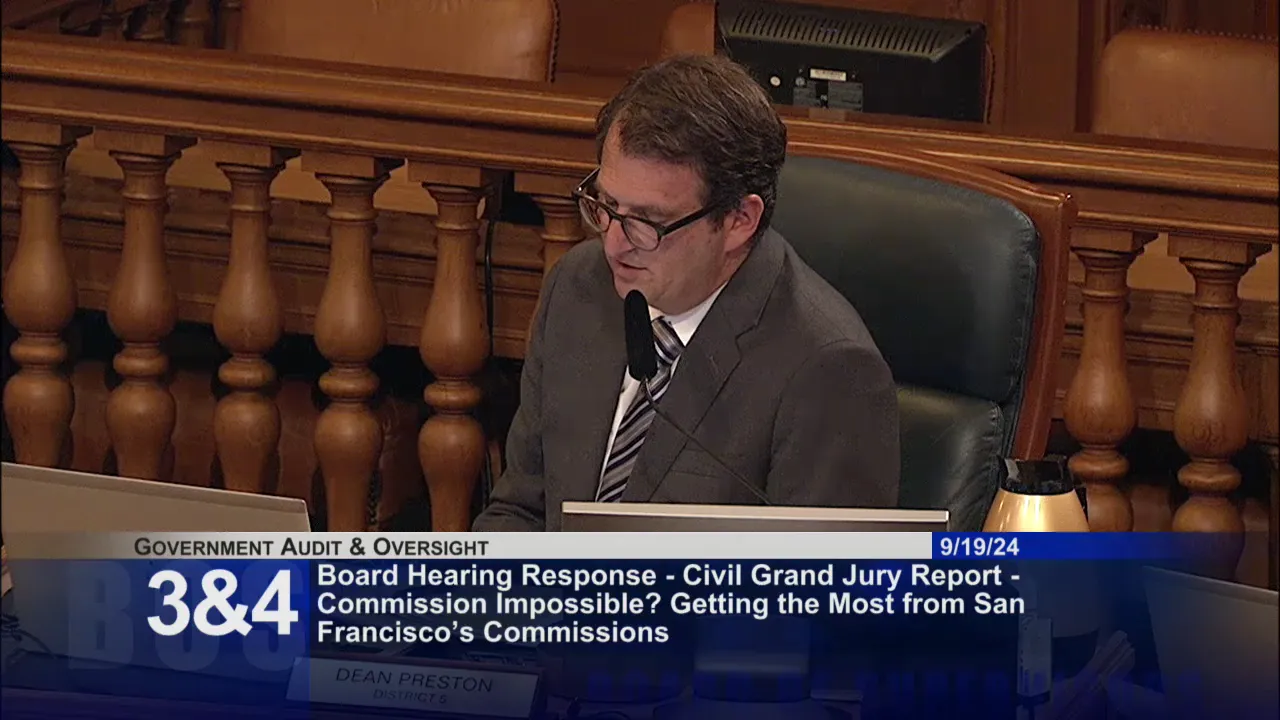
2. City Commissions (Items 3 & 4) – Civil Grand Jury Report: "Commission Impossible?"
- Grand Jury Presentation (John Monson and Niall Murphy): The jury found no current accurate list of active commissions, too many commissions, and poor management due to lack of single oversight authority. They recommended the city attorney publish an accurate annual list (with the "three A's": accurate, active, annual) and create a permanent commission oversight body. The jury noted that the city attorney's list, even after a July 2024 correction, still does not comply with the 2014 and 2024 grand jury recommendations. They also recommended standardizing training, performance evaluations, and annual reports.
- City Response (Sophia Kittler, Mayor's Budget Director): The mayor's office agrees that commissions are essential and that reform is needed, but believes a comprehensive charter reform initiative (expected in 2026) is the proper vehicle. They disagreed with performance evaluations for commissions and with standardizing annual reports. They noted that the city attorney already publishes a list and that the mayor's office monitors commissions.
- City Administrator (Sophie Hayward): The 311 database lists commissions, but relies on department updates.
- Board Discussion: Chair Preston led the item. He acknowledged the need for a comprehensive list but noted existing efforts by the city administrator, city attorney, and clerk of the board. He expressed caution about eliminating commissions without considering their policy origins (e.g., Housing Stability Fund Oversight Board). He proposed responses generally disagreeing partially with findings F1, F2, F3, F5, F7, F9, and agreeing with F4, F6, F8. Many recommendations were not implemented pending the November 2024 election outcomes and charter reform. The board agreed to further analyze R1.2 (improving the database) and R9.1 (training) within six months.
3. Infrastructure (Items 5 & 6) – Civil Grand Jury Report: "Building San Francisco"
- Grand Jury Presentation (Mr. McCaw): The jury's three main intentions: 1) Provide the Public Works Commission with a roadmap for oversight of large capital projects, 2) Encourage proper funding of the Capital Planning Fund, 3) Improve information on financial and operational impacts of degraded assets. The jury recommended better public transparency on project evolution, a realistic assessment of degraded assets, and increased capital planning fund budget. The city disagreed with most recommendations, but the jury urged discussion on how to achieve these goals.
- City Response (Brian Strong, Sophie Hayward, Nicholas King): The city acknowledged finite resources and competing priorities. They described the 10-year capital plan and the Facility Resource Renewal Model that estimates building subsystem life. The Capital Planning Fund has been used but is strained by many bond projects. DPW provides its rates to client departments upon request, but does not publicly post a formal report. The city believes existing transparency measures are sufficient.
- Board Discussion: Vice Chair Stefani led. She noted that many responses were "will not be implemented" but urged continued dialogue. The board partially disagreed with finding F1 (degraded assets) and deferred action on R1.5 (mandatory biannual reporting) pending analysis by the Office of Resilience and Capital Planning, with a decision due within one year.
4. Budget and Governance (Items 7 & 8) – Civil Grand Jury Report: "Lifting the Fog"
- Grand Jury Presentation (Paul Dravis): The jury found that budget oversight responsibilities need improvement, the city administrator's role is ambiguously defined, siloed departments hinder service delivery, and there is no formal process for assessing benefits of legislation. They noted that the city has two inconsistent org charts, and that voter-mandated spending constraints create challenges. They recommended clarifying the city administrator's role, possibly adding deputy mayors, and improving cost-benefit analysis.
- City Response (Sophia Kittler): The mayor's office agrees that governance is complex and that cross-departmental coordination is a challenge. They believe these issues should be addressed through comprehensive charter reform, not piecemeal. They will not implement the specific recommendation for additional cost-benefit analysis beyond the BLA's fiscal impact, as benefits are inherently political. The December 2024 timeline is unrealistic.
- Board Discussion: Supervisor Chan led. She agreed with the findings on budget oversight, city administrator ambiguity, and siloing. She noted that unfunded mandates and set-asides should be revisited. The board proposed responses agreeing with findings F1, F2, and F4, and not implementing recommendations R1.4, R2.1, and R4.2 because they depend on charter amendments or duplicative of existing executive directive.
5. Illegal Fireworks (Item 9) – Civil Grand Jury Report: "Uncontrolled Burn"
- Grand Jury Presentation (Bart Fisher): The jury found lack of interdepartmental coordination, conflicting public messaging on reporting, inadequate public education, failure to stop deployments at known hotspots, and failure to gather metrics. They recommended a working group headed by the Department of Emergency Management and metrics tracked by the Controller's Office. The city disagreed partially with more than half the findings and did not implement the working group, calling it "duplicative." The jury noted that other cities have successful task forces, civil penalties, public reporting apps, and targeted media campaigns.
- City Response (Sophia Kittler, Jackie Thorntell - DEM, Captain Jonathan Baxter - SFFD): The city acknowledged that coordination and messaging have improved since the report, especially around July 4th. DEM is working on year-round messaging, including for Lunar New Year. Reporting is via 311 (unless life safety). The fire department is committed to reducing illegal fireworks and their harms.
- Board Discussion: Supervisor Chan led. She emphasized the year-round nature of the problem and the need for education on impacts on veterans, people with dementia, and pets. The board filed the hearing (no resolution required from the board).
Key Outcomes
- Items 1 & 2 (Flood Management): The hearing (Item 1) was continued to the call of the chair. The resolution (Item 2) was forwarded to the full Board of Supervisors with a positive recommendation (3-0 vote; all present: Preston, Stefani, Chan) with the responses as read by Vice Chair Stefani.
- Items 3 & 4 (Commissions): The hearing (Item 3) was continued to the call of the chair. The resolution (Item 4) was forwarded to the full board with a positive recommendation (3-0) with the responses as read by Chair Preston, amended to include a six-month timeline for analysis of R1.2 and R9.1.
- Items 5 & 6 (Infrastructure): The hearing (Item 5) was continued to the call of the chair. The resolution (Item 6) was forwarded to the full board with a positive recommendation (2-0, with Supervisor Chan absent) with the responses as read by Vice Chair Stefani.
- Items 7 & 8 (Budget & Governance): The hearing (Item 7) was filed. The resolution (Item 8) was forwarded to the full board with a positive recommendation (3-0) with the responses as read by Supervisor Chan.
- Item 9 (Illegal Fireworks): The hearing was heard and filed (3-0). No board resolution was required.
Meeting Transcript
19th, 2024 regular meeting of the government audit and oversight committee of the San Francisco Board of Supervisors. I'm Supervisor Dean Preston, the chair of the committee, joined by Vice Chair Catherine Stephanie and Supervisor Connie Chan. The committee clerk today is Monique Creighton, and we want to thank the team at SFGov TV for staffing this meeting. Madam Clerk, do you have any announcements? Yes. Public comment will be taken on each item on each item on the agenda. When your item of interest comes up in public comment is called, please line up to speak on your right. Alternatively, you may submit public comment in writing in either of the following ways. Email them to the government audit and oversight committee clerk at M O N IQE dot C R A Y T O N at SFgov.org. If you submit public comment via email, it will be forwarded to the supervisors and also included as part of the official file. You may also send your written comments via U.S. Postal Service to our office in City Hall. Number one, Dr. Carlton Be Goodlit Place, Room 244, San Francisco, California 94102. If you have documents you would like to be included as part of the file, please submit them to me before the end of the meeting. Please make sure to silence all cell phones and electronic devices to prevent any interruptions to today's proceedings. Finally, items acted upon today are expected to appear on the Board of Supervisors Agenda of August October 1st, 2024, unless otherwise stated. Thank you, Madam Clerk. Please call items one and two. Items one and two are uh hearings, uh hearing and a resolution responding to the civil grand jury report, the 2023-2024 civil grand jury report entitled Come Heller High Water Flood Management in a Changing Climate. Thank you. Um, and before I turn it over to uh Vice Chair Stephanie who's leading on these particular items, I did want to uh make some uh introductory comments uh about our civil grand jury uh reports that are before us and also give uh some time for four person to to address this as well. Um colleagues will are hearing, as you know, this year's uh civil grand jury reports today. Each year, the civil grand jury investigates, uh conducts interviews of city employees and policymakers and others, and then makes findings and recommendations in the form of a report. Um an uh important process, one that helps us uh build trust with the public and improve the operations of city government. Um I will say as the chair of this committee uh that this is uh one of I think the most um uh productive and important uh parts of the year annually when we hear these reports and they uh result in many positive changes uh in our city uh government and our operations. So we'll be hearing uh today uh five reports um authored by the civil grand jurors this year. Uh then we will discuss um the responses from uh the mayor from uh various departments uh and uh and proposed responses uh from the board of supervisors uh that we will put forward uh and uh presumably adopt today. Really want to thank all the departments who are here today, uh not just for their for being here today to answer questions and to give their presentations, um, but also for their work in responding to the civil grand jury uh reports uh and recommendations and findings related to those departments uh and their communication um with our office. There's a ton of work, and I really want to thank the civil grand jurors for countless hours of work uh on these reports, on the research, on the investigations, and on the preparation of reports, uh, and for being here today. Uh so before we move forward uh with all this, I would like to invite uh Markle Michael Carboy, the um uh civil grand jury uh for person to introduce the jury and to uh speak briefly about this process. Um and uh I understand you have a presentation of about about three minutes, so let's make it four. We'll give you four, and please uh the floor is yours. Thank you very much, Chair Preston. Good morning, Chair Preston, Supervisor Stephanie, and Supervisor Chan, ladies and gentlemen. Thank you for convening the government audit and oversight uh committee hearing for the 23-24 San Francisco Civil Grand Jury reports. My name is Michael Kerboy, and it was my honor to serve as the jury four person. The jury served from June of last year until this most recent July, tasked by the state constitution with investigating the operation of various offices, departments, and agencies of the San Francisco government. We were fortunate to have a great talent team, including editors, medical scientists, attorneys, project developers, industrial, corporate, and finance executives. Our body of 19 jurors, five women and 14 men, represented nine of the city's 11 supervisorial districts, and we were politically diverse as one could imagine, yet we kept politics out of our work. Our efforts amounted to approximately 18,400 work hours. The equivalent of nine full-time employees. We conducted over 260 interviews in the course of our five investigations. Those investigations are as follows. Mr. Lane will present come hell or high water. Mr. Monson, Mr. Murphy will present Commission Impossible, Mr. McCall will present Building San Francisco, Mr.
openpublica.com