San Francisco Government Audit and Oversight Committee Regular Meeting - October 17, 2024
STREAMING COPY IN PREPARATION — RECORDING AVAILABLE FROM THE ORIGINAL SOURCE
San Francisco Government Audit and Oversight Committee Regular Meeting - October 17, 2024
The Government Audit and Oversight Committee met on October 17, 2024, chaired by Supervisor Dean Preston. The committee considered three major items: a pilot program offering cash incentives for sobriety, a grocery store closure notification ordinance, and a hearing on oversight failures in city departments. Consent calendar items covering litigation settlements were also approved.
Cash Not Drugs Sobriety and Recovery Pilot Program (Item 240799)
Supervisor Dorsey introduced an ordinance authorizing a three-year voluntary pilot program called "Cash Not Drugs." The program would offer eligible CAP (County Adult Assistance Program) recipients up to $100 per week for testing negative for illicit drugs, as a contingency management strategy for substance use disorder treatment. The Human Services Agency (HSA) and Department of Public Health (DPH) would implement the program after a six-month planning period.
Public Comments & Testimony:
- Zach Fournette (Episcopal Community Services) expressed full support based on lived experience.
- H. Brown advocated for drug legalization and criticized punitive approaches.
- A black community member called for inclusivity and representation in program design.
- Dennis Williams (Fillmore CDC) supported the program, citing past negative impacts of "Care Not Cash."
- Billy Lemon (Castro Country Club) shared personal success with contingency management, crediting it for his sobriety.
- Other speakers emphasized the need for spiritual and trauma-informed approaches.
Discussion: Susie Smith (HSA) explained the program's integration with Prop F, which requires CAP recipients to engage in treatment. The Budget Legislative Analyst (BLA) estimated costs between $220,000 and $1.2 million per year based on scale (50-150 participants, 12-24 week durations). The program is contingent on funding, with potential sources including general fund, Prop C mental health funds, or Medi-Cal (limited to stimulant use disorders). Supervisor Dorsey noted the legislation intentionally avoids over-prescription, leaving design to experts. He confirmed the $100 weekly maximum was aspirational and aligned with existing DPH contingency management programs ($300-$599 per cycle).
Key Outcomes: Chair Preston added as co-sponsor. The committee voted 2-0 to forward the ordinance to the full board with a positive recommendation.
Neighborhood Grocery Protection Act (Item 240333)
Supervisor Preston introduced an ordinance requiring large supermarkets (20,000+ sq ft with food preparation) to provide six months' notice before permanent closure, hold community meetings, and explore replacement markets. The legislation responds to Safeway's abrupt closure announcement at Fillmore and Webster Street.
Public Comments & Testimony:
- Alice Kawahat (Japan Town Task Force) applauded the ordinance but noted it came too late for the Safeway closure, urging community outreach from developers.
- Jeremy Chan (Japan Town Task Force) emphasized the store's role in festivals and daily needs.
- Multiple speakers criticized the closure and lack of community engagement, with some demanding affordable housing and grocery services on the site.
- Others called for inclusive development and support for black businesses.
- Howard Smith urged collaboration between the mayor and board.
Discussion: Supervisor Preston circulated amendments adding HSA to notification recipients and clarifying enforcement provisions. Deputy City Attorney Ann Pearson was thanked for drafting. OEWD's memo raised concerns about definition scope, but DPH Assistant Director Jen Calahor confirmed the ordinance targets supermarkets with food preparation, excluding retailers like movie theaters. Preston rejected OEWD's suggestion to tie formula retail restrictions to this ordinance, stating it is outside scope. The mayor's office was criticized for reportedly blocking a Community Opportunity to Purchase Act request for the site.
Key Outcomes: The committee voted 2-0 to adopt the amendments and forward the ordinance to the full board with a positive recommendation.
Hearing on Lack of Oversight of Fraudulent Activities (Item 240914)
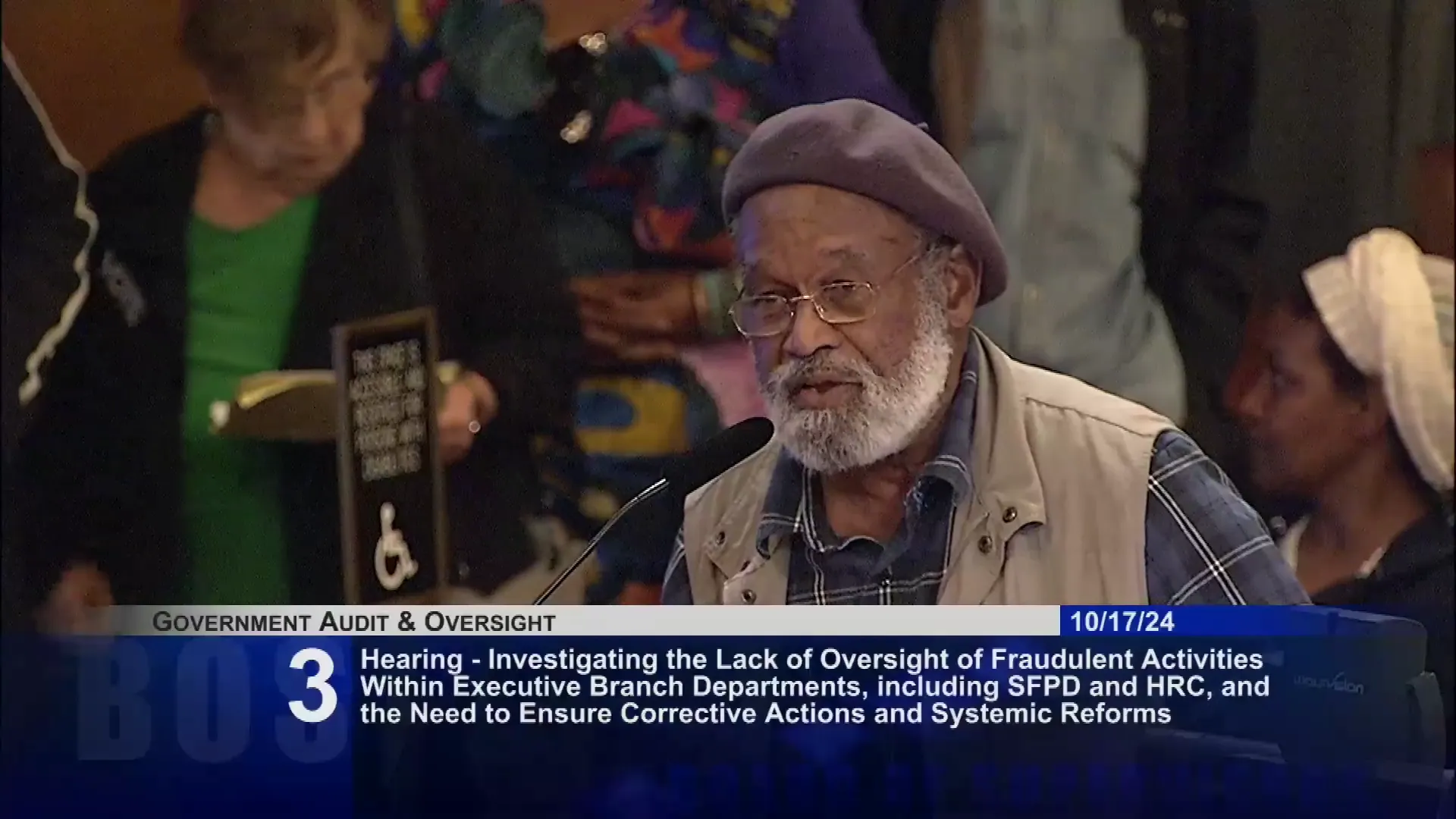
President Peskin convened a hearing to examine oversight failures in executive branch departments (SFPD, HRC) and the Dreamkeeper Initiative (DKI). The hearing focused on allegations of mismanagement at the Human Rights Commission (HRC) and systemic reforms needed.
Public Comments & Testimony:
- Numerous speakers defended Dr. Sheryl Davis and the Dreamkeeper Initiative, highlighting its positive impact on black-led organizations, arts, workforce training, and mental health services.
- Many urged the release of paused funds, citing severe disruptions to services and potential layoffs.
- Some speakers criticized the hearing as a political attack during an election year.
- A few speakers raised concerns about exclusion of African immigrants and lack of a designated bereavement center.
- Latinx leaders (Latino Task Force) expressed solidarity with the black community.
Discussion:
- Controller Greg Wagner reported the controller's office is conducting audits of HRC's Prop Q purchases and grant agreements with collective impact. Prop Q delegation has been rescinded. He noted a 2023 post-audit identified seven high-risk findings, including payments without sufficient documentation, and HRC had responded with corrective actions but lacked segregation of duties.
- Dr. Paula Jones (DPH) described DKI-funded programs: 200 individuals in birthing justice, 358 perinatal appointments, 69 lactation trainees, mental health services for 1,000 clients, and life coaches for 79 individuals. DPH's funding dropped from $15 million to $1.7 million in FY24-25 after funds were reallocated to HRC. She confirmed prior year funds were returned to the general fund.
- Sarah Dennis Phillips (OEWD) reported workforce training (592 enrollments, 558 completions, 94% rate) and small business support (300 new entrepreneurs, 193 businesses). OEWD is delaying its RFP until winter 2025 pending an impact report and implementing a performance improvement notification process. No irregularities were flagged with collective impact contracts.
- Mawoli Togbenyo (Acting Director, HRC) outlined reforms: suspending discretionary spending, retraining staff on Prop Q, restructuring financial division, and pausing new contracts. He stated active contracts continue. He could not provide a timeline for lifting the pause but emphasized urgency. The mayor appointed him after Dr. Davis's departure. He confirmed the CFO role was filled only seven months ago; previous requests for more oversight resources are unknown.
- President Peskin pressed for answers on the mayor's oversight of Dr. Davis and asked to continue the hearing.
Key Outcomes: The committee voted 2-0 to continue the hearing to the call of the chair. No further action was taken pending ongoing audits and investigations.
Consent Calendar: Litigation Settlements (Items 4-13)
The committee considered closed session items for settlements and claims, including:
- Settlement with San Francisco Apartment Association et al. - $93,000
- Three settlements with Park Hotels & Resorts Inc. - stipulated assessed values and refunds totaling approximately $3.4 million
- Settlement with Maplebear, Inc. (unlitigated) - $8,250,342.21
- Settlement with Bechtel Group, Inc. (unlitigated) - $43,235.10
- Settlement for stolen property claim - Brian McSharry - not to exceed $2,117.88
- Settlements of lawsuits: Yulanda Williams - $625,000; Jane Doe - $200,000; Barnard Jones and Patricia Farrell - $475,000
Chair Preston determined that a closed session was unnecessary after questions were answered, and public comment yielded no speakers. The committee voted 2-0 to forward items 4-9 and 11-13 with positive recommendations to the Board of Supervisors, and item 10 (Bechtel) as a committee report for the October 22 board meeting.
Key Outcomes
- The committee forwarded two ordinances to the full board with positive recommendations (Cash Not Drugs and Neighborhood Grocery Protection Act).
- The hearing on oversight failures was continued to the call of the chair.
- Settlement and litigation items were approved as consent calendar.
- The committee adjourned.
Meeting Transcript
Good morning. The meeting will come to order. Welcome to the October 17 2024 regular meeting of the Government Audit and Oversight Committee of the San Francisco Board of Supervisors. I'm Supervisor Dean Preston, Chair of the Committee, joined today by Supervisor Connie Chan. Our committee clerk is Monique Creighton. Our thanks to SFGov TV for staffing this meeting. At the outset, I'd like to make a motion to excuse Vice Chair Stephanie for this meeting. Can we call the roll on that motion? Yes, on the motion to excuse Vice Chair Stephanie. Member Chan. Member Chan, I. Chair Preston. Aye. Chair Preston, I have two eyes with uh Vice Chair Stephanie Excuse. Thank you. That motion passes. Madam Clerk, do you have any announcements? Yes, public comment will be taken on each item on this agenda. When your item of interest comes up and public comment is called, please line up to speak on your right. Alternatively, you may submit public comment in writing in either of the following ways. Email them to the government audit and oversight committee clerk at M O N I Q U E dot C R A Y T O N at sfgov.org. If you can submit public comment via email, it will be forwarded to the supervisors and also included as part of the official file. You may also send your written comments via U.S. Postal Service to our office in City Hall. Number one, Dr. Carl Carlton B. Goodly, place, room 244 San Francisco, California 94102. If you said if you have documents you would like to be included as part of the file, please submit them to me before the end of the meeting. Please make sure to silence all cell phones and electronic devices to prevent any interruptions to today's proceedings. Items acted upon today are expected to appear on the Board of Supervisors Agenda of October 29th, 2024, unless otherwise stated. Finally, I would like to note that the clerk is in receipt of a presidential action memo appointing Supervisor Peskin as a temporary member of the committee should the committee lose quorum today. Thank you, Madam Clerk. Please call the first item. The first item is an ordinance amending the administrative code to authorize a human services agency in coordination with the Department of Public Health to establish a voluntary three-year sobriety and recovery incentive treatment program known as Cash Not Drugs to provide a weekly payment of up to $100 to eligible beneficiaries of the county adult assistant pro assistance programs, CAP, who have been screened for a substance use disorder and referred to you to substance use disorder treatment as a condition of further receipt of CAP benefits, and who test negative for illicit drugs once per week, exempting the cash not drugs payments from the CAP eligibility calculation, providing for a six-month implementation plan before the program becomes operational, and revising the homelessness and supportive housing fund to include the Cash Not Drugs program as a permitted use of funds. Thank you, Madam Clerk. Supervisor Dorsey is with us today, is the sponsor of this item. Looking forward to hearing more about your ordinance. So the floor is yours to for some opening remarks and to uh recognize our uh our presenters. Great. Thank you so much, Chair Preston, for scheduling this item. And thanks as well to our other uh GAO committee member, Supervisor Chan, for welcoming me today. Um the proposed ordinance I'm here to discuss would authorize the creation of a pilot program that adds a contingency management strategy to treatment options offered to those diagnosed with substance use disorders or SUDs under the March 2024 ballot measure proposition F. Now, for those unfamiliar with contingency management, it's an addiction treatment strategy that offers patients tangible incentives like modest cash grants or gift cards to reinforce positive behaviors. Those positive behaviors can include such intended outcomes as abstinence from addicted substances or adherence to medication-assisted treatments or MAT, in which substance use disorders are treated with prescribed medications like buprenorphine, methadone, or an altrexone. Contingency management is considered, and here I am quoting from a 2022 report in psychiatric times. One of the most effective behavioral interventions for initiating and maintaining abstinence from most types of commonly used drugs and alcohol. End quote. That observation about contingency management's promise is no outlier. In fact, the medical literature is replete with similar attestations to the success of this approach, going back decades, in fact, to treat a wide range of addictions, non substance related addictive disorders, and alcoholism. Notably, its success is also well recognized locally.
openpublica.com